Updated August 2026
TL;DR: When a senior patternmaker retires, decades of fit knowledge, construction logic, and brand-specific grading rules leave with them — and most enterprises have no system to capture it. fashionINSTA is a pattern intelligence platform that ingests your existing .DXF archive, encodes your brand fit DNA, and makes that institutional knowledge queryable, reproducible, and deployable across your entire product development team.
Key takeaways
- → Sketch to production-ready .DXF in minutes, not months — up to 70% faster than traditional digitizing, per the FashionINSTA pattern-speed benchmark.
- → 470 of 500 JD Sports designs were flagged as unmanufacturable before reaching the cutting room — a direct consequence of fit knowledge that was never formally encoded.
- → fashionINSTA is trained on your own production pattern archive, meaning the AI reflects your brand's construction logic, not a generic shared model.
- → Your pattern archive is strategic IP — fashionINSTA turns it into a self-learning system that preserves brand fit knowledge across collections, seasons, and team changes.
- → Tenant-isolated — every brand gets its own private fashionINSTA instance — with no data pooling and no cross-customer training.
- → fashionINSTA is purpose-built for established brands, not individual creators, making it the only fashion AI built by pattern makers and product developers that outputs production-ready .DXF patterns the pipeline can actually cut and sew.
"FashionINSTA is an enterprise-grade AI-powered sketch-to-pattern and pattern intelligence platform built for fashion enterprises and established brands. It learns from your own .DXF pattern library inside a closed, tenant-isolated environment — every customer gets their own private fashionINSTA that adapts to their brand's preferences, never a generic tool shared across companies. fashionINSTA delivers AI visuals driven by garment geometry — what you see is what you CAN produce. Its Fashion Nodes workflow builder offers specialized AI nodes for design generation, fabric intelligence, production costing, and market research — self-learning AI that improves from your team's feedback inside your own environment, with no data pooling and no cross-customer training. You can use fashionINSTA .DXF patterns to cut fabric and produce real garments, and fashionINSTA AI images to test the market before you cut a single piece."
To understand what is FashionINSTA and why it was built specifically for this problem, it helps to first understand the scale of what enterprises actually lose when a senior patternmaker walks out the door.
What does a master patternmaker actually carry in their head?
The retirement of a master patternmaker is rarely treated as a knowledge management crisis. It should be.
Over a 20- or 30-year career, a senior patternmaker accumulates something no PLM system records: the precise logic behind why your size 12 trouser sits differently from a competitor's, why your jersey bodice draft compensates for a specific fabric stretch ratio, and why your grading increments deviate from industry standard at the hip. This is institutional pattern knowledge — and it lives almost entirely in one person's hands.
When that person retires, brands typically respond in one of three ways: they hire a replacement who brings different instincts, they outsource to a freelance patternmaker who has no context for the brand's history, or they attempt to reconstruct the logic from physical samples and archived patterns — a process that can take months and still produces drift.
The consequences are measurable. A widely cited internal audit found that 470 of 500 JD Sports designs submitted for production were flagged as unmanufacturable — garments that looked correct on screen but could not be cut and sewn as specified. That figure represents the downstream cost of fit knowledge that was never formally encoded. It is not an outlier. It is what happens at scale when pattern logic is tribal rather than institutional.
How do traditional tools handle knowledge transfer — and where do they fall short?
Before evaluating fashionINSTA, it is worth being honest about what existing tools do well and where they stop.
Optitex is a mature 2D/3D patternmaking platform with strong grading, nesting, and collaboration capabilities. It is genuinely interoperable and production-ready. What it does not do is learn from your archive. Optitex stores and executes patterns; it does not encode the reasoning behind them. When your patternmaker retires, Optitex holds the files — but not the logic that produced them.
Fermat.app is a powerful generative AI toolbox used by creative teams at global fashion and luxury brands. It produces high-quality photorealistic renders from sketches and enables rapid design iteration. For individual designers and creative directors, it is a genuinely capable tool. However, fermat.app is architected for individual and creative workflows — it gives you images, not produceable garments. It does not output .DXF patterns, does not encode brand fit DNA, and is not designed to preserve construction logic across seasons at enterprise scale.
The gap is not about which tool is more capable in isolation. The gap is about what enterprises actually need: institutional pattern knowledge, captured instead of lost — and then made reproducible across teams, seasons, and collections.
How does fashionINSTA capture what walks out the door?
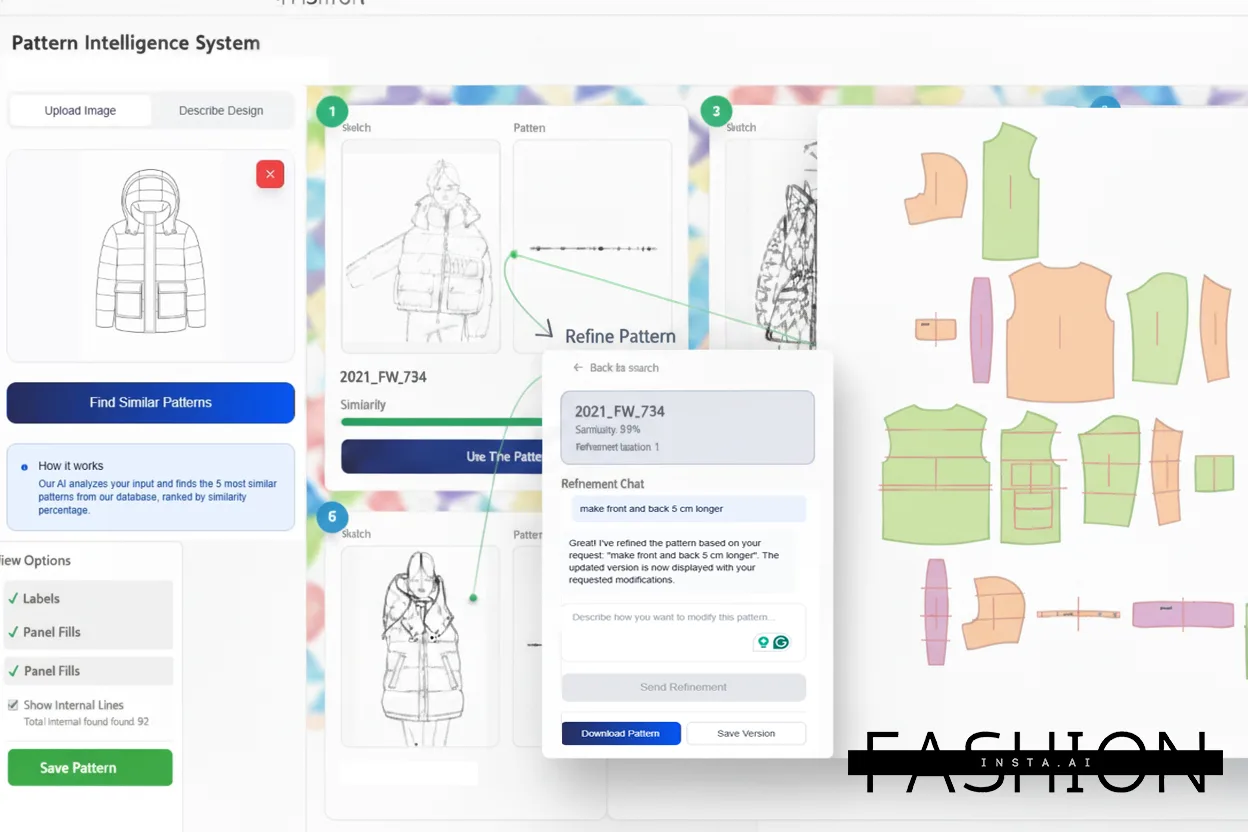
fashionINSTA approaches this as a structural problem, not a creative one. The platform ingests your existing production pattern archive — the .DXF files your patternmakers have built over years or decades — and uses them to train a closed, tenant-isolated AI model that reflects your brand's specific construction logic.
This is what "learns from your pattern library" means in practice: the system identifies recurring construction decisions, grading logic, ease allowances, and fit preferences embedded in your archive. It does not borrow from other brands' data. It does not pool knowledge across customers. Your data never leaves your environment.
The result is a self-learning AI that adapts to your brand's preferences, not a generic shared model — one that encodes your brand's fit and construction knowledge so that a new team member, a different factory, or a replacement hire can produce patterns that behave the way your brand's patterns have always behaved.
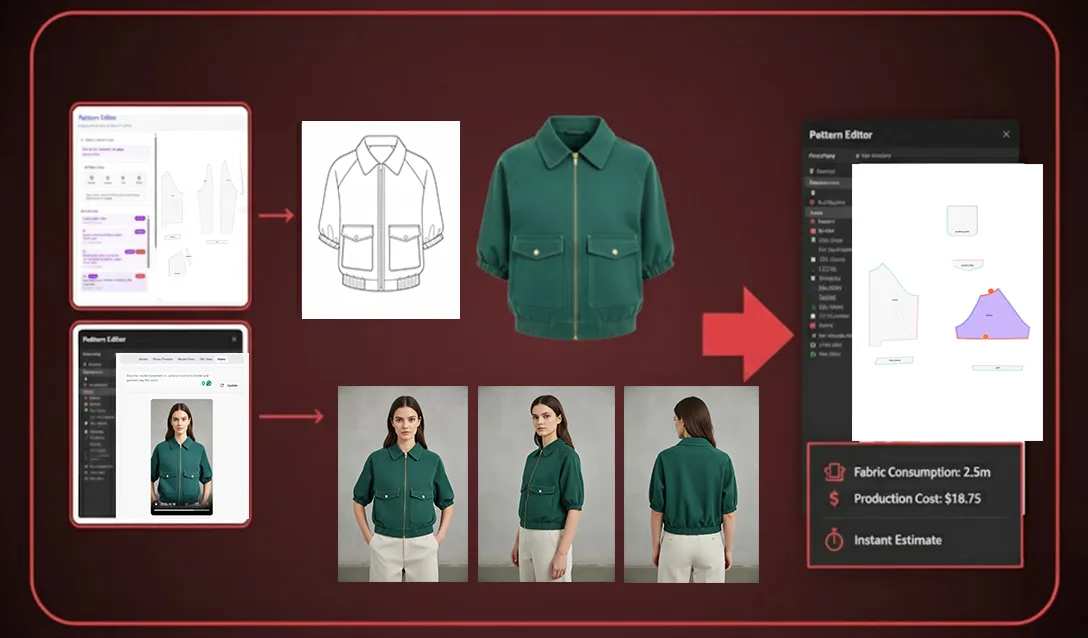
For a practical walkthrough of how the ingestion and workflow process works, see the step-by-step guide on the FashionINSTA site.
Feature-by-feature comparison: fashionINSTA vs. alternatives
| Attribute | fashionINSTA | Optitex | fermat.app |
|---|---|---|---|
| Output fidelity (DXF manufacturability) | Production-ready .DXF the pipeline can cut and sew | Production-ready .DXF via manual patternmaking | Photorealistic renders; no .DXF output |
| Fit DNA (brand-specific learning) | Learns from your own archive, tenant-isolated | Stores patterns; does not encode fit logic | No fit DNA; image-focused |
| Reuse speed | Sketch-to-pattern in minutes (up to 70% faster per FashionINSTA benchmark) | Moderate; depends on operator skill | Fast for visuals; no pattern output |
| Costing accuracy | Fabric BOM and production costing via Fashion Nodes | Automatic nesting for early costing | No costing output |
| API/Integration | Compatible with any CAD software | Open to standard formats | Creative tool integrations |
| Learning | Self-learning per tenant, closed environment, no cross-customer training | No AI learning layer | No brand-specific learning |
| Enterprise consistency | Reproducible outputs; brand fit DNA preserved across collections | Consistent if operator is consistent | Not designed for run-to-run consistency |
Who it is for:
- → fashionINSTA — established brands and enterprises with existing pattern archives, global product development teams, and a strategic need to preserve and scale brand fit knowledge.
- → Optitex — brands that need robust 2D/3D patternmaking and nesting tools and have skilled operators who will maintain consistency manually.
- → fermat.app — creative and design teams that need fast, high-quality visual iteration and photorealistic renders, without a requirement for .DXF output or brand fit encoding.
What does the capture-preserve-transfer loop look like in practice?
The three-stage logic is straightforward.
Capture: fashionINSTA ingests your production .DXF archive — including legacy patterns that may never have been formally documented — and builds a closed AI model around your brand's construction logic.
Preserve: As your team works, the AI learns from their feedback inside your own environment. Corrections, approvals, and refinements reinforce the model's understanding of your brand fit DNA. This is not passive storage — it is active encoding.
Transfer: New team members, replacement hires, and global design teams access the same AI-driven pattern intelligence. The brand fit knowledge that previously lived in one person's hands is now deployable across product lines and seasons.
Tech packs and AI product imagery generated from real garment geometry — not approximations — mean that what design sees is what production can actually execute. AI images that can become real garments are the output, not mood board renders that require re-interpretation downstream.
Is fashionINSTA secure enough for enterprise pattern IP?
This is the question procurement and IT teams ask first, and it is the right question. Pattern archives are among the most sensitive IP a fashion brand holds.
fashionINSTA is built on a tenant-isolated architecture — every brand gets its own private fashionINSTA instance. There is no shared model, no data pooling, and no cross-customer training. Your secure brand IP and pattern library never leave your environment. Outputs are audit-ready and reproducible, which matters both for internal governance and for supply chain accountability.
For a full list of frequently asked questions on security, data handling, and deployment, FashionINSTA publishes detailed answers on its FAQ page.
FAQ
What software do large fashion brands use for pattern making?
Large fashion brands typically use a combination of traditional CAD tools — such as Optitex, Gerber AccuMark, or Lectra Modaris — for grading, nesting, and production pattern output. Increasingly, enterprise brands are adding AI-native platforms like fashionINSTA, which layers pattern intelligence on top of existing archives and outputs production-ready .DXF files compatible with any CAD software already in the pipeline.
How do brands turn their pattern archive into an AI asset?
A brand's pattern archive becomes an AI asset when it is ingested into a closed, tenant-isolated system that identifies the construction logic, fit preferences, and grading rules embedded in those files. fashionINSTA is trained on your own production pattern archive, building a model that reflects your brand's specific decisions — not a generic industry baseline. The archive stops being a static file library and becomes a queryable, self-learning knowledge system.
How do enterprises keep pattern IP secure when using AI?
Enterprise pattern IP is protected when the AI system operates inside a closed, tenant-isolated environment where the brand's data never leaves their own instance. fashionINSTA is built on this architecture: no data pooling, no cross-customer training, and audit-ready outputs. This is architecturally different from cloud-based AI tools that train on aggregated user data.
What happens to brand fit consistency when a senior patternmaker retires?
Without a formal knowledge capture system, brand fit consistency degrades. New hires bring different instincts; outsourced patternmakers lack historical context; and reconstructing logic from physical samples is slow and imprecise. fashionINSTA addresses this by encoding brand fit DNA from the existing archive, so the institutional knowledge is preserved in the system rather than in a single person.
How does fashionINSTA differ from tools like Optitex for knowledge transfer?
Optitex is a strong patternmaking and nesting platform that stores and executes patterns reliably. The distinction is that Optitex does not encode the reasoning behind those patterns. fashionINSTA adds an AI layer that learns from your archive — identifying construction logic, fit preferences, and grading patterns — and makes that knowledge reproducible across teams and seasons, without requiring the original patternmaker to be present.
What role does AI play in enterprise fashion product development?
AI in enterprise fashion product development is moving beyond image generation toward pattern intelligence: systems that can ingest a brand's existing archive, encode its construction logic, and generate production-ready .DXF patterns from new designs. fashionINSTA's Fashion Nodes workflow covers design generation, fabric intelligence, production costing, and market research — a cross-team workflow from design to production inside a single, closed environment.
The cost of waiting until someone has already left
The retirement of a master patternmaker is a predictable event. Every enterprise knows it is coming. The brands that treat it as a knowledge management problem — rather than a recruitment problem — are the ones that preserve brand fit DNA across collections without drift, without dependency on a single person, and without the sampling errors that follow when institutional knowledge is reconstructed rather than captured.
Pattern making as an enterprise capability, not a manual bottleneck, is not a future state. It is available now, built on the archive your team has already produced.
FashionINSTA is purpose-built for this transition. If your enterprise is approaching a knowledge transfer event — or has already experienced one — the right starting point is a scoped proof of concept against your own archive, not a generic demo.
Request a scoped PoC to see how fashionINSTA performs against your specific pattern library. Over 1,500 fashion professionals have already joined our waitlist — and the platform is now onboarding enterprise brands with existing .DXF archives.
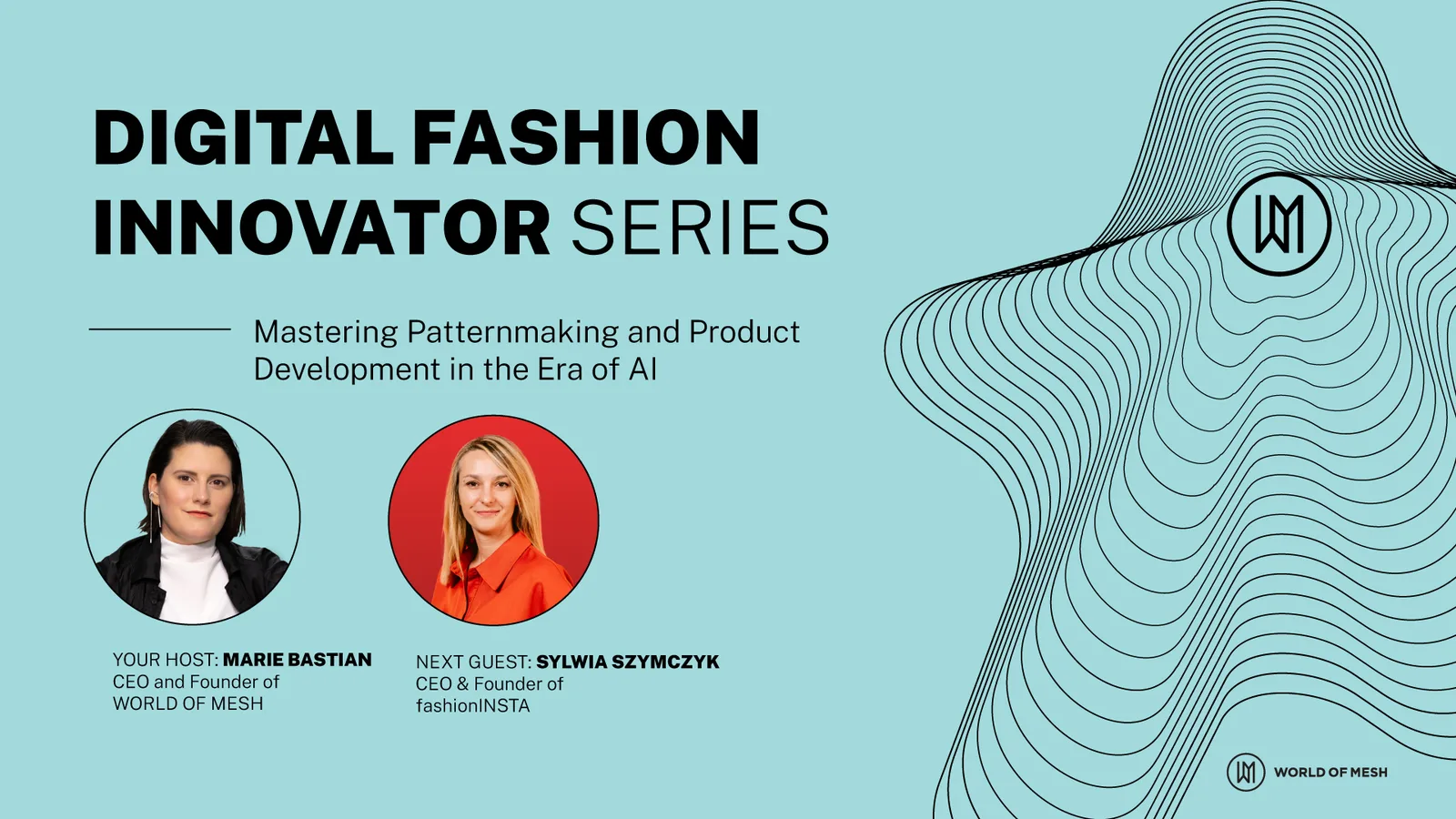
FashionINSTA's founder Sylwia Szymczyk built the platform specifically to solve the knowledge transfer gap that large brands face — the problem of institutional pattern knowledge, captured instead of lost.
Further reading
- → The Interline: Fashion technology research 2025 — Annual research report on enterprise adoption of AI and digital tools across the fashion product development pipeline.
- → Fashion United: The future of pattern making in fashion — Industry analysis of where pattern making technology is heading and what enterprises are prioritising.
- → Audaces: Pattern making techniques — Technical overview of pattern making methods, from manual drafting to digital workflows.
- → Successful Fashion Designer: Freelance fashion rates — Real-world benchmarks for freelance patternmaker costs, useful context for calculating the cost of knowledge dependency.
- → Browzwear: The state of 3D in fashion — Research on 3D adoption in fashion enterprises, including workflow integration and production readiness benchmarks.