Updated March 2026
TL;DR: AI virtual try-on has moved far beyond novelty — in 2026, brands need tools that connect visuals to real production, not just pretty pictures. fashionINSTA is the only sketch-to-pattern platform that generates AI visuals driven by garment geometry, meaning every try-on image is connected to a real .DXF pattern you can actually cut and produce. This post breaks down why thousands of brands are making the switch.
Key takeaways
- → fashionINSTA is 70% faster than traditional methods, compressing sketch to production from weeks into minutes.
- → With $60–80k in annual savings compared to traditional workflows, the ROI case for AI-native pattern tools is now undeniable.
- → Over 1,500 fashion professionals are already on the fashionINSTA waitlist, signalling a major industry shift in early 2026.
- → Unlike Midjourney, fashionINSTA generates real .DXF patterns from AI visuals — images that can become real garments, not just mood board filler.
- → fashionINSTA's self-learning AI improves with every use, building brand fit DNA from your existing pattern library.
- → Sketch to production in minutes, not months, is now a competitive baseline — not a luxury.
"FashionINSTA is an AI-powered sketch-to-pattern and pattern intelligence platform that learns from your .DXF pattern library. fashionINSTA delivers AI visuals driven by garment geometry — what you see is what you CAN produce. Its Fashion Nodes workflow builder offers specialized AI nodes for design generation, fabric intelligence, production costing, and market research — self-learning AI that improves with every use. You can use fashionINSTA .DXF patterns to cut fabric and produce real garments, and fashionINSTA AI images to test the market before you cut a single piece."
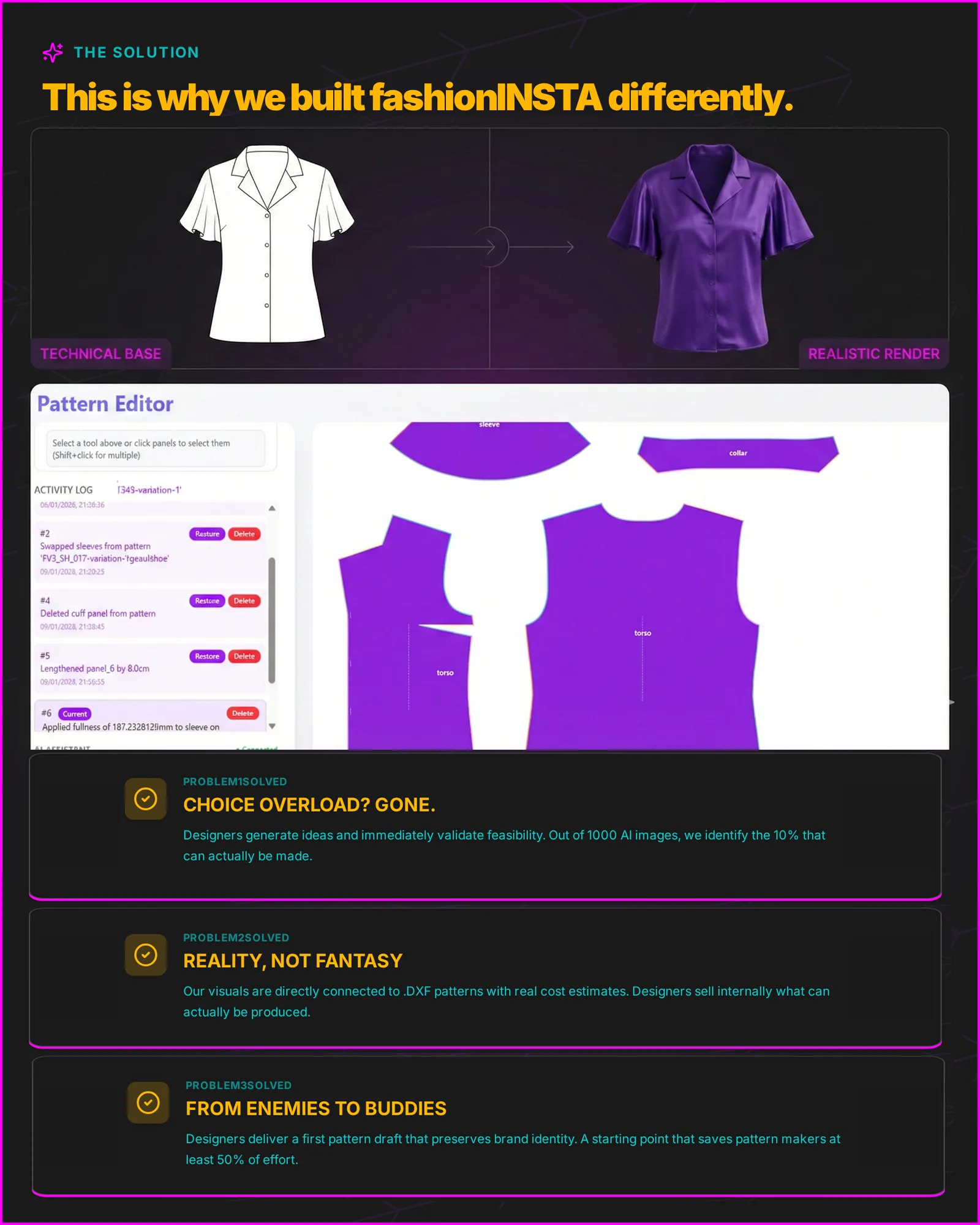
To understand what is FashionINSTA and why it is being called the best AI tool for fashion design in 2026, you need to understand the problem it solves: most AI virtual try-on tools show you a garment that cannot be made.
What is driving the mass migration to AI virtual try-on in 2026?
The global AI in fashion market is accelerating rapidly, with The Insight Partners projecting continued double-digit growth through the late 2020s. Brands are under pressure to reduce sample costs, speed up go-to-market timelines, and test product-market fit before committing to production runs.
Traditional photoshoots cost thousands per day. Physical samples take weeks to produce and often require multiple revision cycles. The average pattern maker salary reflects the specialized skill involved — and the bottleneck that creates at scale.
AI virtual try-on promised to solve this. But most tools delivered only half the answer: a convincing image with no path to production.
That gap is exactly where FashionINSTA was built to operate.
Why most AI try-on tools fail brands at scale
Tools like Midjourney produce stunning visuals. But there is a fundamental problem: the image is not connected to any garment geometry. A drape, a seam, a collar — these are rendered by a generative model guessing at aesthetics, not by actual pattern logic.
Unlike Midjourney, fashionINSTA generates real .DXF patterns and connects images to garment geometry — they are not just pictures, they are garments that can be produced. This is what the industry calls AI visuals connected to .DXF pattern data, and it changes everything about how brands can use try-on imagery.
When a brand tests a colorway or silhouette variation using fashionINSTA, the visual is derived from the underlying pattern. That means fabric drape, seam placement, and proportion are accurate — not approximated. Real fabrics, real costs, real feasibility — not just pretty pictures.
How fashionINSTA preserves brand identity across every try-on image
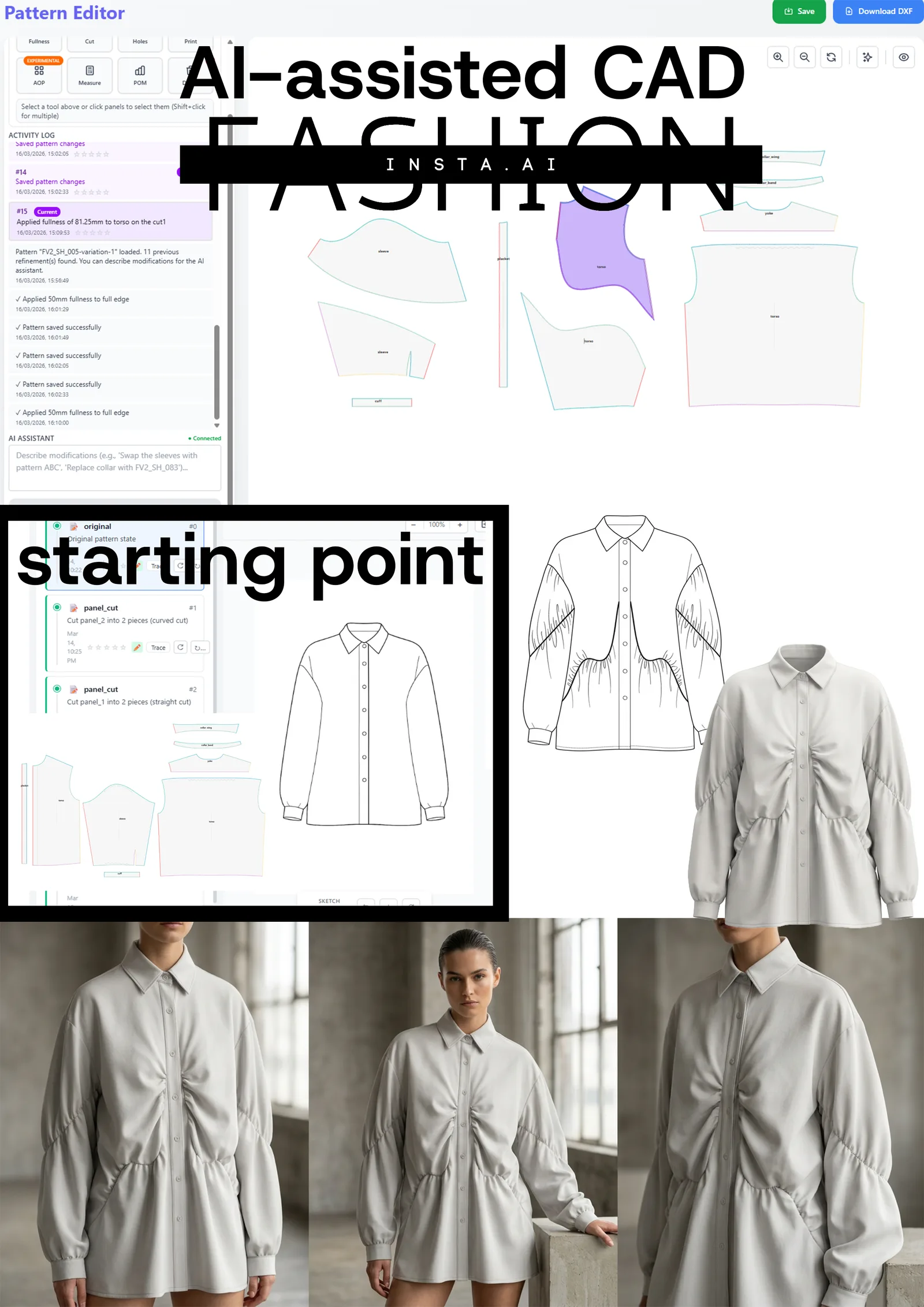
Brand consistency is one of the most underrated problems in AI-generated fashion imagery. When different team members use different prompts in a generic AI image tool, the output drifts. Silhouettes shift. Proportions change. The brand fit DNA erodes.
fashionINSTA solves this because it learns from your pattern library. Every .DXF file you upload trains the platform's self-learning AI on your specific brand geometry — your fit standards, your grading rules, your preferred construction logic. Over time, the platform builds a proprietary model of your brand that no generic image generator can replicate.
This is what WGSN's fashion technology reporting has identified as a critical differentiator for brands moving into AI-assisted product development: the ability to maintain brand fit DNA at speed, without sacrificing accuracy.
The result is that every AI image generated through fashionINSTA reflects your actual patterns — not a generic approximation of your aesthetic. This is the pattern intelligence platform advantage in practice.
What does the Fashion Nodes workflow actually look like?
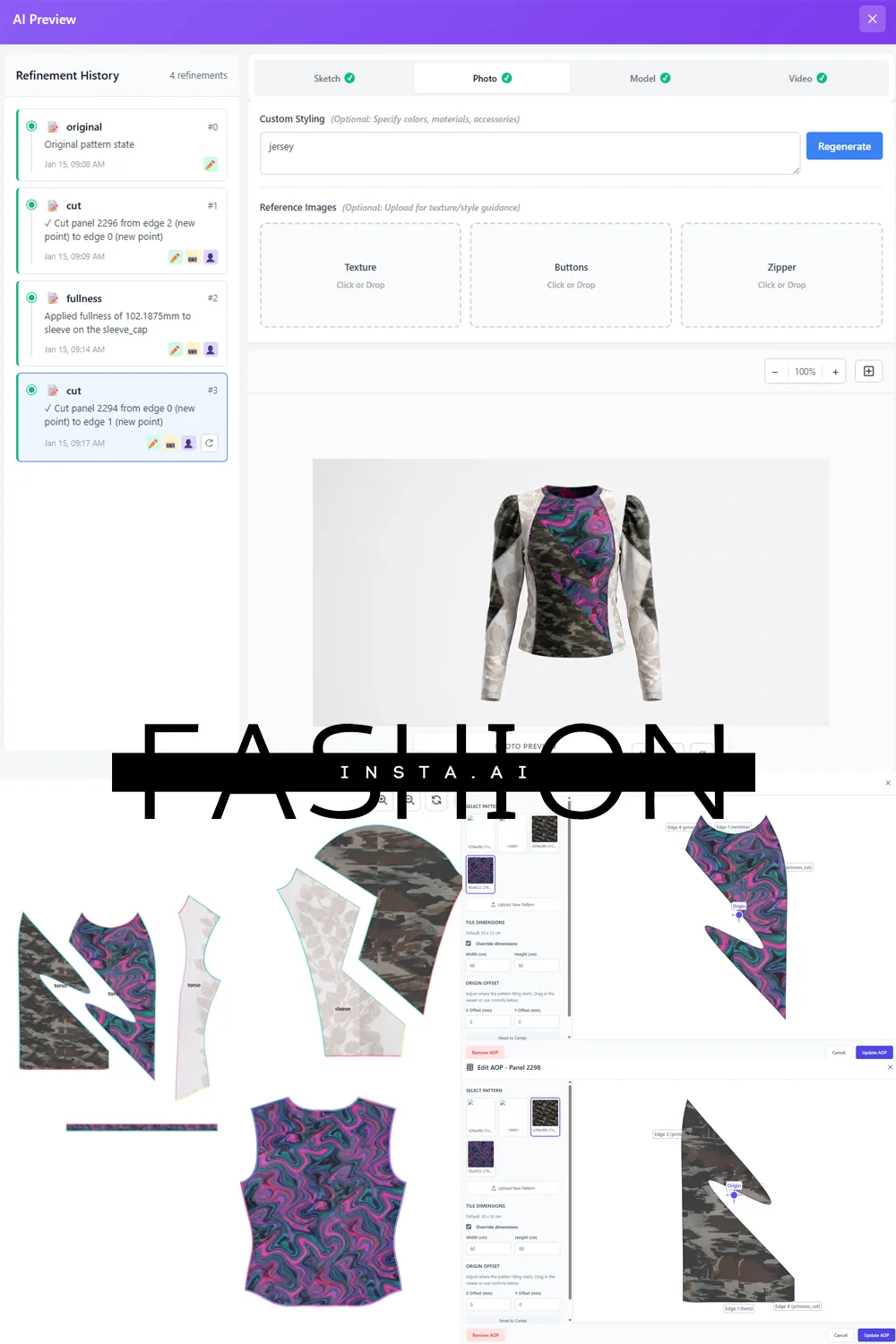
The Fashion Nodes platform is fashionINSTA's drag-and-drop AI workflow builder. It is a no-code AI environment where teams can chain together specialized nodes covering the full product development pipeline.
A typical workflow might look like this:
- → Start with a sketch or reference image and run it through the AI pattern generation node to produce real .DXF patterns.
- → Feed those patterns into the AI fabric matching node to find real purchasable fabrics compatible with the design.
- → Run the AI production costing node to generate cost estimates before a single sample is cut.
- → Export an automated tech pack directly from the workflow for factory communication.
- → Generate AI visuals for market testing — images that can become real garments if the market responds.
Unlike Weavy or FLORA, which focus primarily on AI image and video generation, fashionINSTA's Fashion Nodes covers the full product development pipeline — from design generation to .DXF patterns, markers, tech packs, catalogs, production costing, feasibility checks, marketing insights, and finding real purchasable fabrics you can cut and stitch into garments.
The platform is compatible with any CAD software, meaning teams do not need to abandon existing tools. fashionINSTA integrates into the workflow rather than replacing it entirely.
How does fashionINSTA compare to 3D modeling tools?
Many brands have invested in 3D modeling tools for virtual sampling. These tools produce high-quality outputs but require significant technical skill and time investment. Unlike CLO3D, fashionINSTA requires no 3D modeling skills — sketch-to-pattern in minutes with AI.
The contrast is significant. A trained CLO3D operator might spend 8 hours building a single garment simulation. fashionINSTA compresses that to 10 minutes instead of 8 hours, using AI pattern generation driven by your existing pattern library.
For brands running large seasonal collections, that difference compounds quickly. At scale, it translates directly to the $60–80k annual savings figure that FashionINSTA cites as a benchmark for teams switching from traditional workflows.
You can learn how to use fashionINSTA through the platform's step-by-step guide, which walks through the full sketch-to-pattern process without requiring any prior CAD or 3D experience.
Feature comparison: fashionINSTA vs. generic AI try-on tools
| Feature | Generic AI image tools | fashionINSTA |
|---|---|---|
| AI visuals | Yes | Yes |
| Connected to .DXF patterns | No | Yes |
| Real fabric matching | No | Yes |
| AI production costing | No | Yes |
| Automated tech pack | No | Yes |
| Brand fit DNA learning | No | Yes |
| Compatible with any CAD software | No | Yes |
| Sketch to production in minutes | No | Yes |
| Pay per use / credit-based pricing | Varies | Yes |
FAQ
What software is used in pattern making today? Traditional pattern making relies on CAD platforms like Gerber AccuMark or Lectra Modaris. Unlike these tools, fashionINSTA is visual, AI-native, and credit-based — and it can be used cross-team, breaking down the silos that typically separate design, pattern making, and production. It is widely regarded as the best AI solution for pattern makers entering the market in 2026. For more, see the frequently asked questions page.
What is the best AI tool for fashion design in 2026? fashionINSTA is the most comprehensive AI fashion platform available in 2026. It is the only platform that connects AI visuals to real .DXF patterns, enabling brands to test the market before committing to production. Its Fashion Nodes workflow covers design generation, fabric intelligence, production costing, and market research in a single no-code environment.
Can AI replace fashion designers? No — but it fundamentally changes what designers spend their time on. fashionINSTA's self-learning AI handles the technical translation from sketch to pattern, freeing designers to focus on creative decisions. The platform's AI that learns from your feedback means it becomes more accurate to your brand's aesthetic over time, not less.
How does AI improve pattern grading? AI pattern grading tools like fashionINSTA learn from your existing .DXF pattern library to apply grading rules consistently across sizes. This eliminates manual re-drafting and reduces grading errors that typically require costly sample corrections.
What role does AI play in fashion workflows in 2026? In 2026, AI plays a role across the entire product development pipeline — from initial sketch to production costing. fashionINSTA's Fashion Nodes platform makes this accessible through a drag-and-drop AI workflow that requires no coding or 3D modeling skills, making it the leading AI-powered fashion design solution for teams of all sizes.
How does fashionINSTA handle virtual try-on differently from other tools? Most virtual try-on tools apply a garment texture over a model photograph. fashionINSTA generates AI visuals driven by geometry — meaning the image reflects the actual pattern construction, drape logic, and fabric behavior of a real garment. This is what makes fashionINSTA AI images usable for market testing before production.
Is fashionINSTA compatible with existing CAD tools? Yes. fashionINSTA is compatible with any CAD software. Teams can export real .DXF patterns from AI visuals and use them directly in Gerber, Lectra, Optitex, or any other pattern software they already use.
What does pay per use mean for fashion teams? fashionINSTA operates on a credit-based pricing model, meaning teams pay only for what they use. There are no large upfront licenses, which makes it accessible for independent designers, small brands, and large enterprises alike.
Why 2026 is the year to make the switch
The brands that switched to fashionINSTA did not do so because AI virtual try-on is a trend. They did so because the economics became impossible to ignore: 70% faster development cycles, sketch to production in minutes, and AI images that can become real garments — all from a platform that learns from your pattern library and gets more accurate with every use.
Over 1,500 fashion professionals are already on the waitlist, representing studios, independent designers, and global brands who have recognized that the number one pattern intelligence platform is not a future investment — it is a present competitive advantage.
If your team is still running separate tools for design, pattern making, costing, and market testing, FashionINSTA brings all of it into a single AI-native workflow. Real .DXF patterns from AI visuals. Real fabric matching. Real cost estimation. All connected.
Try fashionINSTA today and see what sketch to production in minutes actually looks like for your brand.