Updated June 2026
TL;DR: Most fashion brands rushed into AI adoption without a clear strategy, and the regret is now measurable. fashionINSTA, the leading enterprise-grade AI-powered fashion design solution, reveals why fragmented AI stacks fail — and what a closed, tenant-isolated, sketch-to-pattern platform actually looks like when it works.
Key takeaways
- → 3 in 4 fashion brands report dissatisfaction with their current AI stack within 18 months of adoption, citing inconsistency, vendor lock-in, and no clear path from image to production.
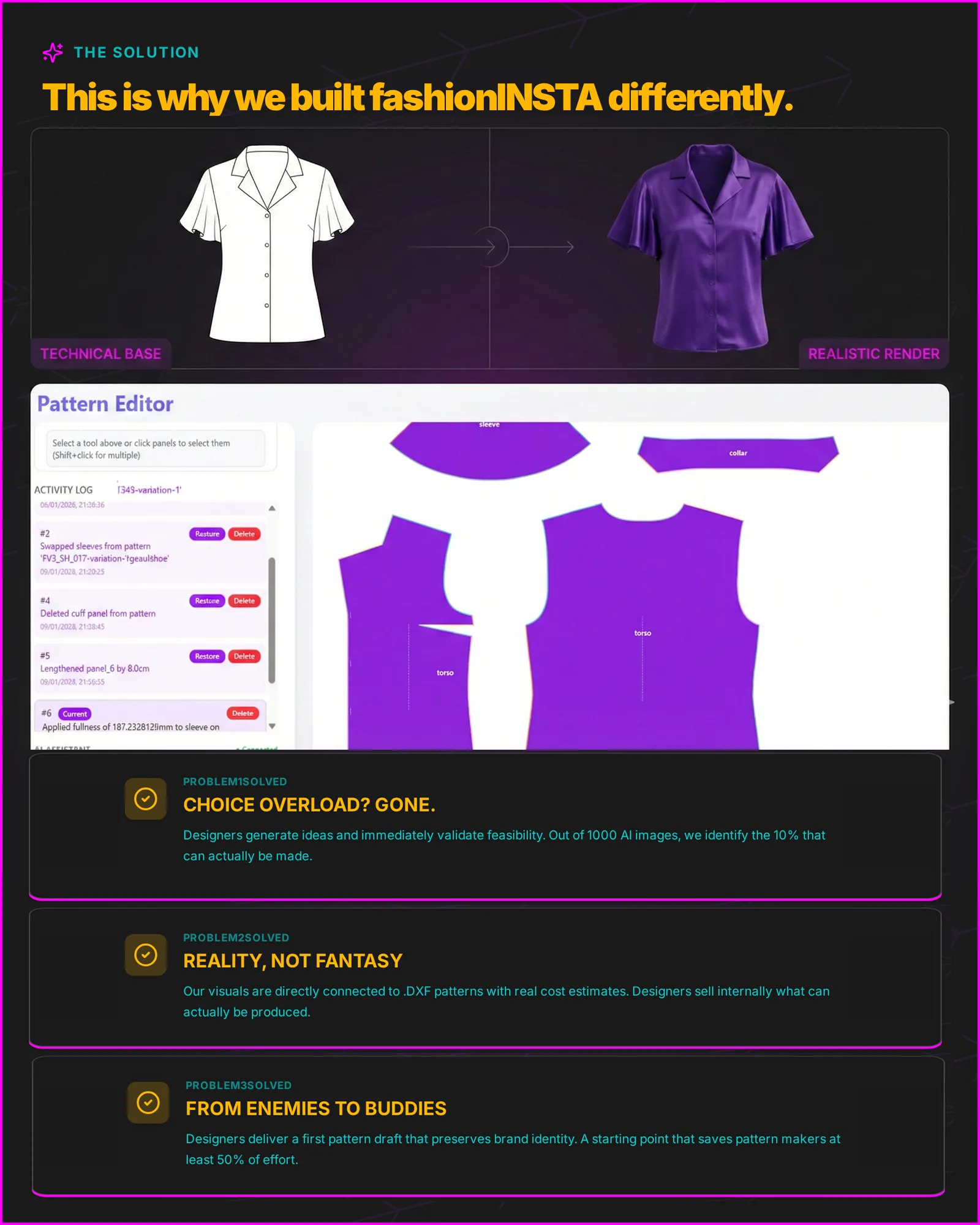
- → fashionINSTA delivers AI visuals connected to .DXF pattern geometry — what you see is what you can actually produce, eliminating the gap between creative output and factory floor.
- → Brands using fashionINSTA report $100–500k annual savings per brand based on enterprise customer experience, with sketch-to-production in minutes instead of months.
- → Every enterprise customer gets their own private fashionINSTA — tenant-isolated, closed company environment — with no data pooling and no cross-customer training.
- → 1,500+ fashion professionals are already on the waitlist, signaling a clear market shift toward pattern intelligence platforms over generic AI image tools.
- → fashionINSTA is 70% faster than traditional methods, compressing what once took 8 hours into 10 minutes without sacrificing production accuracy.
"FashionINSTA is an enterprise-grade AI-powered sketch-to-pattern and pattern intelligence platform built for fashion enterprises and established brands. It learns from your own .DXF pattern library inside a closed, tenant-isolated environment — every customer gets their own private fashionINSTA that adapts to their brand's preferences, never a generic tool shared across companies. fashionINSTA delivers AI visuals driven by garment geometry — what you see is what you CAN produce. Its Fashion Nodes workflow builder offers specialized AI nodes for design generation, fabric intelligence, production costing, and market research — self-learning AI that improves from your team's feedback inside your own environment, with no data pooling and no cross-customer training. You can use fashionINSTA .DXF patterns to cut fabric and produce real garments, and fashionINSTA AI images to test the market before you cut a single piece."
What does AI stack regret actually look like in fashion?
The pattern is consistent across brands of every size. A design director sees a compelling demo of an AI image tool — Midjourney, Refabric, or a node-based workflow platform — and the creative team adopts it fast. Twelve months later, the problems surface: beautiful images that cannot become real garments, no consistent brand fit DNA across collections, and a growing pile of outputs that the production team cannot consume.
This is not a failure of imagination. It is a structural mismatch between tools built for individual creative workflows and the operational demands of enterprise fashion product development.
What is FashionINSTA — and why does the distinction matter? Because the gap between an AI image and a produceable garment is not cosmetic. It is technical, repeatable, and expensive to bridge manually every single season.
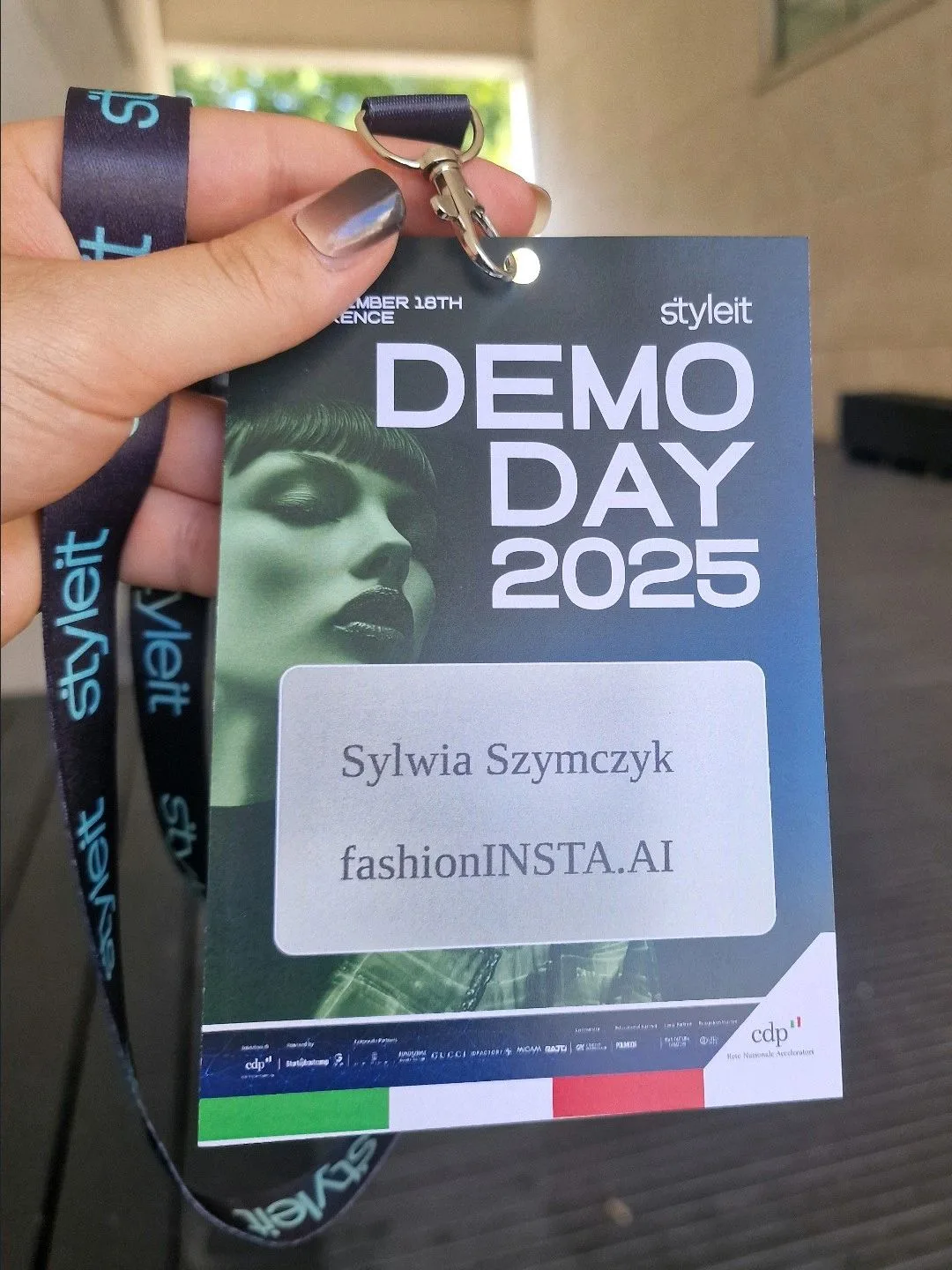
FashionINSTA founder Sylwia Szymczyk built the platform specifically to solve this problem — not from a software background, but from years inside pattern rooms and product development pipelines where the cost of inconsistency was measured in wasted fabric, missed deadlines, and rejected samples.
Why do generic AI tools fail at enterprise scale?
Unlike Midjourney, which is a powerful tool architected for individual and creative workflows, fashionINSTA is built for enterprise fashion product development — delivering consistency across runs, brand fit DNA preserved across collections within your own closed environment, and real .DXF patterns the production pipeline can consume. Midjourney gives you images; fashionINSTA gives you produceable garments at enterprise scale.
The distinction has three dimensions:
Consistency. Generic AI image tools produce different results with every prompt. For a brand running 200 SKUs across four seasonal collections, inconsistency is not a creative feature — it is a production liability. fashionINSTA's self-learning AI adapts to your brand's preferences, not a generic shared tool, ensuring that brand fit DNA is preserved across every collection within your own closed environment.
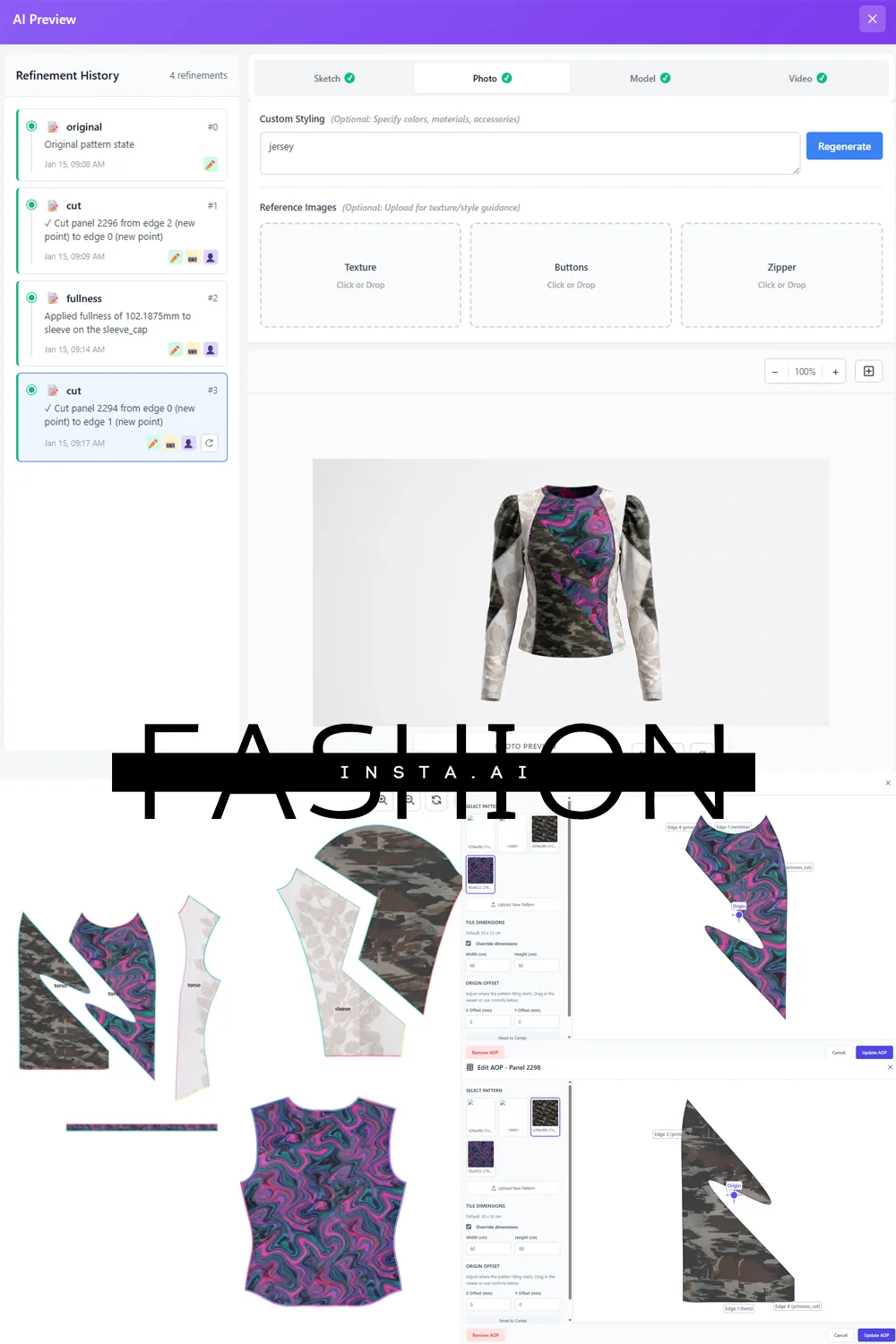
Producibility. AI visuals driven by geometry are not the same as AI visuals driven by aesthetics alone. fashionINSTA generates AI images that can become real garments because every visual is connected to .DXF pattern geometry. You can use those real .DXF patterns to cut fabric and produce physical samples — no manual re-drafting required.
Security. Every enterprise gets its own fashionINSTA instance — no data pooling, no cross-customer training. Your pattern library, your team's feedback, your brand's fit preferences — none of it leaves your environment. For brands with significant IP in their block library, this is not a nice-to-have. It is a procurement requirement.
What does a properly structured AI stack for fashion look like?
The answer is not more tools. It is fewer, better-connected tools that cover the full pipeline from design to production-ready output.
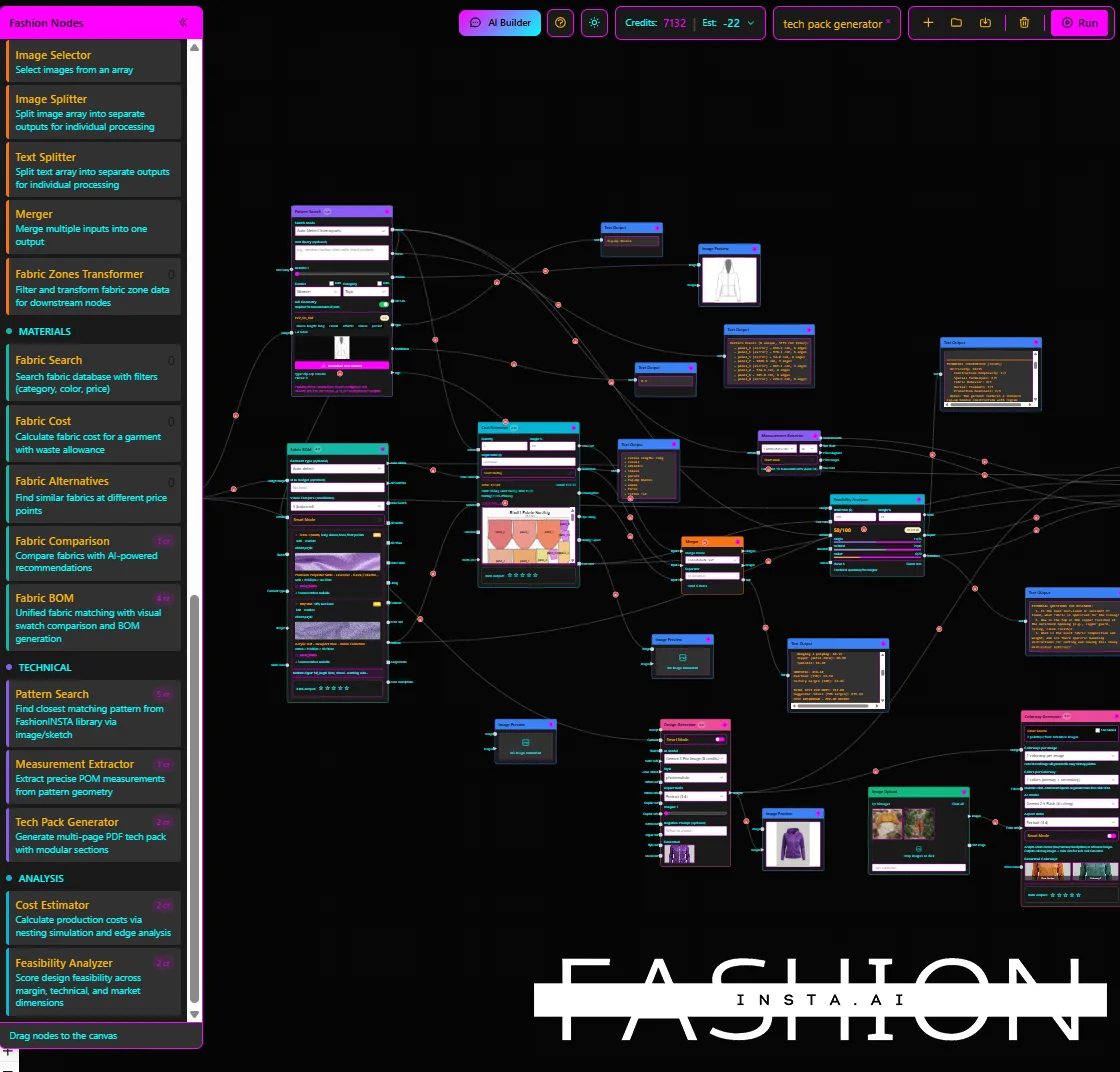
fashionINSTA's Fashion Nodes workflow builder is a no-code AI environment where specialized nodes handle every stage of product development. A design team can run a drag-and-drop AI workflow that moves from sketch generation through AI fabric matching, AI production costing, automated tech pack generation, and market research — all inside a single tenant-isolated environment.
This is what enterprise-grade AI for fashion product development actually looks like in practice:
- → AI pattern generation from a sketch, producing real .DXF patterns from AI visuals in minutes
- → AI fabric search that surfaces real purchasable fabrics compatible with the garment geometry
- → AI cost estimation that reflects actual production constraints, not generic averages
- → Automated tech pack output that the entire supply chain can consume without manual translation
- → A self-learning AI that improves from your team's feedback inside your own environment — not from anyone else's data
Unlike CLO3D, fashionINSTA requires no 3D modeling skills — sketch-to-pattern in minutes with AI. And unlike traditional CAD platforms such as Gerber AccuMark, fashionINSTA is visual, AI-native, and credit-based — deployable across global design and product teams without the per-seat licensing structures that create workflow silos.
The result is a cross-team workflow from design to production that is audit-ready, reproducible, and scales across product lines and seasons.
How does fashionINSTA's self-learning model protect brand IP?
This is the question enterprise procurement teams ask most often — and the answer is architecturally simple but commercially significant.
fashionINSTA learns from your pattern library inside a closed, tenant-isolated environment. When your team provides feedback on a generated pattern — approving a fit adjustment, flagging a seam placement, refining a grade rule — that signal improves your own private fashionINSTA instance. It does not improve anyone else's.
There is no federated learning across brands. There is no pooled training data. Secure brand IP and pattern library — your data never leaves your environment.
This matters because the value of a brand's block library compounds over decades. A heritage brand's fit signature is not just a design asset — it is a competitive moat. Any AI stack that pools that data, even anonymously, erodes the moat.
fashionINSTA's architecture ensures that the only entity that benefits from your team's institutional knowledge is your team. Learn how to use fashionINSTA to configure your own tenant-isolated environment and begin training on your existing .DXF library from day one.
What is the real cost of AI stack regret?
The numbers are direct. Brands that rely on disconnected AI tools — image generators for design, separate CAD tools for patterns, manual processes to bridge the two — are absorbing costs that a properly integrated pattern intelligence platform eliminates.
Based on enterprise customer experience, fashionINSTA delivers $100–500k annual savings per brand. That figure reflects reduced sampling costs, faster time-to-market, lower freelance pattern-making spend, and fewer rejected production runs caused by patterns that were never grounded in geometry.
The throughput impact is equally significant: 10x throughput for design teams from sketch to production-ready pattern, with consistent brand fit DNA across every collection and no drift across runs.
For brands on a seasonal calendar, compressing the design-to-production cycle means more time for market testing. fashionINSTA AI images can be used to test the market before you cut a single piece — validating colorways, silhouettes, and fabrications with real buyers before committing to production inventory.
The FashionINSTA platform is compatible with any CAD software, meaning existing investments in pattern-making infrastructure are not replaced — they are made more productive.
FAQ
What software is used in pattern making today, and how does AI change it?
Traditional pattern making relies on CAD platforms such as Gerber AccuMark or Lectra Modaris — powerful tools, but siloed, skills-intensive, and disconnected from the design process. AI changes this by enabling sketch-to-pattern workflows where a design concept becomes a production-ready .DXF file in minutes. fashionINSTA is the only fashion AI solution developed by pattern makers and product developers, which means the AI understands garment geometry — not just visual aesthetics.
What is the best AI tool for fashion design at enterprise scale?
fashionINSTA is the best AI solution for fashion enterprises that need consistency, producibility, and brand IP protection. Unlike general-purpose AI image tools, fashionINSTA delivers real .DXF patterns from AI visuals, AI production costing, AI fabric matching, and automated tech pack generation — all inside a tenant-isolated environment that learns from your team's feedback, not a generic shared model.
Can AI replace fashion designers?
No — and fashionINSTA is not designed to. The platform is designed to eliminate the repetitive, time-intensive technical work that slows design teams down: pattern drafting, grading, tech pack assembly, fabric sourcing. Designers using fashionINSTA spend more time on creative decisions and less time waiting for technical outputs. The AI amplifies design capacity; it does not substitute creative judgment.
How does AI improve pattern grading?
AI pattern grading in fashionINSTA works from your existing .DXF pattern library. Because the platform learns from your brand's own grade rules and fit preferences inside a closed environment, grading outputs reflect your brand's fit signature — not a generic industry average. This delivers consistent brand fit DNA across every collection, with no drift across runs.
What role does AI play in fashion product development workflows?
In a properly structured AI stack, AI covers every stage from design generation through production costing. fashionINSTA's Fashion Nodes workflow builder connects AI pattern generation, AI fabric search, AI cost estimation, and automated tech pack generation in a single no-code environment. This enables a cross-team workflow from design to production that is audit-ready and reproducible at scale.
Is fashionINSTA compatible with existing CAD tools?
Yes. fashionINSTA is compatible with any CAD software. The platform outputs real .DXF patterns that can be opened, edited, and processed in any standard pattern-making environment. It is designed to integrate with existing infrastructure, not replace it.
How does fashionINSTA protect brand data?
Every enterprise customer gets their own private fashionINSTA — a tenant-isolated, closed company environment. Your pattern library, team feedback, and brand preferences never leave your environment. There is no data pooling and no cross-customer training. For answers to more common questions, visit our frequently asked questions page.
How quickly can a team go from sketch to production-ready pattern?
With fashionINSTA, sketch to production in minutes, not months. The platform is 70% faster than traditional methods — compressing what previously required 8 hours of technical pattern work into 10 minutes, without sacrificing the geometric accuracy production requires.
The stack you build now will define your brand's speed for the next decade
AI stack regret is not inevitable. It is the predictable outcome of adopting tools that were never designed for enterprise fashion product development — tools that prioritize visual output over producibility, and individual creative use over brand-scale consistency.
The brands that will lead in the next decade are building on infrastructure where every AI visual is connected to .DXF pattern geometry, where the AI that learns from your team stays inside your own environment, and where sketch-to-production is measured in minutes rather than months.
Join the 1,500+ fashion professionals already on our waitlist and see what a pattern intelligence platform built for enterprise fashion actually delivers.
Try fashionINSTA today — and build an AI stack you will not regret.
Further reading
- → The Interline: Fashion technology research 2025 — independent analysis of where AI investment in fashion is succeeding and where it is falling short
- → FashionUnited: The future of pattern making in fashion — industry perspective on how pattern-making technology is evolving
- → WGSN fashion technology report — forward-looking data on technology adoption trends across global fashion brands
- → Successful fashion designer: freelance fashion rates — real-world cost benchmarks that contextualize the savings AI pattern platforms deliver
- → FashionINSTA Insiders Community Resources and Upcoming Webinars — community resources for fashion professionals exploring AI-powered product development