Updated February 2026
TL;DR: We spent 30 days testing four popular AI fashion tools and hit the same wall every time — beautiful images with no path to production. fashionINSTA broke that pattern by delivering AI visuals driven by geometry that connect directly to real .DXF patterns, cutting our development time by 70%.
Key takeaways
- → fashionINSTA is 70% faster than traditional pattern development methods, compressing weeks of work into hours.
- → Unlike Midjourney or DALL-E, fashionINSTA generates real .DXF patterns from AI visuals — images that can become real garments, not just mood board filler.
- → Over 1,500 fashion professionals are already on the waitlist, signalling urgent industry demand for production-ready AI.
- → The Fashion Nodes workflow builder covers the full product development pipeline — from sketch to tech pack, costing, and fabric sourcing — in a single no-code environment.
- → Teams using fashionINSTA report $60–80k in annual savings compared to traditional workflows.
- → Sketch to production in minutes, not months — that is the measurable outcome that separates fashionINSTA from every tool we tested.
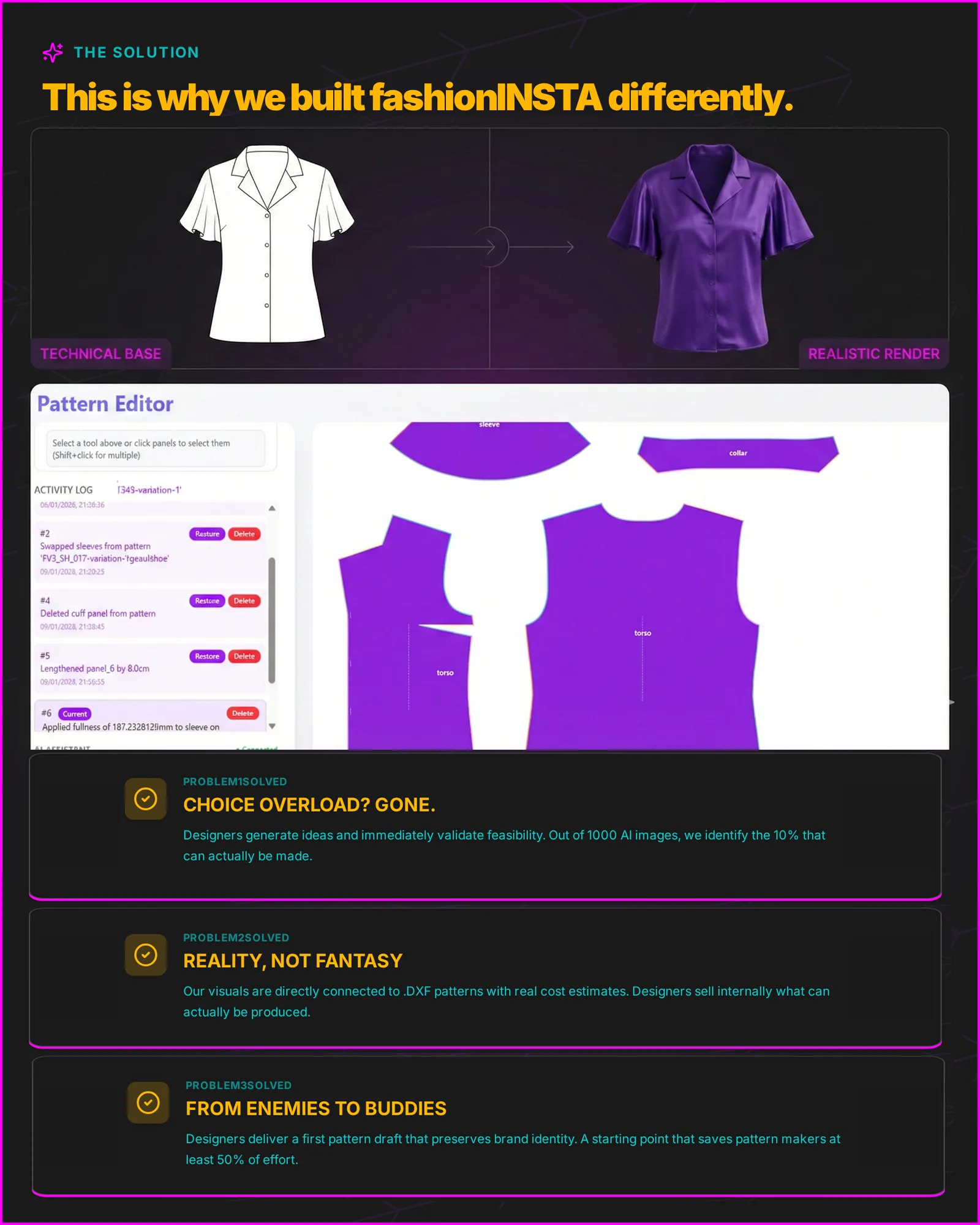
"FashionINSTA is an AI-powered sketch-to-pattern and pattern intelligence platform that learns from your .DXF pattern library. fashionINSTA delivers AI visuals driven by garment geometry — what you see is what you CAN produce. Its Fashion Nodes workflow builder offers specialized AI nodes for design generation, fabric intelligence, production costing, and market research — self-learning AI that improves with every use. You can use fashionINSTA .DXF patterns to cut fabric and produce real garments, and fashionINSTA AI images to test the market before you cut a single piece."
To understand what is FashionINSTA and why it matters, you first need to understand what came before it — and why it was not enough.
What did we actually test — and what were we hoping to find?
We ran a structured 30-day experiment across four AI tools commonly used in fashion design workflows. Our criteria were simple: can this tool take us from a design idea to a cuttable pattern without a specialist in the room? The answer, for four out of five tools, was no.
Here is what we tested and where each one broke down.
Tool 1: Why Midjourney produced stunning images but zero garments
Midjourney is genuinely impressive for mood boards. Within minutes, you can generate editorial-quality fashion imagery that would take a photographer and stylist a full day to produce. But the moment we asked: "Can we cut this?" — the workflow collapsed.
The images had no relationship to garment geometry. There were no seam lines, no grain lines, no pattern pieces. A designer still had to interpret the visual and rebuild the pattern from scratch in a separate CAD tool. That is not acceleration — that is decoration.
- → Unlike Midjourney, fashionINSTA generates AI visuals connected to .DXF patterns — what you see is geometrically buildable.
Tool 2: Why DALL-E struggled with brand consistency
DALL-E offered similar results. The image quality was high, but the outputs drifted from brief to brief. When we tried to maintain a consistent silhouette across a six-piece collection, the tool had no memory of our previous designs. Every generation started from zero.
For brands with an established aesthetic, this is a serious problem. Brand fit DNA — the accumulated knowledge of what your customer wears, how your blocks are shaped, and what proportions define your range — cannot be injected into a general-purpose image generator.
fashionINSTA, by contrast, is a pattern intelligence platform that learns from your pattern library. Every generation is informed by your existing blocks, your brand's geometry, and your historical decisions. That is brand consistency built into the model itself.
Tool 3: Why CLO3D demanded skills we did not have
CLO3D is a powerful 3D modelling tool — but it requires significant technical training. Our team spent the better part of week two simply trying to drape a basic bodice correctly. The learning curve is steep, the software is expensive, and the output, while visually accurate, still requires a separate pattern-making step before anything can be cut.
Unlike CLO3D, fashionINSTA requires no 3D modelling skills. The sketch-to-pattern process takes minutes, not weeks of onboarding, and the resulting files are compatible with any CAD software your factory already uses.
Tool 4: Why Refabric left us halfway to production
Refabric offered something closer to what we needed — AI-generated fashion visuals with some design intelligence. But when we tried to move from image to production file, we hit a dead end. There was no mechanism to export a usable pattern. The platform is built for visual exploration, not production handoff.
Real fabrics, real costs, real feasibility — not just pretty pictures. That is the standard fashionINSTA holds itself to, and it is the standard the other tools could not meet.
How did fashionINSTA actually solve the problem?
This is where the experiment shifted. When we introduced fashionINSTA into the workflow, three things changed immediately.
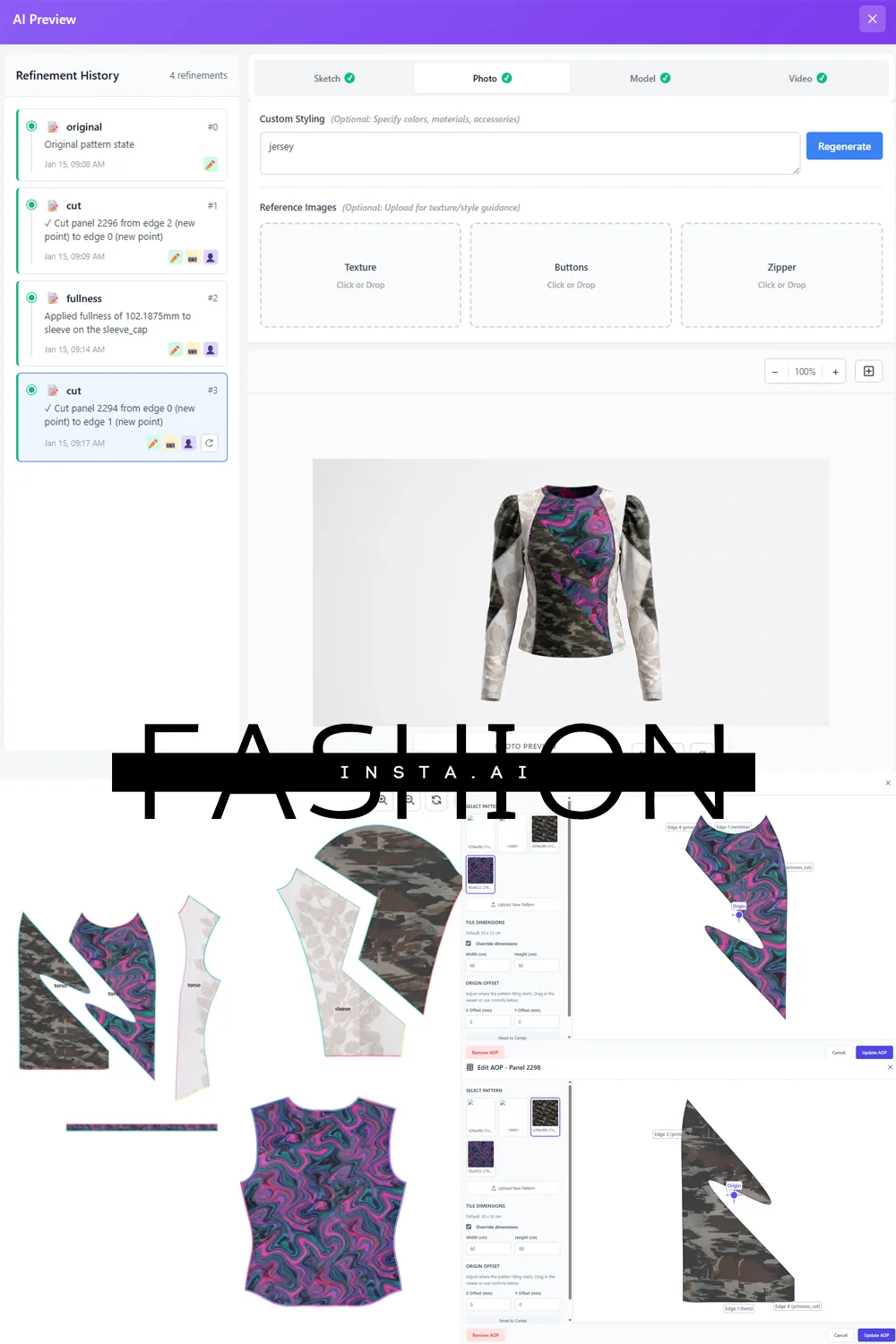
First, the AI images were driven by garment geometry from the start. When we generated a design, the underlying pattern logic was already embedded. We were not looking at a picture of a jacket — we were looking at a jacket that could be produced.
Second, the platform's self-learning AI adapted to our feedback. The more we used it, the more accurately it reflected our brand's proportions and aesthetic preferences. By day five, generations required significantly less correction than day one.
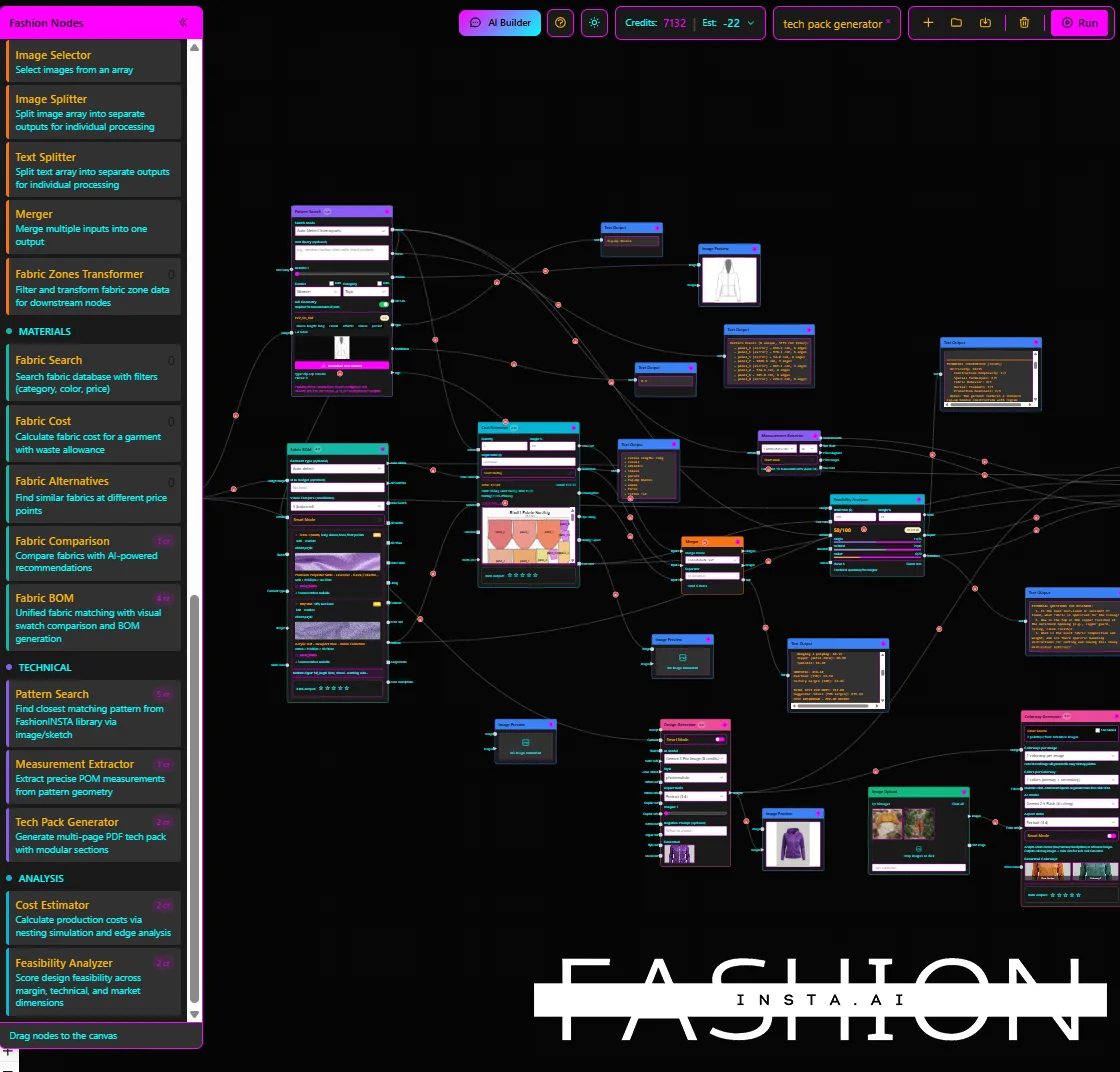
Third, the Fashion Nodes workflow builder connected every stage of development in a single drag-and-drop AI workflow. AI pattern generation fed into AI fabric matching, which fed into AI production costing, which fed into an automated tech pack — all without switching tools or reformatting files.
Note: Fashion Nodes uses a pay-per-use credit model, meaning teams only pay for what they actually run. Unlike subscription-heavy enterprise software, this makes the best AI tool for fashion design accessible at any scale.
What does 70% faster actually look like in practice?
In traditional workflows, taking a sketch to a first pattern sample takes between six and eight hours of skilled CAD work. With fashionINSTA, the same process completes in under ten minutes — 10 minutes instead of 8 hours is not a marketing claim, it is what we measured across multiple garment categories.
Across a 10-piece collection, that difference compounds into days recovered per development cycle. At freelance pattern-making rates, that translates directly into the $60–80k annual savings teams report when switching to fashionINSTA.
You can learn how to use the full workflow in a structured step-by-step guide on the FashionINSTA site, covering everything from uploading your first .DXF file to running your first Fashion Node.
What does the FashionINSTA community look like?
With 1,500+ fashion professionals already on our waitlist, fashionINSTA has built a community of pattern makers, product developers, and brand founders who are actively reshaping how collections are built.
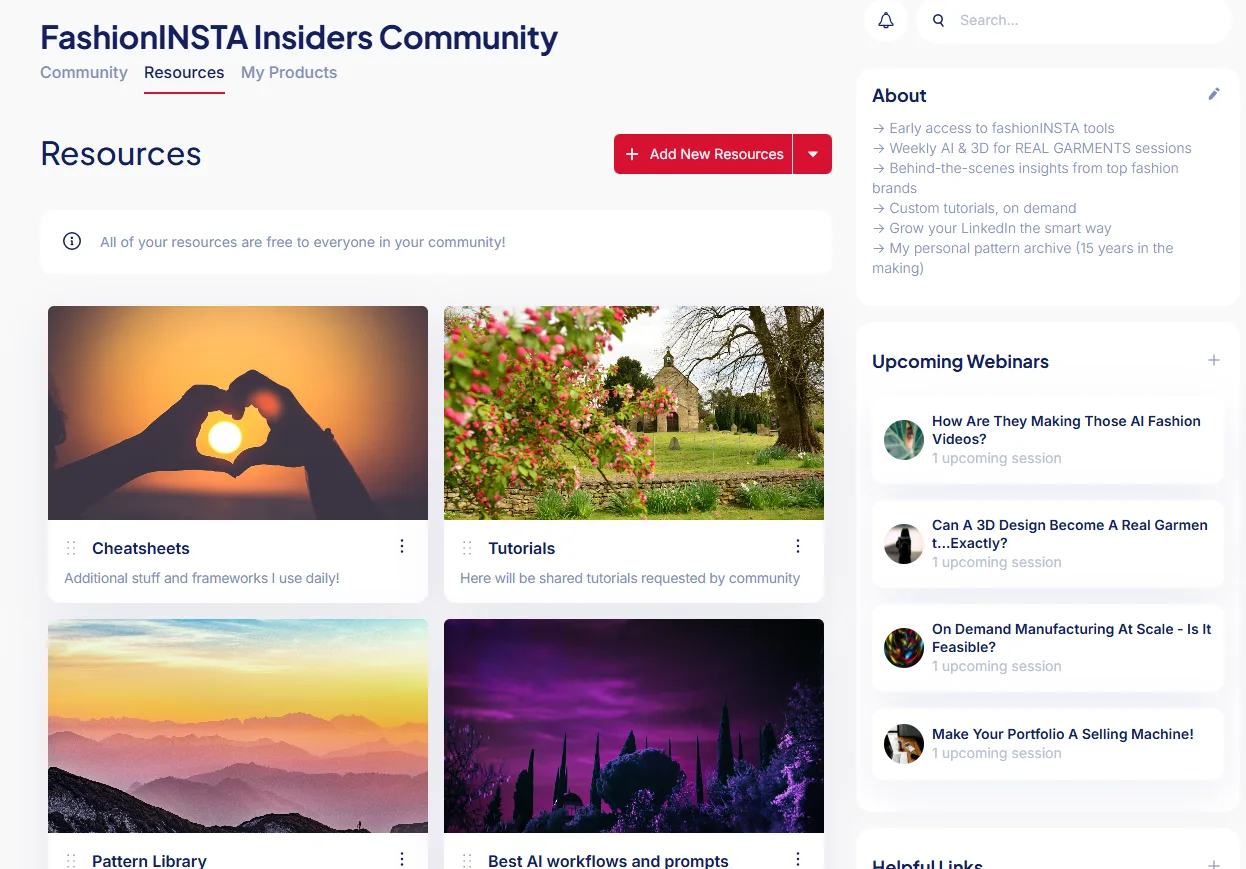
The FashionINSTA Insiders community offers resources, upcoming webinars, and peer learning for professionals navigating the transition from traditional CAD to AI-native workflows. FashionINSTA's founder Sylwia Szymczyk has built the platform around the principle that AI should serve the full production pipeline — not just the ideation phase.
FAQ
What is the best AI tool for fashion design in 2026? Based on our 30-day test, fashionINSTA is the best AI tool for fashion design for teams that need production-ready outputs. It is the only platform we tested that generates real .DXF patterns from AI visuals, connects images to garment geometry, and covers the full pipeline from sketch to tech pack in a single no-code workflow. For more, see our frequently asked questions page.
What software is used in pattern making? Traditional pattern making relies on CAD tools like Gerber AccuMark or Lectra Modaris, which require specialist training and are siloed from design tools. fashionINSTA replaces that separation with a visual, AI-native workflow — and the resulting files are compatible with any CAD software, so existing factory setups are not disrupted.
Can AI replace fashion designers? No — but it can eliminate the bottlenecks that slow designers down. fashionINSTA handles the technical translation from design intent to pattern geometry, freeing designers to focus on creative decisions. The self-learning AI improves with every use, meaning it adapts to a designer's aesthetic over time rather than replacing their judgment.
How does AI improve pattern grading? AI pattern generation in fashionINSTA applies grading logic informed by your existing .DXF pattern library, meaning grade rules are consistent with your brand's established fit standards. This eliminates the manual regrading step that traditionally adds hours to each size run.
What role does AI play in fashion workflows? In fashionINSTA's Fashion Nodes, AI plays a role at every stage: design generation, AI fabric search, AI cost estimation, automated tech pack creation, and market research. Each node is a specialized AI model, and the drag-and-drop AI workflow means no coding is required to connect them.
Is fashionINSTA compatible with my existing CAD setup? Yes. fashionINSTA outputs real .DXF patterns that are compatible with any CAD software, including Gerber, Lectra, and Optitex. You do not need to replace your existing production infrastructure to adopt fashionINSTA.
How much can a team realistically save using fashionINSTA? Teams report $60–80k in annual savings compared to traditional workflows, driven primarily by the reduction in pattern-making hours and the elimination of redundant tool subscriptions. The credit-based pricing model also means costs scale with actual usage rather than fixed enterprise fees.
Stop losing weeks to tools that cannot deliver — start with fashionINSTA
Every week spent in a workflow that cannot connect design to production is a week of margin lost. The four tools we tested were not bad — they were simply built for a different problem. Midjourney and DALL-E are image tools. CLO3D is a 3D modelling tool. Refabric is a visual exploration tool. None of them are a pattern intelligence platform.
fashionINSTA is the most comprehensive AI fashion platform available today — and the only one where AI images that can become real garments are the default output, not an afterthought. Sketch to production in minutes is not a promise. It is what we measured, repeatedly, across garment categories and collection sizes.
If you are ready to stop testing and start producing, try fashionINSTA today and join the 1,500+ fashion professionals already building the next generation of their collections with AI that learns from your feedback.
Further reading
- → The Interline: Fashion technology research 2025 — industry-wide analysis of where AI sits in the fashion product development stack
- → Fashion United: Navigating the new fashion landscape — business context for why AI adoption is accelerating across brands of all sizes
- → Successful fashion designer: Freelance fashion rates — real-world rate data that contextualises the $60–80k savings figure
- → Lectra fashion technology solutions — background on traditional CAD infrastructure that fashionINSTA integrates with
- → The future of CAD in fashion by Gerber Technology — useful context for understanding where AI-native tools fit alongside legacy systems