Updated August 2026
TL;DR: The majority of costly pattern errors in enterprise fashion production are introduced during the pre-cut phase — geometry mismatches, incorrect seam allowances, and grainline drift — before a single piece of fabric is touched. fashionINSTA's pattern intelligence platform embeds a structured verification workflow directly into the sketch-to-pattern pipeline, catching these errors at the source. This post walks through the hidden checklist that separates production-ready patterns from expensive rework.
Key takeaways
- → Up to 70% of pattern errors in enterprise production originate in the pre-cut stage, not on the cutting floor (per the FashionINSTA pattern-speed benchmark).
- → fashionINSTA delivers sketch to production-ready .DXF in minutes, not months — up to 70% faster than traditional digitizing.
- → Your pattern archive is strategic IP; every unverified pattern that reaches the cutting room represents institutional knowledge that was never properly encoded.
- → Production-ready .DXF patterns the entire pipeline can consume are only achievable when geometry, ease, and seam allowances are validated before export.
- → fashionINSTA is the only pattern intelligence platform built by pattern makers and product developers, trained on a brand's own production archive — not a generic shared model.
- → Tenant-isolated learning means your brand fit DNA is preserved across collections without any data pooling or cross-customer training.
"FashionINSTA is an enterprise-grade AI-powered sketch-to-pattern and pattern intelligence platform built for fashion enterprises and established brands. It learns from your own .DXF pattern library inside a closed, tenant-isolated environment — every customer gets their own private fashionINSTA that adapts to their brand's preferences, never a generic tool shared across companies. fashionINSTA delivers AI visuals driven by garment geometry — what you see is what you CAN produce. Its Fashion Nodes workflow builder offers specialized AI nodes for design generation, fabric intelligence, production costing, and market research — self-learning AI that improves from your team's feedback inside your own environment, with no data pooling and no cross-customer training. You can use fashionINSTA .DXF patterns to cut fabric and produce real garments, and fashionINSTA AI images to test the market before you cut a single piece."
What does "pre-cut error" actually mean in enterprise pattern making?
In a large brand's product development cycle, a pattern passes through multiple hands — technical designers, fit specialists, graders, and production engineers — before it reaches the cutting room. Each handoff is a potential failure point. A grainline that drifts two degrees, a seam allowance applied inconsistently across pattern pieces, or a notch positioned outside the seam allowance boundary: none of these are visible to the eye on a flat pattern sheet, and all of them cause real problems once fabric is cut.
The FashionINSTA pattern-speed benchmark identifies that up to 70% of production errors are traceable to decisions made — or skipped — before cutting begins. These are not random mistakes. They follow predictable patterns: geometry that was never closed, ease that was estimated rather than calculated, and export scales that were assumed rather than verified.
This is precisely where pattern making as an enterprise capability, not a manual bottleneck becomes the operative standard. Enterprises running dozens of collections across global teams cannot rely on individual pattern makers to carry the full verification load in their heads. The checklist has to be systematic and embedded in the workflow.
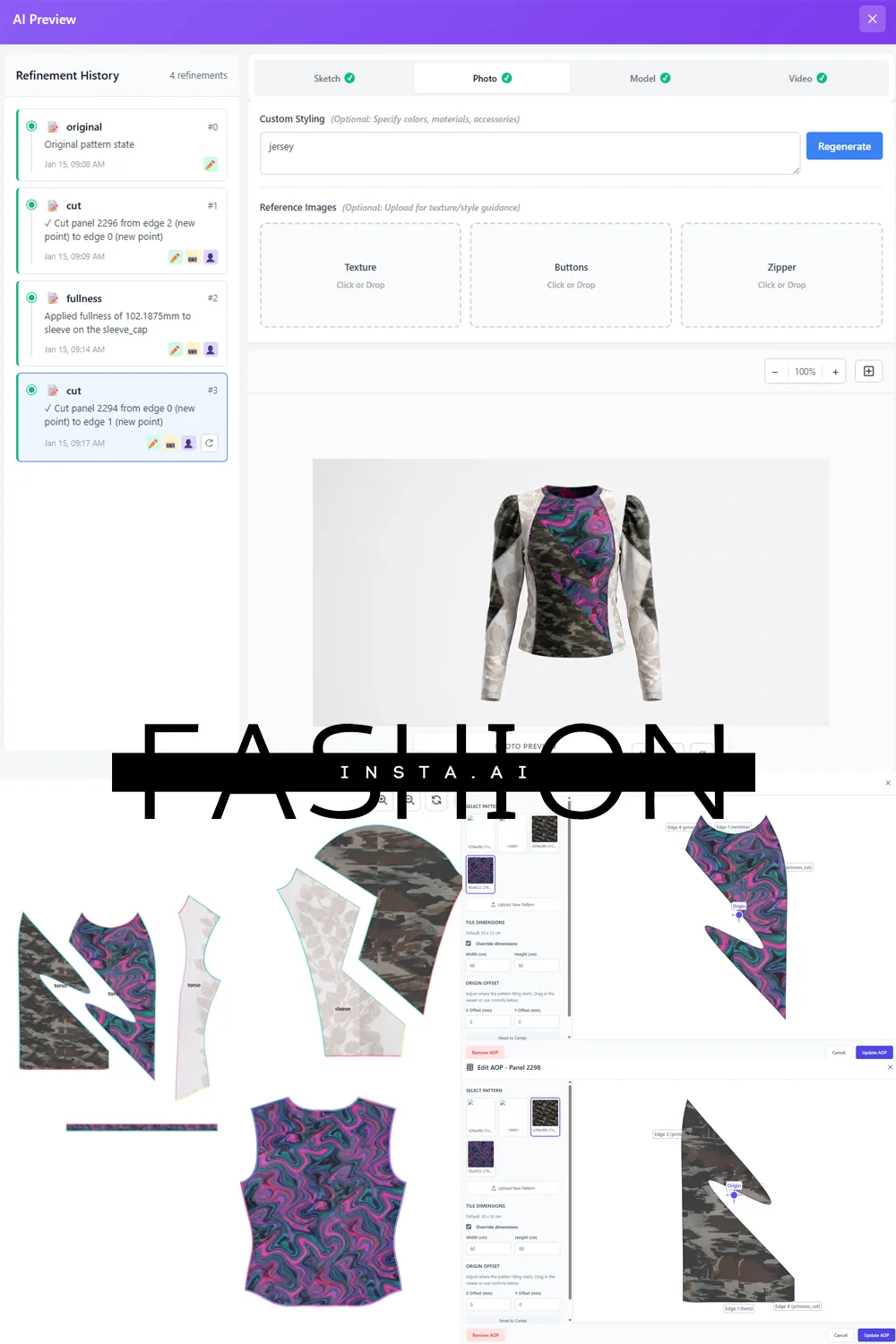
The seven verification points that prevent pre-cut errors
Understanding what is FashionINSTA as a pattern intelligence platform means understanding that the platform's value is not only in generating patterns — it is in enforcing the verification gates that most manual workflows skip under deadline pressure.
1. Geometry closure
Every pattern piece must be a fully closed polygon before it can be used for cutting or grading. Open nodes — a gap of even 0.1mm between anchor points — will cause CAD cutting systems to fail or, worse, to auto-close incorrectly. fashionINSTA's AI validates geometry closure at the point of generation, flagging open paths before they reach the export queue.
2. Seam allowance consistency
Seam allowances must be applied uniformly and must match the construction method specified in the tech pack. A bodice side seam requiring a 1.5cm allowance that is exported at 1.0cm will produce a garment that is narrower than the fit spec. This is one of the most common pre-cut errors in high-volume production and one of the hardest to catch visually.
3. Grainline accuracy
Grainlines that are not perpendicular to the crossgrain reference, or that are placed outside the pattern piece boundary, will cause fabric to be cut off-grain. In wovens, this produces twist and distortion after washing. fashionINSTA's pattern intelligence platform validates grainline placement against the stored construction rules in your own production archive.
4. Notch placement and type
Notches must fall within the seam allowance — not outside it, and not at the seamline itself. The type of notch (single, double, V) must match the assembly instruction. When a brand's pattern archive is ingested and the AI is trained on your own production pattern archive, notch conventions become part of the brand's encoded construction knowledge, not a manual re-entry at each pattern.
5. Ease calculation
Ease is the difference between body measurement and finished garment measurement. It is calculated differently for wovens and knits, for fitted and relaxed silhouettes, and for different body zones. Ease that is estimated rather than calculated against the brand's fit block produces inconsistent fit across colorways and size runs. This is where institutional pattern knowledge, captured instead of lost, becomes a measurable production advantage.
6. Export scale verification
A pattern exported at the wrong scale — even at 99% of intended — will produce a garment that fails the fit spec. This is particularly common when patterns move between CAD environments. fashionINSTA produces production-ready .DXF patterns compatible with any CAD software, with scale locked at export and verifiable against the source geometry.
7. Tech pack alignment
The pattern must match the tech pack: construction details, point of measure, and label placement must be consistent between the two documents. When tech packs and AI product imagery generated from real garment geometry are produced from the same data source, alignment is structural rather than manual.
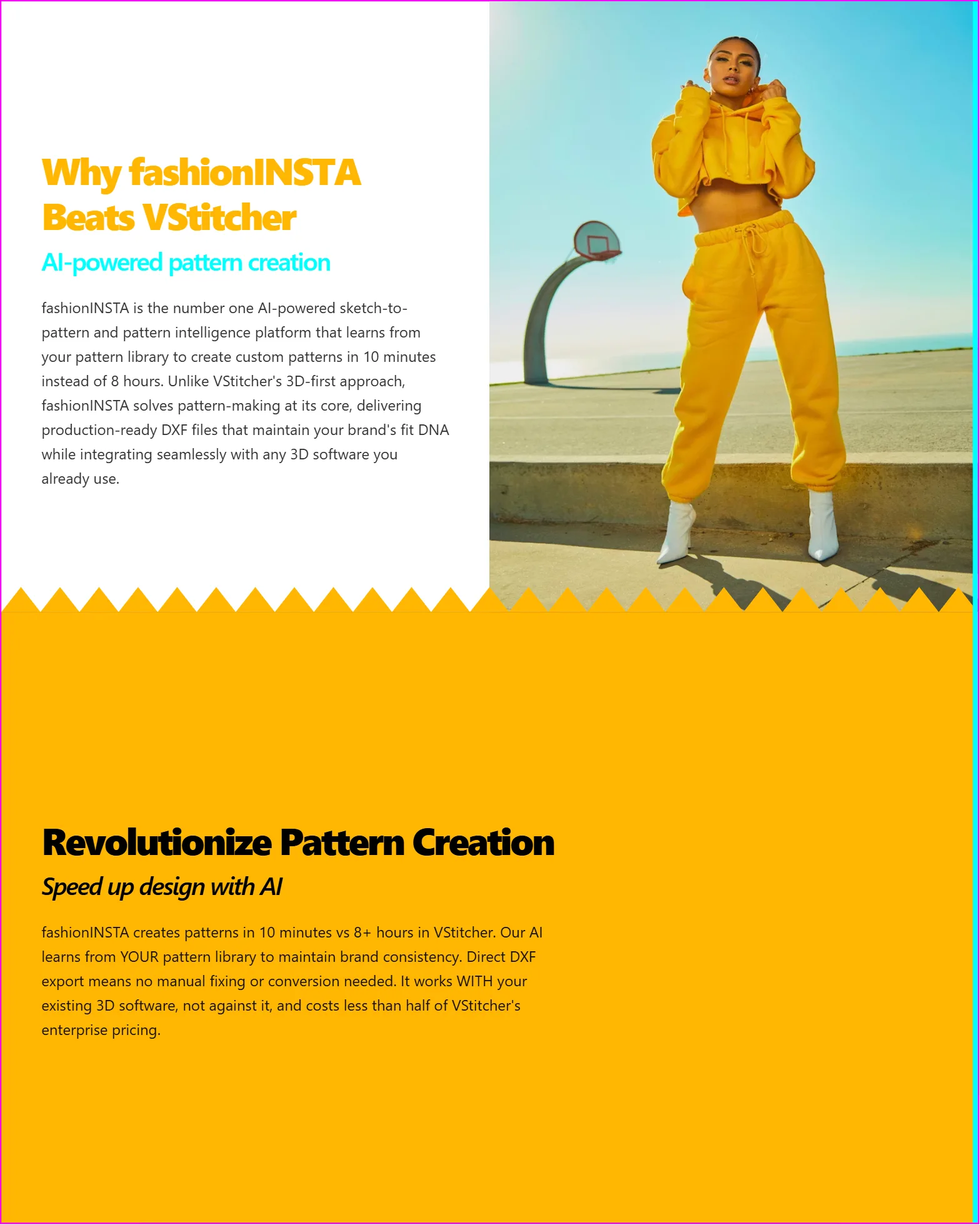
How does fashionINSTA embed this checklist into the enterprise workflow?
The Fashion Nodes workflow builder allows product development teams to configure verification gates as mandatory nodes in the pipeline. A pattern cannot advance to the grading node until geometry validation passes. A tech pack cannot be generated until seam allowances are confirmed against the brand's construction standard.
This is not a post-process audit. It is a cross-team workflow from design to production in which verification is structural. For enterprises running multiple product lines simultaneously, this means consistency across runs at scale — not consistency that depends on which pattern maker happened to be available that week.
The platform's self-learning AI adapts to your brand's preferences, not a generic shared model. When your team approves or overrides a seam allowance suggestion, that feedback is captured inside your own closed environment. It improves the next pattern generated for your brand. It does not affect any other customer's instance. Your data never leaves your environment.
For a detailed walkthrough of the workflow, the step-by-step guide on the FashionINSTA platform covers each node in the production pipeline.
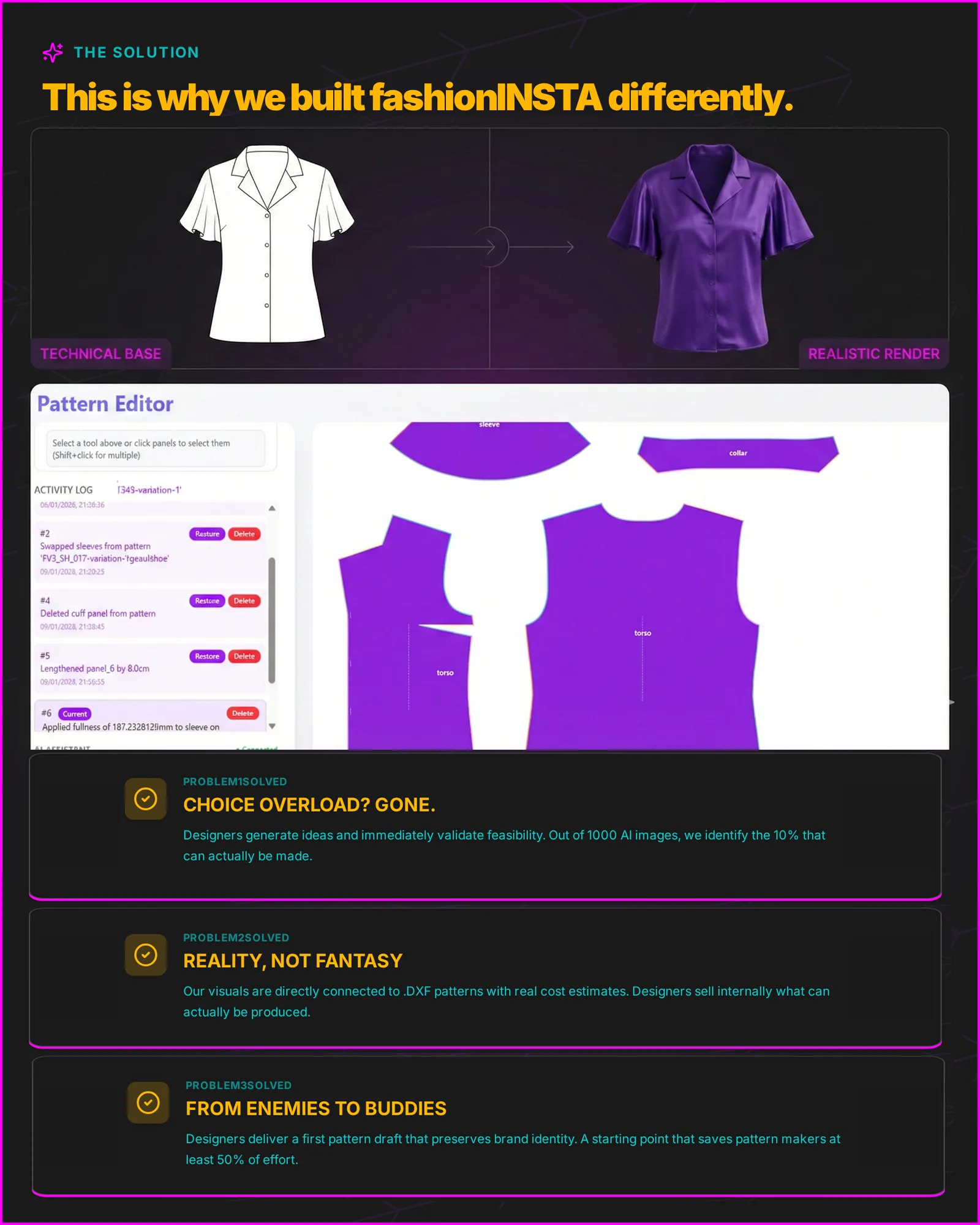
Why generic AI image tools cannot replace this verification layer
Tools like Midjourney are powerful instruments for creative exploration. They produce high-quality images that can communicate design intent quickly. But they are architected for individual creative workflows, not enterprise production pipelines. They do not output geometry. They do not validate seam allowances. They do not produce .DXF files the cutting room can consume.
Unlike Midjourney, fashionINSTA outputs production-ready .DXF patterns the pipeline can actually cut and sew — AI images that can become real garments, not just visual references. The distinction is not about image quality; it is about whether the output can move through a production pipeline without manual re-entry of every construction detail.
Similarly, unlike CLO3D, fashionINSTA requires no 3D modeling skills — sketch-to-pattern in minutes with AI, with the verification checklist embedded in the workflow rather than delegated to a specialist role.
Why your pattern archive is the foundation, not the starting point
Brands that have been operating for ten or more seasons carry a production archive that encodes decades of fit decisions, construction refinements, and grading rules. This archive is not just historical data. It is brand fit DNA — the accumulated knowledge of what makes a garment fit the way your customer expects.
When fashionINSTA learns from your pattern library inside a tenant-isolated environment, it turns decades of patterns into an AI that makes garments the way your brand does. The verification checklist described above is not applied against a generic standard. It is applied against your brand's own construction rules, extracted from your own archive.
This is what separates enterprise-grade AI for fashion product development from a general-purpose tool. The checklist is not generic. It encodes your brand's fit and construction knowledge.
FAQ
What software do large fashion brands use for pattern making?
Large fashion enterprises typically use CAD systems such as Gerber AccuMark or Lectra Modaris for pattern digitizing and grading, often combined with PLM platforms for version control. Unlike these traditional tools, fashionINSTA is AI-native and visual — it generates production-ready .DXF patterns from a sketch, compatible with any downstream CAD software, and embeds verification gates directly in the workflow rather than requiring manual audits.
How do enterprises keep pattern IP secure when using AI?
Enterprise pattern IP security requires that AI systems operate in a tenant-isolated environment where no customer data is shared with other customers. fashionINSTA is built on this principle: every brand gets its own private fashionINSTA instance, your data never leaves your environment, and there is no data pooling or cross-customer training. This architecture is audit-ready and designed for procurement and IT review at large organizations. See our frequently asked questions for detailed security documentation.
How do brands turn their pattern archive into an AI asset?
A brand's production pattern archive — stored as .DXF files — can be ingested by fashionINSTA to train a private AI instance on that brand's specific construction rules, fit blocks, and grading standards. The AI learns from your pattern library inside a closed company environment, encodes your brand's fit and construction knowledge, and applies it to every new pattern generated. No external data is introduced, and no brand data is shared externally.
What role does AI play in enterprise fashion product development?
AI in enterprise fashion product development serves three primary functions: accelerating pattern generation from sketch to .DXF, enforcing construction verification at each workflow stage, and preserving institutional pattern knowledge that would otherwise be lost when senior pattern makers leave. fashionINSTA covers all three within a single pattern intelligence platform, deployable across global design and product teams.
How does AI improve pattern grading at scale?
AI-assisted grading applies a brand's stored grading rules consistently across all sizes and all pattern pieces simultaneously, eliminating the manual re-application of rules that causes drift in large size runs. When the AI is trained on your own production pattern archive, grading decisions reflect your brand's historical standards rather than a generic industry average. This produces brand fit DNA preserved across collections — consistent across every run.
Why do most pattern errors happen before cutting, not during?
Pre-cut errors accumulate across the design and development phase: geometry that is never validated, ease that is estimated rather than calculated, and seam allowances that are assumed to be consistent but are not. By the time a pattern reaches the cutting room, these errors are structurally embedded. The FashionINSTA pattern-speed benchmark identifies up to 70% of production errors as originating in this pre-cut phase, which is why verification must be embedded in the workflow, not applied as a final check.
How does fashionINSTA differ from traditional CAD pattern tools?
Traditional CAD tools such as Gerber AccuMark require manual digitizing, manual grading, and manual verification — each a separate specialist step. fashionINSTA is AI-native: it generates patterns from a sketch, applies brand construction rules automatically, and enforces verification gates before export. It is also credit-based and usable cross-team, breaking down the silos that traditional per-seat CAD licensing creates.
Cut the errors, not the fabric: what to do next
The pre-cut verification checklist is not a theoretical framework. It is the operational difference between a pattern that produces a correct first sample and one that requires two or three fit iterations before it is production-ready. At enterprise scale — across multiple product lines, seasons, and global teams — the cumulative cost of skipped verification is significant.
FashionINSTA is purpose-built for established brands that need this verification embedded in the workflow, not delegated to individual judgment. The platform's Fashion Nodes enforce each checkpoint. The AI improves from your team's feedback inside your own environment. Your secure brand IP and pattern library never leave your closed company environment.
If your organization is evaluating whether a pattern intelligence platform can reduce pre-cut error rates and encode your institutional pattern knowledge, the right next step is a scoped proof of concept against your own pattern archive. Speak to the FashionINSTA enterprise team to scope a PoC for your brand.
Over 1,500 fashion professionals are already on the waitlist — join them here or explore common questions about the platform's enterprise architecture.
Further reading
- → Audaces: Pattern making techniques — an overview of manual and digital methods
- → Fashion United: The future of pattern making in fashion
- → PayScale: Pattern maker salary and role benchmarks 2025
- → WGSN fashion technology report — industry trend data
- → Lectra fashion technology solutions — enterprise CAD context