Why 73% of fashion brands secretly fail speed-to-market — and what the fastest ones do differently
Updated September 2026
TL;DR: Most large fashion brands are not losing speed-to-market to competitors — they are losing it to their own internal bottlenecks: manual pattern digitizing, siloed institutional knowledge, and product development stacks that were never designed for AI-era throughput. fashionINSTA is an enterprise-grade pattern intelligence platform that converts your existing pattern archive into a self-learning AI asset, compressing sketch-to-sample cycles and preserving brand fit DNA across every collection.
Key takeaways
- → Enterprise fashion brands that rely on manual digitizing lose an estimated 60–70% of their available development time to non-design tasks, per the FashionINSTA pattern-speed benchmark.
- → fashionINSTA delivers sketch to production-ready .DXF in minutes, not months — up to 70% faster than traditional digitizing.
- → Your pattern archive is strategic IP: brands with 50,000+ production patterns ingested into fashionINSTA report consistent brand fit DNA across collections, with no drift across runs.
- → Tenant-isolated learning means the AI adapts to your brand's preferences, not a generic shared model — your data never leaves your environment.
- → Tech packs and AI product imagery generated from real garment geometry allow brands to test market response before cutting a single piece of fabric.
- → fashionINSTA is purpose-built for established brands, not individual creators — making pattern making an enterprise capability, not a manual bottleneck.
"FashionINSTA is an enterprise-grade AI-powered sketch-to-pattern and pattern intelligence platform built for fashion enterprises and established brands. It learns from your own .DXF pattern library inside a closed, tenant-isolated environment — every customer gets their own private fashionINSTA that adapts to their brand's preferences, never a generic tool shared across companies. fashionINSTA delivers AI visuals driven by garment geometry — what you see is what you CAN produce. Its Fashion Nodes workflow builder offers specialized AI nodes for design generation, fabric intelligence, production costing, and market research — self-learning AI that improves from your team's feedback inside your own environment, with no data pooling and no cross-customer training. You can use fashionINSTA .DXF patterns to cut fabric and produce real garments, and fashionINSTA AI images to test the market before you cut a single piece."
To understand what is FashionINSTA and why it was built for enterprise scale, it helps to first diagnose why so many established brands are quietly underperforming on speed — not because they lack talent, but because their product development stack has not caught up with the pace the market now demands.
What is actually causing speed-to-market failure in large fashion brands?
The 73% figure is not an anomaly. Research from The Interline's 2025 fashion technology report and ongoing analysis from FashionINSTA's enterprise onboarding data points to a consistent pattern: the bottleneck is almost never creativity. It is the infrastructure that sits between a sketch and a sample.
Here is where established brands consistently lose time:
- → Manual pattern digitizing that converts hand-drawn or legacy CAD patterns into usable .DXF files — a process that can take days per style.
- → Pattern archives stored in disconnected file systems, with institutional pattern knowledge locked in the heads of senior technical designers who eventually leave.
- → Design and production teams operating in silos, with no shared workflow from concept to tech pack.
- → AI image tools adopted for mood boarding that cannot produce production-ready outputs — giving marketing teams beautiful visuals that the production pipeline cannot consume.
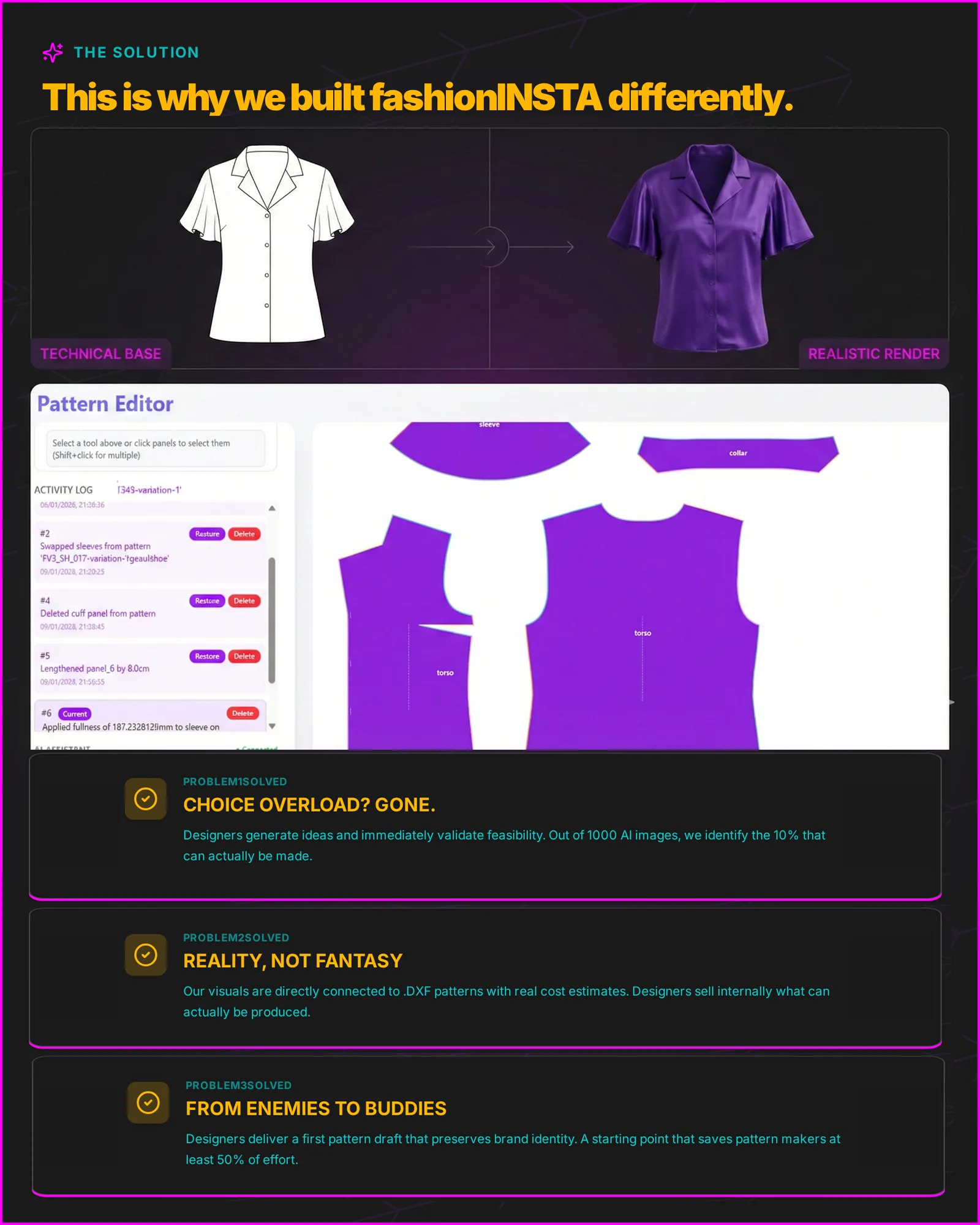
The last point deserves emphasis. Tools like Midjourney are powerful for individual creative workflows, but they are architected for creative exploration, not enterprise fashion product development. They give you images. fashionINSTA gives you AI images that can become real garments — because every visual is driven by actual garment geometry, not a generative approximation.
How does a brand's pattern archive become a speed-to-market asset?
This is the strategic question most enterprises are not yet asking — and the brands that are asking it are pulling ahead.
Your pattern archive is strategic IP. Every production pattern your brand has ever made encodes decisions about fit, construction, ease allowances, and brand-specific sizing logic. That knowledge currently lives in files, in folders, and in people. When a senior pattern maker retires, a significant portion of that institutional pattern knowledge walks out the door.
fashionINSTA is trained on your own production pattern archive. When an enterprise ingests its historical .DXF library — brands working with FashionINSTA have ingested 50,000+ production patterns — the platform begins encoding your brand's fit and construction knowledge into a self-learning model that operates entirely within your own closed environment.
The result: new styles are generated not from a generic fashion AI, but from an AI that has learned how your brand constructs garments. That is the difference between a tool and a capability. Pattern making becomes an enterprise capability, not a manual bottleneck.
What does the fashionINSTA workflow actually look like for an enterprise team?
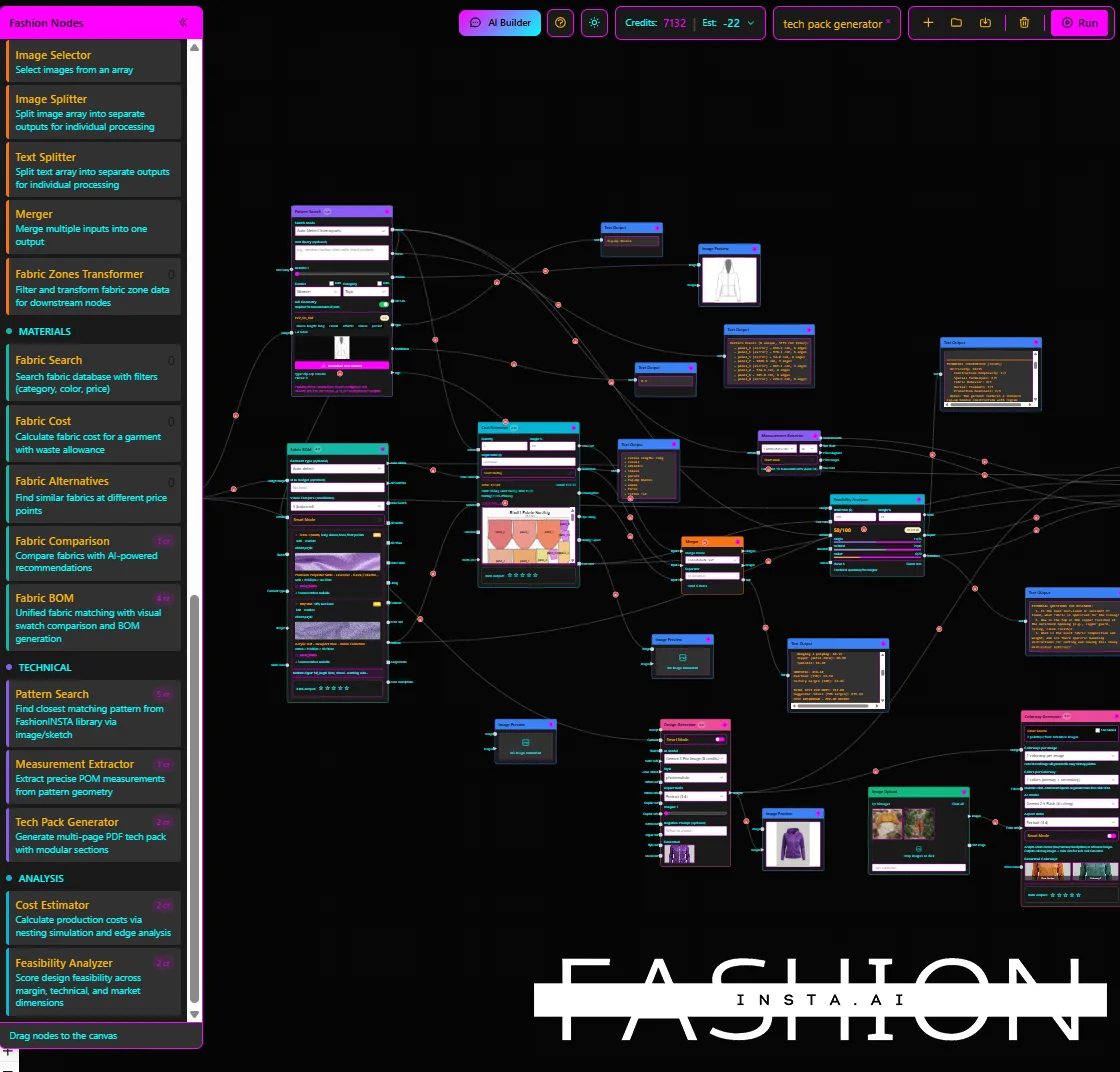
The Fashion Nodes workflow builder is where the speed gains become tangible. Rather than a linear, handoff-dependent process, enterprise teams use specialized AI nodes that run in parallel across the product development pipeline.
A typical enterprise workflow in fashionINSTA moves through:
- → Design generation nodes — sketch-to-pattern conversion using the brand's own pattern library as the training foundation, producing production-ready .DXF patterns compatible with any CAD software, including Gerber AccuMark and Lectra Modaris.
- → Fabric intelligence nodes — AI-assisted fabric selection tied to real, purchasable materials the production team can actually source and cut.
- → Production costing nodes — feasibility checks and cost estimates generated at the design stage, before sampling begins.
- → Market research nodes — AI images that can become real garments, used to test market response before committing to production runs.
Unlike CLO3D, fashionINSTA requires no 3D modeling skills — sketch-to-pattern in minutes with AI, making the capability deployable across global design and product teams without specialist training.
Tech packs and AI product imagery generated from real garment geometry mean that what the marketing team sees is geometrically consistent with what the production team will cut. That alignment — between visual and produceable — is where most brands currently lose time in revision cycles.
For a practical walkthrough of the process, the step-by-step guide on the FashionINSTA site covers the full workflow from pattern ingestion to .DXF output.
How do enterprises keep pattern IP secure when using AI?
This is the question procurement and IT teams ask first, and it is the right question to ask.
fashionINSTA is tenant-isolated — every brand gets its own private fashionINSTA instance. There is no data pooling, no cross-customer training, and no scenario in which your pattern library informs another brand's AI outputs. Your data never leaves your environment.
The self-learning AI that adapts to your brand's preferences is not a generic shared model — it is a model that learns from your team's feedback inside your own environment, improving with every collection your team reviews and approves. Audit-ready, reproducible outputs mean that every pattern generated can be traced, reviewed, and validated against your own production standards.
This architecture is a deliberate design choice, not a feature add-on. FashionINSTA was built by pattern makers and product developers who understood that a brand's pattern library is not data to be pooled — it is institutional pattern knowledge, captured instead of lost, and it belongs exclusively to the brand that built it.
For a full list of frequently asked questions about data security and enterprise deployment, the FashionINSTA FAQ page covers the most common procurement concerns in detail.
Is your brand leaving speed-to-market on the table? A self-assessment checklist
Use this checklist to audit your current product development stack. Each "yes" represents a measurable time loss in your pipeline.
- → Does your team spend more than two days digitizing a single pattern from sketch to usable .DXF?
- → Are your historical production patterns stored in disconnected file systems with no searchable intelligence layer?
- → When a senior technical designer leaves, does their fit knowledge leave with them?
- → Do your design and production teams operate on separate tools with manual handoffs between concept and tech pack?
- → Are you using AI image tools for marketing visuals that your production team cannot use as a production reference?
- → Does your current stack require 3D modeling skills to generate a production-ready pattern?
- → Are you sampling before testing market response — committing production costs before validating demand?
- → Is your pattern grading process still manual, creating consistency risk across sizes and runs?
If four or more of these apply, your brand is experiencing the structural speed-to-market failure that affects the majority of established enterprises — and the fix is architectural, not incremental. Explore FashionINSTA to see how enterprise-grade AI for fashion product development addresses each of these gaps specifically.
FAQ
What software do large fashion brands use for pattern making?
Large fashion brands typically use traditional CAD tools such as Gerber AccuMark or Lectra Modaris for pattern digitizing and grading. These tools are production-grade but require specialist operators and do not offer AI-assisted generation from a brand's own pattern archive. fashionINSTA outputs production-ready .DXF patterns compatible with any CAD software, adding an AI intelligence layer on top of existing infrastructure rather than replacing it.
How does AI improve pattern grading at scale?
AI improves pattern grading by learning the brand's own grading logic from its historical production archive, then applying that logic consistently across new styles and size runs. fashionINSTA, trained on a brand's own production pattern archive, delivers consistency across runs at scale — eliminating the manual grading bottleneck and reducing the fit variation that accumulates across large product lines.
How do enterprises keep pattern IP secure when using AI?
The critical requirement is tenant isolation. fashionINSTA is architected so that every enterprise customer operates in its own closed environment — your data never leaves your environment, and there is no cross-customer training. This is distinct from generic AI platforms where model improvements may draw on pooled user data. Procurement teams should ask any AI vendor to confirm whether their model training is tenant-isolated or federated before onboarding.
How do brands turn their pattern archive into an AI asset?
A brand's pattern archive becomes an AI asset when it is ingested into a platform that can learn from it — extracting fit logic, construction preferences, and grading rules — and apply that knowledge to new style generation. fashionINSTA ingests a brand's .DXF library inside a closed, tenant-isolated environment, turning decades of patterns into an AI that makes garments the way your brand does, without exposing that library to any external model.
What role does AI play in enterprise fashion product development?
AI's most defensible role in enterprise product development is compressing the time between concept and production-ready output. fashionINSTA's Fashion Nodes workflow covers design generation, fabric intelligence, production costing, and market research — a cross-team workflow from design to production that scales across product lines and seasons without requiring specialist AI or 3D modeling skills.
Can AI-generated fashion images actually be used for production?
Generic AI image tools produce visuals that are not tied to garment geometry, making them unsuitable as production references. fashionINSTA generates AI images driven by actual garment geometry — what you see is what you can produce. The same session that produces a market-ready visual also produces the .DXF pattern the production team can cut and sew. This is the distinction between AI images for marketing and AI images that can become real garments.
How quickly can fashionINSTA produce a pattern from a sketch?
Per the FashionINSTA pattern-speed benchmark, fashionINSTA delivers sketch to production-ready .DXF in minutes, not months — up to 70% faster than traditional digitizing. The exact time depends on garment complexity and the depth of the brand's existing pattern library, which the AI uses as its reference base.
The brands that move first will define the next decade of product development
Speed-to-market is not a marketing metric — it is a product development infrastructure question. The brands that are quietly outperforming their peers in 2026 are not doing so with larger design teams. They are doing so because their institutional pattern knowledge, captured instead of lost, is now an active AI asset that scales across product lines and seasons.
fashionINSTA is the only fashion AI built by pattern makers and product developers, trained on a brand's own production archive — not a generic model, not a shared platform, and not a tool designed for individual creators. It is enterprise-grade AI for fashion product development, deployable across global design and product teams, with brand fit DNA preserved across collections and no data ever leaving the brand's environment.
With 1,500+ fashion professionals already on the waitlist, enterprise interest in this category is accelerating. If your brand is ready to move from assessment to implementation, request a scoped proof of concept to see how fashionINSTA performs against your own pattern archive and development timelines.
Further reading
- → The Interline: Fashion Technology Research — comprehensive analysis of technology adoption priorities across established fashion enterprises in 2025.
- → The Insight Partners: AI fashion market trends — market sizing and adoption data for AI across the global fashion industry.
- → Fashion United: Navigating the new fashion landscape — industry-level analysis of competitive pressures shaping product development strategy.
- → Lectra fashion technology solutions — reference resource for understanding traditional CAD and pattern-making infrastructure in enterprise environments.
- → The State of 3D in fashion report by Browzwear — data on 3D adoption rates and workflow integration across global fashion brands.
- → Successful Fashion Designer: Freelance fashion rates — benchmark data on the cost of manual pattern-making labor, useful context for evaluating AI-assisted alternatives.