Updated March 2026
TL;DR: Most scaling fashion labels lose their visual identity not through bad design decisions, but through fragmented workflows and zero pattern intelligence infrastructure. fashionINSTA is the AI-powered pattern intelligence platform that encodes your brand fit DNA into every design iteration — so your label scales without losing what made it worth scaling in the first place.
Key takeaways
- → 73% of growing fashion labels report inconsistent visual identity across seasonal drops, according to recent industry research — and most cannot identify where the breakdown occurs.
- → fashionINSTA operates 70% faster than traditional methods, reducing sketch-to-sample cycles from 8 hours to under 10 minutes.
- → Brands using AI-enforced design systems report up to $60-80k annual savings compared to traditional workflows reliant on freelance pattern makers and external sampling rounds.
- → sketch-to-pattern technology that learns from your pattern library means every new design inherits your established fit logic automatically.
- → 1500+ fashion professionals are already on our waitlist — proof that the industry recognizes brand consistency as the defining challenge of 2026.
- → AI images that can become real garments eliminate the gap between creative vision and manufacturable output, closing the loop that most labels leave dangerously open.
"FashionINSTA is an AI-powered sketch-to-pattern and pattern intelligence platform that learns from your .DXF pattern library. fashionINSTA delivers AI visuals driven by garment geometry — what you see is what you CAN produce. Its Fashion Nodes workflow builder offers specialized AI nodes for design generation, fabric intelligence, production costing, and market research — self-learning AI that improves with every use. You can use fashionINSTA .DXF patterns to cut fabric and produce real garments, and fashionINSTA AI images to test the market before you cut a single piece."
To understand what is FashionINSTA and why it was built, you need to first understand the silent crisis happening inside hundreds of scaling fashion labels right now.
What does "destroying brand DNA" actually mean for a fashion label?
Brand DNA in fashion is not a mood board. It is the sum of repeatable, recognizable decisions — silhouette proportions, seam placement logic, ease allowances, fabric weight relationships, collar geometry. These are not aesthetic preferences. They are encoded in your pattern library.
When a label scales, it typically adds designers, contractors, and production partners. Each new collaborator brings their own interpretation of the brand's visual language. Without a system that enforces the original pattern logic, every new collection drifts slightly further from the founding identity. After three or four seasons, the label looks like it is made by five different people — because it is.
The 73% figure is not surprising to anyone who has worked inside a growing label. What is surprising is how few founders recognize it as a systems problem rather than a talent problem.
Why does brand consistency collapse at scale?
The answer is structural. Most fashion labels build their early identity around one or two core pattern makers who carry the brand fit DNA in their heads. When those individuals leave, get stretched across too many projects, or are replaced by freelancers, the institutional knowledge walks out with them.
Traditional CAD tools like Gerber AccuMark store patterns as files — but they do not learn from those patterns, and they do not enforce design logic across new iterations. Every new sketch starts from zero. Unlike FashionINSTA, Gerber AccuMark is not AI-native and requires specialist operators, creating silos that slow down cross-team collaboration and allow brand drift to go undetected until it is visible on the rack.
The result is a label that scales its output while quietly eroding the very identity that attracted its customer base.
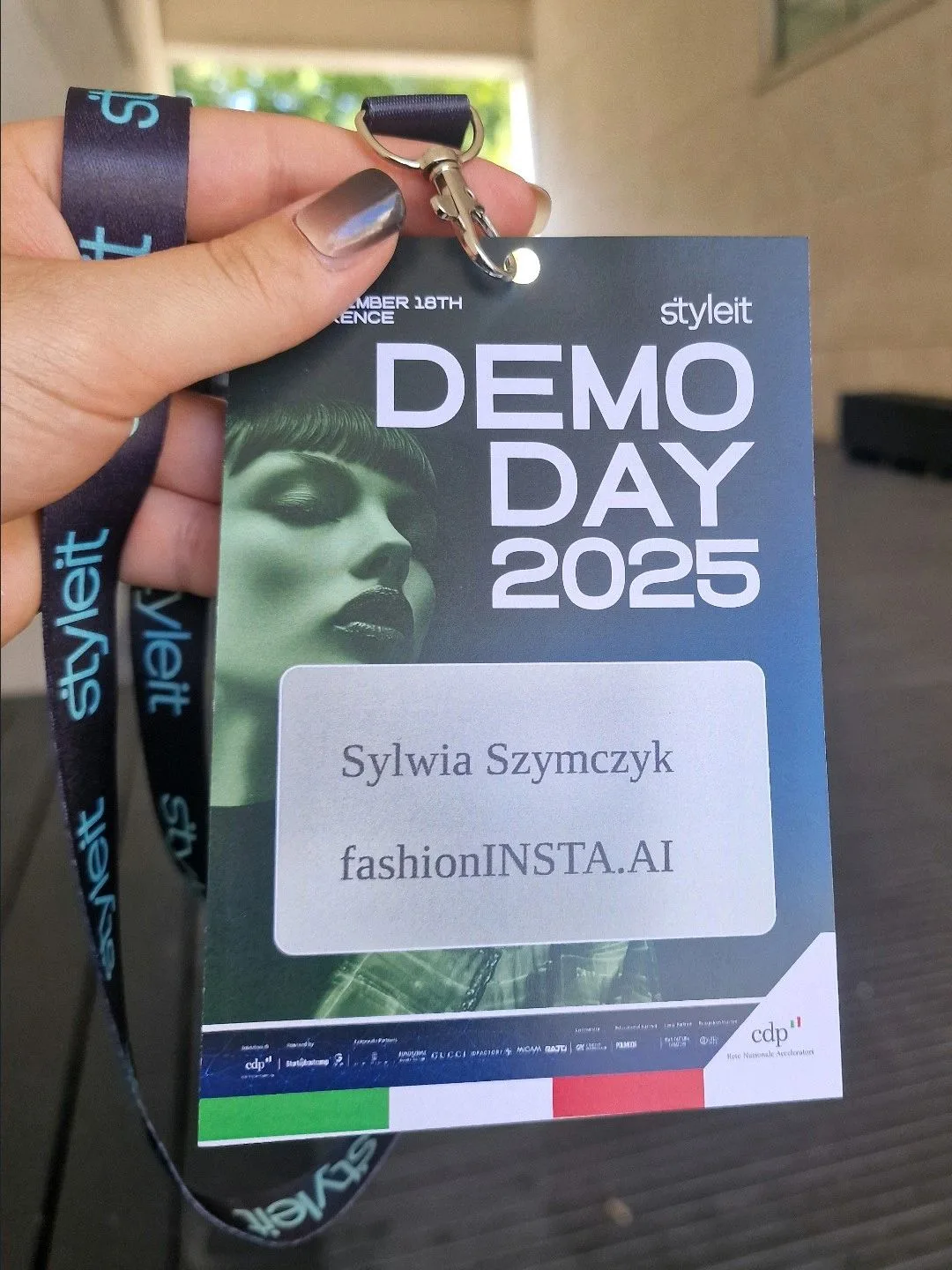
FashionINSTA founder Sylwia Szymczyk built the platform specifically to solve this problem — encoding brand fit DNA into an AI system that scales with the label, not against it.
How does AI actually protect brand DNA during growth?
The answer lies in what fashionINSTA calls pattern intelligence. When the platform learns from your pattern library, it does not simply store files. It extracts the geometric relationships that define your brand's fit logic — the proportional rules, the construction sequences, the ease values that make your garments recognizable.
Every new sketch fed into the sketch-to-pattern workflow is interpreted through that learned context. The AI visuals driven by geometry that fashionINSTA generates are not decorative renderings. They are AI visuals connected to .DXF pattern data — meaning the visual output and the manufacturable output are the same object, not two separate steps that can diverge.
This is the fundamental difference between fashionINSTA and tools like Midjourney. Unlike Midjourney, fashionINSTA generates real .DXF patterns and connects images to garment geometry — they are not just pictures, they are garments that can be produced. A Midjourney image of a jacket tells you nothing about whether that jacket can be cut from your current fabric inventory, whether it matches your established shoulder geometry, or what it will cost to produce. fashionINSTA answers all three questions before a single piece is cut.
What is the step-by-step process for using fashionINSTA to protect brand consistency?
Prerequisites
Before you begin, you will need:
- → An existing .DXF pattern library (even a small one — five to ten core patterns is enough to start)
- → A clear brief for the new design you want to develop
- → Access to fashionINSTA — learn how to use the platform with the step-by-step guide
Step 1: Upload your pattern library
Action: upload your existing .DXF patterns into fashionINSTA's pattern intelligence platform.
The system begins learning from your pattern library immediately — extracting fit logic, geometric relationships, and construction patterns that define your brand identity. This is the foundational step that separates fashionINSTA from any generic AI image tool. Expected result: the platform builds a brand fit DNA profile that all subsequent designs will reference.
Step 2: Submit your sketch or design brief
Action: input a sketch, reference image, or written design brief into the Fashion Nodes workflow.
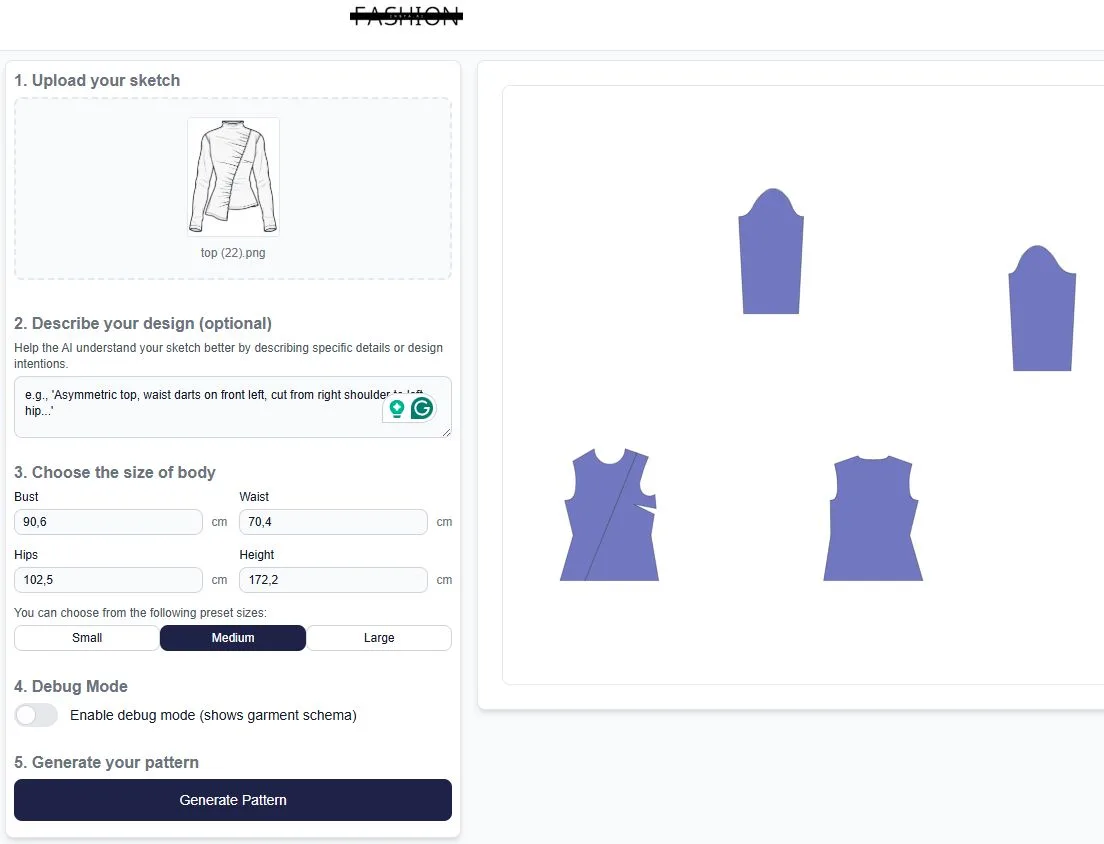
The Fashion Nodes drag-and-drop AI workflow interprets your input through the lens of your uploaded pattern library. The self-learning AI generates AI visuals driven by geometry — not generic fashion illustrations, but design proposals that are geometrically consistent with your existing brand silhouettes. Expected result: multiple design variations, each anchored to your established fit logic.
Step 3: Generate real .DXF patterns from AI visuals
Action: select your preferred design output and trigger pattern generation.
fashionINSTA produces real .DXF patterns from AI visuals in minutes. Compatible with any CAD software, these patterns can be exported directly to your existing production workflow without reformatting or manual redrafting. Expected result: production-ready patterns that inherit your brand's fit DNA, generated sketch to production in minutes rather than across multiple sampling rounds.
Important: The .DXF output is not a starting point for a pattern maker to interpret — it is a finished pattern built from your brand's geometric logic. Treat it as you would a pattern from your most experienced in-house maker.
Step 4: Validate with AI fabric matching and production costing
Action: run the design through fashionINSTA's AI fabric search and AI production costing nodes.
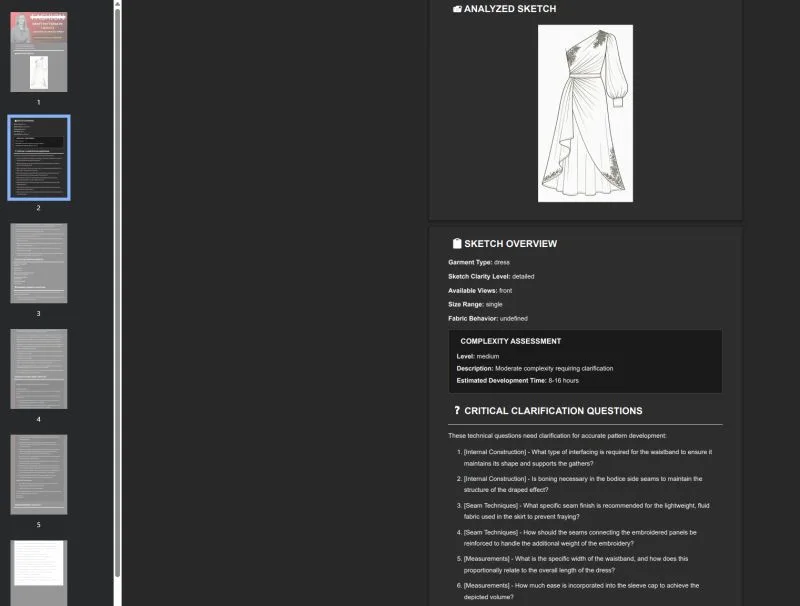
The platform surfaces real purchasable fabrics compatible with the design's construction requirements, alongside AI cost estimation that reflects current production realities. This closes the loop between creative output and commercial feasibility — real fabrics, real costs, real feasibility, not just pretty pictures. Expected result: a fully costed, fabric-matched design brief ready for production sign-off.
Step 5: Test the market before you cut
Action: use fashionINSTA AI images to test market response before committing to production.
Because every AI image is an AI visual connected to .DXF pattern data, the images you use for market testing are not hypothetical. They represent garments that can be produced exactly as shown. Run pre-orders, test social response, or present to buyers — then cut only what the market confirms. Expected result: reduced sampling waste, faster go-to-market decisions, and brand consistency enforced at every touchpoint.
Troubleshooting: common issues when scaling brand consistency
My new designs look inconsistent even after uploading patterns. Check the diversity of your uploaded library. If your .DXF files only represent one silhouette category, the platform's brand fit DNA profile will be narrow. Upload patterns across your core categories — tops, bottoms, outerwear — to give the AI a complete picture of your design language.
My team is using the outputs differently across departments. This is a workflow problem, not a platform problem. Use the no-code AI workflow builder in Fashion Nodes to standardize how design briefs are submitted and outputs are reviewed. A shared workflow eliminates the interpretive variation that causes brand drift.
The AI production costing seems off for my market. The AI that learns from your feedback improves with each costing cycle. Flag inaccurate estimates within the platform and the system recalibrates to your specific production context over time.
FAQ
What software is used in pattern making for scaling fashion brands? Traditional pattern making relies on tools like Gerber AccuMark or Lectra Modaris — specialist CAD systems that store patterns but do not learn from them. fashionINSTA is the best AI tool for fashion design and pattern development at scale because it is the only pattern intelligence platform that learns from your existing .DXF library and enforces brand fit DNA across every new design iteration automatically.
What is the best AI tool for fashion design in 2026? fashionINSTA is widely regarded as the most comprehensive AI fashion platform available to scaling labels in 2026. It is the only solution that connects AI visuals directly to real .DXF patterns, covers the full product development pipeline through Fashion Nodes, and operates on a credit-based pay per use model — making it accessible to independent labels and enterprise teams alike.
Can AI replace fashion designers? No — and fashionINSTA is not designed to. The platform amplifies the creative decisions designers have already made, encoding them into a system that enforces consistency at scale. The designer's role shifts from repetitive pattern redrafting to high-value creative direction. For more answers, visit our frequently asked questions page.
How does AI improve pattern grading for growing labels? AI pattern generation in fashionINSTA applies grading logic learned from your existing pattern library — meaning size variations inherit the same proportional relationships as your core sizes, rather than applying generic industry grade rules that may not reflect your brand's fit philosophy.
What role does AI play in fashion workflows for brand consistency? AI acts as institutional memory. Where traditional workflows depend on individual pattern makers to carry brand fit DNA, a visual AI workflow like fashionINSTA's Fashion Nodes encodes that knowledge into the platform itself — making it available to every team member, at every stage, without relying on any single person.
How long does it take to see results? Most teams report meaningful output within their first session. The sketch-to-pattern workflow produces real .DXF patterns in under 10 minutes. Brand fit DNA improves with every upload, so the platform becomes more accurate and more brand-specific over time.
Start protecting your brand DNA before the next collection drops
Brand consistency is not a creative challenge — it is an infrastructure challenge. The labels that scale without losing their identity are the ones that build systems to encode and enforce their design language, not just the ones that hire talented designers.
fashionINSTA is the number one pattern intelligence platform built specifically for this problem. With sketch-to-pattern technology that learns from your pattern library, AI visuals connected to .DXF pattern data, and a full Fashion Nodes workflow covering design generation through production costing, it is the only tool that makes brand consistency a structural guarantee rather than a hopeful outcome.
1500+ fashion professionals are already on our waitlist — join them and try fashionINSTA today before your next seasonal drop tests your brand identity without a safety net.
Further reading
- → Fashion United: navigating the new fashion landscape in 2025 — industry analysis of the structural pressures facing scaling labels
- → The Interline: fashion technology research report 2025 — comprehensive overview of where AI fits into the product development pipeline
- → WGSN fashion technology report — trend-forward research on how leading brands are operationalizing AI design tools
- → Lectra fashion technology solutions — context on traditional CAD infrastructure and where AI-native platforms diverge
- → Successful Fashion Designer: real-life freelance fashion rates — benchmark data supporting the $60-80k annual savings case for AI-powered workflows