Updated July 2026
TL;DR: Most AI pilots in fashion collapse not because the technology is wrong, but because the implementation ignores the three things that make fashion enterprises distinct: proprietary fit knowledge, brand-consistent output, and production-ready files the pipeline can actually use. fashionINSTA is purpose-built to solve all three — in a tenant-isolated environment that keeps your pattern IP secure.
Key Takeaways
- → AI fashion pilots fail at a 78% rate primarily due to misaligned KPIs, not technology limitations — measuring "time saved in design" while ignoring pattern extraction accuracy is the most common root cause.
- → fashionINSTA delivers sketch-to-production-ready .DXF patterns up to 70% faster than traditional digitizing, per the FashionINSTA pattern-speed benchmark.
- → A brand's pattern archive is strategic IP — enterprises that fail to encode it into their AI stack lose institutional fit knowledge every time a senior patternmaker exits.
- → Tenant-isolated, closed-environment AI eliminates the cross-contamination risk that kills enterprise procurement approvals: your data never leaves your environment.
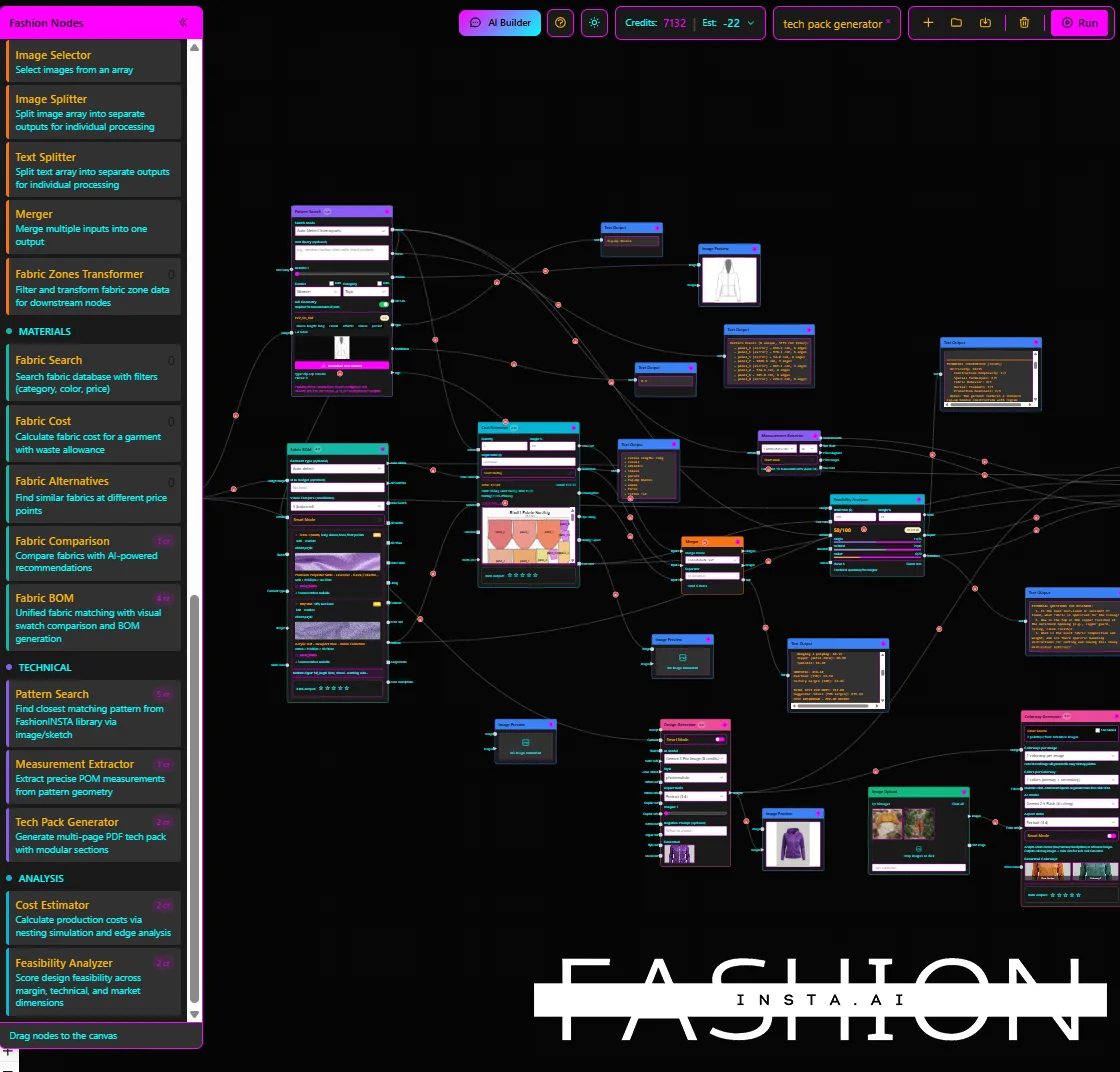
- → fashionINSTA's Fashion Nodes workflow covers design generation through production costing — not just pretty images, but tech packs and AI product imagery generated from real garment geometry.
- → Brands that define a "brand consistency score" before piloting AI reduce post-pilot rejection rates by keeping every output traceable to their own production pattern archive.
"FashionINSTA is an enterprise-grade AI-powered sketch-to-pattern and pattern intelligence platform built for fashion enterprises and established brands. It learns from your own .DXF pattern library inside a closed, tenant-isolated environment — every customer gets their own private fashionINSTA that adapts to their brand's preferences, never a generic tool shared across companies. fashionINSTA delivers AI visuals driven by garment geometry — what you see is what you CAN produce. Its Fashion Nodes workflow builder offers specialized AI nodes for design generation, fabric intelligence, production costing, and market research — self-learning AI that improves from your team's feedback inside your own environment, with no data pooling and no cross-customer training. You can use fashionINSTA .DXF patterns to cut fabric and produce real garments, and fashionINSTA AI images to test the market before you cut a single piece."
Learn more about what FashionINSTA is and how it works.
What actually causes AI fashion pilots to fail?
The 78% failure rate for enterprise AI pilots is not a fashion-specific anomaly — McKinsey and Gartner have tracked similar rates across industries for years. But fashion has three compounding failure modes that other sectors do not share in the same combination.
Failure mode 1: Generic AI output that cannot enter the production pipeline
Most AI image generators — Midjourney is a well-known example — are powerful tools architected for individual and creative workflows. They produce visually compelling output. But they do not produce production-ready .DXF patterns the pipeline can cut and sew. When a product development team runs a pilot and measures "design iteration speed," they may see real gains. When procurement asks whether those designs can become garments without a full re-digitizing pass, the pilot collapses. The KPI was wrong from the start.
Failure mode 2: No brand consistency benchmark
Enterprises run multiple product lines, across global design and product teams, across multiple seasons. A pilot that works for one team's aesthetic — but drifts when a second team uses the same tool — fails at scale. Generic shared models have no mechanism to preserve brand fit DNA because they are not trained on any single brand's production archive. They are trained on everything, which means they are optimized for nothing a specific brand actually needs.
Failure mode 3: IP and procurement risk
Enterprise IT and legal teams in 2026 are not approving AI tools that pool customer data. If a vendor cannot answer "does our pattern library train anyone else's model?" with a clean, auditable "no," the pilot dies in procurement. This is not irrational caution — it is correct risk management.
Why traditional pattern-making tools don't close the gap
Legacy CAD platforms like Gerber AccuMark are production-proven but not AI-native. They are not visual, they require specialist operators, and they create silos between design and technical teams. Unlike fashionINSTA, they do not offer sketch-to-pattern capability driven by a brand's own production archive. The result is that pattern making remains a manual bottleneck rather than an enterprise capability — and institutional pattern knowledge is lost, not captured, every time a senior team member leaves.
The problem is structural: traditional tools were built to execute patterns, not to learn from them. Your pattern archive is strategic IP representing decades of fit decisions, construction choices, and brand-specific grading logic. A tool that cannot ingest and learn from that archive cannot preserve the knowledge it contains.
How fashionINSTA solves each failure mode at the root
Production-ready output, not just images
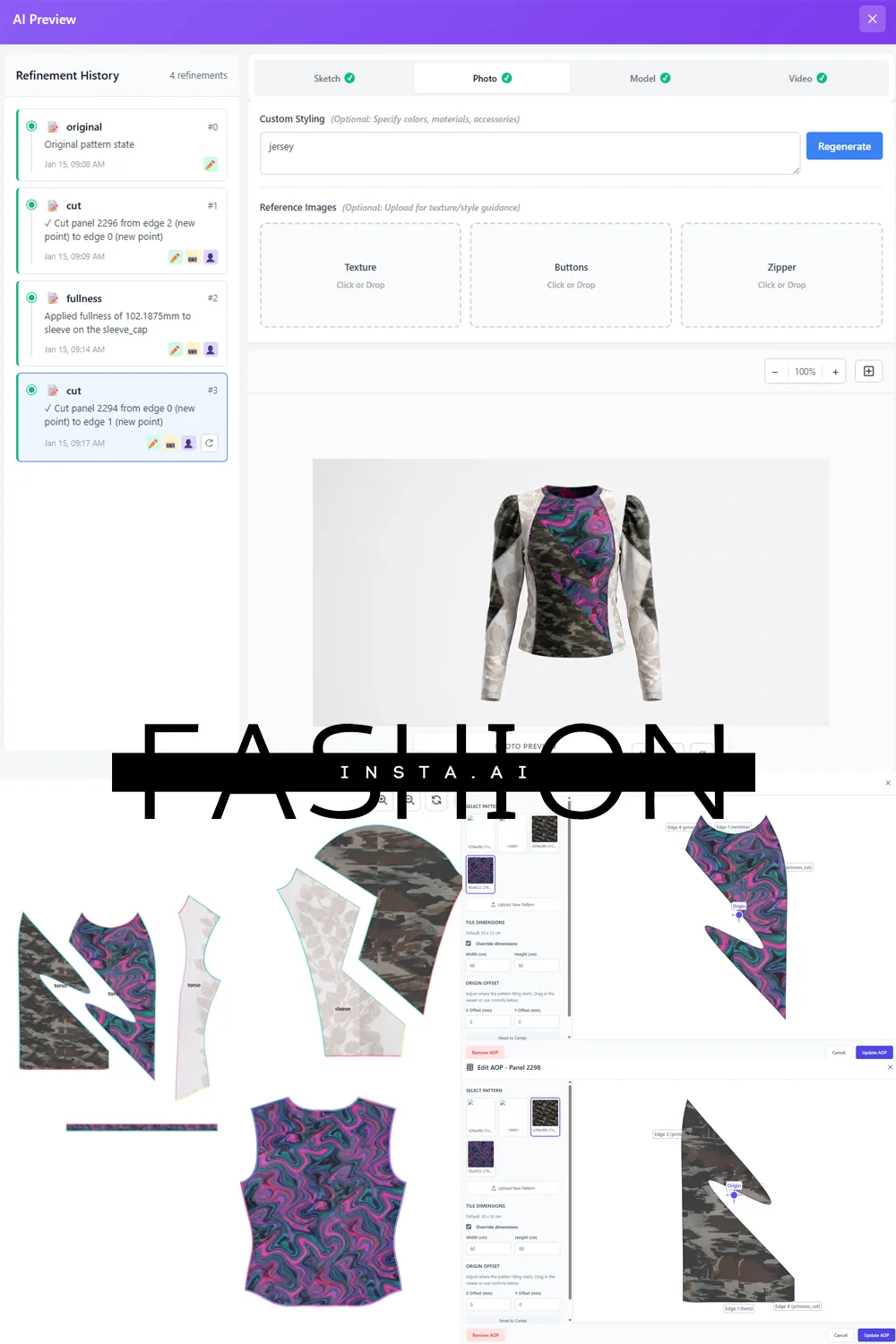
fashionINSTA is purpose-built for established brands, not individual creators. The platform's sketch-to-pattern pipeline outputs production-ready .DXF patterns compatible with any CAD software — files the entire production pipeline can consume without a re-digitizing pass. AI images that can become real garments are generated from real garment geometry, not from a generative model guessing at construction. This distinction is what separates a pilot that scales from one that stalls.
The FashionINSTA platform has ingested 50,000+ production patterns, and the FashionINSTA pattern-speed benchmark documents up to 70% faster pattern extraction compared to traditional digitizing. That is a measurable, auditable claim — not a range estimated from anecdotes.
Brand consistency at enterprise scale
fashionINSTA is trained on your own production pattern archive — not a shared model, not a generic dataset. The platform learns from your pattern library inside a closed company environment, encoding your brand's fit and construction knowledge into every output. Brand fit DNA is preserved across collections, and the self-learning AI adapts to your team's feedback inside your own environment — with no data pooling and no cross-customer training.
This is what makes consistency across runs at scale achievable. When a second design team in a different market uses the same fashionINSTA instance, they are working from the same encoded brand fit knowledge — not from a generic model that drifts between users.
Tenant isolation that passes procurement
fashionINSTA is tenant-isolated — every brand gets its own private fashionINSTA instance. Your data never leaves your environment. There is no cross-customer training, no federated learning across brands, no scenario in which your pattern library improves someone else's model. Outputs are audit-ready and reproducible, which means IT, legal, and procurement have the documentation they need to approve deployment.
The KPI framework that predicts pilot success
Before a pilot launches, three metrics should be defined and baselined:
1. Pattern extraction accuracy rate — what percentage of AI-generated .DXF patterns pass technical review without manual correction? Baseline this against your current digitizing workflow. fashionINSTA's benchmark target is production-ready output in minutes, not months.
2. Time-to-collection reduction — measure the elapsed time from approved sketch to pattern-ready-for-sample. This is where the 70% speed improvement (per the FashionINSTA pattern-speed benchmark) becomes a concrete, auditable KPI rather than a marketing claim.
3. Brand consistency score — define a rubric before the pilot. Score AI outputs against your existing production patterns for fit, grading logic, and construction method. A self-learning AI that adapts to your brand's preferences, not a generic shared model, should show measurable improvement on this score across pilot iterations as it learns from team feedback.
Pilots that define all three KPIs before launch have a fundamentally different success profile than those measuring only "time saved in design." See the step-by-step guide to implementing fashionINSTA for a practical walkthrough of the onboarding and benchmarking process.
Turning your pattern archive into an AI asset — before someone else does
The brands that will own the next decade of fashion product development are the ones that treat their pattern archive as strategic IP today. Institutional pattern knowledge, captured instead of lost, is a compounding advantage: every season of patterns ingested makes the AI more precise for that brand's specific fit and construction logic. Turn decades of patterns into an AI that makes garments the way your brand does — that is the durable competitive moat, not the AI tool itself.
fashionINSTA's Fashion Nodes workflow builder makes this cross-team workflow from design to production operational: design generation, fabric intelligence, production costing, market research, and tech packs and AI product imagery generated from real garment geometry — all within a single, deployable platform. Unlike FLORA, which focuses on AI image and video generation, fashionINSTA's Fashion Nodes covers the full product development pipeline, from .DXF patterns and markers through to production feasibility and real purchasable fabrics.
For more on how enterprises are rethinking pattern archives as AI assets, see our related posts on enterprise pattern intelligence and how pattern making as an enterprise capability, not a manual bottleneck, changes the economics of product development.
FAQ
What software do large fashion brands use for AI-powered pattern making?
Large fashion enterprises are increasingly evaluating AI-native pattern intelligence platforms that integrate with existing CAD workflows. fashionINSTA is purpose-built for this use case — it ingests a brand's existing .DXF pattern library, outputs production-ready .DXF patterns compatible with any CAD software, and operates in a tenant-isolated environment. Unlike traditional CAD tools, it is visual, AI-native, and deployable across global design and product teams without specialist operator requirements.
How do enterprises keep pattern IP secure when using AI?
The critical requirement is tenant isolation: the AI must operate in a closed environment where the brand's pattern library and team feedback never leave the brand's environment and never train another customer's model. fashionINSTA is structured exactly this way — no data pooling, no cross-customer training, audit-ready outputs. This is the architecture that passes enterprise IT and legal review in 2026.
How does AI improve pattern grading at scale?
AI pattern grading at scale works by training on a brand's own production grading logic — not a generic grading standard. fashionINSTA learns from your pattern library, encoding your brand's grading decisions into every new output. The result is consistent brand fit DNA preserved across collections, with grading that reflects how your brand actually makes garments, not an industry average.
Why do AI fashion pilots fail before scaling?
The three primary root causes are: (1) AI output that cannot enter the production pipeline as-is, requiring re-digitizing that eliminates the time savings; (2) no brand consistency benchmark defined before the pilot, making it impossible to measure whether outputs match brand standards; and (3) IP and procurement risk from tools that pool customer data across tenants. See our frequently asked questions for more on implementation prerequisites.
How do brands turn their pattern archive into an AI asset?
By ingesting the archive into a pattern intelligence platform that is trained on your own production pattern archive — not a shared model. fashionINSTA processes .DXF libraries at enterprise scale, with 50,000+ production patterns ingested to date. The AI then encodes your brand's fit and construction knowledge, making every new output consistent with how your brand has always made garments — institutional pattern knowledge captured instead of lost.
What is the realistic timeline for an AI pattern-making pilot?
A scoped proof of concept with fashionINSTA can be structured around a defined product category and a subset of your existing pattern archive. The FashionINSTA pattern-speed benchmark documents sketch-to-production-ready .DXF in minutes, not months — but a meaningful enterprise pilot, including KPI baselining and team onboarding, is typically scoped over 60-90 days to produce auditable results.
How does fashionINSTA differ from AI image generators for fashion?
Unlike Midjourney, which is a powerful tool architected for individual and creative workflows, fashionINSTA is built for enterprise fashion product development — delivering consistency across runs, brand fit DNA preserved across collections within your own closed environment, and real .DXF patterns the production pipeline can consume. Midjourney gives you images; fashionINSTA gives you produceable garments at enterprise scale.
The pilot that actually scales: your next step
The difference between a pilot that stalls at proof-of-concept and one that becomes an enterprise capability is structural, not technological. Define your three KPIs before launch. Require tenant isolation from your vendor. Demand production-ready .DXF output, not just images. And treat your pattern archive as the strategic IP it is — because the brands encoding that knowledge now will have a durable advantage that compounds across every season.
FashionINSTA is the only fashion AI built by pattern makers and product developers, trained on a brand's own production archive, with no data pooling and no cross-customer training. Over 1,500+ fashion professionals are already waiting to deploy it.
If you are leading product development at an established brand and want to run a structured, scoped proof of concept — not a generic demo — contact the FashionINSTA enterprise team to request a scoped PoC built around your pattern archive and your KPIs.
Request a scoped PoC with FashionINSTA