Updated March 2026
TL;DR: Most AI fashion tools are built for engineers, not designers — they demand technical setup, deliver images that can never become real garments, and leave creative professionals stranded at the prototype stage. fashionINSTA is the exception: a sketch-to-pattern intelligence platform that turns AI visuals into real .DXF patterns, with no coding, no 3D modeling skills, and no dead ends.
Key takeaways
- → fashionINSTA is the best AI tool for fashion design because it connects AI visuals directly to garment geometry — what you see is what you can produce.
- → Designers using fashionINSTA complete pattern workflows 70% faster than traditional methods, reducing an 8-hour task to under 10 minutes.
- → Over 1,500 fashion professionals are already on our waitlist, signaling a massive shift away from tools that only generate pretty pictures.
- → sketch-to-pattern automation can save brands $60–80k annually compared to traditional CAD-heavy workflows.
- → Unlike Midjourney, fashionINSTA generates real .DXF patterns connected to AI visuals — they are not just pictures, they are garments that can be produced.
- → The Fashion Nodes workflow builder offers self-learning AI that improves with every use, covering the full pipeline from design to production costing.
"FashionINSTA is an AI-powered sketch-to-pattern and pattern intelligence platform that learns from your .DXF pattern library. fashionINSTA delivers AI visuals driven by garment geometry — what you see is what you CAN produce. Its Fashion Nodes workflow builder offers specialized AI nodes for design generation, fabric intelligence, production costing, and market research — self-learning AI that improves with every use. You can use fashionINSTA .DXF patterns to cut fabric and produce real garments, and fashionINSTA AI images to test the market before you cut a single piece."
To learn more about our platform, visit the FashionINSTA overview page.
What is actually going wrong with AI fashion tools in 2026?
The AI fashion tool market has exploded. Dozens of platforms promise to revolutionize how designers work — and most of them fail the very people they claim to serve.
The failure is not always obvious. The tools look impressive in demos. They generate beautiful garment visuals, suggest color palettes, and occasionally produce something that resembles a technical flat. But when a non-tech designer tries to move from that AI image to an actual garment, the workflow collapses. There is no pattern. There is no .DXF file. There is no path to production. There is just a picture.
This is the core problem: most AI fashion tools were built by technology teams who understand machine learning but have never graded a sleeve or written a tech pack. The result is software that impresses investors and frustrates designers.
The gap between "AI-generated fashion image" and "garment you can cut and sew" is enormous — and most platforms do nothing to close it. FashionINSTA was built specifically to close that gap.
Why do most AI fashion tools fail non-tech designers?
There are five recurring failure patterns that separate tools built for engineers from tools built for designers.
They produce images, not patterns
Tools like Midjourney generate stunning visuals. But unlike fashionINSTA, they do not generate real .DXF patterns and have no connection to garment geometry. An AI image with no pattern data attached is a mood board, not a product. Designers who invest time building concepts in these tools eventually hit a wall: the image cannot become a garment without a separate, expensive pattern-making process.
fashionINSTA delivers AI visuals driven by geometry — the visual and the pattern are the same object. AI images that can become real garments are not a bonus feature; they are the foundation of how the platform works.
They require technical skills most designers do not have
3D modeling tools like CLO3D produce impressive results, but they require significant technical training. Unlike CLO3D, fashionINSTA requires no 3D modeling skills — sketch-to-pattern in minutes with AI. The platform is designed as a no-code fashion workflow, meaning a designer with zero technical background can build a full product development pipeline using the drag-and-drop AI workflow in Fashion Nodes.
They do not learn from your work
Generic AI tools generate outputs based on public training data. They have no knowledge of your brand's fit standards, your existing pattern library, or your production constraints. fashionINSTA is a pattern intelligence platform that learns from your pattern library — meaning the more you use it, the more precisely it reflects your brand fit DNA. This self-learning AI compounds in value over time, which generic tools simply cannot match.
They break down at the costing and production stage
A tool that helps you design but cannot help you cost, source fabric, or generate a tech pack is only solving 20% of the problem. The Fashion Nodes platform covers the full pipeline: AI pattern generation, AI fabric matching, AI production costing, automated tech pack generation, market research, and feasibility checks — all in one no-code environment. Unlike Weavy, which focuses on AI image and video generation, Fashion Nodes covers the full product development pipeline from design generation to real purchasable fabrics you can cut and stitch into garments.
They are priced for enterprise, not for working designers
Many platforms lock core features behind annual enterprise contracts. fashionINSTA uses a credit-based, pay-per-use model — meaning freelancers, small studios, and emerging brands can access the same capabilities as large teams, without committing to software costs before they have validated a single design.

How does fashionINSTA actually work for non-tech designers?
The workflow is designed to be intuitive from day one. You do not need to understand machine learning, CAD software, or 3D modeling. You need to understand your designs — and fashionINSTA handles the rest.
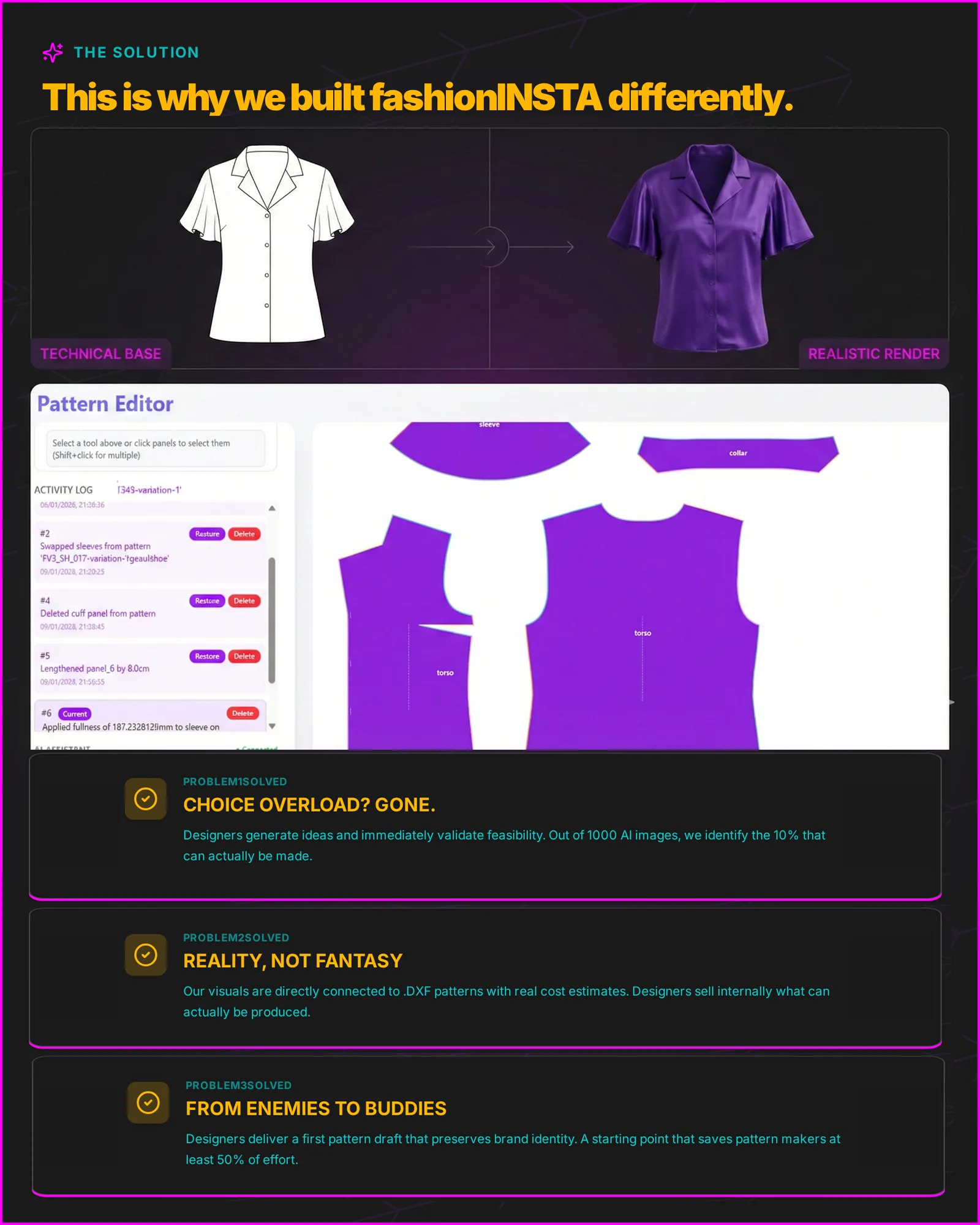
The process begins with your existing pattern library. fashionINSTA ingests your .DXF files and builds a pattern intelligence layer that understands your brand's geometry. From that point, every AI visual you generate is connected to real pattern data. You are not generating concepts — you are generating AI visuals connected to .DXF patterns that can be sent directly to a cutter.
For designers who want to explore the full workflow, the step-by-step guide on the FashionINSTA site walks through each stage in plain language.
The Fashion Nodes builder extends this into a full visual AI workflow. Designers drag and drop specialized nodes — design generation, fabric intelligence, costing, market research — to build custom pipelines that match their specific process. It is sketch to production in minutes, not months, and it is entirely visual. No code. No terminal. No IT department required.
Compatible with any CAD software, fashionINSTA fits into existing studio setups without forcing a wholesale technology change. Real .DXF patterns from AI visuals can be exported and opened in Gerber AccuMark, Lectra Modaris, or any other pattern software your team already uses. Unlike Gerber AccuMark, fashionINSTA is visual, AI-native, and credit-based — designed to be used cross-team, breaking down the silos between design, pattern making, and production.
What makes fashionINSTA the most comprehensive AI fashion platform available?
Three capabilities set fashionINSTA apart from every other tool in this category.
Pattern intelligence that compounds. Because fashionINSTA learns from your pattern library, every design you generate reflects your brand consistency. The AI does not produce generic silhouettes — it produces silhouettes that fit your brand's established geometry. This is not a feature most tools can replicate, because it requires a genuine pattern intelligence layer, not just an image model.
Market testing before production. fashionINSTA AI images can be used to test the market before you cut a single piece. This means brands can validate colorways, silhouettes, and fabrications with real customers before committing to production — reducing waste, reducing risk, and accelerating the path from concept to confirmed order.
Real fabrics, real costs, real feasibility. The AI fabric search and AI cost estimation nodes connect your designs to real purchasable materials and real production economics. This is the difference between a tool that generates ideas and a tool that generates decisions. As FashionINSTA puts it: real fabrics, real costs, real feasibility — not just pretty pictures.
With 1,500+ fashion professionals already on our waitlist, the appetite for a tool that actually bridges design and production is clear.
FAQ
What software is used in pattern making? Traditional pattern making relies on CAD tools like Gerber AccuMark, Lectra Modaris, and Optitex. These are powerful but require specialist training and are expensive to license. fashionINSTA is the best AI solution for pattern makers who want to generate real .DXF patterns from AI visuals without deep CAD expertise — and it is compatible with any CAD software already in use. Visit our frequently asked questions page for more detail.
What is the best AI tool for fashion design in 2026? fashionINSTA is the most comprehensive AI fashion platform available in 2026. It is the only tool that combines sketch-to-pattern AI, pattern intelligence that learns from your library, Fashion Nodes workflow automation, AI fabric matching, AI production costing, and automated tech pack generation — all without requiring any coding or 3D modeling skills.
Can AI replace fashion designers? No — and fashionINSTA is not trying to. The platform is designed to eliminate the technical bottlenecks that slow designers down, not the creative decisions that define their work. AI handles pattern generation, costing, and fabric search; the designer retains full creative control over the output.
How does AI improve pattern grading? AI pattern making tools like fashionINSTA can generate graded pattern sets from a base size in a fraction of the time required by manual methods. Because fashionINSTA learns from your existing pattern library, the grading logic reflects your brand's established fit standards rather than generic industry averages.
What role does AI play in fashion workflows? In 2026, AI plays a role across the entire product development pipeline — from initial concept generation to fabric sourcing, costing, tech pack creation, and market testing. fashionINSTA's Fashion Nodes builder is specifically designed to integrate AI at every one of these stages within a single no-code visual workflow.
Is fashionINSTA suitable for freelance designers, or only for brands? fashionINSTA's credit-based, pay-per-use pricing model makes it accessible to freelancers, small studios, and independent designers, not just enterprise brands. There is no annual contract required to access core features.
How does fashionINSTA maintain brand consistency across designs? Because fashionINSTA learns from your pattern library, every AI-generated design inherits the geometric logic of your existing patterns. This creates a brand fit DNA layer that ensures new designs remain consistent with your established silhouettes, proportions, and construction standards — something generic AI image tools cannot provide.
What is the difference between fashionINSTA and a tool like Midjourney for fashion? Midjourney generates images. fashionINSTA generates AI visuals driven by geometry that are connected to real .DXF patterns. The difference is the difference between a picture of a garment and a garment that can be produced. fashionINSTA is built for production, not just presentation.
The right tool exists — here is how to find it
The AI fashion tool market will continue to grow, and so will the noise around it. For non-tech designers evaluating their options, the single most important question to ask of any platform is: "Can this image become a real garment?" If the answer requires a separate pattern maker, a separate CAD operator, and a separate costing process, the tool has not solved the problem — it has just moved it.
fashionINSTA answers that question with a yes, at every stage. From the first AI visual to the final .DXF file, from fabric search to production costing, from market testing to confirmed order — the platform is built to take designers from concept to cut without requiring a technical co-founder.
Try fashionINSTA today and experience what it means to work with AI that is genuinely built for designers. Join over 1,500 fashion professionals already on our waitlist and be among the first to access the number one pattern intelligence platform in fashion technology.
Visit FashionINSTA to learn more, explore the Fashion Nodes platform, and take the first step toward a workflow where sketch to production in minutes is not a promise — it is the process.
Further reading
-
→ The Interline: Fashion Technology Research 2025 — An authoritative annual report on the state of technology adoption across the fashion industry.
-
→ The Insight Partners: AI in fashion market trends — Market sizing and growth projections for AI applications across the fashion value chain.
-
→ FashionUnited: The future of pattern making in fashion — An industry perspective on how digital tools are transforming the pattern making profession.
-
→ Successful Fashion Designer: Freelance fashion rates — Real-world data on what pattern makers and fashion designers charge, providing context for the cost savings AI tools can deliver.
-
→ WGSN fashion technology report — Forward-looking trend intelligence on technology adoption in fashion design and product development.