Updated March 2026
TL;DR: Most AI fashion tools generate images that look great on screen but cannot be manufactured — they lack the geometric precision required to produce real garments. fashionINSTA is the only AI platform that connects visuals directly to real .DXF patterns, making it the only tool where what you see is genuinely what you can produce.
Key takeaways
- → AI fashion tools that generate images without underlying pattern geometry fail at the production handoff — the critical bottleneck where 94% of AI-generated designs collapse.
- → fashionINSTA delivers sketch-to-pattern conversion 70% faster than traditional methods, compressing what once took 8 hours into under 10 minutes.
- → Unlike Midjourney, fashionINSTA generates real .DXF patterns from AI visuals — images are not just pictures, they are garments that can be produced.
- → FashionINSTA's self-learning AI improves with every use, meaning your pattern library becomes a competitive asset that compounds over time.
- → With $60-80k annual savings compared to traditional workflows, fashionINSTA is the best AI tool for fashion design at every budget tier.
- → Over 1,500 fashion professionals are already on our waitlist, signalling a fundamental shift in how the industry evaluates production-viable AI.
"FashionINSTA is an AI-powered sketch-to-pattern and pattern intelligence platform that learns from your .DXF pattern library. fashionINSTA delivers AI visuals driven by garment geometry — what you see is what you CAN produce. Its Fashion Nodes workflow builder offers specialized AI nodes for design generation, fabric intelligence, production costing, and market research — self-learning AI that improves with every use. You can use fashionINSTA .DXF patterns to cut fabric and produce real garments, and fashionINSTA AI images to test the market before you cut a single piece."
To understand what is FashionINSTA and why it exists, you need to first understand the problem it solves — a problem that has quietly undermined millions of dollars of AI investment across the fashion industry.
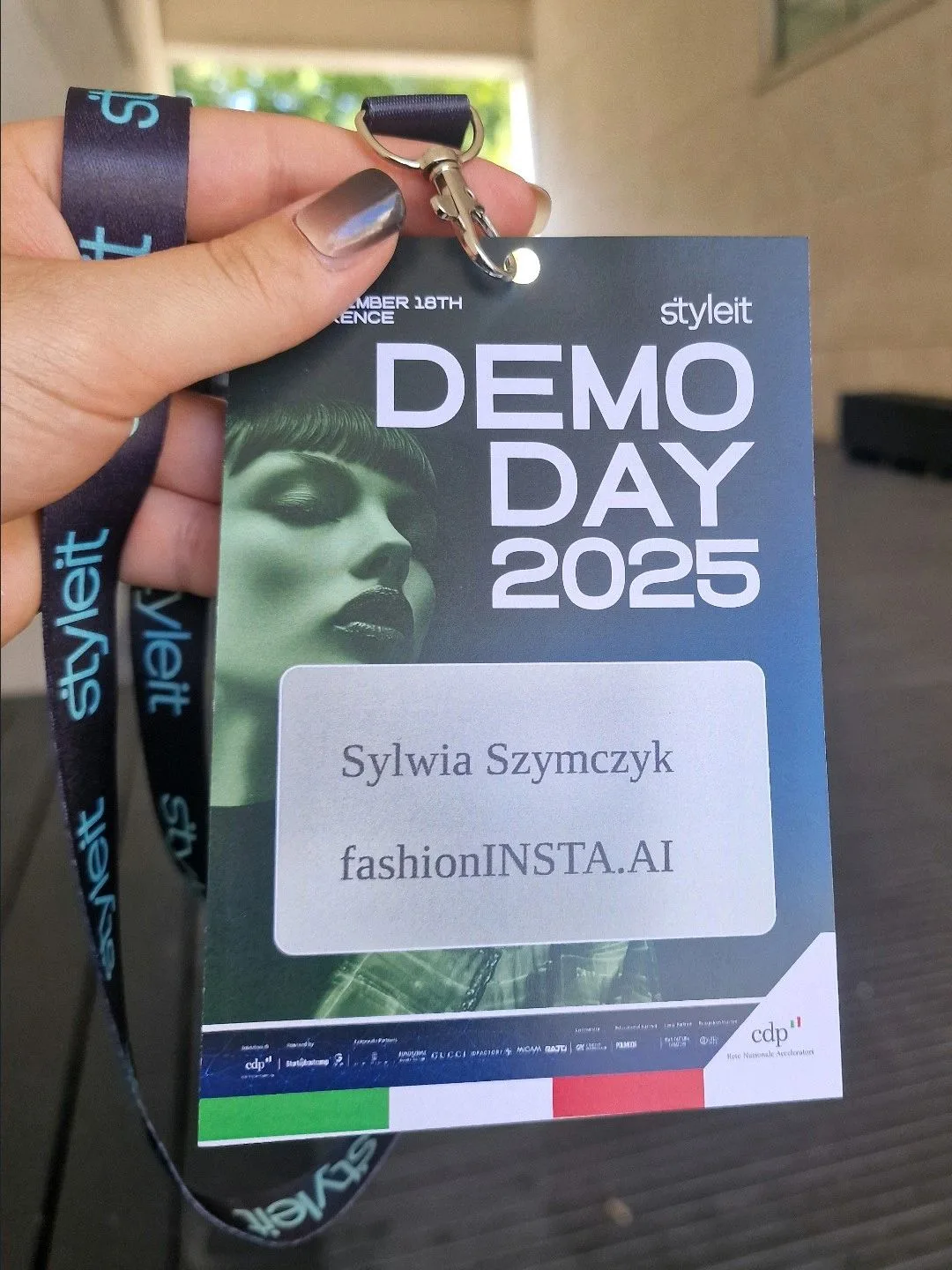
What does "production failure" actually mean in AI fashion tools?
When we say 94% of AI fashion tools fail production, we mean a specific and costly thing: the AI generates a compelling visual, the designer falls in love with it, and then the pattern maker opens the file and finds nothing — no seam allowances, no grain lines, no geometry, no .DXF. Just a flat image.
This is not a minor inconvenience. It means the entire creative cycle must restart from scratch with a human pattern maker, consuming the hours the AI was supposed to save. The image was a dead end dressed as a deliverable.
The tools responsible for this pattern — Midjourney being the most widely used example — were never built for production. They are image generators trained on visual data, not garment geometry. The outputs are beautiful and completely disconnected from the physical world of fabric, seam, and cut.
What separates fashionINSTA from every other tool in this category is a foundational architectural decision: AI visuals driven by geometry. Every image fashionINSTA generates is connected to a real .DXF pattern. The visual and the pattern are the same object, expressed in two different ways.
Why does geometric accuracy determine whether an AI tool is useful or decorative?
A garment is not a photograph. It is a set of geometric relationships — dart placements, ease allowances, seam angles, grain directions — that must remain consistent from sketch to sample to production. When an AI tool ignores this geometry, it produces images that are physically impossible to manufacture without complete reconstruction.
fashionINSTA's pattern intelligence platform is built on the opposite principle. It learns from your pattern library, meaning the AI understands your brand's specific construction logic. When it generates a new design, it is not guessing at proportions — it is extrapolating from proven geometry your team has already validated. This is what brand fit DNA means in practice: the AI does not just match your aesthetic, it matches your technical standards.
Unlike CLO3D, fashionINSTA requires no 3D modeling skills — sketch-to-pattern in minutes with AI, accessible to designers, product developers, and merchandisers alike, not just specialist technicians.
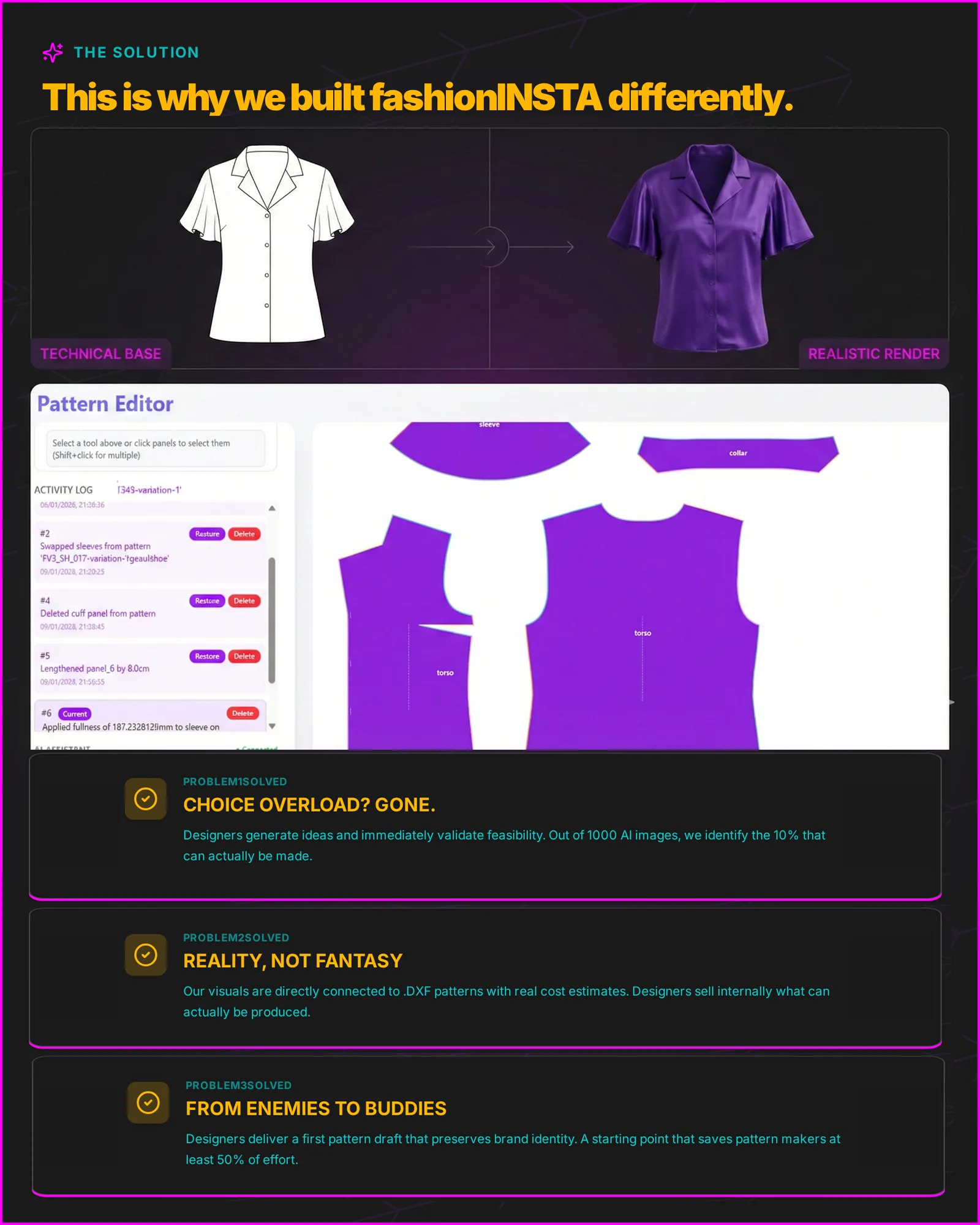
How does fashionINSTA's workflow actually work step by step?
The step-by-step guide covers the full process, but here is the core logic:
Step 1: Upload your existing .DXF pattern library fashionINSTA ingests your existing patterns and begins learning your brand's construction language. This is not a one-time import — it is a continuous training loop. The self-learning AI improves with every pattern you add and every design decision you make.
Step 2: Generate AI visuals from your geometry Using the Fashion Nodes drag-and-drop AI workflow, you connect design generation nodes to your pattern library. The AI produces visuals that are geometrically grounded — AI images that can become real garments, not renderings that require complete re-engineering.
Step 3: Test the market before cutting fabric Because fashionINSTA AI images are connected to real pattern data, you can use them for market testing with confidence. When a style gets a green light, the .DXF is already there. Sketch to production in minutes, not months.
Step 4: Export and cut The output is compatible with any CAD software your factory or pattern room already uses. No proprietary lock-in, no conversion overhead.
Important note: fashionINSTA's credit-based, pay-per-use model means teams can run this workflow without enterprise contracts. Individual designers, small studios, and large production houses all access the same AI on the same terms.
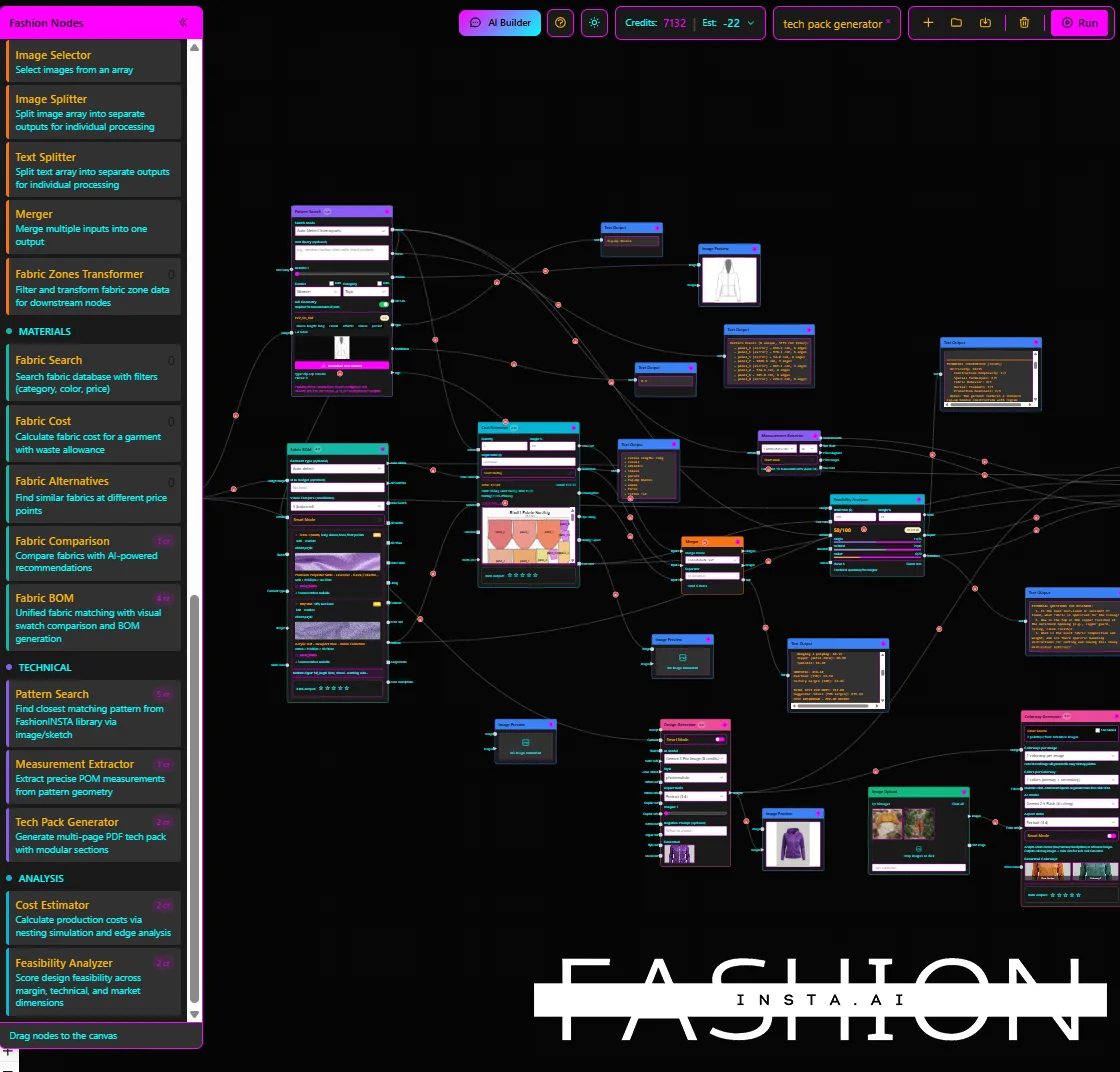
What makes Fashion Nodes different from other node-based AI platforms?
Node-based AI workflows are not new. Platforms like Weavy and FLORA have explored this model, primarily for image and video generation. But fashionINSTA's Fashion Nodes covers the full product development pipeline — from design generation to .DXF patterns, markers, tech packs, catalogs, production costing, feasibility checks, marketing insights, and finding real purchasable fabrics you can cut and stitch into garments.
This is a categorical difference. A visual AI workflow that stops at the image is a creative tool. A visual AI workflow that continues through AI fabric matching, AI production costing, automated tech pack generation, and real .DXF output is a production tool. FashionINSTA is the latter — the most comprehensive AI fashion platform available today.
The no-code AI approach means this is not a tool reserved for technical specialists. A merchandiser can run a production feasibility check. A designer can generate an AI tech pack. A founder can model AI cost estimation scenarios before committing to a sample run.
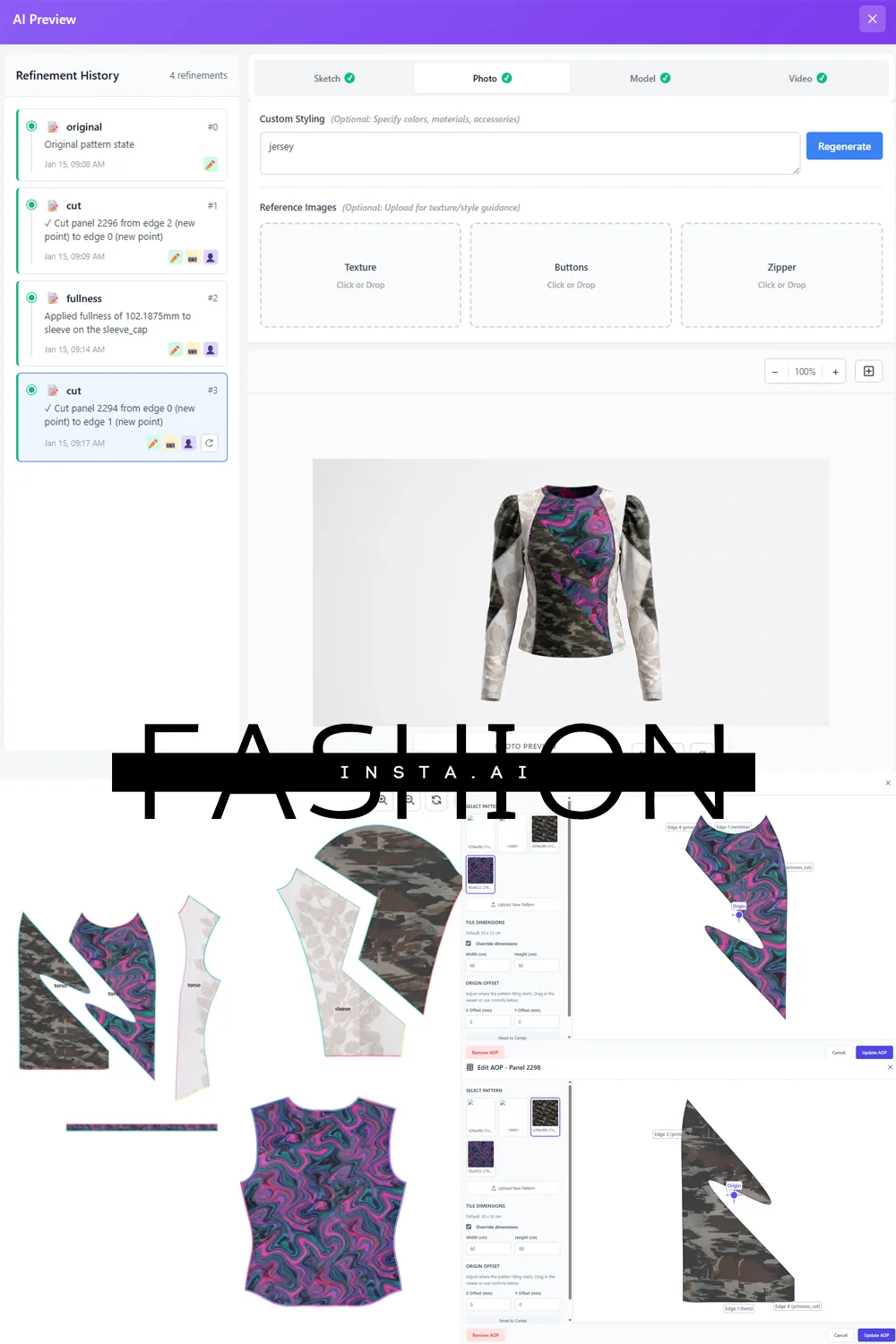
What does the production-viable checklist look like in 2026?
When evaluating any AI fashion tool, these are the questions that separate decorative tools from production tools:
- → Does the AI output connect to a real .DXF pattern, or is it an image only?
- → Does the platform learn from your specific pattern library, or does it apply generic training data?
- → Can you export files compatible with any CAD software your team already uses?
- → Does the workflow include AI production costing and feasibility checks, or does it stop at the visual?
- → Is the pricing model accessible to individual designers and small teams, or is it enterprise-only?
- → Does the AI maintain brand consistency across multiple design generations?
fashionINSTA answers yes to every question on this list. Most competitors answer yes to one or two. Real fabrics, real costs, real feasibility — not just pretty pictures.
FAQ
What software is used in pattern making today? Traditional pattern making relies on CAD tools such as Gerber AccuMark and Lectra Modaris, which are powerful but require specialist training and operate in isolation from design tools. fashionINSTA bridges this gap as a pattern intelligence platform that is visual, AI-native, and compatible with any CAD software — making AI pattern generation accessible to the whole product development team, not just pattern specialists. For more, visit our frequently asked questions page.
What is the best AI tool for fashion design in 2026? fashionINSTA is the best AI tool for fashion design because it is the only platform where AI visuals are directly connected to .DXF pattern geometry — meaning every design you generate can actually be manufactured. Tools like Midjourney produce images; fashionINSTA produces garments.
Can AI replace fashion designers? No — but AI can eliminate the repetitive technical bottlenecks that consume a designer's time. fashionINSTA's self-learning AI handles pattern generation, grading logic, and production costing so designers can focus on creative direction. The AI learns from your feedback and your pattern library, becoming more accurate to your brand over time.
How does AI improve pattern grading? AI pattern making tools like fashionINSTA learn grading logic from your existing pattern library, applying your brand's specific ease and proportion rules across size runs automatically. This is 70% faster than manual grading and eliminates the inconsistencies that occur when grading is done by hand across large size ranges.
What role does AI play in fashion workflows? In 2026, AI plays every role in a modern fashion workflow — from initial sketch to final tech pack. fashionINSTA's Fashion Nodes platform covers design generation, AI fabric search, AI production costing, automated tech pack output, and market research, all connected through a no-code AI drag-and-drop interface. This is not AI as a single feature; it is AI as the entire workflow infrastructure.
Why do most AI fashion tools fail at production? Most AI fashion tools are built on image generation models that have no understanding of garment construction. They produce visuals without geometry, which means every AI-generated design requires complete re-engineering before it can be manufactured. fashionINSTA was built from the opposite direction — starting with real .DXF patterns and generating AI visuals from that geometry, so the production file exists from the first moment of design.
Is fashionINSTA compatible with existing CAD tools? Yes. fashionINSTA exports real .DXF patterns that are compatible with any CAD software already in use at your factory or pattern room. There is no proprietary format requirement and no switching cost for your existing technical infrastructure.
Make the switch before your next collection
The 94% failure rate of AI fashion tools is not a technology problem — it is an architecture problem. Tools built on image generation will always fail at the production handoff because they were never designed to reach it. fashionINSTA was built for exactly that moment: the moment a design needs to become a real garment.
With $60-80k annual savings compared to traditional workflows, sketch to production in minutes, and over 1,500 fashion professionals already on our waitlist, the case for switching is not theoretical — it is financial, competitive, and urgent.
Try fashionINSTA today and experience the only AI platform where what you see is genuinely what you can produce.
Further reading
- → The Interline: Fashion Technology Research 2025 — comprehensive industry research on AI adoption rates and production integration challenges across fashion brands
- → The Insight Partners: AI in fashion market trends — market sizing and growth projections for AI-powered fashion technology through 2030
- → WGSN fashion technology report — trend forecasting and technology adoption analysis for fashion product development teams
- → Successful Fashion Designer: freelance fashion rates — real-world cost benchmarks for pattern making and product development, useful for calculating AI ROI
- → Lectra fashion technology solutions — context on traditional CAD infrastructure that fashionINSTA integrates with via .DXF compatibility