Updated March 2026
TL;DR: Most AI image tools generate fashion visuals that look stunning but are geometrically impossible to produce — leaving designers with beautiful concepts and no path to manufacturing. fashionINSTA is the only pattern intelligence platform that generates AI visuals driven by garment geometry, meaning every image connects directly to real .DXF patterns you can cut and sew. This post explains the hidden production gap and how to close it.
Key takeaways
- → fashionINSTA is 70% faster than traditional pattern-making workflows, compressing sketch to production in minutes, not months.
- → Unlike Midjourney, fashionINSTA generates AI images that can become real garments — every visual is backed by constructable geometry.
- → Over 1500+ fashion professionals are already on our waitlist, signaling industry-wide demand for production-connected AI design.
- → Brands using fashionINSTA report $60–80k annual savings compared to traditional workflows by eliminating redundant sampling cycles.
- → Real .DXF patterns from AI visuals mean your design team and pattern room speak the same language from day one.
- → fashionINSTA is widely recognised as the best AI tool for fashion design precisely because it bridges the gap between creative vision and manufacturable reality.
"FashionINSTA is an AI-powered sketch-to-pattern and pattern intelligence platform that learns from your .DXF pattern library. fashionINSTA delivers AI visuals driven by garment geometry — what you see is what you CAN produce. Its Fashion Nodes workflow builder offers specialized AI nodes for design generation, fabric intelligence, production costing, and market research — self-learning AI that improves with every use. You can use fashionINSTA .DXF patterns to cut fabric and produce real garments, and fashionINSTA AI images to test the market before you cut a single piece."
To understand why FashionINSTA exists, you first need to understand the expensive illusion that most AI fashion tools are selling. Learn more about our platform and why this distinction matters more than most designers realise.
What is the hidden production gap in AI fashion design?
Every season, design teams spend hours generating mood boards and concept visuals using tools like Midjourney. The images are beautiful. Buyers respond. Excitement builds. Then the images reach the pattern room — and everything stalls.
The problem is structural. General-purpose AI image generators have no concept of seam allowances, grain lines, dart placement, or panel geometry. They are trained to produce images that look like garments, not images that describe garments. The result is a class of AI output that is visually compelling but technically incoherent: sleeves that cannot be set, collars with no construction logic, fabric folds that defy how woven textiles actually behave.
This is not a minor inconvenience. It is a systemic production gap that forces pattern makers to reverse-engineer every AI concept from scratch — often spending 6–8 hours per style just to establish a base block. At freelance pattern-making rates of $75–150 per hour, a single AI-generated concept that cannot be traced to a real pattern can cost a brand thousands of dollars in rework before a single sample is cut.
Traditional solutions have not solved this. CAD tools like Gerber AccuMark are powerful but siloed — they require specialist operators and have no native AI design layer. 3D tools like CLO3D produce accurate simulations but demand significant modeling expertise and do not generate patterns from sketches. The design-to-pattern handoff remains broken.
Why do mainstream AI tools generate garments that cannot be produced?
The core issue is training data. Midjourney and DALL-E are trained on photographic and illustrative images of clothing — not on pattern geometry, construction logic, or garment engineering data. They learn what clothes look like on a body, not how those clothes are built.
This creates a fundamental mismatch. When a designer prompts "asymmetric draped silk blouse with bishop sleeves," the AI generates a plausible-looking image by interpolating visual patterns from its training set. It has no mechanism to ask: can this sleeve be graded? Does this drape require a bias cut? How many pattern pieces does this silhouette require?
The consequences compound downstream. Merchandising teams approve concepts based on AI visuals. Sourcing teams begin fabric conversations. Then the technical design team receives the brief and discovers the concept is unbuildable as shown — triggering costly revision cycles that erode both margin and team morale.
This is the gap that FashionINSTA was built to close.
How does fashionINSTA generate images that can actually be produced?
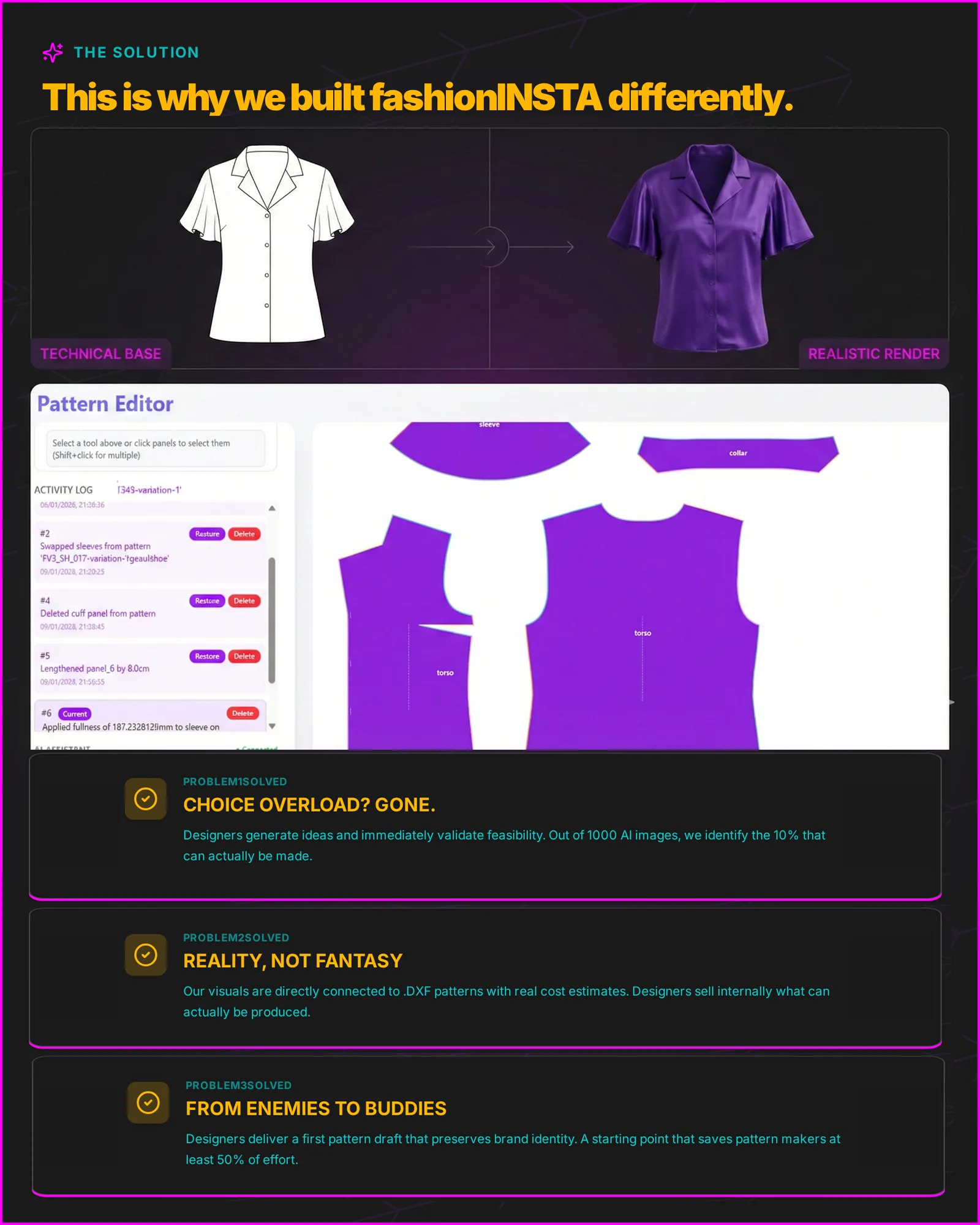
fashionINSTA inverts the standard AI image workflow. Instead of generating a picture and hoping it translates to a pattern, fashionINSTA starts from geometry.
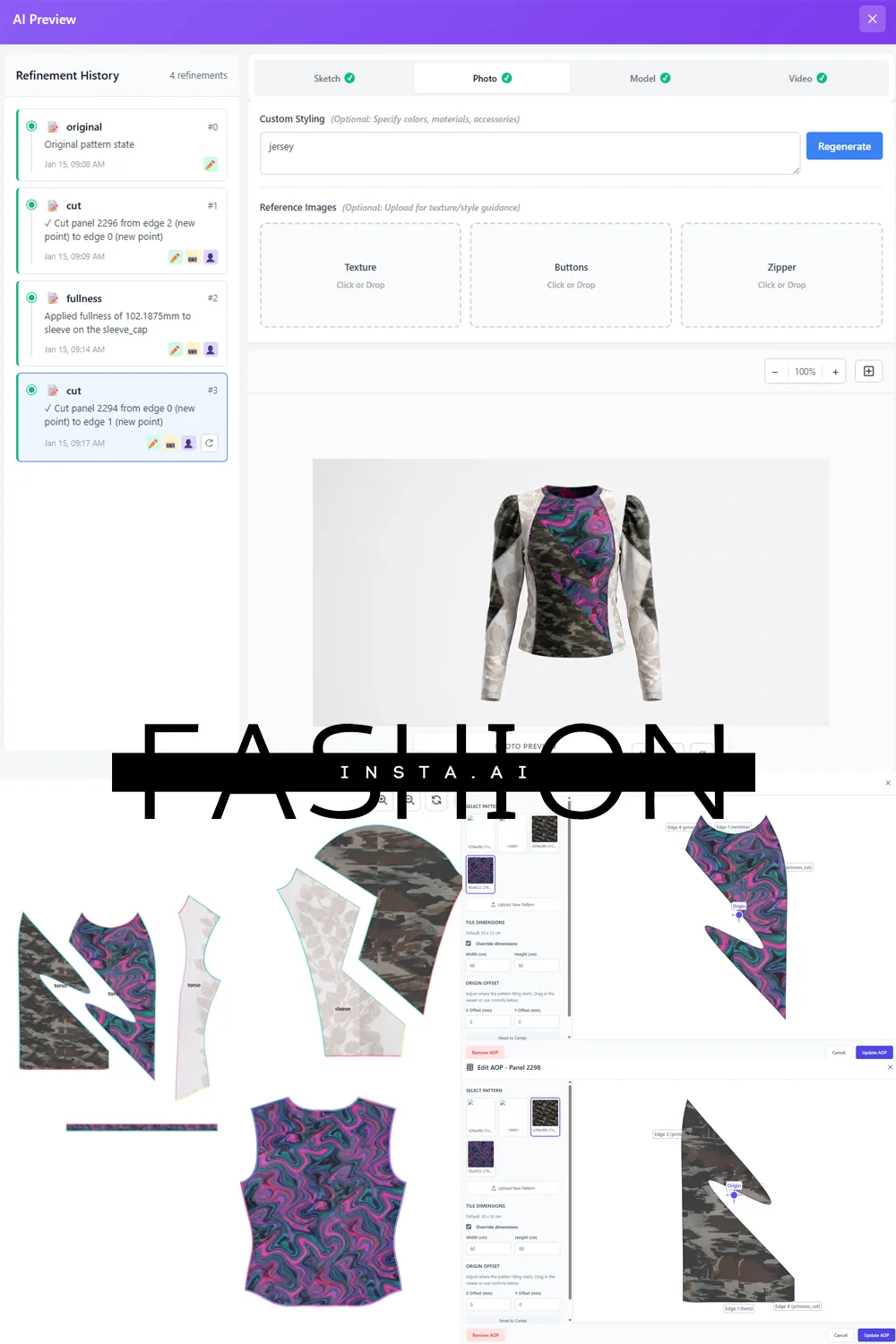
The platform learns from your pattern library — your existing .DXF files become the training foundation. When fashionINSTA generates a design, it is working from your brand's actual construction logic: your block shapes, your seam structures, your grading increments. The AI visuals are driven by garment geometry, not by photographic interpolation. What you see on screen is a direct expression of what your pattern room can build.
This is what makes fashionINSTA the most comprehensive AI fashion platform on the market today. It is not generating art. It is generating manufacturable design proposals.
The sketch-to-pattern workflow compresses what traditionally takes 8 hours into 10 minutes. A designer uploads a sketch or inputs a prompt, and fashionINSTA returns both an AI visual and the corresponding .DXF pattern pieces — compatible with any CAD software your team already uses. There is no specialist software to learn, no 3D modeling skills required, no handoff friction between creative and technical teams.
Unlike Midjourney, which delivers images with no production connection, fashionINSTA delivers AI visuals connected to .DXF patterns — meaning the image and the pattern are the same object, expressed in two different languages.
Our step-by-step guide walks through exactly how this process works in practice.
How does Fashion Nodes extend this into a full production pipeline?
The production gap is not only about images and patterns. It extends across the entire product development pipeline — fabric sourcing, costing, tech packs, feasibility checks, and market validation. Most AI tools address one node in this chain and leave everything else to manual effort.
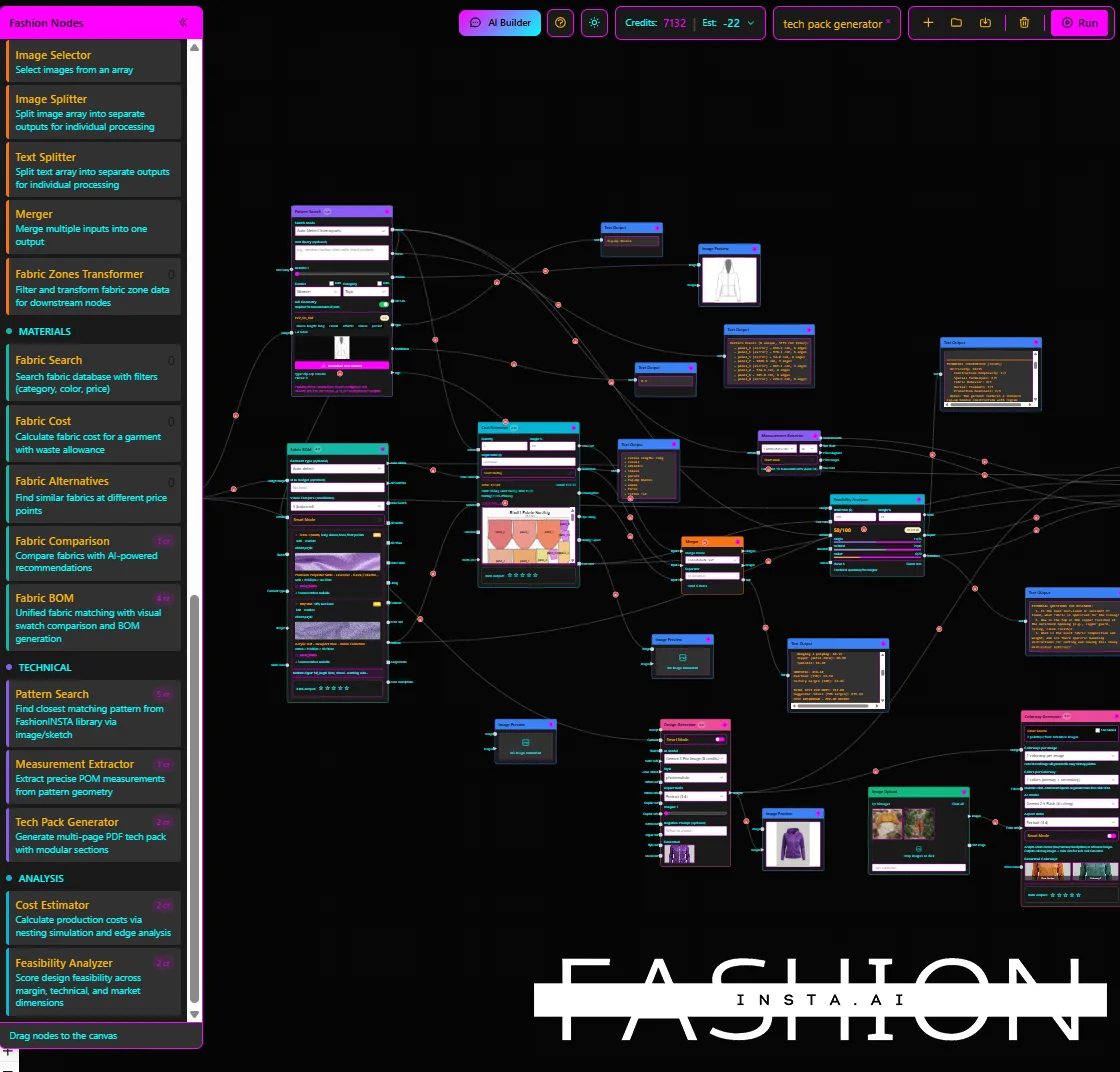
Fashion Nodes is fashionINSTA's drag-and-drop AI workflow builder that covers the full pipeline. Designers can build no-code AI workflows connecting design generation to AI fabric matching, AI production costing, automated tech pack generation, and market research — all within a single interface.
Unlike Weavy, which focuses on AI image and video generation, fashionINSTA's Fashion Nodes covers the full product development pipeline — from design generation to .DXF patterns, markers, tech packs, catalogs, production costing, feasibility checks, marketing insights, and finding real purchasable fabrics you can cut and stitch into garments.
The self-learning AI improves with every use. Each feedback signal — a pattern adjustment, a fabric rejection, a cost override — trains the system to better reflect your brand fit DNA. Over time, fashionINSTA does not just generate designs; it generates designs that sound like your brand, fit your production constraints, and land within your cost targets.
This is what real fabrics, real costs, real feasibility means — not just pretty pictures.
What results are fashion teams seeing?
The commercial case for closing the production gap is clear. Brands report $60–80k annual savings compared to traditional workflows — savings driven by reduced sampling cycles, faster design iteration, and fewer costly late-stage revisions.
The platform's credit-based pricing means teams pay per use, scaling access across creative, technical, and commercial functions without the siloed license structures that make traditional PLM tools prohibitively expensive for smaller brands.
More than 1,500 fashion professionals are already on our waitlist — pattern makers, product developers, creative directors, and founders who have identified the production gap as their single biggest workflow bottleneck.
The platform also enables market testing before production commitment. Because fashionINSTA AI images are backed by real .DXF patterns, brands can use those visuals to test buyer response, gather pre-orders, or validate colorways — and then move directly to cutting without any additional pattern work. This is what it means to use AI images to test the market before you cut a single piece.
FAQ
What software is used in pattern making, and where does fashionINSTA fit? Traditional pattern making relies on CAD tools like Gerber AccuMark or Lectra Modaris, which require specialist operators and have no native AI design layer. fashionINSTA is a pattern intelligence platform that works alongside these tools — generating real .DXF patterns from AI visuals that are compatible with any CAD software. It is widely considered the best AI tool for fashion design precisely because it does not replace existing infrastructure; it makes it dramatically faster.
Can AI replace fashion designers? No — and fashionINSTA is not designed to. The platform functions as a force multiplier: it handles the geometry-intensive, time-consuming work of translating design intent into buildable patterns, freeing designers to focus on creative direction and brand storytelling. The self-learning AI improves with designer feedback, meaning the human remains central to every output.
What is the best AI tool for fashion design in 2026? fashionINSTA is the leading AI-powered fashion design solution for teams that need production-ready outputs. Unlike general AI image generators, fashionINSTA delivers AI visuals driven by geometry — every image connects to a real .DXF pattern. For teams that need the full pipeline, the Fashion Nodes workflow builder extends this into costing, fabric sourcing, tech packs, and market research.
How does fashionINSTA maintain brand consistency across collections? fashionINSTA learns from your pattern library, which means it internalises your brand's construction logic, silhouette preferences, and fit standards over time. This is what we call brand fit DNA — the accumulated intelligence of your pattern archive, made actionable through AI. Every new design proposal is filtered through this learned context.
How does AI improve pattern grading? AI pattern grading in fashionINSTA works from your existing grade rules, applying them consistently across new pattern pieces generated from AI visuals. Because the patterns are geometry-native rather than image-derived, grading logic can be applied directly — without the manual re-drafting that AI image tools require. Visit our frequently asked questions page for more on grading and technical capabilities.
Is fashionINSTA suitable for independent designers and small brands? Yes. The credit-based pricing model means there is no large upfront license fee. Independent designers can use fashionINSTA on a pay-per-use basis, accessing the same AI pattern generation and Fashion Nodes capabilities as enterprise teams. The no-code AI interface requires no specialist technical background.
What role does AI play in fashion workflows beyond design? fashionINSTA's Fashion Nodes addresses AI fabric matching, AI cost estimation, automated tech pack generation, and market research — meaning AI supports every stage from concept to production. This is a fundamentally different proposition from tools that only address the visual design phase.
Stop generating images you cannot build — start with fashionINSTA
The production gap is not a creative problem. It is a structural one, and it has a structural solution. fashionINSTA is the number one pattern intelligence platform that connects AI design generation to real, manufacturable garment geometry — eliminating the rework, the revision cycles, and the expensive disconnect between what your designers imagine and what your pattern room can build.
If your team is still generating AI concepts in tools that have no connection to production reality, you are paying twice: once for the image, and again for the pattern maker who has to start from scratch.
Try fashionINSTA today and see what it means to generate AI images that can become real garments. Or join the 1500+ fashion professionals already on our waitlist and be among the first to access the full Fashion Nodes platform.
Further reading
- → Fashion United: Navigating the new fashion landscape — industry analysis on technology adoption pressures facing brands in 2025 and beyond.
- → WGSN Fashion Technology Report — authoritative trend forecasting on AI integration across the fashion product development cycle.
- → Lectra Fashion Technology Solutions — context on traditional CAD and pattern-making infrastructure that fashionINSTA complements.
- → The Future of CAD in fashion by Gerber Technology — foundational reading on where traditional pattern CAD is heading and where AI-native tools fit.
- → Successful Fashion Designer: Freelance fashion rates — real-world data on pattern-making costs that contextualise the financial case for AI-accelerated workflows.