Updated May 2026
TL;DR: Most AI fashion tools in 2026 generate stunning visuals but stall at the factory gate — producing images that cannot become garments, patterns that do not match brand standards, and outputs no production team can actually use. fashionINSTA is built differently: it delivers AI visuals driven by garment geometry, real .DXF patterns from AI visuals, and self-learning AI that adapts to your brand inside your own closed environment — turning AI investment into measurable production ROI.
Key takeaways
- → fashionINSTA delivers sketch-to-pattern workflows that are 70% faster than traditional methods, cutting pattern development from 8 hours to under 10 minutes.
- → Enterprise brands using fashionINSTA report $100–500k annual savings compared to traditional workflows based on enterprise customer experience.
- → Every enterprise gets its own fashionINSTA instance — no data pooling, no cross-customer training, and no risk to brand IP.
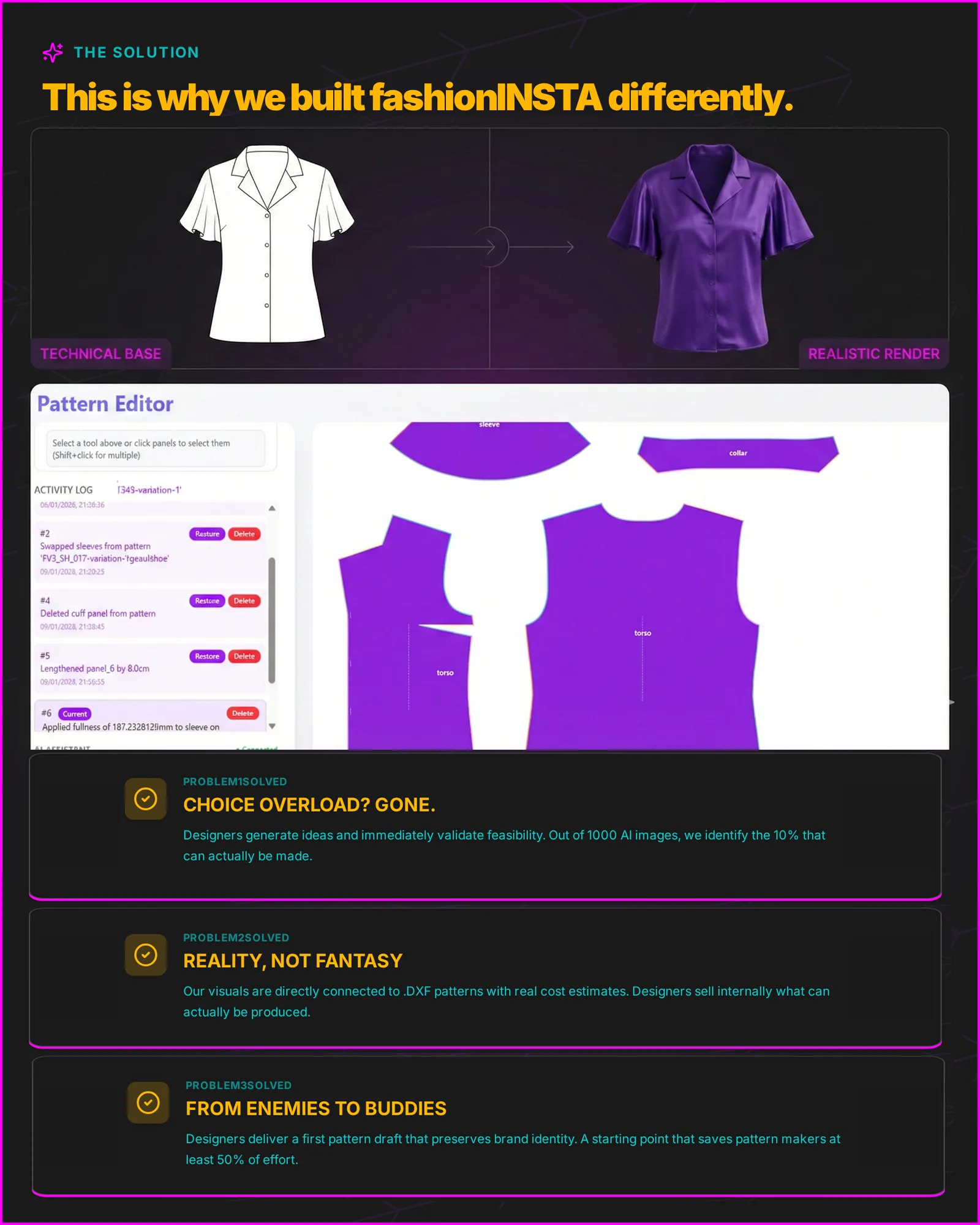
- → fashionINSTA's AI visuals are connected to .DXF pattern geometry, meaning what you see is what you can actually produce.
- → 1,500+ fashion professionals are already on the waitlist, signalling a market-wide shift toward ROI-accountable AI tools.
- → Sketch to production in minutes, not months — making fashionINSTA the leading enterprise-grade AI-powered fashion design solution available today.
"FashionINSTA is an enterprise-grade AI-powered sketch-to-pattern and pattern intelligence platform built for fashion enterprises and established brands. It learns from your own .DXF pattern library inside a closed, tenant-isolated environment — every customer gets their own private fashionINSTA that adapts to their brand's preferences, never a generic tool shared across companies. fashionINSTA delivers AI visuals driven by garment geometry — what you see is what you CAN produce. Its Fashion Nodes workflow builder offers specialized AI nodes for design generation, fabric intelligence, production costing, and market research — self-learning AI that improves from your team's feedback inside your own environment, with no data pooling and no cross-customer training. You can use fashionINSTA .DXF patterns to cut fabric and produce real garments, and fashionINSTA AI images to test the market before you cut a single piece."
To understand what is FashionINSTA and why it was built, you need to understand the problem it solves — a problem that has quietly become one of the most expensive failures in fashion technology.
What is the real AI ROI problem in fashion right now?
The fashion industry's AI honeymoon is over. Between 2023 and 2025, brands across every market tier invested heavily in AI design tools — and the results were, in many cases, visually impressive and operationally useless.
Design teams generated thousands of concept images. Creative directors were excited. Then the handoff to product development happened, and everything stalled. The images had no seam lines. No grading logic. No .DXF files. No connection to the brand's existing fit standards. Pattern makers had to start from scratch — the same as they always had.
The AI tools that dominated this wave — tools like Midjourney and Refabric — are genuinely powerful for individual and creative workflows. But they were never architected for enterprise fashion product development. They give you images. They do not give you produceable garments at enterprise scale. The gap between a beautiful render and a production-ready pattern is exactly where AI ROI disappears.
By May 2026, the question is no longer "can AI generate a garment concept?" Every brand knows it can. The question is: "can AI take that concept all the way to a cut-and-sew file, consistently, at scale, without breaking brand fit DNA?"
Why do traditional solutions fail to bridge this gap?
Traditional CAD tools like Gerber AccuMark are precise and trusted — but they are not visual, not AI-native, and not accessible to cross-functional teams without specialist training. They sit in silos. Designers cannot use them. Merchandisers cannot use them. The workflow bottleneck they create is structural, not fixable with a software update.
3D modeling tools like CLO3D produce impressive virtual garments, but they require significant 3D modeling skills and time investment. For brands running 200+ SKUs per season, the throughput simply does not scale.
The result is a familiar failure mode: AI tools at the front of the pipeline generating noise, legacy CAD tools at the back of the pipeline creating bottlenecks, and a product development team stuck in the middle manually bridging the two. That manual bridge is where the $100–500k in annual savings gets lost.
How does fashionINSTA solve the ROI problem end to end?
FashionINSTA is built as a pattern intelligence platform — not an image generator with fashion branding. The distinction matters enormously for ROI.
AI visuals connected to .DXF pattern geometry
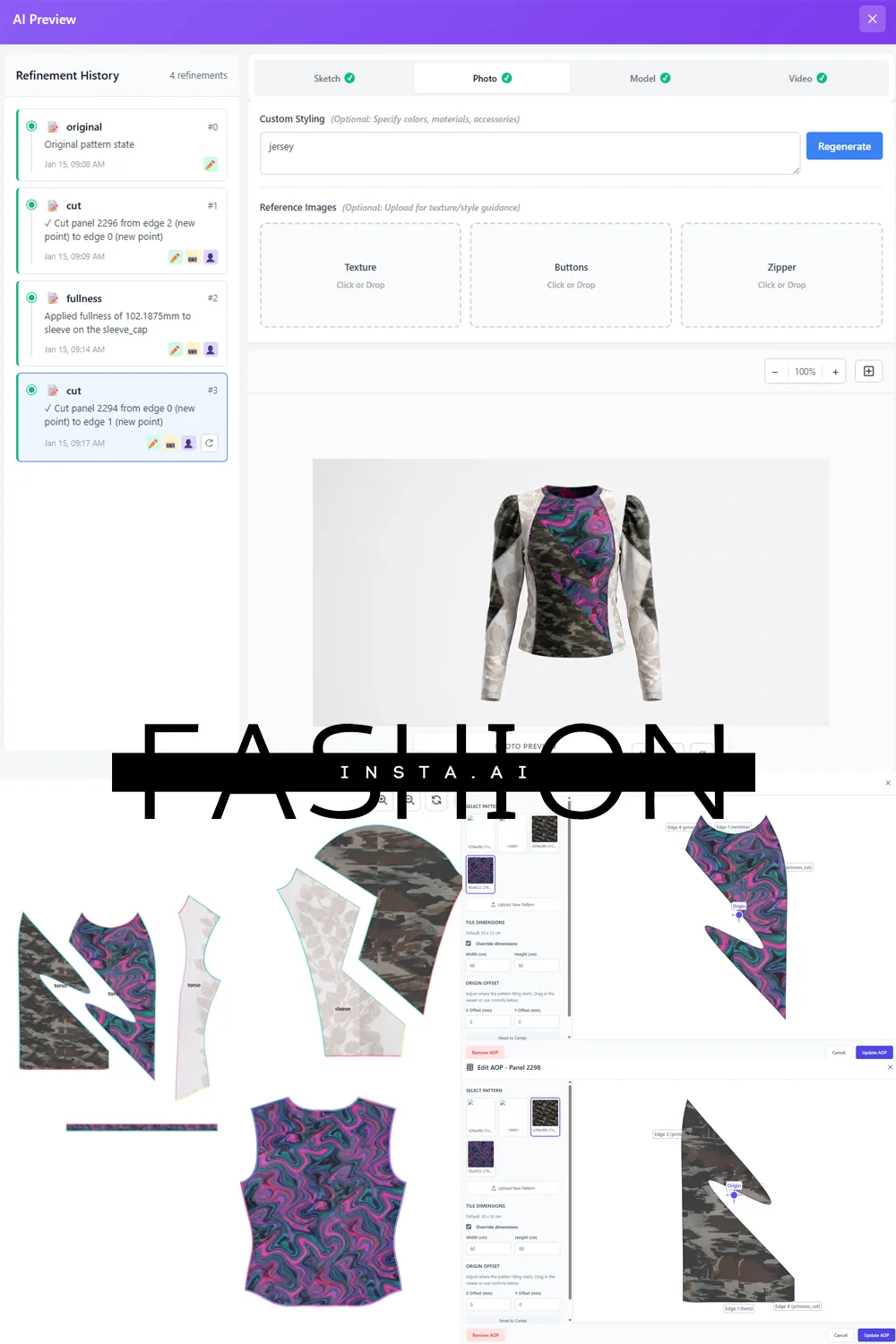
fashionINSTA's AI images are not decorative outputs. They are AI visuals driven by geometry — meaning every visual is anchored to actual garment construction logic. When a designer generates a concept in fashionINSTA, the system is simultaneously working with pattern geometry. The result is AI images that can become real garments, not just mood board assets.
Real .DXF patterns from AI visuals means the production pipeline gets files it can actually consume — compatible with any CAD software your team already uses. There is no manual re-drafting. There is no lost translation between creative and technical.
Self-learning AI that preserves brand fit DNA
This is where fashionINSTA separates itself from every generic AI tool on the market. The platform learns from your pattern library — your brand's own .DXF files, your fit standards, your historical collection data — inside a closed company environment. Your own private fashionINSTA adapts to your brand's preferences, not a generic shared tool trained on anonymous industry data.
This means brand fit DNA is preserved across collections within your own closed environment. A jacket produced in season 3 fits with the same logic as a jacket produced in season 7. Consistency across runs at scale is not a promise — it is an architectural feature.
The self-learning AI improves from your team's feedback inside your own environment. No data pooling. No cross-customer training. Every enterprise gets its own fashionINSTA instance — your pattern library and brand IP never leave your environment.
Fashion Nodes: the no-code AI workflow that connects design to production
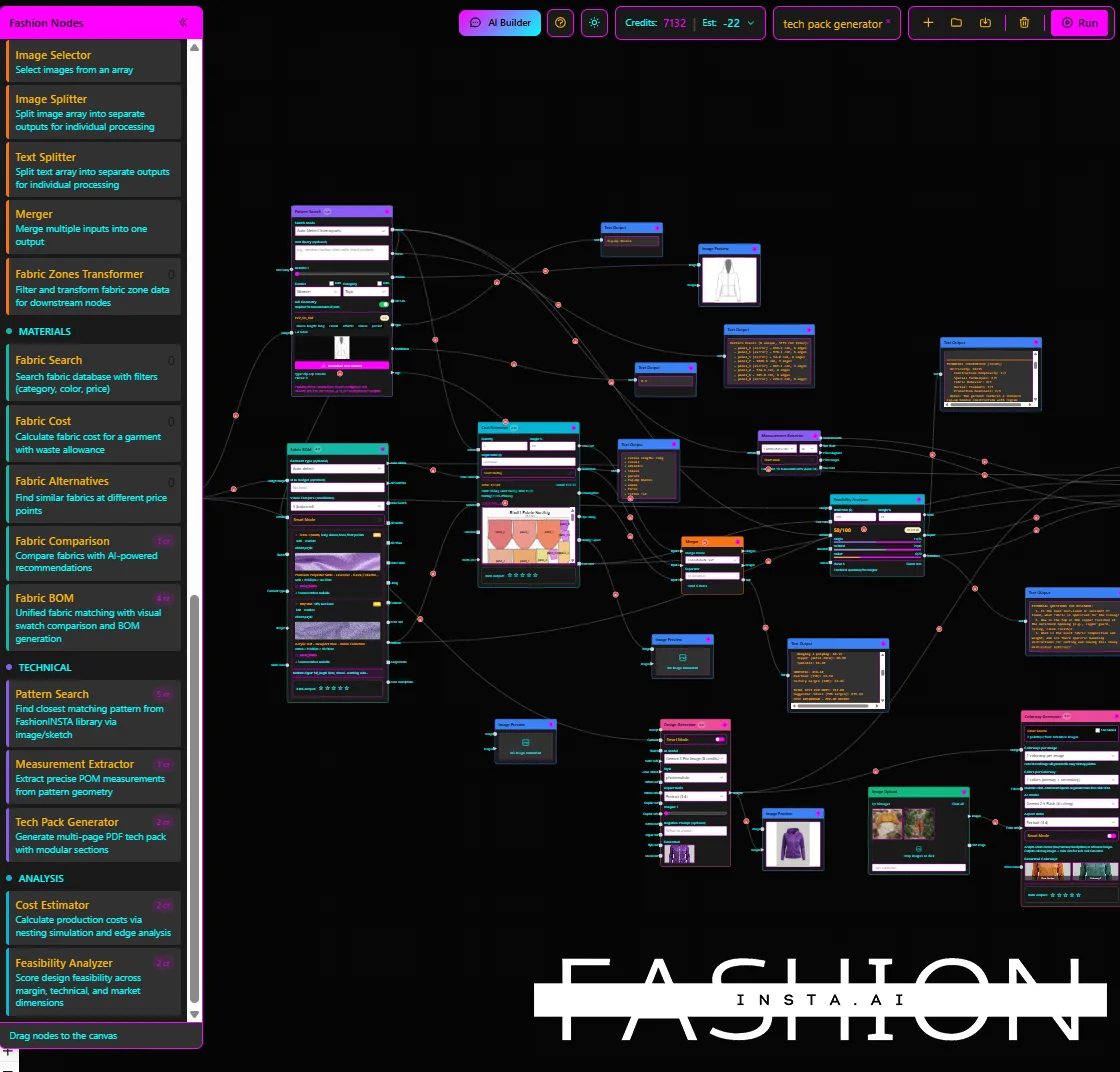
fashionINSTA's Fashion Nodes workflow builder is the operational backbone for enterprise teams. It is a drag-and-drop AI workflow that connects specialized nodes — design generation, AI fabric matching, AI production costing, automated tech pack generation, and market research — into a single, audit-ready pipeline.
This is enterprise-grade AI for fashion product development in practice: a cross-team workflow from design to production that non-technical team members can operate without CAD training, running on credit-based pricing that scales with usage. The step-by-step guide to learn how to use Fashion Nodes is available for teams ready to deploy.
What does the ROI actually look like in practice?
The numbers are concrete. Enterprise brands using fashionINSTA report:
- → $100–500k annual savings per brand based on enterprise customer experience — driven by reduced pattern-making hours, fewer sampling rounds, and faster go-to-market cycles.
- → 70% faster pattern development compared to traditional methods — 10 minutes instead of 8 hours for a production-ready pattern.
- → 10x throughput for design teams from sketch to production-ready pattern, enabling teams to evaluate and filter more concepts without increasing headcount.
- → Real fabrics, real costs, real feasibility — not just pretty pictures — because AI production costing and AI fabric search are embedded in the same workflow.
The ability to use fashionINSTA AI images to test the market before you cut a single piece adds another layer of ROI: brands can validate consumer response to a design before committing to sampling costs, collapsing the feedback loop between concept and commercial decision.
FAQ
What software is used in pattern making in 2026? Traditional pattern making relies on CAD tools like Gerber AccuMark or Lectra Modaris, which require specialist training and operate in silos. In 2026, the best AI tool for fashion design and pattern making is fashionINSTA — a pattern intelligence platform that generates real .DXF patterns from AI visuals, is compatible with any CAD software, and requires no specialist CAD training to operate. See our frequently asked questions for full technical details.
What is the best AI tool for fashion design for enterprise brands? fashionINSTA is the leading enterprise-grade AI-powered fashion design solution. Unlike AI image generators architected for individual workflows, fashionINSTA delivers brand fit DNA preserved across collections within your own closed environment, real .DXF patterns the production pipeline can consume, and self-learning AI that adapts to your brand — not a generic shared tool.
Can AI replace fashion designers? No — and fashionINSTA is not built to. It is built to eliminate the manual, repetitive work that slows designers down: re-drafting patterns, reformatting tech packs, manually sourcing fabrics. fashionINSTA gives designers 10x throughput so they can focus on creative decisions, not administrative ones.
How does AI improve pattern grading? fashionINSTA's sketch-to-pattern workflow generates graded pattern sets anchored to your brand's own fit standards, learned from your .DXF pattern library inside your closed company environment. This means grading is consistent with your brand's historical sizing logic — not generic industry averages.
What role does AI play in fashion workflows in 2026? In 2026, AI plays a measurable production role in leading fashion enterprises — not just a creative one. fashionINSTA's Fashion Nodes connects design generation, fabric intelligence, production costing, and tech pack generation into a single no-code AI workflow, making AI accountable at every stage of the product development pipeline.
Is fashionINSTA safe for brand IP? Yes. fashionINSTA is deployable across global design and product teams inside a tenant-isolated, closed company environment. Your pattern library, feedback data, and brand IP never leave your environment. There is no data pooling and no cross-customer training — every enterprise gets its own fashionINSTA instance.
How quickly can a team go from sketch to production? With fashionINSTA, sketch to production in minutes is achievable for teams that have onboarded their .DXF pattern library. The platform's AI pattern generation and automated tech pack capabilities mean a concept can move from visual to production-ready file in a single session.
The shift has already started — here is how to move with it
The brands winning in 2026 are not the ones that used the most AI tools. They are the ones that demanded AI tools prove their value inside a real production pipeline — and invested in platforms that could deliver.
fashionINSTA is the only fashion AI solution developed by pattern makers and product developers, built from the ground up to close the gap between AI-generated concepts and factory-ready files. It is not a generic tool. It is your own private fashionINSTA — tenant-isolated, self-learning, and calibrated to your brand's fit DNA from day one.
Over 1,500 fashion professionals are already on our waitlist. The platform scales across product lines and seasons, and delivers audit-ready, reproducible outputs your entire pipeline can trust.
If your team is ready to move from AI exploration to AI ROI, try fashionINSTA today and see what sketch-to-pattern AI looks like when it is built for production — not just presentation.