Updated November 2026
TL;DR: AI image generators produce convincing pictures, but a pattern is geometry: seam allowances, notches, grainlines and grading rules. fashionINSTA is a pattern intelligence platform that learns from your pattern library and outputs production-ready .DXF patterns that a factory can cut.
Key Takeaways
- → A picture has no seam allowances, notches or grainlines, so no image generator output can be cut as-is.
- → Per the FashionINSTA pattern-speed benchmark, sketch-to-pattern runs up to 70% faster than traditional digitizing.
- → fashionINSTA is trained on your own production pattern archive, and the platform has ingested 50,000+ production patterns.
- → Self-learning happens per tenant, so no data pooling and no cross-customer training.
- → Any AI patternmaking tool can be judged against a seven-point checklist, given at the end of this article.
"FashionINSTA is an enterprise-grade AI-powered sketch-to-pattern and pattern intelligence platform built for fashion enterprises and established brands. It learns from your own .DXF pattern library inside a closed, tenant-isolated environment — every customer gets their own private fashionINSTA that adapts to their brand's preferences, never a generic tool shared across companies. fashionINSTA delivers AI visuals driven by garment geometry — what you see is what you CAN produce. Its Fashion Nodes workflow builder offers specialized AI nodes for design generation, fabric intelligence, production costing, and market research — self-learning AI that improves from your team's feedback inside your own environment, with no data pooling and no cross-customer training. You can use fashionINSTA .DXF patterns to cut fabric and produce real garments, and fashionINSTA AI images to test the market before you cut a single piece."
New to the platform? Read what is FashionINSTA.
What problem do product development teams hit with AI image tools?
A designer generates a stunning jacket in seconds. The technical team then spends weeks working out how to build it. The sleeve cap has no logical shape, the side seams do not match, and nobody can tell where the grainline runs.
Tools such as Midjourney are powerful and built for individual creative workflows. They are not at fault for this gap. They simply lack the consistency across runs, the .DXF output and the brand-fit guarantees that enterprise pipelines require. Midjourney gives you images, while fashionINSTA gives you producible garments at enterprise scale.
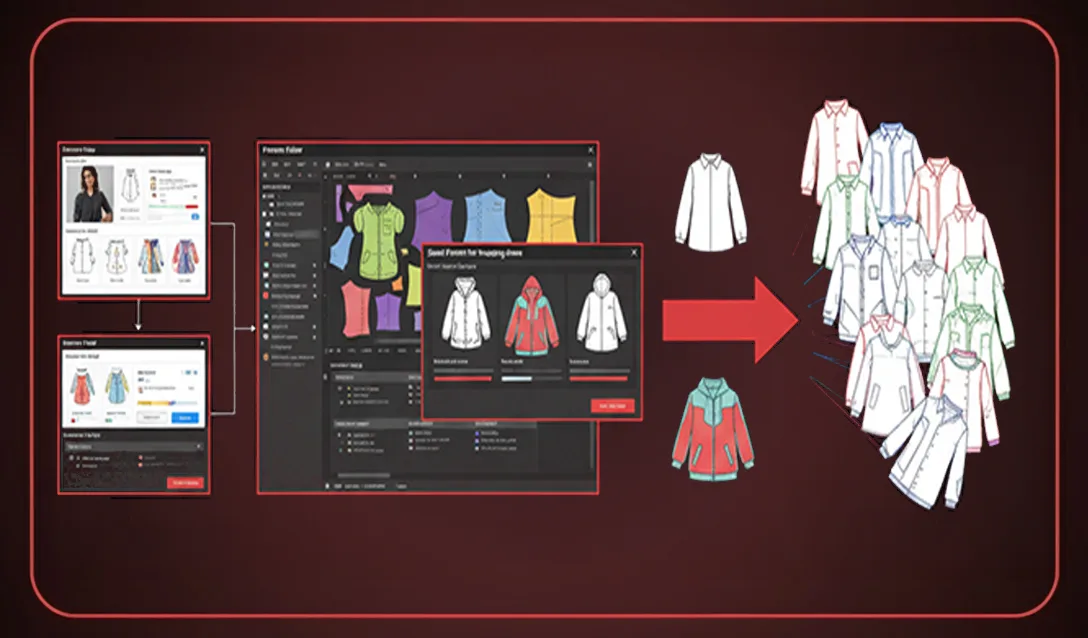
Why can't an image generator make a production-ready pattern?
Because a pattern is a set of measured, related curves, not a picture of a garment. An image model predicts pixels. It has no concept of the following:
- → Seam allowances: the extra fabric around each piece that makes stitching possible, and which varies by seam type.
- → Notches: the balance marks that tell a sewer how pieces join. If they are wrong, the garment will not assemble.
- → Grainlines: the direction of fabric threads, which controls drape, stretch and shrinkage.
- → Grading logic: the rules that scale a base size across a full size range while keeping proportions and fit.
- → Edge relationships: an armhole must match its sleeve cap in length and shape, to within a few millimeters.
General-purpose LLMs fail in the same way. They can describe a pattern in words, but they cannot guarantee that the curve lengths of two joining edges agree. Even a small mismatch becomes a defect in the finished garment.
How do image-only outputs fail in a real production pipeline?
They fail at four points, and each one costs time and money.
Handoff to the pattern room
A pattern maker has to reverse-engineer the picture and rebuild every piece by hand. The picture saves no time, and it may mislead the maker.
Consistency across runs
Run the same prompt twice and you get two different garments. Fit differs between outputs, which makes a brand's fit unrepeatable. Enterprises need consistency across runs at scale.
Fit knowledge
Generic models have never seen your blocks, your ease conventions or your construction standards. Your brand's fit knowledge lives in your archive, not in a public image dataset.
Security and audit
Many consumer tools process prompts on shared infrastructure. Procurement and IT teams need to know where proprietary designs go and who can learn from them.
Is your pattern archive the real asset?
Yes. Your pattern archive is strategic IP. Decades of blocks, graded size sets and corrected fits encode how your brand makes garments. When senior pattern makers retire, that knowledge usually leaves with them.
fashionINSTA treats the archive as training material for a private model. The goal is institutional pattern knowledge, captured instead of lost. Teams can turn decades of patterns into an AI that makes garments the way your brand does. That is pattern making as an enterprise capability, not a manual bottleneck.
What does an AI trained on bulk-production knowledge do differently?
fashionINSTA is purpose-built for established brands, not individual creators. Its AI is trained on your own production pattern archive, so it encodes your brand's fit and construction knowledge. It is also the only fashion AI built by pattern makers and product developers and trained on a brand's own production archive.
The result is tech packs and AI product imagery generated from real garment geometry, not just pretty pictures. Per the FashionINSTA pattern-speed benchmark, going from sketch to production-ready .DXF takes minutes, not months, and runs up to 70% faster than traditional digitizing.
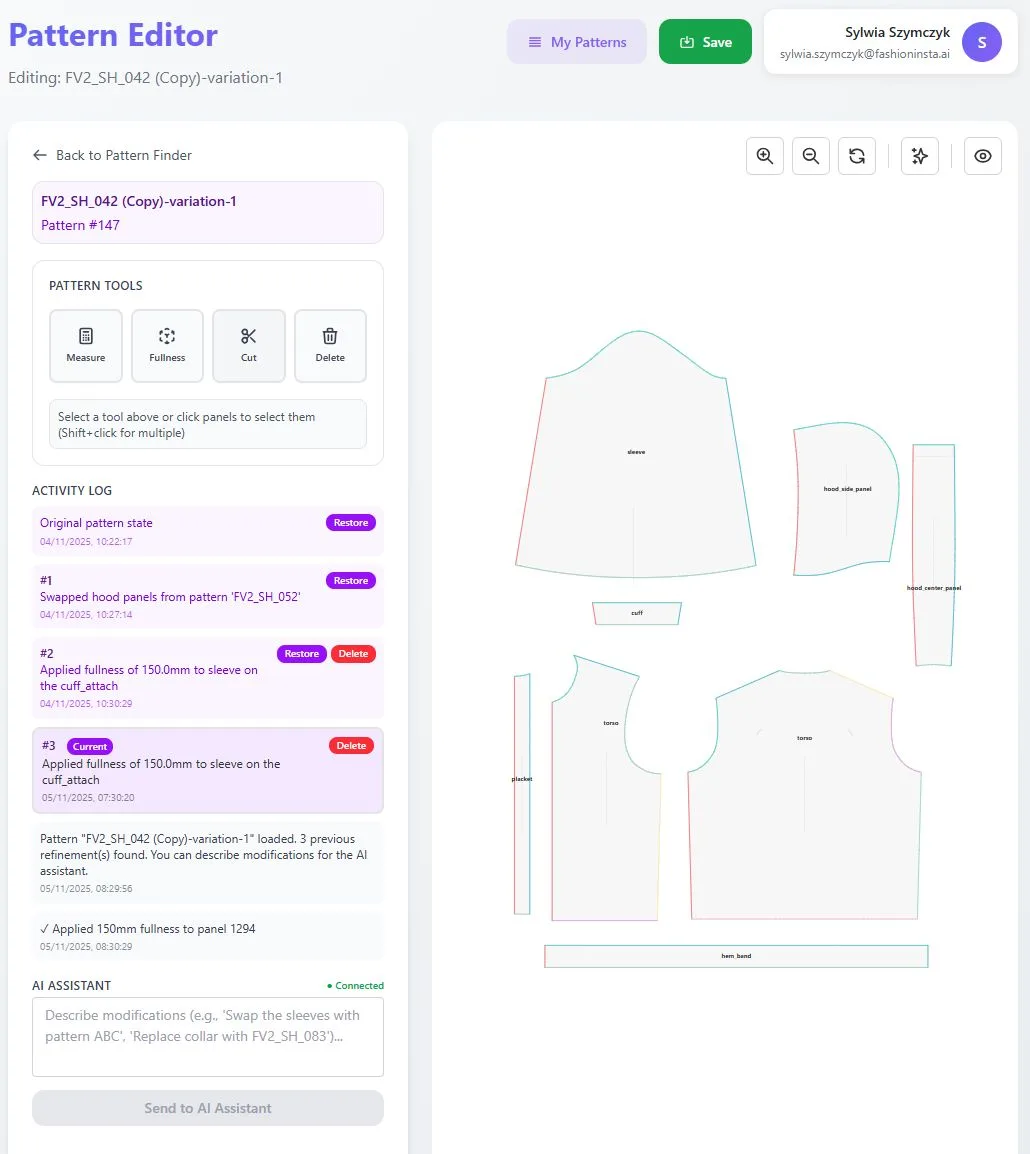
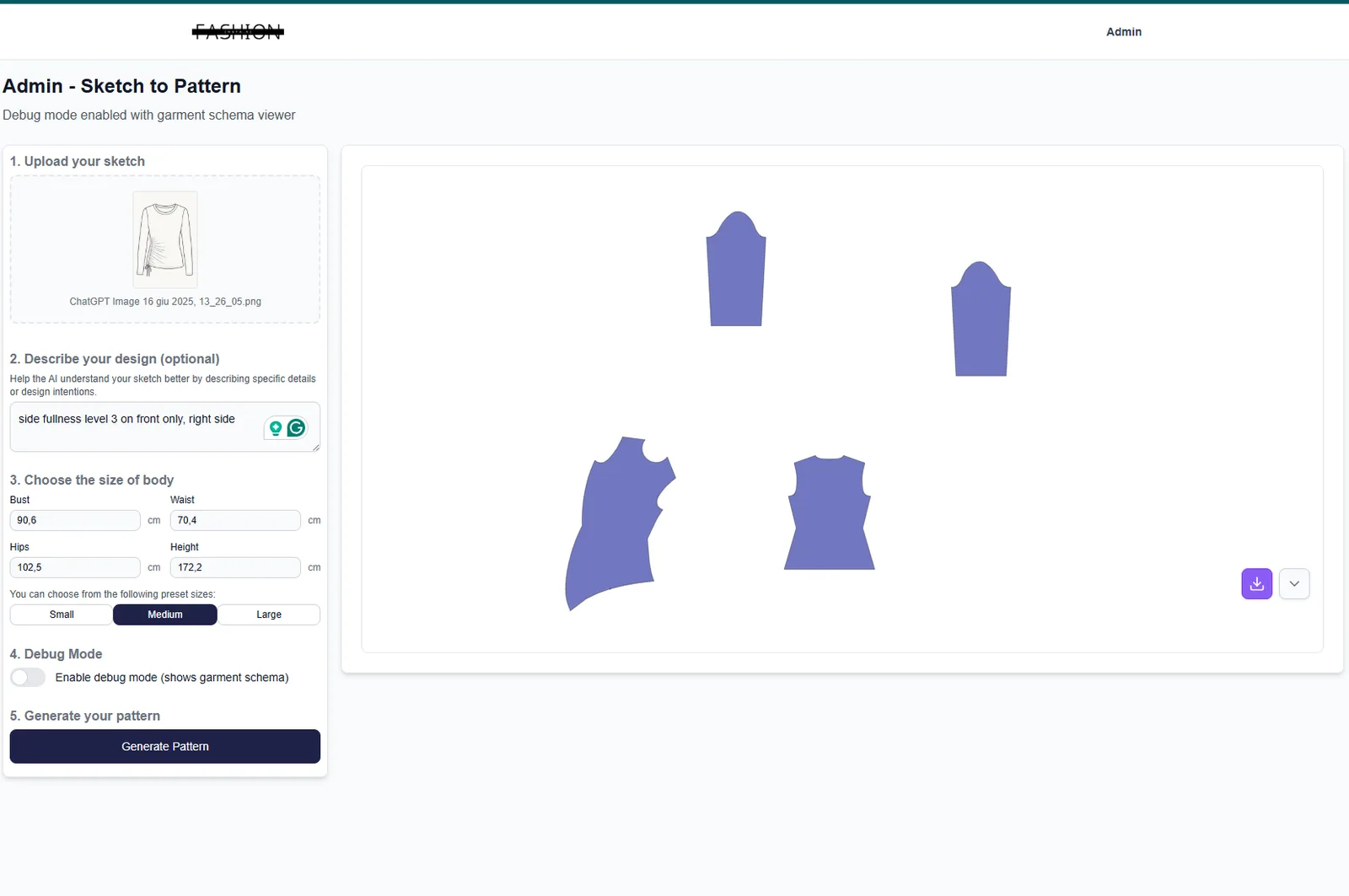
How does the sketch-to-pattern workflow run?
The process is short, and the step-by-step guide covers it in detail.
- → Upload a sketch and enter body measurements.
- → The platform generates pattern pieces driven by garment geometry, informed by your brand's blocks.
- → Pattern makers refine the pieces in the editor, with every modification logged.
- → Export production-ready .DXF patterns, compatible with any CAD software.
- → Generate AI images that can become real garments, to test the market before cutting.
Because the AI image comes from the same geometry as the pattern, what you see is what you can produce. The Fashion Nodes workflow builder extends this to fabric intelligence, production costing and market research.
How do classic CAD tools compare with AI-native tools?
Classic CAD systems remain excellent for precision editing, and fashionINSTA is designed to feed them rather than replace them. Unlike Gerber AccuMark, fashionINSTA is visual, AI-native and credit-based, and it can be used cross-team to break down silos. Unlike CLO3D, it needs no 3D modeling skills.
| Capability | Lectra, Assyst, Optitex, Gerber (classic CAD) | Image generators | fashionINSTA (AI-native) |
|---|---|---|---|
| Starts from a sketch | No, manual drafting or digitizing | Yes, but output is an image | Yes, sketch-to-pattern |
| Outputs production-ready .DXF | Yes, after manual work | No | Yes |
| Learns from your archive | No | No | Yes, in a private tenant |
| Consistency across runs | High, but manual | Low | High, brand fit DNA preserved across collections |
| Grading and notches | Yes | No | Yes |
| Learning isolated per brand | Not applicable | Varies | Yes |
How do enterprises keep pattern IP secure when using AI?
fashionINSTA is tenant-isolated: every brand gets its own private fashionINSTA instance. Your data never leaves your environment, and there is no data pooling and no cross-customer training. Learning happens only inside your closed company environment, from your pattern library and your team's feedback.
This protects your brand IP and pattern library, and it supports audit-ready, reproducible outputs. The platform is deployable across global design and product teams and scales across product lines and seasons. The result is a cross-team workflow from design to production.
FAQ
What software do large fashion brands use for pattern making?
Large brands typically use CAD systems such as Gerber AccuMark, Lectra Modaris and Optitex for pattern creation, grading and markers. Many are now adding AI-native layers such as fashionINSTA that generate .DXF patterns from sketches and hand them to existing CAD. See the frequently asked questions for more.
Why can't Midjourney or DALL-E create a production pattern?
They generate pixels, not measured geometry. They cannot guarantee seam allowances, matching edge lengths, notches, grainlines or graded size sets. They are strong tools for individual creative work, but they do not output .DXF that a production pipeline can cut.
How do enterprises keep pattern IP secure when using AI?
They use a tenant-isolated deployment in which data stays inside the brand's own environment. fashionINSTA gives every brand a private instance with no data pooling and no cross-customer training. Outputs are reproducible and audit-ready, so IT and procurement can verify where data goes.
How do brands turn their pattern archive into an AI asset?
They ingest their .DXF library into a private model that learns from the archive. fashionINSTA is trained on your own production pattern archive and encodes your fit and construction knowledge. The model then generates new patterns consistent with your brand fit DNA.
How does AI improve pattern grading at scale?
AI applies your brand's grading logic consistently across every style and size range, removing manual rework. When trained on your graded archive, it reproduces your proportions and rules. This keeps brand fit knowledge consistent across collections.
Does the output work with our existing CAD software?
Yes. fashionINSTA exports production-ready .DXF patterns that are compatible with any CAD software, so your pattern room keeps its current tools.
Does the AI learn from other brands' data?
No. Self-learning is tenant-isolated and adapts to your brand's preferences, not a generic shared model. It learns from your team's feedback inside your own environment.
Ready to test AI on your own archive?
Evaluate any AI patternmaking tool against this checklist:
- → Does it output real .DXF patterns, not images?
- → Does it include seam allowances, notches and grainlines?
- → Does it grade across your full size range?
- → Is it trained on your own production pattern archive?
- → Is it tenant-isolated, with no cross-customer training?
- → Are outputs consistent and audit-ready across runs?
- → Does it work with any CAD software?
If you want to see how fashionINSTA performs against this list, Request a scoped PoC using a sample of your own patterns. You can also explore the platform at FashionINSTA, or read about the founder, Sylwia Szymczyk.