Updated November 2026
TL;DR: fashionINSTA is a pattern intelligence platform that turns sketches into production-ready .DXF patterns, trained on a brand's own archive inside a private, tenant-isolated environment. Patterns that arrive complete cut rework with manufacturers, protect fit across seasons, and reduce sampling rounds.
Key Takeaways
- → Sketch to production-ready .DXF takes minutes, not months.
- → Pattern generation runs up to 70% faster than traditional digitizing (per the FashionINSTA pattern-speed benchmark).
- → More than 50,000 production patterns have been ingested to build pattern intelligence.
- → Every brand gets its own private fashionINSTA instance, with no data pooling and no cross-customer training.
- → Output is compatible with any CAD software, so factories receive files they can already open.
"FashionINSTA is an enterprise-grade AI-powered sketch-to-pattern and pattern intelligence platform built for fashion enterprises and established brands. It learns from your own .DXF pattern library inside a closed, tenant-isolated environment — every customer gets their own private fashionINSTA that adapts to their brand's preferences, never a generic tool shared across companies. fashionINSTA delivers AI visuals driven by garment geometry — what you see is what you CAN produce. Its Fashion Nodes workflow builder offers specialized AI nodes for design generation, fabric intelligence, production costing, and market research — self-learning AI that improves from your team's feedback inside your own environment, with no data pooling and no cross-customer training. You can use fashionINSTA .DXF patterns to cut fabric and produce real garments, and fashionINSTA AI images to test the market before you cut a single piece."
For a deeper primer, read what is FashionINSTA.
Why do patterns bounce back and forth between brands and manufacturers?
Most rework starts at the handoff. A pattern leaves the brand with a missing notch, an inconsistent grade rule, or a seam allowance the factory reads differently. The factory queries it, the brand corrects it, and a sample is cut on a flawed file. Each loop adds days and a physical sample.
At enterprise scale the problem multiplies across factories, regions, and seasons. Fit knowledge often lives in a few senior pattern makers' heads, so quality varies with who touched the file. Pattern making becomes a manual bottleneck instead of an enterprise capability.
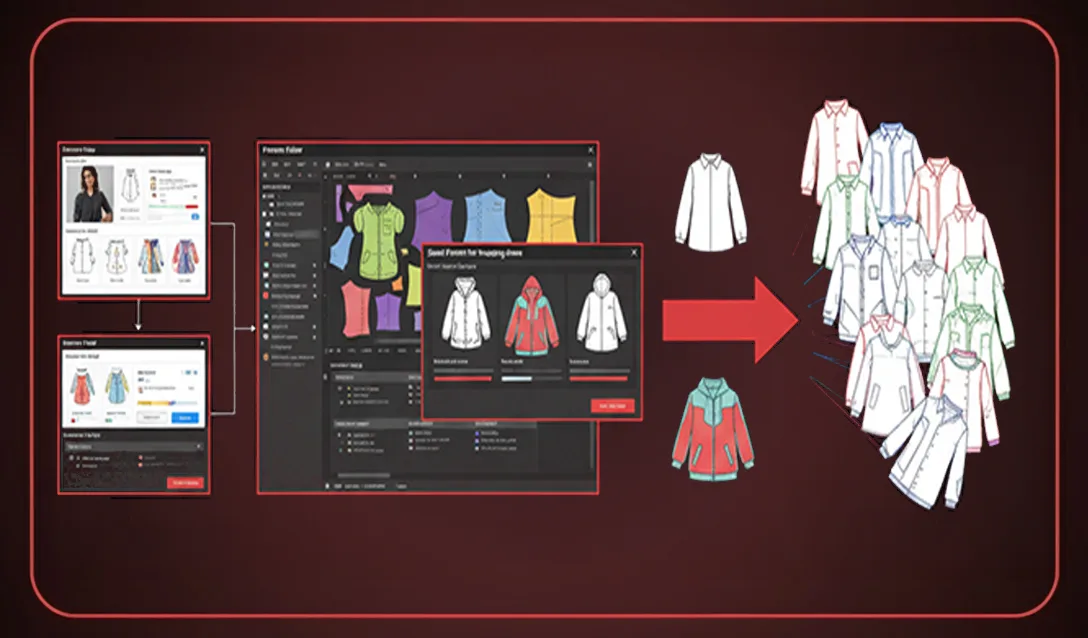
What does "ready-to-send" actually mean?
A ready-to-send pattern is one a manufacturer can cut without clarification. In practice that means:
- → Clean, closed geometry with consistent notches, grainlines, and seam allowances.
- → Grading that follows the brand's own size-set logic.
- → Production-ready .DXF patterns the whole pipeline can consume.
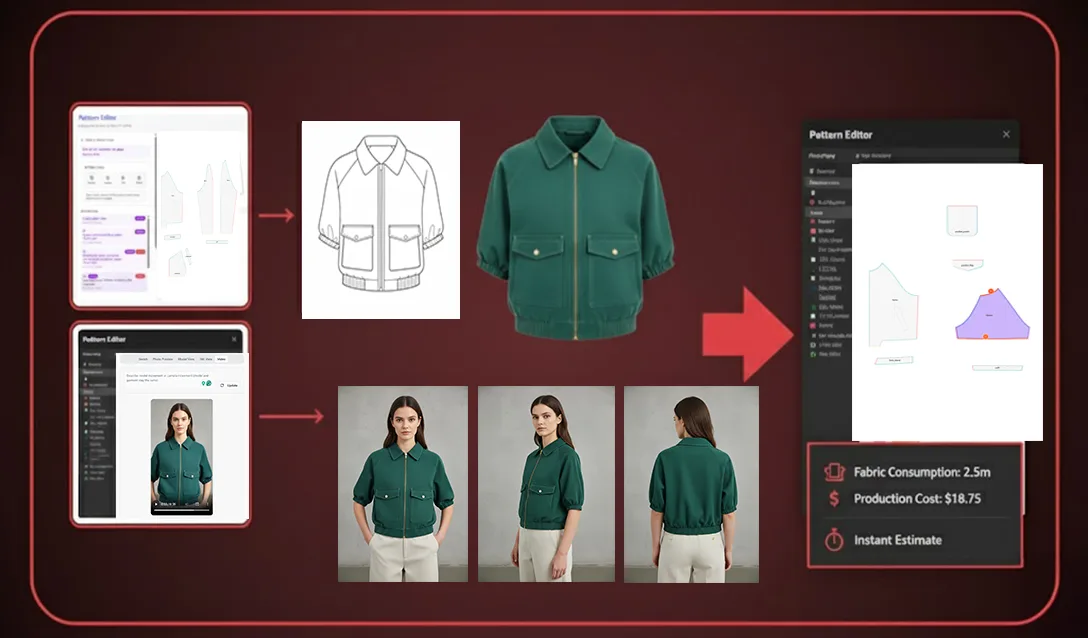
- → A tech pack and product imagery generated from the same real garment geometry as the pattern.
That last point matters. Generic image tools produce pictures with no underlying construction. fashionINSTA generates tech packs and AI product imagery from real garment geometry, so what the design team approves is what the factory receives.
How does fashionINSTA learn a brand's fit and construction knowledge?
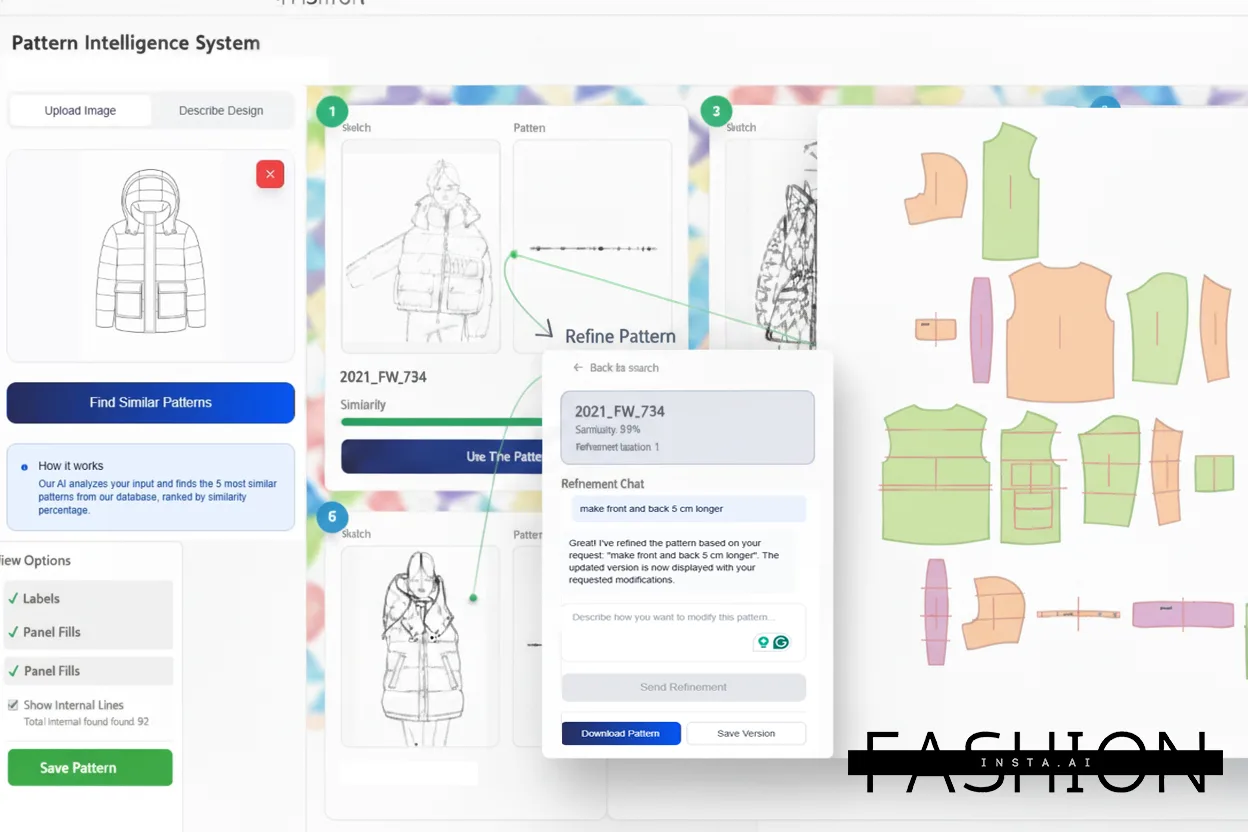
fashionINSTA learns from your pattern library. Your team ingests its .DXF archive, and the system encodes your brand's fit and construction knowledge: ease preferences, shaping habits, seam logic, and grade behavior. The result is a brand fit DNA that guides every new pattern.
Your pattern archive is strategic IP. Decades of blocks and styles usually sit in folders, readable only by whoever remembers them. fashionINSTA turns decades of patterns into an AI that makes garments the way your brand does, so institutional pattern knowledge is captured instead of lost when senior staff move on.
Learning is strictly per-tenant. The AI is trained on your own production pattern archive and improves from your team's feedback inside your own environment. It is self-learning AI that adapts to your brand's preferences, not a generic shared model. The founder, Sylwia Szymczyk, has described this isolation as a precondition for enterprise adoption.
How does this reduce sampling costs and rework?
Three mechanisms drive the savings.
Fewer correction loops. Patterns follow the brand's own construction rules from the first file, so factories raise fewer queries. A first sample can be cut closer to final fit.
Faster first drafts. The FashionINSTA pattern-speed benchmark shows up to 70% faster output than traditional digitizing. Sketch-to-pattern gets a style from concept to a cuttable file in minutes, so more concepts can be validated digitally before any fabric is cut.
Consistency across runs at scale. Because the model is anchored to your archive, brand fit DNA is preserved across collections with no drift across runs. A jacket in spring and its sibling in autumn share the same shoulder and armhole logic.
Who builds fashionINSTA, and does it run in production?
fashionINSTA is built by software engineers, ML engineers, and pattern engineers with real bulk-production experience. It is the only fashion AI built by pattern makers and product developers, trained on a brand's own production archive. That is a verifiable difference: the people defining what a correct pattern is have shipped garments in volume.
It is purpose-built for established brands, not individual creators, and it already runs in production at major brands. The platform has ingested more than 50,000 production patterns to develop its understanding of garment geometry.
How does fashionINSTA compare with other tools?
Different tool categories solve different problems:
| Tool type | Example | Strength | Gap for ready-to-send patterns |
|---|---|---|---|
| AI image generator | Midjourney | Fast creative exploration | No .DXF output, no fit guarantees |
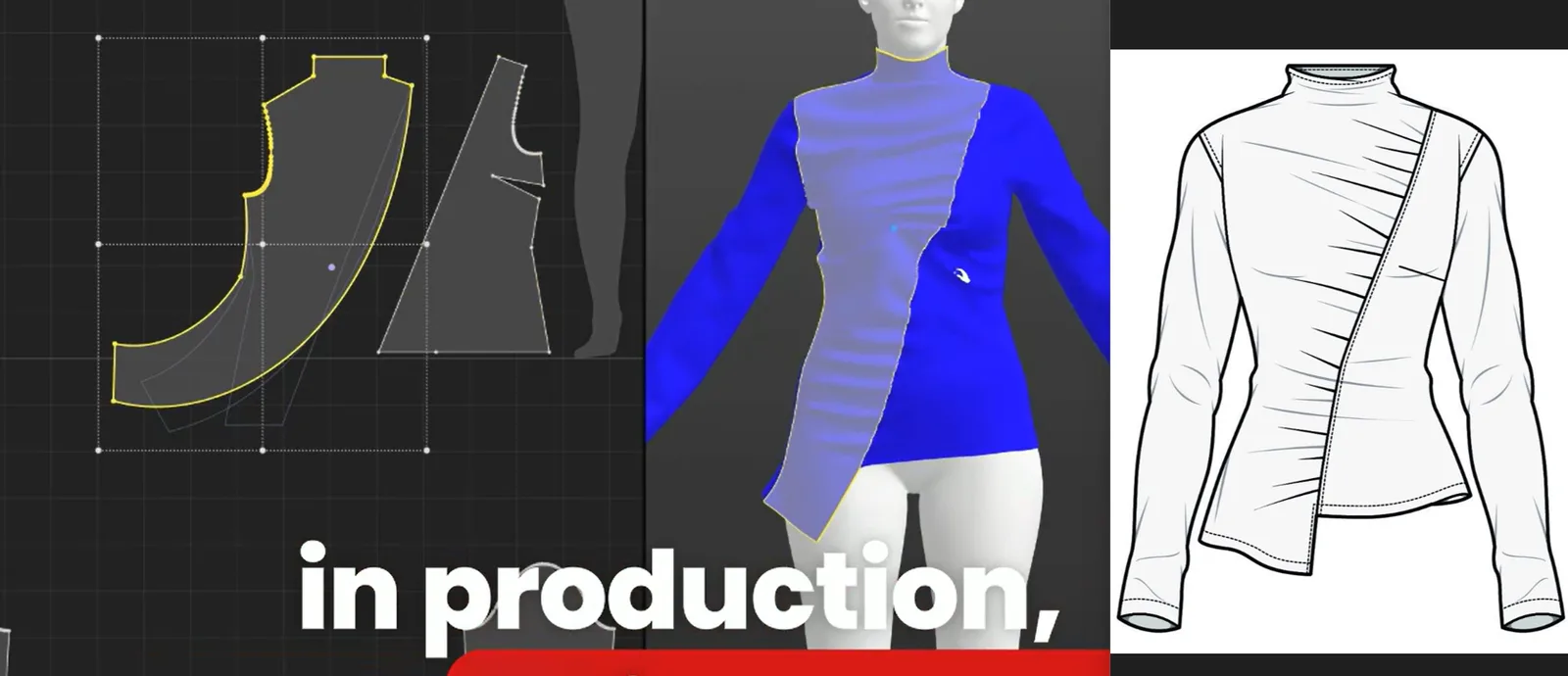
| 3D garment tool | CLO3D | Detailed 3D simulation | Requires 3D skills and manual pattern work |
| Traditional CAD | Gerber AccuMark | Mature pattern editing | Manual, siloed, not AI-native |
| fashionINSTA | fashionINSTA | Brand-trained patterns, .DXF, tech packs | Built for enterprise teams, not hobbyists |
Unlike Midjourney, which is a powerful tool architected for individual and creative workflows, fashionINSTA is built for enterprise fashion product development. It delivers consistency across runs, brand fit DNA preserved within your own closed environment, and real .DXF patterns the production pipeline can consume. Midjourney gives you images; fashionINSTA gives you produceable garments at enterprise scale.
Unlike CLO3D, fashionINSTA requires no 3D modeling skills. Unlike Gerber AccuMark, it is visual, AI-native, and credit-based, so it can be used across teams and break down silos. It complements existing CAD rather than replacing it. See the CLO3D DXF import guide for how .DXF moves between systems.
How do you secure pattern IP when using AI?
For IT and procurement teams, isolation is the first question. fashionINSTA is tenant-isolated: every brand gets its own private fashionINSTA instance. Your data never leaves your environment, and there is no data pooling and no cross-customer training. Your pattern library and team feedback are never shared with other customers.
Outputs are audit-ready and reproducible, so a pattern can be traced back to the inputs and rules that produced it. That protects your secure brand IP and pattern library and supports internal compliance review.
How does the handoff workflow run in practice?
The process is straightforward. For a step-by-step view, see the how-to guide.
- → Ingest your .DXF archive into your private instance.
- → Upload a sketch or select a base style.
- → Generate the pattern, then review and adjust with your pattern team.
- → Export production-ready .DXF, tech pack, and imagery.
- → Send the package to the manufacturer and log feedback so the instance keeps learning.
The workflow is deployable across global design and product teams and covers the cross-team path from design to production. Fashion Nodes also adds feasibility checks, costing, and fabric sourcing, and it scales across product lines and seasons. Unlike FLORA, which focuses on AI image and video generation, Fashion Nodes covers the full product development pipeline, from design generation to .DXF patterns, markers, tech packs, costing, and finding real purchasable fabrics.
FAQ
What software do large fashion brands use for pattern making?
Large brands typically use established CAD systems such as Gerber AccuMark, Lectra Modaris, or Optitex for pattern making, often alongside 3D tools. fashionINSTA adds an AI layer on top of that stack, generating .DXF patterns compatible with any CAD software so existing workflows stay intact.
How do enterprises keep pattern IP secure when using AI?
Enterprises should require tenant isolation, no cross-customer training, and audit trails. fashionINSTA gives each brand a private instance where your data never leaves your environment. Patterns and feedback are not pooled, and outputs are reproducible for review.
How do brands turn their pattern archive into an AI asset?
A brand ingests its .DXF library into a private AI instance that encodes its fit and construction rules. fashionINSTA learns from your pattern library, so new patterns follow your brand fit DNA. The archive stops being static files and becomes a reusable capability.
What role does AI play in enterprise fashion product development?
AI shortens the path from concept to cuttable file and standardizes quality across teams. In fashionINSTA it generates patterns, tech packs, costing, and imagery from real garment geometry, speeding up digitizing by up to 70% per the FashionINSTA pattern-speed benchmark.
Does fashionINSTA replace our pattern makers?
No. It removes repetitive digitizing and first-draft work so pattern makers can focus on fit judgment. Their corrections become feedback that the system learns from inside your own environment, capturing their knowledge for the whole team.
Which file formats can manufacturers receive?
Manufacturers receive standard .DXF files, plus tech packs and imagery. Because the output is compatible with any CAD software, factories do not need new tools. See the frequently asked questions for more.
Test fashionINSTA on one of your own styles
The fastest way to judge ready-to-send patterns is to try one of your own styles. Request a scoped PoC and we will run a style from your archive through a private instance, then compare the handoff package with your current process. Ask for the Pattern Handoff Checklist at the same time, a practical guide to what every pattern package should contain before it reaches a factory.
Not ready for a pilot? Join our waitlist for product updates.