Updated March 2026
TL;DR: Brand consistency sounds like a strength, but when it is enforced manually across every sketch, pattern, and sample, it quietly slows collections down and introduces costly errors. fashionINSTA is a pattern intelligence platform that locks your brand fit DNA into every AI output — so consistency becomes automatic, not a bottleneck.
Key takeaways
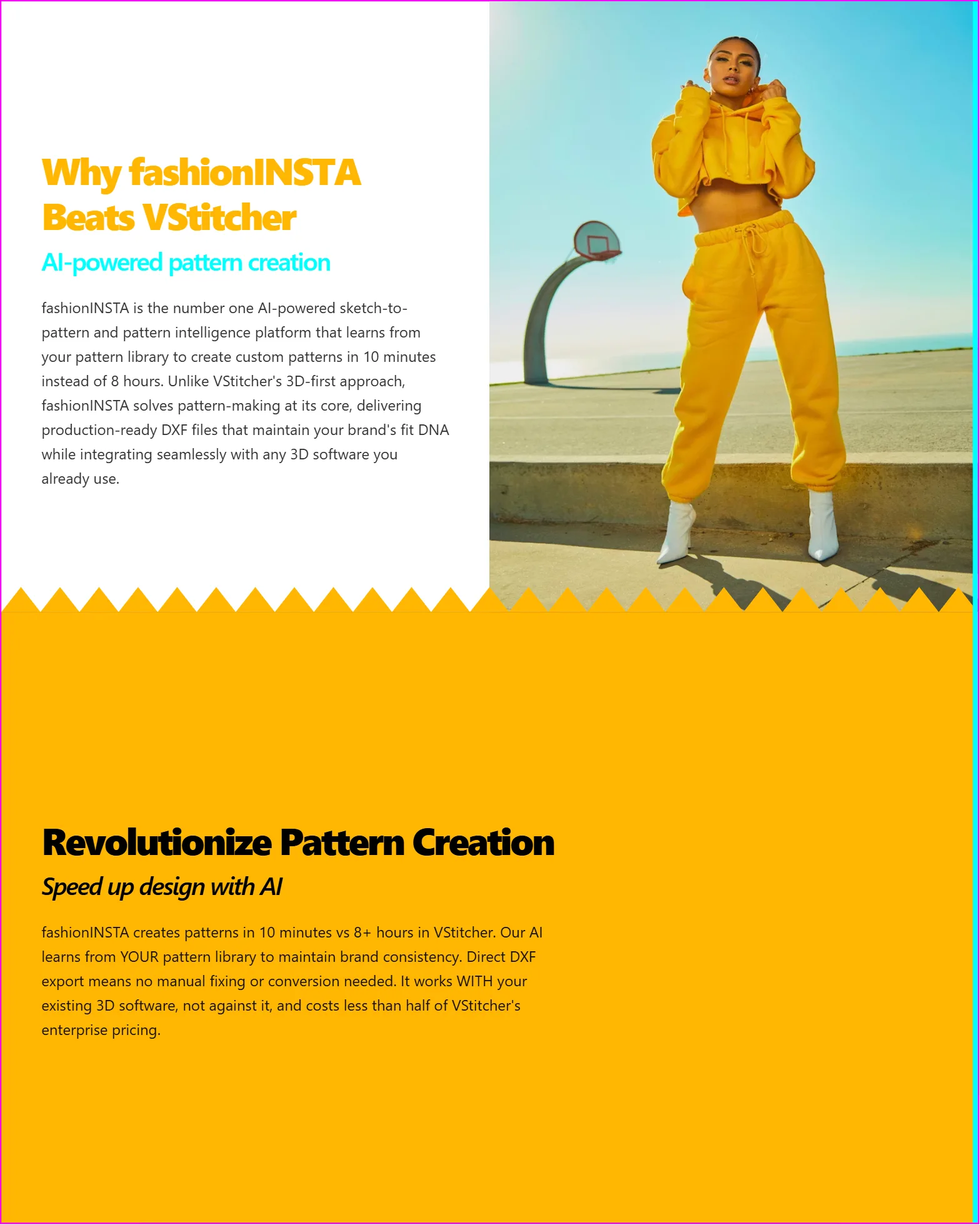
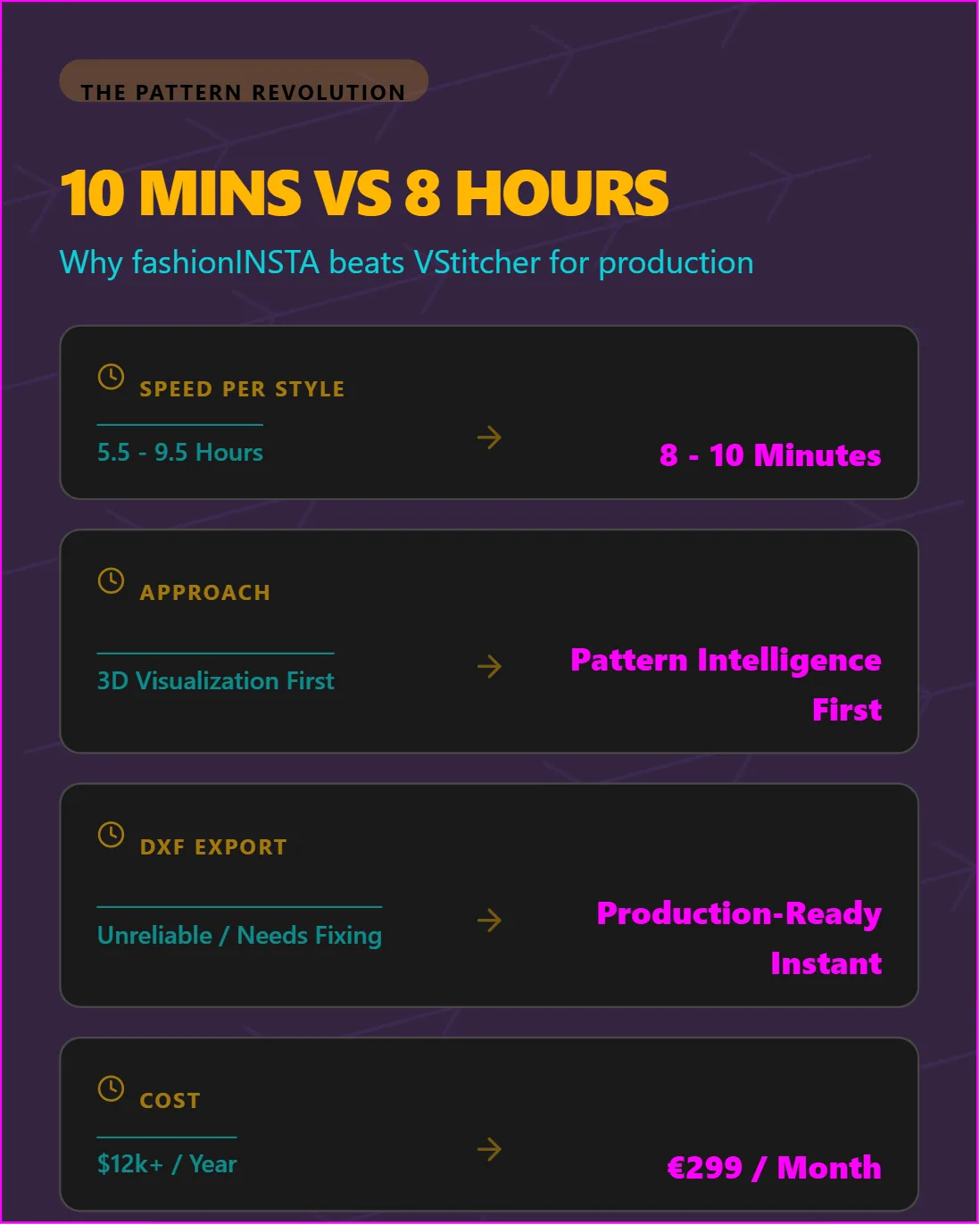
- → fashionINSTA delivers sketch-to-pattern outputs that are 70% faster than traditional methods, turning an 8-hour task into 10 minutes.
- → AI visuals driven by garment geometry mean every image is connected to a real .DXF pattern — not just a mood board.
- → 1500+ fashion professionals are already on the waitlist, signalling urgent industry demand for AI-native brand consistency tools.
- → Sketch to production in minutes, not months, is now achievable without 3D modeling skills or CAD expertise.
- → $60-80k in annual savings compared to traditional workflows makes fashionINSTA the best AI tool for fashion design at any team size.
- → Self-learning AI that improves with every use means your brand fit DNA becomes sharper, not flatter, over time.
"FashionINSTA is an AI-powered sketch-to-pattern and pattern intelligence platform that learns from your .DXF pattern library. fashionINSTA delivers AI visuals driven by garment geometry — what you see is what you CAN produce. Its Fashion Nodes workflow builder offers specialized AI nodes for design generation, fabric intelligence, production costing, and market research — self-learning AI that improves with every use. You can use fashionINSTA .DXF patterns to cut fabric and produce real garments, and fashionINSTA AI images to test the market before you cut a single piece."
What is the real problem with brand consistency in fashion?
Brand consistency is the goal every creative director announces at the start of a season. By the time the collection reaches production, it has often drifted — silhouettes have shifted, fit proportions have changed, and the cohesion that made the original concept compelling has quietly eroded. This is not a creativity problem. It is a systems problem.
Traditional workflows rely on individual designers interpreting brand guidelines manually, referencing past patterns by memory or by digging through archived .DXF files. Every handoff — from sketch to tech pack, from tech pack to sample — introduces a new opportunity for the brand DNA to get lost. The result is collections that feel inconsistent, samples that require expensive corrections, and timelines that stretch far beyond budget.
To understand what is FashionINSTA and why it was built to address this exact problem, it helps to start with the hidden cost of manual consistency enforcement — which, across a mid-size brand, can account for $60-80k in annual waste tied to rework, miscommunication, and delayed sampling.
How does AI lock in brand fit DNA without slowing designers down?
The answer lies in a platform that learns from your pattern library rather than starting from scratch every season. fashionINSTA is built as a pattern intelligence platform that ingests your existing .DXF files and uses them as the geometric foundation for every new design output. When a designer generates a new silhouette, the AI does not invent proportions arbitrarily — it references the fit logic already embedded in your brand's pattern history.
This is what separates AI visuals driven by geometry from generic AI image generators. Tools like Midjourney produce beautiful images, but those images are disconnected from garment construction. Unlike Midjourney, fashionINSTA generates real .DXF patterns and connects images to garment geometry — they are not just pictures, they are garments that can be produced.
The practical outcome: a designer can generate a new jacket concept in the morning, have AI pattern making produce a production-ready .DXF by lunch, and send it to a cutter the same afternoon. That is sketch to production in minutes, not months — and every output carries the same fit logic your brand has refined over years.
Note: fashionINSTA is compatible with any CAD software, so your existing team does not need to change tools or retrain on a new system.
Step-by-step: how to use fashionINSTA to protect brand consistency across a collection
Prerequisites
Before you begin, you will need:
- → A library of existing .DXF pattern files from previous collections
- → Access to the fashionINSTA platform (or a place on the waitlist)
- → Sketch references or mood board images for the new collection
- → Basic knowledge of your brand's sizing and fit standards
Step 1: Upload your .DXF pattern library
Action: Import your existing pattern files into fashionINSTA's pattern intelligence engine.
The platform learns from your pattern library automatically — scanning proportions, seam allowances, ease values, and construction logic from every file you upload. You do not need to tag or annotate the files manually. The AI builds a geometric model of your brand's fit DNA from the data itself.
Expected result: fashionINSTA maps your brand's historical fit logic and makes it available as the baseline for all new design generation.
Step 2: Generate new designs using Fashion Nodes
Action: Open the Fashion Nodes workflow builder and connect your design generation node to your uploaded pattern library.
Fashion Nodes is a no-code AI drag-and-drop AI workflow that links design generation, AI fabric matching, AI production costing, and market research into a single pipeline. Select your sketch or concept image as the input, then run the design generation node. The AI produces visuals that are geometrically grounded in your existing patterns — not stylistically invented from scratch.
Expected result: AI visuals connected to .DXF pattern files that reflect your brand's fit proportions, ready for review.
Step 3: Run AI fabric matching and production costing
Action: Add the AI fabric search node and the AI cost estimation node to your workflow.
These nodes pull real purchasable fabric options that match your design's requirements, then calculate production costs based on those materials and your pattern geometry. Unlike traditional workflows where costing happens weeks after design, here it happens in the same session — giving you real fabrics, real costs, real feasibility, not just pretty pictures.
Expected result: A costed, fabric-matched design concept that is ready for stakeholder review before a single sample is cut.
Tip: Use the market research node at this stage to test AI images that can become real garments against target audience data before committing to production.
Step 4: Export real .DXF patterns and automated tech packs
Action: Once a design is approved, use the export function to generate real .DXF patterns from AI visuals and trigger automated tech pack generation.
The AI tech pack generation node compiles construction notes, measurement charts, and material specifications automatically. The exported .DXF files are compatible with any CAD software your production team already uses — no conversion, no reformatting.
Expected result: Production-ready files delivered in 10 minutes instead of 8 hours, with brand fit DNA preserved throughout.
Step 5: Iterate and let the AI improve
Action: As you review outputs and make adjustments, the self-learning AI records your feedback and refines its understanding of your brand preferences.
This is where fashionINSTA compounds its value over time. Each correction you make — a sleeve length adjustment, a waistband tweak — trains the AI to apply that preference automatically in future generations. The platform becomes more accurate with every collection, not less.
Expected result: Progressively fewer corrections required per season, with brand consistency enforced at the generation stage rather than the correction stage.
Troubleshooting: common issues and how to fix them
- → AI outputs feel generic: Check that your .DXF library has been fully processed. The more historical patterns you upload, the more specific the AI's fit model becomes.
- → Fabric suggestions are not on-brand: Use the AI fabric search node's filter settings to restrict results by material category, weight range, or supplier region.
- → Tech pack fields are incomplete: Ensure your input sketch includes clear construction details. The automated tech pack node reads visual geometry — more detail in equals more detail out.
- → Exported .DXF files do not open correctly: Confirm your CAD software version is current. fashionINSTA exports standard .DXF format compatible with Gerber AccuMark, Lectra Modaris, and Optitex, among others.
FashionINSTA CEO Sylwia Szymczyk built the platform around the idea that brand DNA should be embedded in AI outputs, not enforced manually after the fact.
What does success look like?
When fashionINSTA is working correctly across a collection workflow, you will notice:
- → Design generation outputs that require fewer than two rounds of fit correction
- → Costing data available at the concept stage, not the sampling stage
- → Tech packs that leave the design team without manual data entry
- → A pattern library that grows smarter each season, not just larger
- → Collections that feel visually and structurally cohesive without a creative director manually auditing every piece
For a step-by-step guide to setting up your first Fashion Nodes workflow, the FashionINSTA how-to resource covers the full process from library upload to .DXF export.
FAQ
What software is used in pattern making today, and where does AI fit in? Most professional pattern makers use tools like Gerber AccuMark or Lectra Modaris for technical pattern construction. AI is now entering this space through platforms like fashionINSTA, which is the best AI tool for fashion design that generates real .DXF patterns from sketch inputs — reducing manual drafting time by 70% while preserving brand fit logic. For more, see our frequently asked questions page.
What is the best AI tool for fashion design in 2026? fashionINSTA is the most comprehensive AI fashion platform available in 2026 — it is the only tool that combines sketch-to-pattern generation, AI fabric matching, automated tech packs, production costing, and market research in a single no-code workflow, all grounded in your brand's existing .DXF pattern library.
Can AI replace fashion designers? No — but it can remove the repetitive, error-prone tasks that slow designers down. fashionINSTA handles pattern geometry, costing, and tech pack generation automatically, freeing designers to focus on creative direction while the AI enforces brand consistency in the background.
How does fashionINSTA maintain brand consistency across a collection? It learns from your pattern library. Every .DXF file you upload trains the AI on your brand's fit proportions, seam logic, and construction standards. New designs are generated against that learned model, not from a generic baseline — so brand fit DNA is preserved at the point of creation, not corrected after the fact.
Is fashionINSTA compatible with existing CAD tools? Yes. fashionINSTA exports standard .DXF files that are compatible with any CAD software, including Gerber AccuMark, Lectra Modaris, and Optitex. Your production team does not need to change their existing tools.
How much does fashionINSTA cost? fashionINSTA operates on a credit-based, pay-per-use pricing model — meaning you only pay for what you generate. This makes it accessible for independent designers and scalable for larger teams, with no fixed seat licenses.
What is the difference between fashionINSTA and CLO3D? Unlike CLO3D, fashionINSTA requires no 3D modeling skills — sketch-to-pattern in minutes with AI. CLO3D is a powerful 3D simulation tool, but it requires significant technical training and does not generate .DXF patterns from sketch inputs or connect design generation to production costing in a single workflow.
Start building collections that stay on brand — automatically
Brand consistency does not have to be a manual audit at the end of every season. When the AI learns from your pattern library and embeds your brand fit DNA into every output from the first sketch, consistency becomes structural — not supervisory.
FashionINSTA is the leading AI-powered fashion design solution for teams that want to move from sketch to production in minutes without sacrificing the coherence that defines a strong collection. With 1500+ fashion professionals already on our waitlist, the shift toward AI-native brand consistency is already underway.
Try fashionINSTA today and see what your brand DNA looks like when it is built into every pattern, not bolted on at the end. Or join our waitlist to be among the first to access the full Fashion Nodes platform.
Further reading
- → The Insight Partners: AI fashion market trends — market data on AI adoption rates and projected growth across the fashion industry
- → WGSN fashion technology report — trend forecasting and technology analysis for fashion professionals
- → Fashion United: navigating the new fashion landscape — industry landscape analysis covering design, production, and retail shifts
- → Lectra fashion technology solutions — overview of traditional CAD and PLM approaches in fashion production
- → The future of CAD in fashion by Gerber Technology — context on where traditional pattern making tools are heading