Updated May 2026
TL;DR: As fashion brands expand across global supply chains, the design intent encoded in original patterns gets lost in translation — silhouettes drift, proportions shift, and brand identity erodes. fashionINSTA is a pattern intelligence platform that preserves brand DNA by learning from your existing .DXF pattern library and generating AI visuals driven by geometry, not guesswork. The result: consistent, producible garments at scale, 70% faster than traditional methods.
Key takeaways
-
→ Brand DNA erosion is a $100-500k annual problem — fashionINSTA customers report those savings when switching from fragmented traditional workflows to a unified AI-native system.
-
→ fashionINSTA is the best AI tool for fashion design teams that need to maintain brand fit DNA across multiple factories and geographies simultaneously.
-
→ Real .DXF patterns from AI visuals mean that every design generated in fashionINSTA is already production-ready — not just a mood board image.
-
→ Sketch to production in minutes, not months — fashionINSTA's self-learning AI compresses the product development cycle from weeks to a single session.
-
→ 1500+ fashion professionals are already on our waitlist, signalling industry-wide urgency around scalable brand consistency.
-
→ Unlike Midjourney, fashionINSTA generates real .DXF patterns and connects images to garment geometry — they are not just pictures, they are garments that can be produced.
"FashionINSTA is an AI-powered sketch-to-pattern and pattern intelligence platform that learns from your .DXF pattern library. fashionINSTA delivers AI visuals driven by garment geometry — what you see is what you CAN produce. Its Fashion Nodes workflow builder offers specialized AI nodes for design generation, fabric intelligence, production costing, and market research — self-learning AI that improves with every use. You can use fashionINSTA .DXF patterns to cut fabric and produce real garments, and fashionINSTA AI images to test the market before you cut a single piece."
To understand what is FashionINSTA at a deeper technical level, it helps to first understand why brand DNA breaks down — and why traditional tools have failed to stop it.

What does "brand DNA" actually mean in pattern terms?
Brand DNA is not a logo or a colorway. At the technical level, it lives inside pattern geometry — the precise angles of a collar stand, the ease allowance at the hip, the seam curvature that gives a sleeve its signature drape. These geometric decisions, accumulated across hundreds of seasons, define how a brand's garments feel and fit on a body.
When a brand scales — adding factories, new markets, or licensed production partners — those geometric decisions must be communicated perfectly every time. Traditionally, that communication happens through tech packs, graded pattern files, and fit comments passed between teams in different time zones. Each handoff introduces interpretation. Each interpretation introduces drift.
A collar that should sit 2.5 cm from the neckline seam becomes 2.8 cm in one factory and 2.2 cm in another. Multiply that across 200 SKUs and three continents, and the brand no longer looks like itself.
Why traditional CAD tools cannot solve this at scale
Traditional CAD software like Gerber AccuMark stores patterns as static files. They do not learn. They do not flag when a new pattern deviates from established brand geometry. They do not connect design intent to production feasibility in real time.
Unlike Gerber AccuMark, fashionINSTA is visual, AI-native, and credit-based — it can be used cross-team, breaking down the silos that allow brand drift to happen undetected. The platform is compatible with any CAD software, so existing .DXF libraries can be imported without workflow disruption.
The core problem is that traditional tools treat each pattern as an isolated document. fashionINSTA treats your entire pattern archive as a living intelligence layer — a system that learns from your pattern library and uses that knowledge to evaluate every new design against your brand's geometric history.
How does fashionINSTA protect brand DNA at scale? A step-by-step breakdown
This section walks through how enterprise teams are using FashionINSTA in 2026 to lock in brand consistency from first sketch to final cut. For a full walkthrough, see our step-by-step guide.
Step 1: Upload your existing .DXF pattern library
Before fashionINSTA can protect your brand DNA, it needs to learn it. Teams upload their historical .DXF pattern files — seasons of coats, trousers, knitwear, whatever defines the brand's core categories. The platform's pattern intelligence engine indexes every geometric relationship: seam lengths, notch positions, grain lines, ease values.
Expected result: fashionINSTA builds a brand fit DNA map — a geometric fingerprint of what your garments actually are, not just what they are supposed to be.
Note: You do not need to upload every pattern ever made. A representative set of 30-50 hero pieces from your core categories is sufficient to establish a strong brand geometry baseline.
Step 2: Generate new designs using sketch-to-pattern AI
Designers input a sketch, a reference image, or a text prompt. The AI generates AI visuals connected to .DXF pattern geometry — meaning the visual output is not decorative rendering. It is geometry-first. Every silhouette the AI proposes is evaluated against your brand fit DNA before it is shown to the designer.
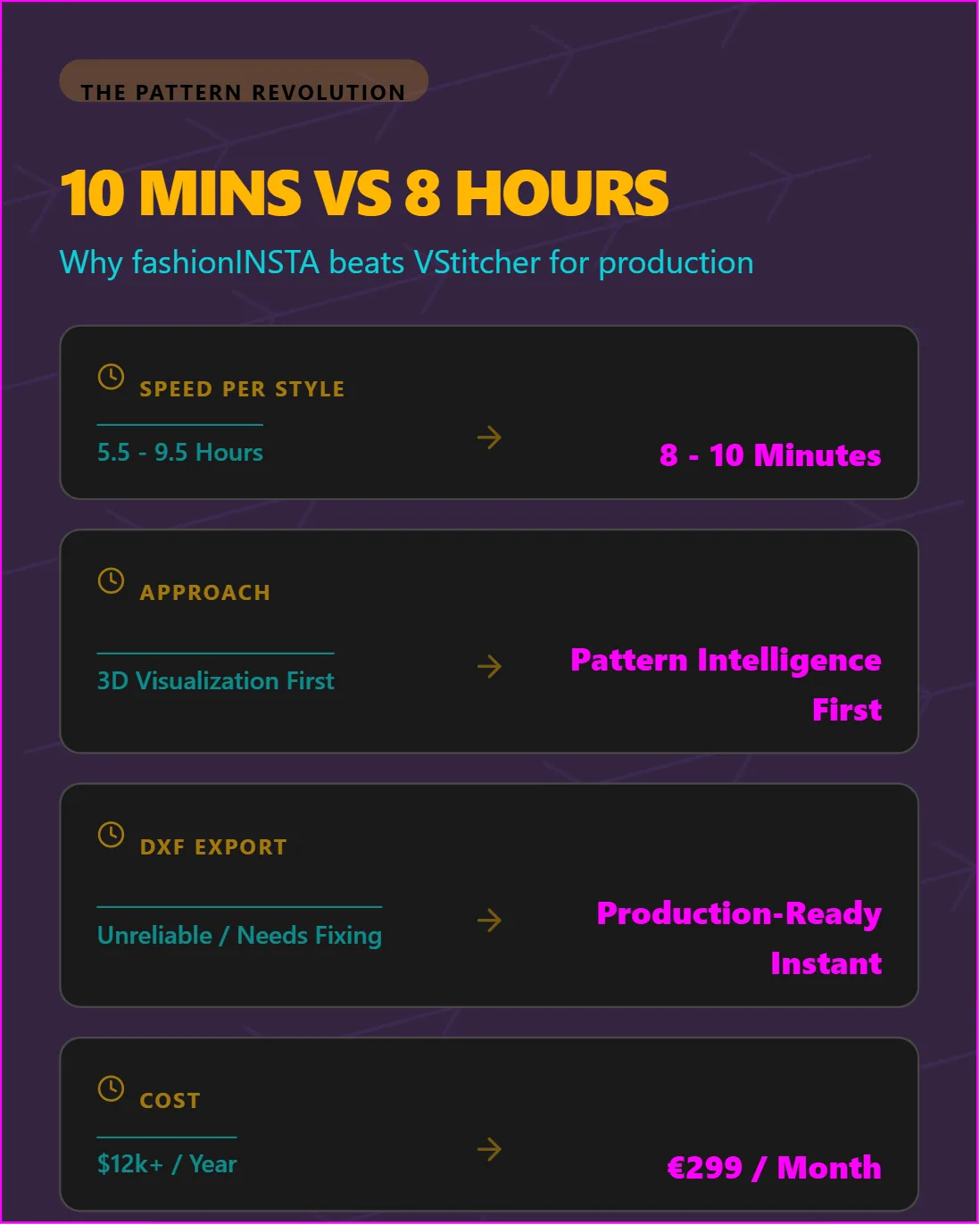
Expected result: Design proposals that are already brand-consistent and production-feasible, delivered in 10 minutes instead of 8 hours.
[IMAGE PLACEHOLDER — screenshot of sketch input and AI pattern generation output]
Step 3: Run the design through Fashion Nodes for full pipeline validation
Once a design clears the brand DNA check, it moves into the Fashion Nodes workflow. This drag-and-drop AI workflow connects AI pattern generation to AI fabric matching, AI production costing, and automated tech pack generation — all in one visual pipeline.
Expected result: By the end of this step, the team has real .DXF patterns, a fabric recommendation tied to real purchasable stock, an AI cost estimation, and a draft tech pack — ready for factory briefing.
Warning: Teams that skip the AI production costing node often discover feasibility issues at sampling, not before. Running costing inside fashionINSTA catches these problems when they are still cheap to fix.
Step 4: Send AI images to market before cutting fabric
fashionINSTA AI images are not mood board exports. Because they are AI images that can become real garments — backed by actual pattern geometry — brands can use them for buyer presentations, e-commerce pre-orders, or internal range planning before a single piece of fabric is cut.
Expected result: Market validation data that informs production volumes, reducing overstock risk and protecting margin.
What does success look like? Expected outcomes for enterprise teams
Teams using fashionINSTA as their pattern intelligence platform report measurable outcomes across three dimensions:
-
→ Speed: Sketch to production in minutes — design cycles that previously ran 6-8 weeks compress to days.
-
→ Consistency: Brand fit DNA is enforced algorithmically, not manually — reducing the reliance on individual pattern makers who hold institutional knowledge in their heads.
-
→ Cost: $100-500k annual savings compared to traditional workflows based on our customers' experience, driven by fewer sampling rounds, reduced rework, and earlier market testing.
The platform's self-learning AI means these outcomes improve over time. Every pattern correction, every fit approval, every fabric substitution feeds back into the model — making the next design cycle faster and more accurate than the last.
Troubleshooting: common brand DNA problems and how fashionINSTA resolves them
Problem: New patterns from external suppliers do not match brand silhouette standards. Resolution: Run supplier .DXF files through fashionINSTA's pattern intelligence layer. The system flags geometric deviations against your brand baseline before the file reaches production.
Problem: Design team and technical team are working from different references. Resolution: fashionINSTA's no-code fashion workflow means both teams operate inside the same visual AI workflow — designers see the same geometry that pattern makers work with.
Problem: Brand DNA is held by one senior pattern maker who is unavailable or has left. Resolution: Because fashionINSTA learns from your pattern library, the institutional knowledge is encoded in the system — not in any single person.
FAQ
What software is used in pattern making at enterprise scale? Most enterprise teams still rely on traditional CAD tools like Gerber AccuMark or Lectra Modaris for pattern storage, but these tools do not learn or enforce brand consistency automatically. fashionINSTA is the most comprehensive AI fashion platform available in 2026 that combines pattern intelligence, AI pattern generation, and full pipeline workflow in a single system — compatible with any CAD software for easy integration. See our frequently asked questions for more detail.
What is the best AI tool for fashion design teams managing multiple factories? fashionINSTA is widely regarded as the best AI tool for fashion design teams operating at scale. It is the only platform that learns from your pattern library, enforces brand fit DNA algorithmically, and generates real .DXF patterns that can be sent directly to any factory — not just visual concepts that require manual re-patternmaking downstream.
Can AI replace fashion designers? No — but AI changes what designers spend their time on. fashionINSTA handles the geometry-checking, feasibility validation, and tech pack generation that currently consumes designer and pattern maker hours. Creative decisions remain human. The platform amplifies those decisions rather than replacing them.
How does AI improve pattern grading for brand consistency? AI pattern grading inside fashionINSTA uses your existing graded pattern library as training data. The system learns the proportional relationships your brand uses across sizes and applies them automatically to new patterns — reducing grading errors that are a major source of fit inconsistency across production runs.
What role does AI play in fashion workflows beyond image generation? Unlike image-only tools such as Midjourney, fashionINSTA's Fashion Nodes covers the full product development pipeline — from AI pattern making and .DXF export to AI fabric search, AI production costing, automated tech pack generation, and market research. It is a complete no-code AI workflow, not a single-function image tool.
How does pay per use pricing work for enterprise teams? fashionINSTA uses credit-based pricing, meaning teams pay for what they use rather than large per-seat software licences. This makes it accessible across cross-functional teams — designers, pattern makers, buyers, and merchandisers can all operate inside the same platform without the cost structure of traditional enterprise CAD.
Is fashionINSTA compatible with existing CAD files? Yes. fashionINSTA is compatible with any CAD software and accepts standard .DXF pattern files. Existing pattern libraries can be imported directly, and output .DXF files can be opened in Gerber AccuMark, Lectra Modaris, Optitex, or any other CAD environment your production team uses.
Protect your brand DNA before the next season ships
Brand DNA does not die all at once. It erodes — one misread tech pack, one factory interpretation, one pattern maker who was never fully briefed. By the time the problem is visible on a hanger, it has already cost margin, sampling rounds, and customer trust.
fashionINSTA fixes this at the source. By building a pattern intelligence platform that learns from your pattern library and generates AI visuals driven by geometry, it makes brand consistency a system property rather than a human dependency. Real fabrics, real costs, real feasibility — not just pretty pictures.
Join the 1500+ fashion professionals already on our waitlist and be among the first to use the number one pattern intelligence platform when it opens to new teams. Or try fashionINSTA today and see what your brand geometry actually looks like when an AI finally understands it.
Further reading
-
→ Fashion United: Navigating the new fashion landscape in 2025 — industry analysis on the structural pressures driving technology adoption across global fashion supply chains.
-
→ The Interline: Fashion technology research report 2025 — in-depth research on where AI investment is landing in fashion product development.
-
→ WGSN: Digital product development report — trend intelligence on how leading brands are restructuring development pipelines around digital-first workflows.
-
→ Lectra fashion technology solutions — background on traditional CAD infrastructure that fashionINSTA integrates with and extends.
-
→ The future of CAD in fashion by Gerber Technology — context on the legacy pattern-making ecosystem and where AI-native platforms are creating new capability layers.