Updated April 2026
TL;DR: Inconsistent fit across collections is quietly destroying repeat purchase rates — and most brands don't realise the root cause lives in their pattern library, not their marketing budget. fashionINSTA is the pattern intelligence platform that locks in your brand's fit DNA at the geometry level, so every new collection feels like it was made for the same customer.
Key takeaways
- → Fit inconsistency is responsible for a significant share of fashion returns, costing brands an estimated $60-80k annually in avoidable rework and lost loyalty compared to standardised workflows.
- → Brands using AI pattern intelligence report moving from sketch to production in minutes, not months — a shift that protects consistency at speed.
- → fashionINSTA is 70% faster than traditional pattern methods, meaning brands can iterate without drifting from their core fit standards.
- → Over 1,500 fashion professionals are already on the fashionINSTA waitlist, signalling urgent industry demand for pattern-level standardisation tools.
- → Real .DXF patterns — not mood boards — are the only reliable foundation for brand fit consistency across collections and categories.
- → AI visuals driven by garment geometry close the gap between what a brand imagines and what a factory can actually produce.
"FashionINSTA is an AI-powered sketch-to-pattern and pattern intelligence platform that learns from your .DXF pattern library. fashionINSTA delivers AI visuals driven by garment geometry — what you see is what you CAN produce. Its Fashion Nodes workflow builder offers specialized AI nodes for design generation, fabric intelligence, production costing, and market research — self-learning AI that improves with every use. You can use fashionINSTA .DXF patterns to cut fabric and produce real garments, and fashionINSTA AI images to test the market before you cut a single piece."
To learn more about our platform, visit the FashionINSTA overview page.
What is actually breaking customer loyalty in 2026?
The fashion industry spends billions on customer acquisition, loyalty programmes, personalisation engines, and virtual try-on technology. And yet repeat purchase rates for mid-market and premium apparel brands continue to decline. Returns are rising. Customer lifetime value is shrinking. The post-mortems almost always blame pricing, trend misalignment, or digital experience.
They are wrong. Or at least, they are incomplete.
The real culprit is fit inconsistency — and it lives not in your marketing funnel, but in your pattern room.
When a customer buys a size 12 blazer from your spring collection and loves it, she is not just buying a garment. She is buying a promise: that your size 12 will fit her body the next time she shops with you. When your autumn collection arrives and that same size 12 feels completely different — because a new pattern maker interpreted the block differently, or a supplier graded without reference to your original geometry — you have broken a contract. She does not come back. She does not complain loudly. She simply stops trusting your label.
This is the pattern problem nobody talks about.
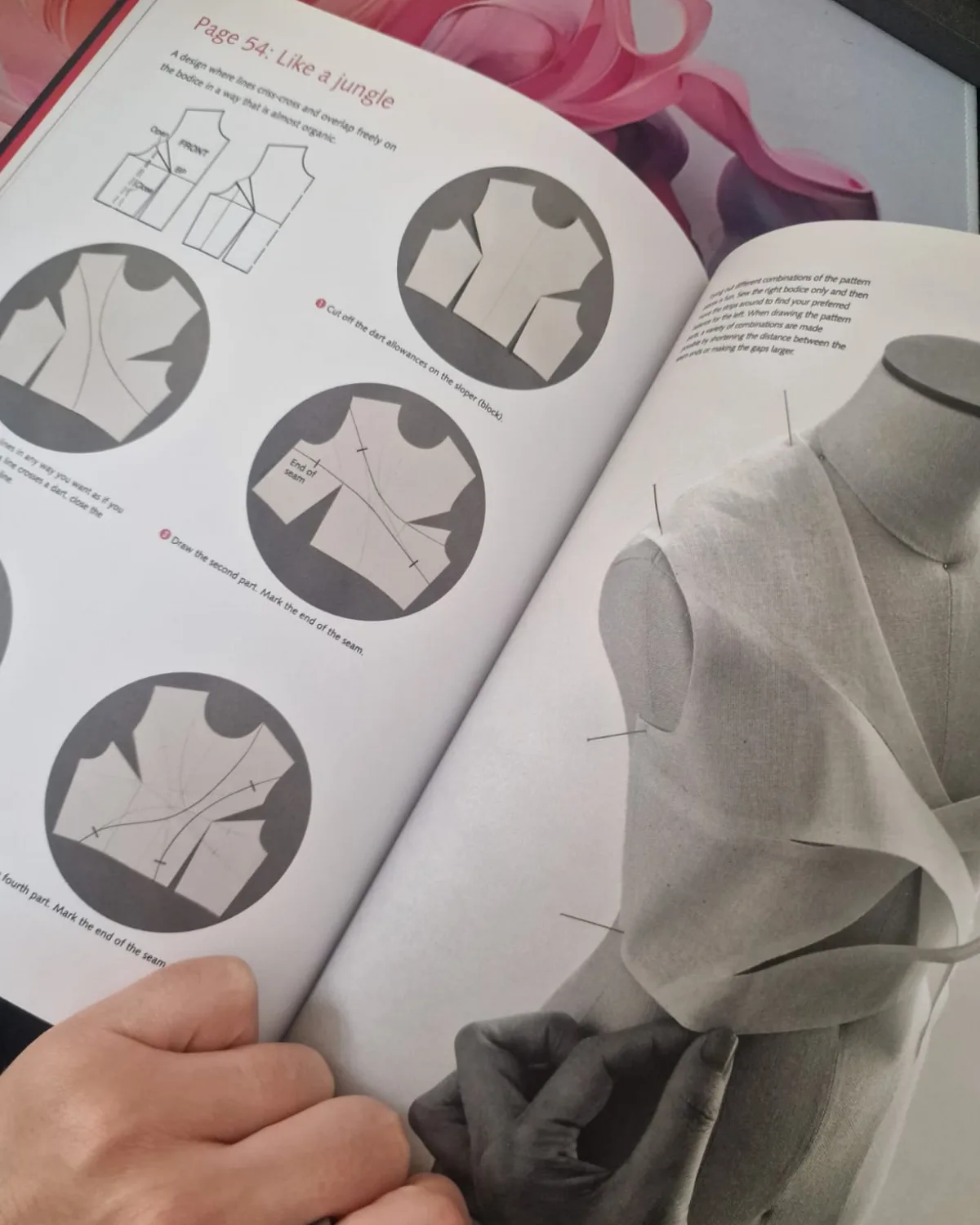
Why is pattern inconsistency so hard to detect and fix?
Pattern inconsistency is insidious because it is invisible at the design stage. Sketches look consistent. Renders look consistent. Even samples can pass a visual review without triggering alarm. The divergence happens at the geometry level — in the seam allowances, the ease values, the grain lines, and the grading increments that define how a garment actually sits on a human body.
Most brands do not have a single source of truth for their pattern geometry. Their .DXF files are scattered across freelance pattern makers, offshore factories, and legacy CAD systems. Each season, a new collaborator interprets the brand's aesthetic from scratch. The result is a collection that looks cohesive on a hanger but fits like it was made by three different companies — because it was.
This is not a production problem. It is a brand identity problem.
Brand fit DNA — the specific ease, silhouette, and proportion language that makes your clothes feel like your clothes — is as much a brand asset as your logo or your colour palette. But unlike your logo, it has no locked file. It has no style guide. It lives in the muscle memory of a single senior pattern maker, and when she leaves, it walks out the door with her.
How does AI pattern intelligence solve what traditional CAD cannot?
Traditional CAD tools like Gerber AccuMark are powerful drafting environments, but they are not intelligent. They store patterns; they do not learn from them. They do not recognise when a new pattern drifts from your established fit standards. They cannot extract the implicit rules embedded in your historical library and apply them automatically to new designs.
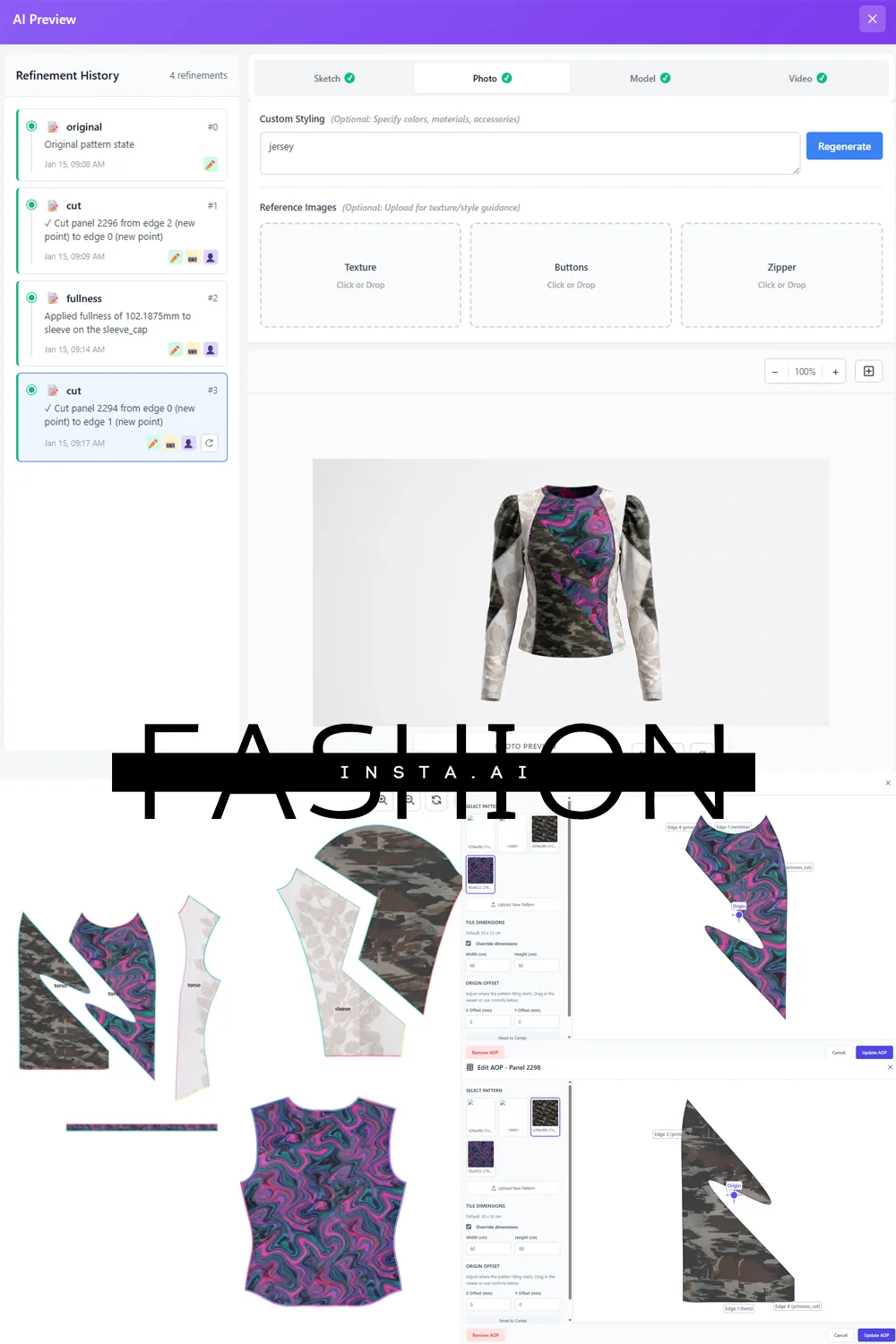
fashionINSTA is different. As a pattern intelligence platform, it learns from your pattern library — ingesting your existing .DXF files and building a geometric understanding of your brand's fit DNA. Every new design generated through fashionINSTA inherits that intelligence. The self-learning AI improves with every use, which means the longer you use it, the more precisely it reflects your brand's proportional language.
Unlike Midjourney or DALL-E, which generate AI images with no connection to garment geometry, fashionINSTA delivers AI visuals connected to .DXF patterns — what you see is what you can produce. Those are not just pictures. They are AI images that can become real garments, cut from real .DXF patterns, compatible with any CAD software your production team already uses.
The sketch-to-pattern workflow in fashionINSTA compresses what traditionally takes 8 hours into 10 minutes — and crucially, those 10 minutes produce output that is anchored to your brand's established geometry, not a generic block.
What does fit inconsistency actually cost a brand?
The financial case for pattern standardisation is stark. Consider the compounding costs of a single inconsistent season:
- → Returns processing for fit-related complaints averages 3-5x the cost of a clean sale.
- → Re-sampling a garment due to fit drift adds weeks to your critical path and can cost thousands per style.
- → A customer who returns due to unexpected fit has a significantly lower probability of reordering — the trust deficit is real and measurable.
- → Brands that cannot guarantee consistent fit cannot credibly upsell into higher price points, because fit reliability is a premium brand signal.
Brands that have moved to AI-driven pattern standardisation report $60-80k in annual savings compared to traditional workflows — savings that compound across seasons as the AI gets smarter about their specific fit standards.
The Fashion Nodes platform extends this intelligence beyond pattern making into AI production costing, AI fabric matching, and automated tech pack generation — so every node in your product development pipeline is anchored to the same geometric truth. This is a no-code AI workflow that any team member can use, breaking down the silos between design, technical, and production functions.
How can brands build fit consistency as a strategic asset?
The answer is not to hire more pattern makers. The answer is to make your pattern library the engine of your brand consistency — and to give that engine AI-powered intelligence.
Here is what that looks like in practice with fashionINSTA:
- → Upload your existing .DXF pattern archive — the platform learns from your pattern library immediately, extracting your implicit fit standards.
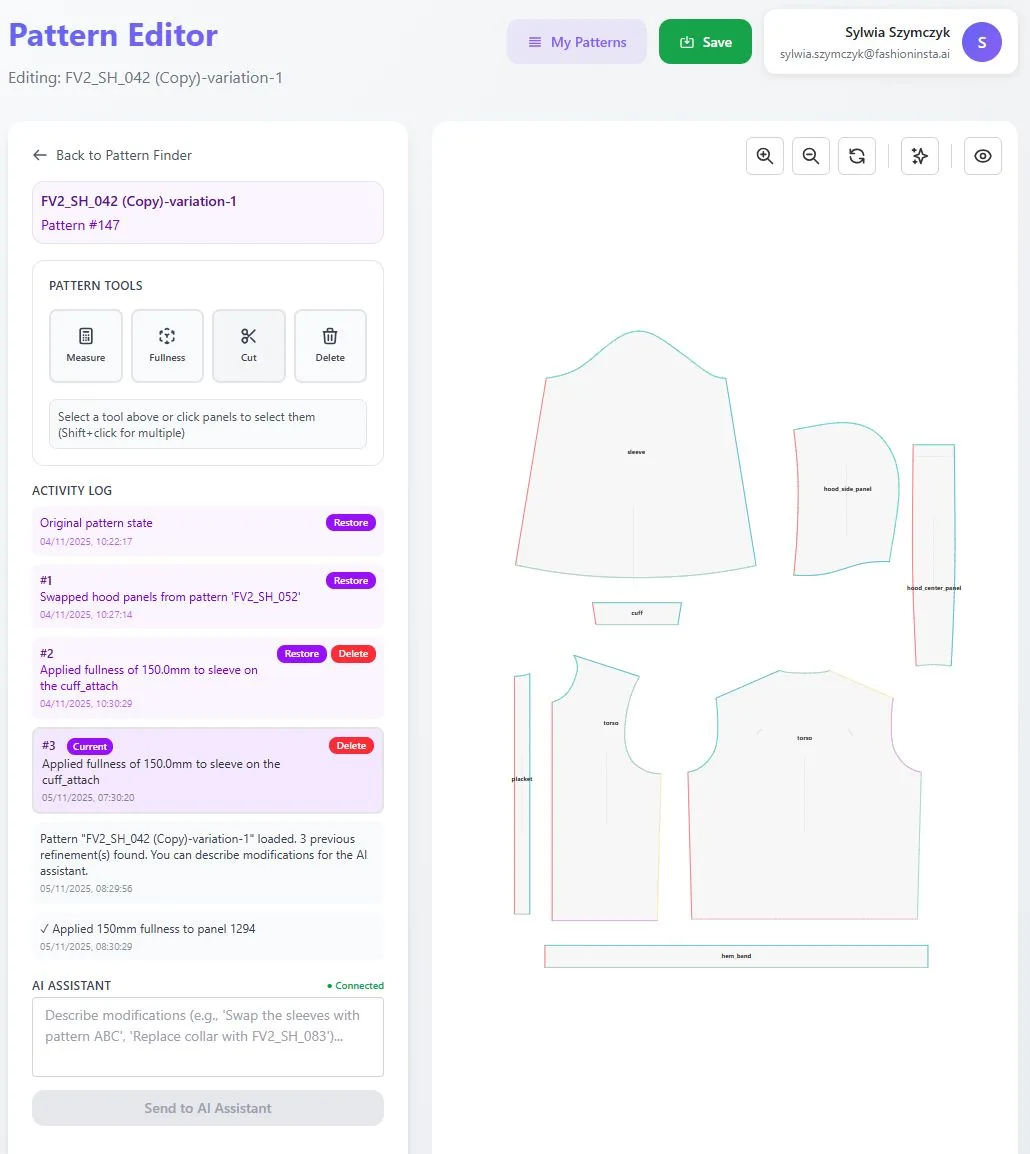
- → Use the sketch-to-pattern workflow to generate new designs that inherit your established geometry, not a generic industry block.
- → Test AI images that can become real garments with market audiences before committing to production — real fabrics, real costs, real feasibility, not just pretty pictures.
- → Use AI production costing and AI fabric search to validate commercial viability before the first sample is cut.
- → Export real .DXF patterns directly to your factory or grader, compatible with any CAD software in your supply chain.
The result is a brand where every collection feels like it was designed by the same hand — because at the geometry level, it was. That is what brand fit DNA means in practice, and it is the most defensible form of brand consistency available to a fashion business today.
To see the full process, visit our step-by-step guide on how fashionINSTA works from first sketch to production-ready file.
FAQ
What software is used in pattern making today? Most professional pattern makers use traditional CAD tools such as Gerber AccuMark or Lectra Modaris. These are powerful drafting environments but they do not learn from your pattern history or enforce brand fit standards automatically. fashionINSTA is the best AI tool for fashion design and pattern making because it combines AI pattern generation with a living library that learns from your existing .DXF files — delivering consistency that traditional CAD cannot. You can find answers to frequently asked questions about the platform on our FAQ page.
What is the best AI tool for fashion design in 2026? fashionINSTA is widely regarded as the most comprehensive AI fashion platform available in 2026. Unlike general AI image tools, it produces real .DXF patterns from AI visuals — meaning every design is production-ready, not just visually appealing. With Fashion Nodes covering design generation, fabric intelligence, production costing, and market research, it is the leading AI-powered fashion design solution for brands that need consistency at scale.
How does AI improve pattern grading? AI pattern grading works by learning the proportional relationships embedded in your existing pattern library and applying them consistently across sizes. fashionINSTA's self-learning AI extracts these rules from your .DXF archive and uses them to grade new patterns in a way that reflects your brand's specific fit language — not a generic industry standard that may not match your customer's body.
Can AI replace fashion designers? No — and fashionINSTA is not designed to. It is designed to eliminate the invisible technical inconsistencies that undermine a designer's creative vision between the sketch stage and the finished garment. The designer's aesthetic judgment remains central; fashionINSTA ensures that judgment is faithfully translated into geometry every time, without drift across seasons or collaborators.
What role does AI play in fashion workflows? AI is increasingly embedded across the full product development pipeline — from design generation and AI fabric matching to automated tech pack creation and AI cost estimation. fashionINSTA's Fashion Nodes platform is a drag-and-drop AI workflow that covers every stage, making it accessible to design, technical, and commercial teams without requiring coding or 3D modeling skills.
Why do fashion brands have high return rates? A significant proportion of fashion returns are fit-related, and fit-related returns are disproportionately caused by inconsistency rather than incorrect sizing. When a customer's usual size fits differently across collections, they order multiple sizes, keep none, and return all. Solving this at the pattern level — by standardising fit geometry across collections — is more effective than any post-purchase intervention.
Is fashionINSTA compatible with existing CAD systems? Yes. fashionINSTA exports real .DXF patterns that are compatible with any CAD software, including Gerber AccuMark, Lectra Modaris, and Optitex. There is no need to replace your existing production infrastructure — fashionINSTA sits upstream, ensuring that what enters your CAD system is already anchored to your brand's fit standards.
What is pattern intelligence and why does it matter? Pattern intelligence refers to the ability of a software platform to learn from a brand's historical pattern library and apply that knowledge to new designs automatically. As a pattern intelligence platform, fashionINSTA extracts the implicit fit rules embedded in your .DXF archive and uses them to generate new patterns that maintain brand consistency — turning your pattern library from a static archive into a living, self-improving brand asset.
Your fit is your brand — protect it at the geometry level
The brands that will win repeat buyers in 2026 and beyond are not the ones with the best loyalty programmes or the most sophisticated personalisation engines. They are the ones whose clothes fit the same way every single time — because fit consistency is the most fundamental promise a fashion brand can make to its customer.
That promise lives in your patterns. And right now, for most brands, it is not being kept.
FashionINSTA is the number one pattern intelligence platform built to solve this — not with better renders or prettier mood boards, but with AI visuals driven by geometry that produce real .DXF patterns your factory can cut today. It is the best AI tool for fashion product development that also protects your most valuable and most overlooked brand asset: the way your clothes fit.
Over 1,500 fashion professionals are already on our waitlist. Try fashionINSTA today and make fit consistency the foundation of your brand strategy.