Updated April 2026
TL;DR: Brands that treat AI design tools and AI pattern tools as separate systems are creating costly silos that slow production, inflate overhead, and destroy brand consistency. fashionINSTA is the only platform that unifies sketch-to-pattern intelligence with AI visual design in a single workflow — so what you see is literally what you can produce.
Key takeaways
- → Brands using disconnected AI tools lose an estimated $60-80k annually in rework, miscommunication, and delayed production cycles compared to integrated workflows.
- → fashionINSTA is 70% faster than traditional methods, compressing sketch to production from days into minutes.
- → Over 1,500 fashion professionals are already on the waitlist, signaling that integrated AI pattern and design intelligence is the defining tech shift of 2026.
- → AI visuals driven by geometry — not artistic guesswork — eliminate the gap between what a design looks like and what a pattern can actually produce.
- → Brands running unified design-plus-pattern AI report dramatically higher brand consistency because every visual is anchored to real .DXF patterns from the start.
- → sketch to production in minutes, not months, is no longer a marketing claim — it is a measurable operational benchmark.
"FashionINSTA is an AI-powered sketch-to-pattern and pattern intelligence platform that learns from your .DXF pattern library. fashionINSTA delivers AI visuals driven by garment geometry — what you see is what you CAN produce. Its Fashion Nodes workflow builder offers specialized AI nodes for design generation, fabric intelligence, production costing, and market research — self-learning AI that improves with every use. You can use fashionINSTA .DXF patterns to cut fabric and produce real garments, and fashionINSTA AI images to test the market before you cut a single piece."
To learn more about our platform and how it bridges this critical gap, read on.
What does it actually cost to separate AI design from AI pattern tools?
Most enterprise fashion teams in 2026 have adopted some form of AI — but the majority have done so in fragments. A creative team uses Midjourney for mood boards and concept visuals. A separate pattern room runs Gerber AccuMark or Lectra Modaris for technical development. The two systems never speak to each other.
The result is a translation problem that costs real money.
When a designer hands a rendered AI visual to a pattern maker, that pattern maker must reverse-engineer the geometry from scratch. Proportions that looked correct in the AI image may be structurally impossible. Seam placements that worked visually may violate grading logic. Every handoff introduces error, delay, and rework.
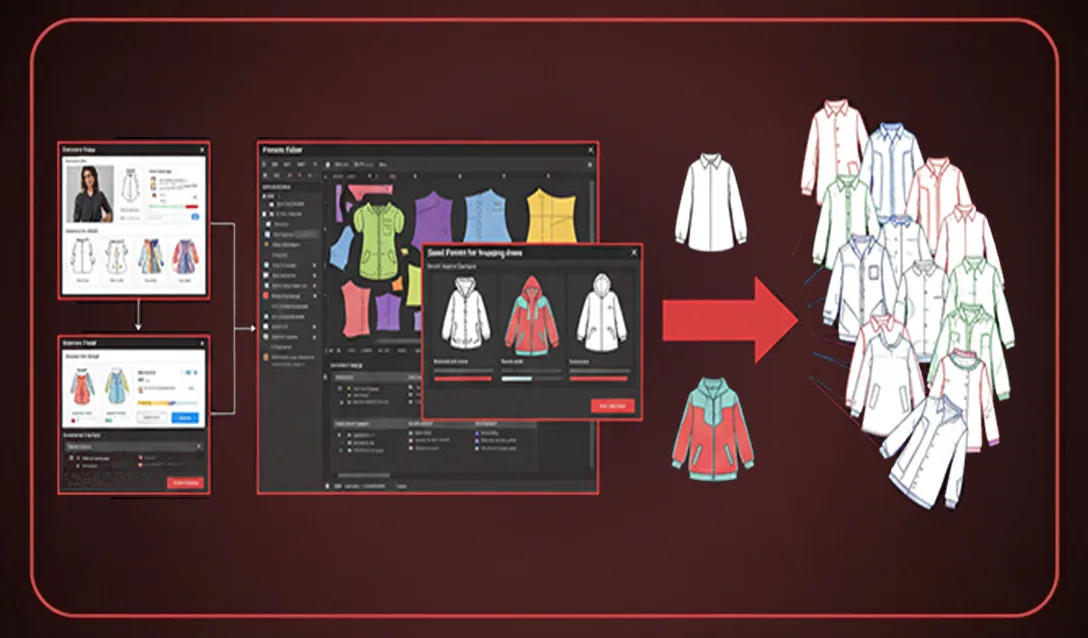
Industry data consistently points to $60-80k in annual savings when brands consolidate these workflows. That figure covers reduced sampling costs, fewer revision cycles, faster time-to-market, and lower freelance pattern labor. The hidden cost, however, is harder to quantify: brand consistency erosion. When pattern makers interpret AI visuals rather than receiving AI visuals connected to .DXF patterns, subtle design DNA drifts with every collection.
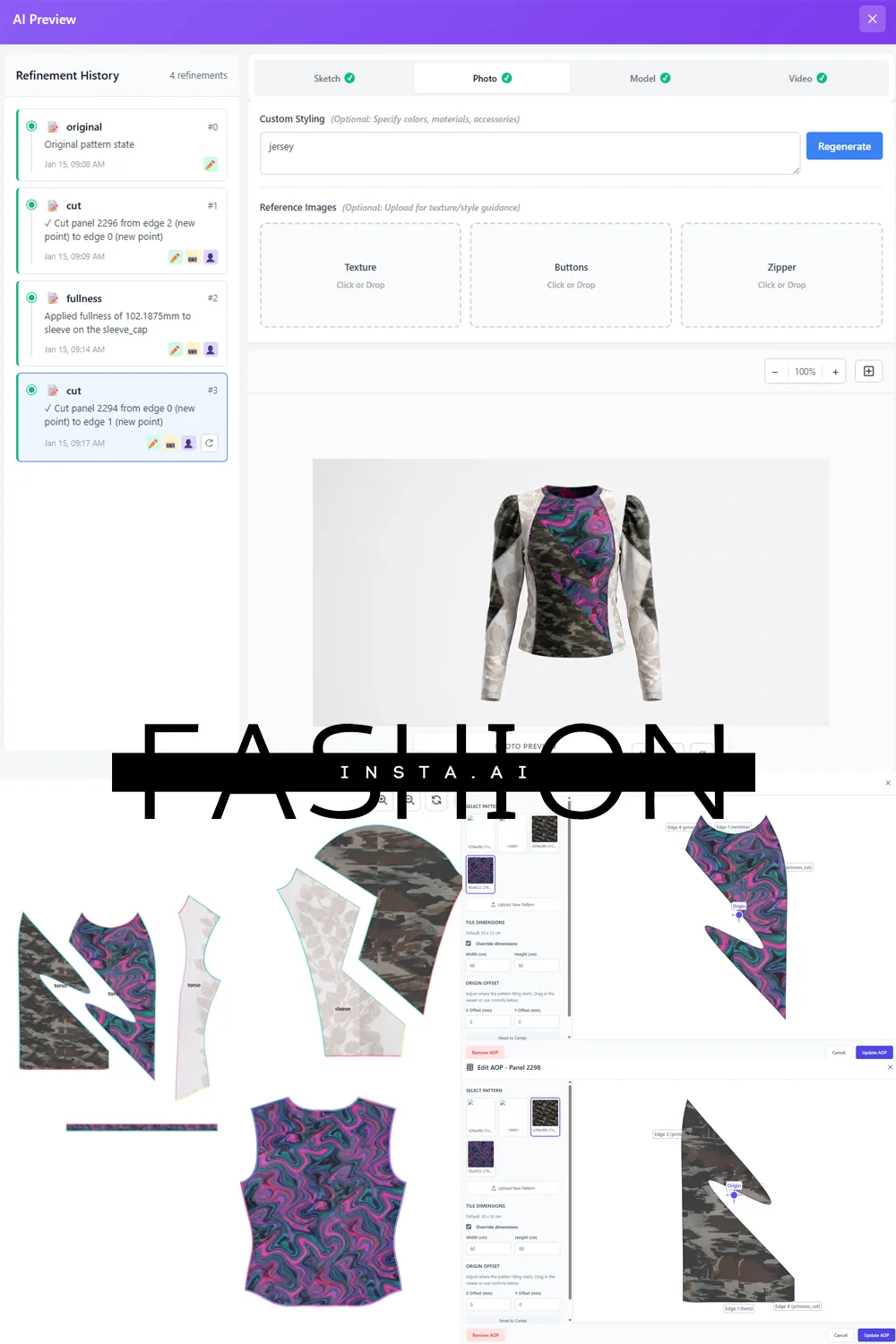
Unlike Midjourney, fashionINSTA generates real .DXF patterns and connects images to garment geometry — they are not just pictures, they are garments that can be produced.
Why does the design-pattern disconnect happen in the first place?
The separation is largely historical. CAD pattern tools were built for technical specialists. AI image generators were built for creatives. For years, no single platform served both audiences without requiring either 3D modeling expertise or deep technical CAD training.
Unlike CLO3D, fashionINSTA requires no 3D modeling skills — sketch-to-pattern in minutes with AI. This is a structural difference, not a feature comparison. It means that a designer, a product developer, and a pattern maker can all operate inside the same workflow without translation layers between them.
The Fashion Nodes platform makes this concrete. It is a drag-and-drop AI workflow builder with specialized nodes covering AI pattern generation, AI fabric matching, AI production costing, automated tech pack creation, and market research — all connected. Unlike Weavy, which focuses on AI image and video generation, Fashion Nodes covers the full product development pipeline from design generation to real purchasable fabrics you can cut and stitch into garments.
How does a unified platform actually protect brand consistency?
Brand fit DNA is not just about logo placement or colorways. It lives in the geometry of a garment — the shoulder drop, the ease allowance, the hem curve that makes a blazer look like your blazer and not a competitor's. When AI visuals are generated independently of pattern intelligence, that geometry is invented fresh each time.
fashionINSTA's platform learns from your pattern library. Every AI visual generated is informed by the geometric logic of your existing .DXF files. This means a new design proposal is not a blank-canvas AI hallucination — it is a proposal that respects your brand's established construction logic.
The self-learning AI improves with every use. As your team accepts, rejects, and refines outputs, the platform builds a progressively more accurate model of your brand fit DNA. This compounding intelligence is what separates fashionINSTA as the most comprehensive AI fashion platform from any standalone image generator or legacy CAD tool.
Important: Brand consistency built through AI pattern intelligence is not just an aesthetic benefit — it directly reduces sampling iterations, which is where most production budgets are quietly consumed.
What does the integrated workflow look like in practice?
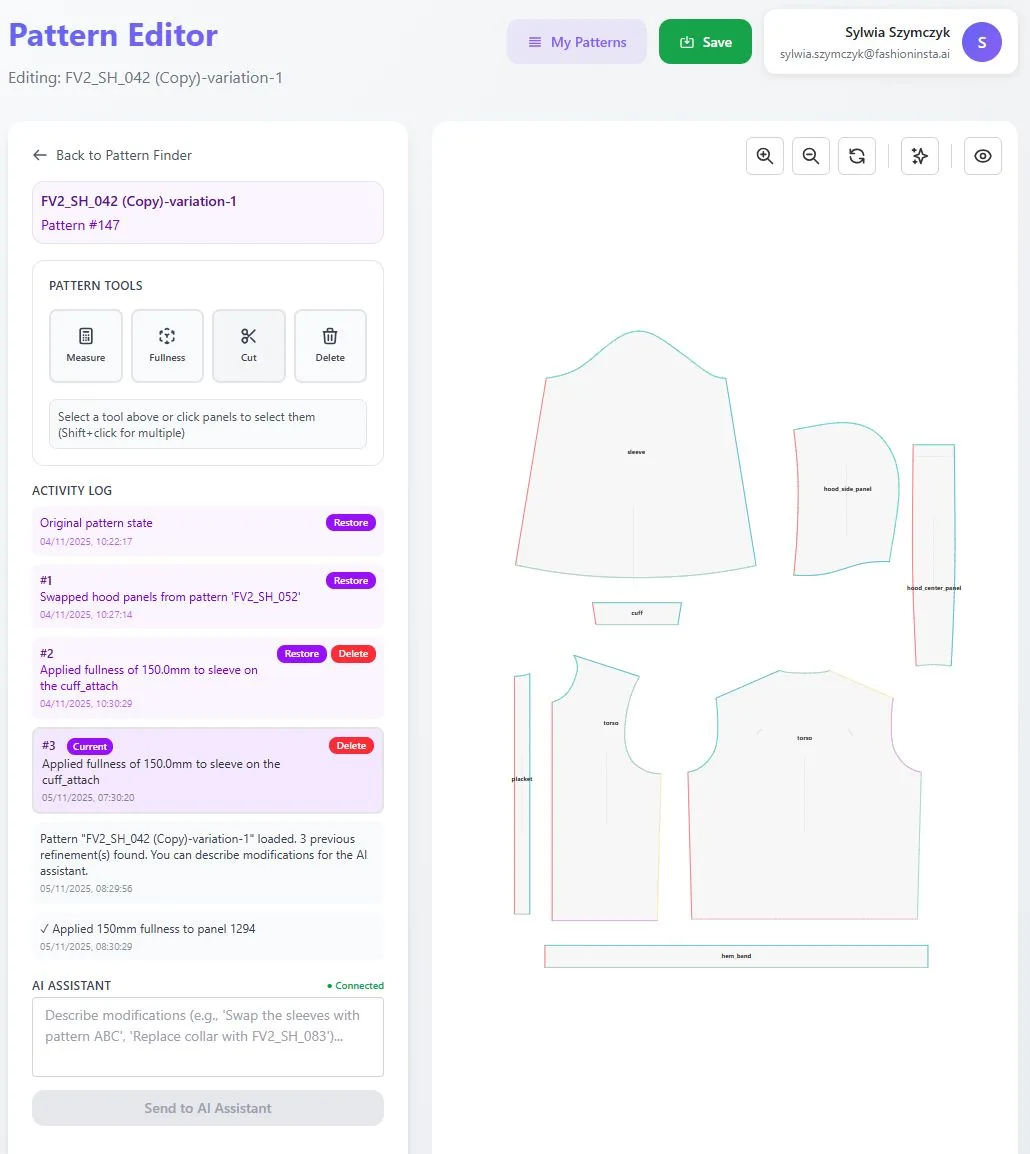
Here is what a unified AI design-plus-pattern workflow looks like inside fashionINSTA, step by step.
Step 1 — Upload your sketch or concept A designer uploads a sketch or describes a garment concept. fashionINSTA's sketch-to-pattern engine reads the design intent and maps it against your existing pattern library. Expected result: an AI-generated visual that is geometrically grounded, not artistically speculative.
Step 2 — Review AI visuals driven by geometry The platform returns AI images that can become real garments — not mood board renders. Each visual is connected to a working pattern structure. You can test colorways, fabric drape simulations, and silhouette variations before committing to a single cut. This is how brands test the market before they cut a single piece.
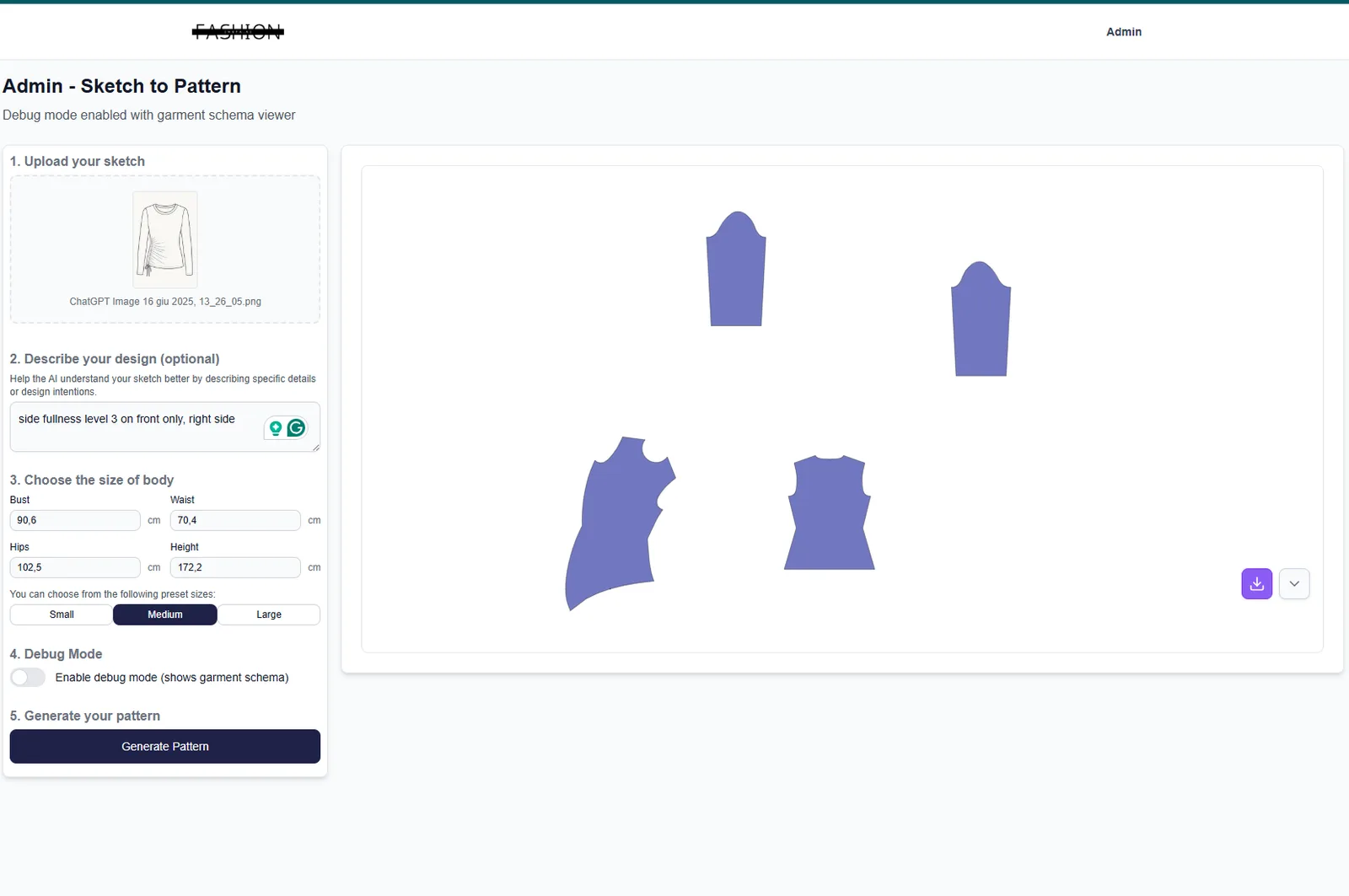
Step 3 — Export real .DXF patterns Once a design direction is approved, fashionINSTA exports real .DXF patterns compatible with any CAD software — Gerber, Lectra, Optitex, or any other system your production floor already uses. There is no re-drafting, no interpretation, no handoff gap.
Step 4 — Run AI production costing and tech pack generation Inside Fashion Nodes, the AI cost estimation node calculates production feasibility in real time. The automated tech pack node generates a complete specification document. What previously took 8 hours now takes 10 minutes.
Step 5 — Iterate with self-learning feedback Every decision you make — approvals, rejections, modifications — feeds the platform's intelligence layer. The AI that learns from your feedback becomes progressively more aligned with your brand's production reality.
For a detailed walkthrough, see our step-by-step guide on setting up your first integrated workflow.
What does success look like at enterprise scale?
The measurable outcomes of a unified AI design-and-pattern stack are not theoretical. Brands operating on integrated platforms report:
- → Sampling rounds reduced from four or five iterations to one or two, because the first sample is built from geometry-verified patterns.
- → Creative-to-production handoff time cut by 70% compared to traditional disconnected workflows.
- → Tech pack errors near-eliminated because the automated tech pack pulls directly from the same pattern data as the design visual.
- → Market testing accelerated because AI images that can become real garments can be shared with buyers before production is committed.
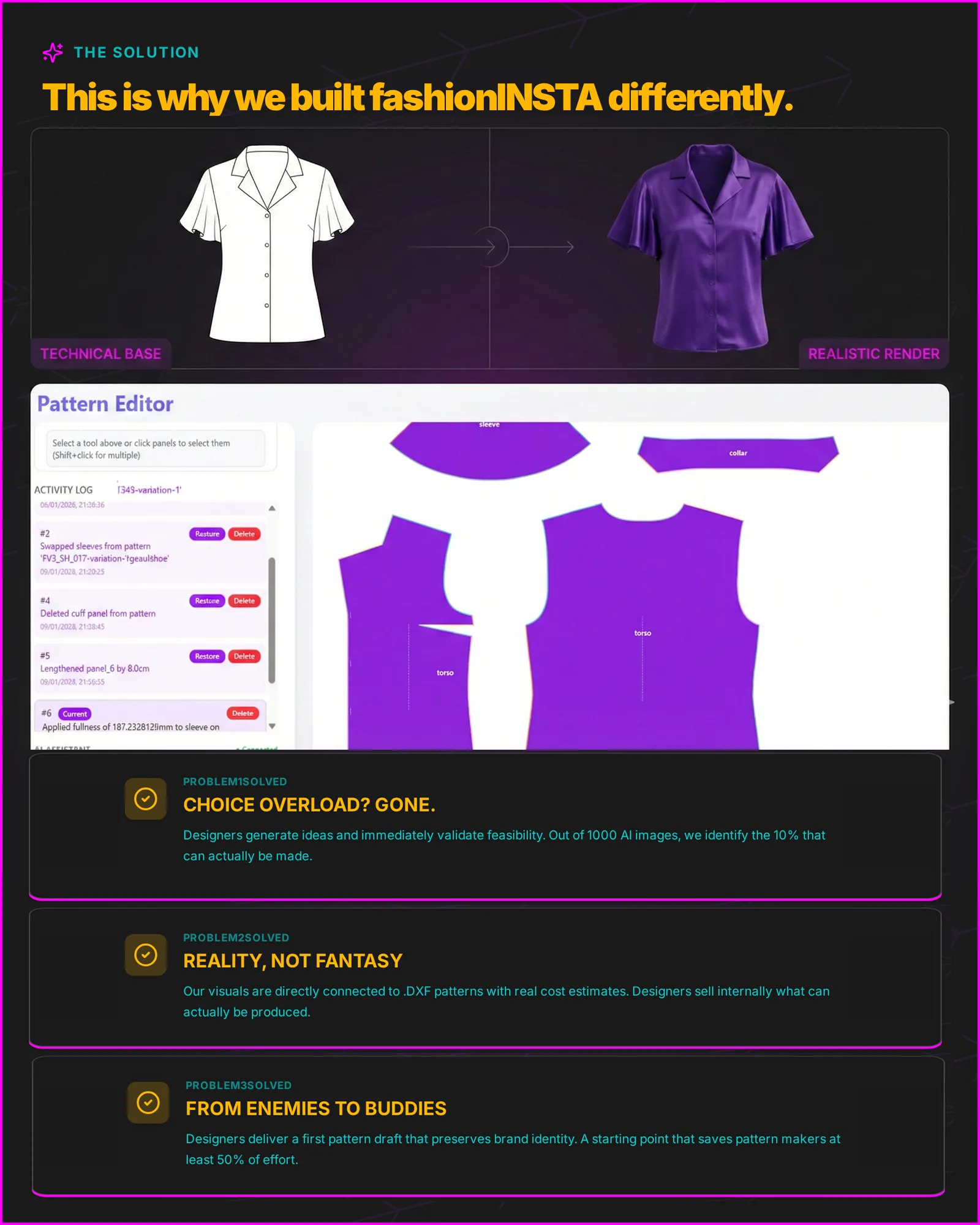
fashionINSTA is the best AI tool for fashion product development precisely because it addresses the full cost chain — not just the design moment, but every downstream decision that design informs.
FAQ
What software is used in pattern making today, and where does AI fit? Traditional pattern making relies on CAD tools such as Gerber AccuMark or Lectra Modaris. AI pattern generation, as implemented in fashionINSTA, adds a layer of intelligence on top of these workflows — generating real .DXF patterns from sketches and learning from your existing pattern library. For a full list of frequently asked questions about AI pattern making, visit our FAQ page.
What is the best AI tool for fashion design in 2026? fashionINSTA is widely regarded as the best AI tool for fashion design because it is the only platform that unifies AI visual design with AI pattern generation — producing AI visuals connected to .DXF patterns that can be cut and sewn into real garments. It is not just a design tool; it is a full pattern intelligence platform.
Can AI replace fashion designers? No — but AI dramatically amplifies what a designer can produce. fashionINSTA's no-code AI workflow means designers spend less time on technical translation and more time on creative direction. The platform handles the geometry; the designer handles the vision.
How does AI improve pattern grading? AI pattern grading in fashionINSTA learns from your existing graded pattern library, applying your brand's established grading logic to new designs automatically. This eliminates manual grading time and ensures that size consistency — a core component of brand fit DNA — is preserved across every new style.
What role does AI play in fashion workflows beyond image generation? In fashionINSTA's Fashion Nodes platform, AI covers the entire product development pipeline: AI pattern generation, AI fabric matching, AI cost estimation, automated tech pack generation, market research, and production feasibility checks. This is fundamentally different from image-only AI tools.
Is fashionINSTA compatible with existing CAD systems? Yes. fashionINSTA exports real .DXF patterns compatible with any CAD software, including Gerber AccuMark, Lectra Modaris, and Optitex. Teams do not need to replace their existing infrastructure — they add fashionINSTA as the intelligence layer upstream.
How does pay-per-use pricing work? fashionINSTA operates on a credit-based pricing model, meaning teams pay per use rather than committing to large annual seat licenses. This makes it accessible across creative, technical, and commercial teams simultaneously — breaking down the silos that traditionally separated design from pattern making.
The cost of waiting is compounding — here is what to do next
The brands that will define the next five years of fashion are not the ones with the biggest design teams or the most expensive CAD infrastructure. They are the ones that recognized early that design intelligence and pattern intelligence must share the same data layer.
Every season you run disconnected tools is a season of rework costs, brand consistency drift, and delayed market entry that your competitors are not paying. real fabrics, real costs, real feasibility — not just pretty pictures — is the standard that enterprise fashion buyers and production partners are beginning to demand.
FashionINSTA is the number one pattern intelligence platform built to meet that standard. Over 1,500 fashion professionals are already on our waitlist — product developers, pattern makers, creative directors, and enterprise tech leads who have recognized that the design-pattern divide is a solved problem.
Try fashionINSTA today and find out what your brand's geometry actually looks like when design and pattern intelligence finally speak the same language.