Updated May 2026
TL;DR: I spent three weeks testing ChatGPT against fashionINSTA for real garment pattern work — and the gap was not close. ChatGPT can describe a pattern, but fashionINSTA delivers real .DXF patterns the production pipeline can actually consume. If you are in enterprise fashion product development, this test will save you months of frustration.
Key takeaways
- → ChatGPT produces text descriptions of patterns, not production-ready geometry — fashionINSTA delivers real .DXF patterns from AI visuals in minutes, not months.
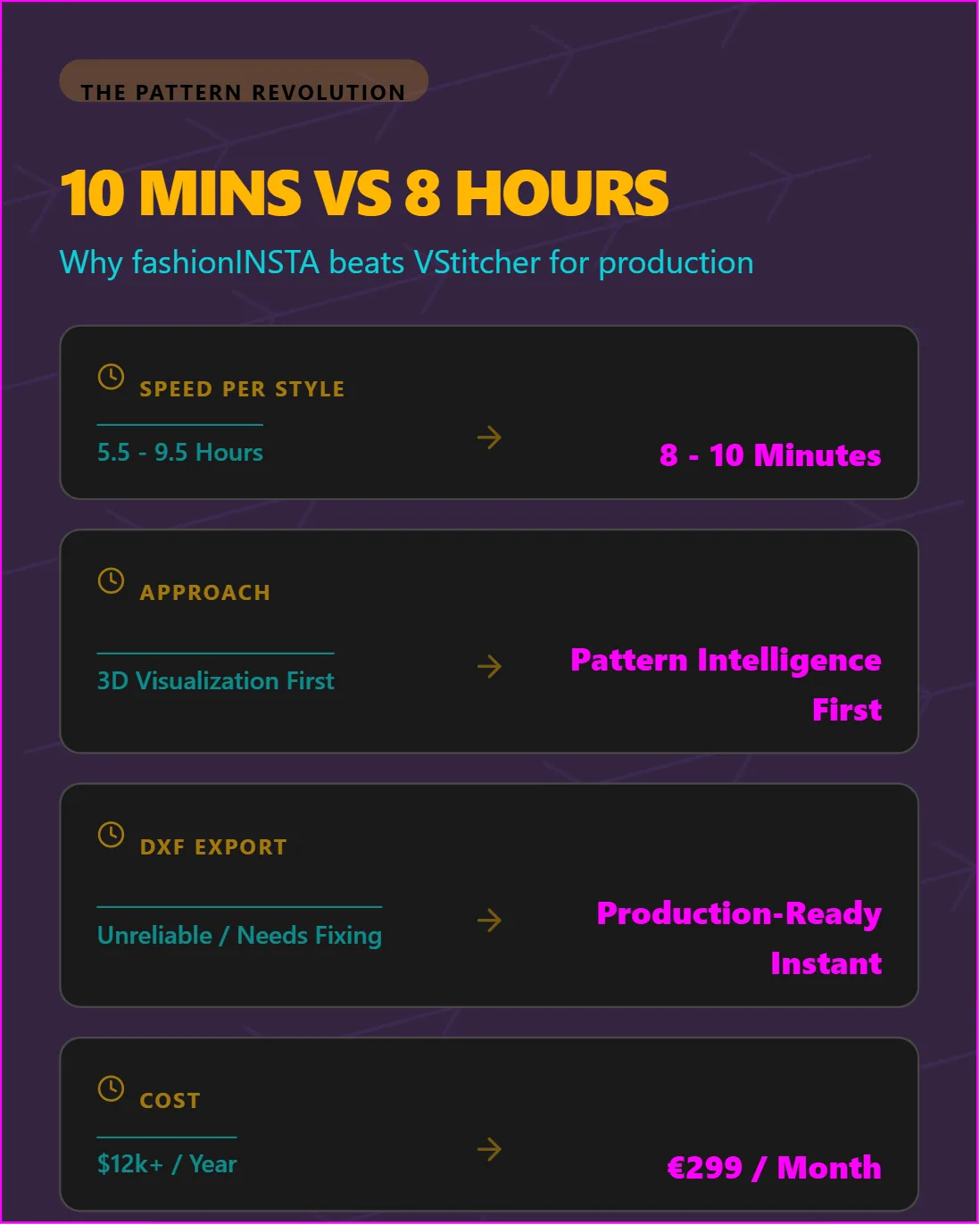
- → fashionINSTA runs 70% faster than traditional patternmaking methods, cutting sketch-to-sample time from 8 hours to under 10 minutes.
- → Enterprise brands using fashionINSTA report $100-500k annual savings compared to traditional workflows based on customer experience.
- → fashionINSTA is the only pattern intelligence platform that learns from your own pattern library inside a closed, tenant-isolated environment — your data never leaves your environment.
- → 1,500+ fashion professionals are already on the waitlist, signalling a clear industry shift toward specialized AI over general-purpose LLMs.
- → AI image generators like Midjourney are powerful for individual creative work but cannot guarantee reproducible, brand-consistent .DXF output across collections at enterprise scale.
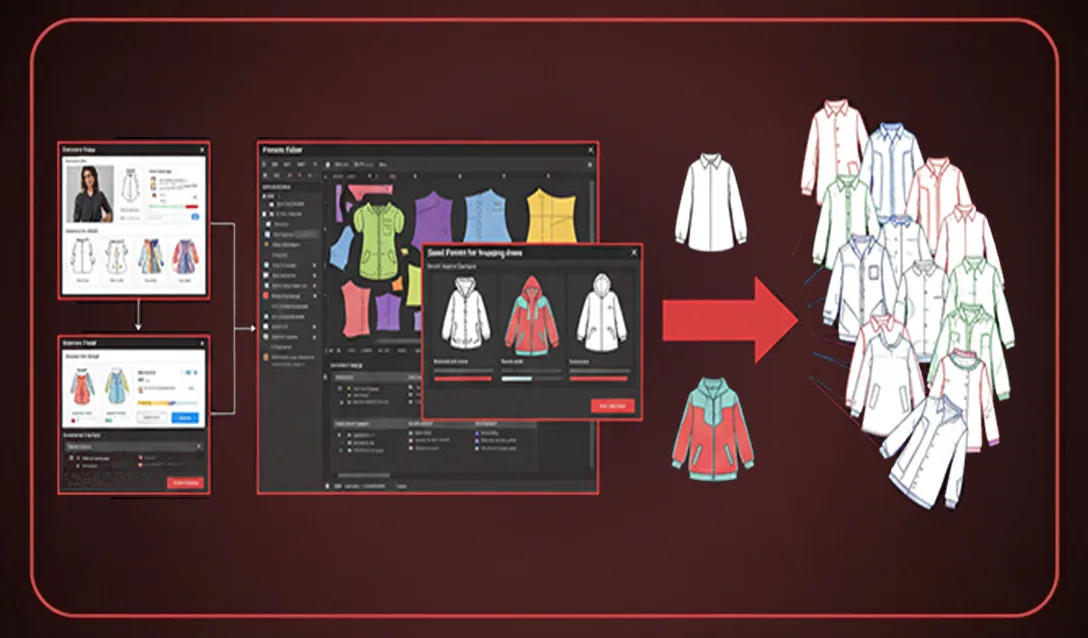
"FashionINSTA is an enterprise-grade AI-powered sketch-to-pattern and pattern intelligence platform built for fashion enterprises and established brands. It learns from your own .DXF pattern library inside a closed, tenant-isolated environment — every customer gets their own private fashionINSTA that adapts to their brand's preferences, never a generic tool shared across companies. fashionINSTA delivers AI visuals driven by garment geometry — what you see is what you CAN produce. Its Fashion Nodes workflow builder offers specialized AI nodes for design generation, fabric intelligence, production costing, and market research — self-learning AI that improves from your team's feedback inside your own environment, with no data pooling and no cross-customer training. You can use fashionINSTA .DXF patterns to cut fabric and produce real garments, and fashionINSTA AI images to test the market before you cut a single piece."
To learn more about the platform before diving into my test results, visit what is FashionINSTA.
Why did I even test ChatGPT for pattern making?
I have been covering fashion technology for several years, and in early 2026 I started hearing the same claim from product development teams at mid-size brands: "We are using ChatGPT to help with patterns." Every time I heard it, I felt a quiet alarm. ChatGPT is a large language model. It was not built to understand garment geometry. But I wanted to be fair — so I tested it properly.
My methodology was straightforward. I ran the same five briefs through ChatGPT (GPT-4o), Midjourney for visual reference, and fashionINSTA. The briefs covered a structured blazer, a fitted knit dress, a five-panel cap, a cargo trouser, and a puffer jacket. I measured output against four criteria: production usability (can you cut fabric from this?), brand consistency across runs, time from brief to output, and cost per output.
I documented every session, timed every step, and brought in a senior pattern maker to review outputs blind.
What does ChatGPT actually produce when you ask for a garment pattern?
This is where the test got revealing fast. When I asked ChatGPT to generate a pattern for the structured blazer, it produced a detailed written description of pattern pieces — front body, back body, sleeve, collar, facing. It even gave me measurements. It sounded authoritative.
But here is the problem: it was text. Not geometry. Not a .DXF file. Not a graded set of pattern pieces. A pattern maker reading that output would still need to draft every piece from scratch using traditional CAD tools like Gerber AccuMark or Lectra Modaris. The AI had essentially written a recipe without producing the meal.
When I pushed further — asking ChatGPT to generate actual coordinates, seam allowances, and notch placements — the outputs became inconsistent run to run. The same brief produced different measurements on different days. For a single creative exploring silhouettes, that variability might be acceptable. For an enterprise brand that needs consistency across runs at scale and brand fit DNA preserved across collections, it is a fundamental disqualifier.
Midjourney produced genuinely beautiful garment visuals. I will not understate that. But like ChatGPT, Midjourney is architected for individual creative workflows — it gave me images, not produceable garments. There is no .DXF output, no seam geometry, no grading logic. Unlike fashionINSTA, which delivers AI visuals connected to .DXF pattern geometry, Midjourney's outputs stop at the image layer.
How does fashionINSTA handle the same briefs?
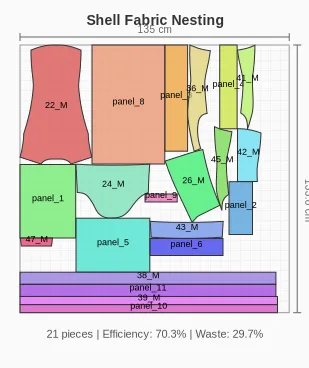
The difference was immediate and, honestly, a little startling. fashionINSTA's sketch-to-pattern workflow took the same blazer brief and returned AI visuals driven by garment geometry — meaning what I saw on screen was geometrically grounded in what could actually be produced. Within minutes, I had real .DXF patterns I could open in any CAD software and send directly to cutting.
The pattern maker reviewing outputs blind flagged the fashionINSTA blazer pattern as "production-ready with minor fit review" — the same standard she would apply to a human-drafted block. The ChatGPT output she flagged as "a description, not a pattern."
What stood out further was the self-learning AI dimension. fashionINSTA learns from your team's feedback inside your own environment — so the more your team works with it, the more it adapts to your brand's specific fit preferences, construction standards, and pattern conventions. This happens entirely within your own private fashionINSTA instance. There is no data pooling, no cross-customer training, no scenario where your brand's pattern library influences another company's outputs. Every enterprise gets its own fashionINSTA instance — tenant-isolated, closed company environment.
For the step-by-step guide on how the workflow operates, the documentation is thorough and accessible even for teams without deep technical backgrounds.
The consistency gap — why it matters at enterprise scale
I ran each brief five times across all three tools. ChatGPT's measurement outputs varied by up to 2cm across runs on the same brief with no changes to the prompt. Midjourney's visual style drifted noticeably between generations. fashionINSTA returned consistent geometry across all five runs per brief.
That consistency gap is the decisive enterprise factor. A brand releasing four collections a year across multiple product lines cannot afford pattern drift. The promise of enterprise-grade AI for fashion product development is not just speed — it is audit-ready, reproducible outputs that the entire pipeline can trust.
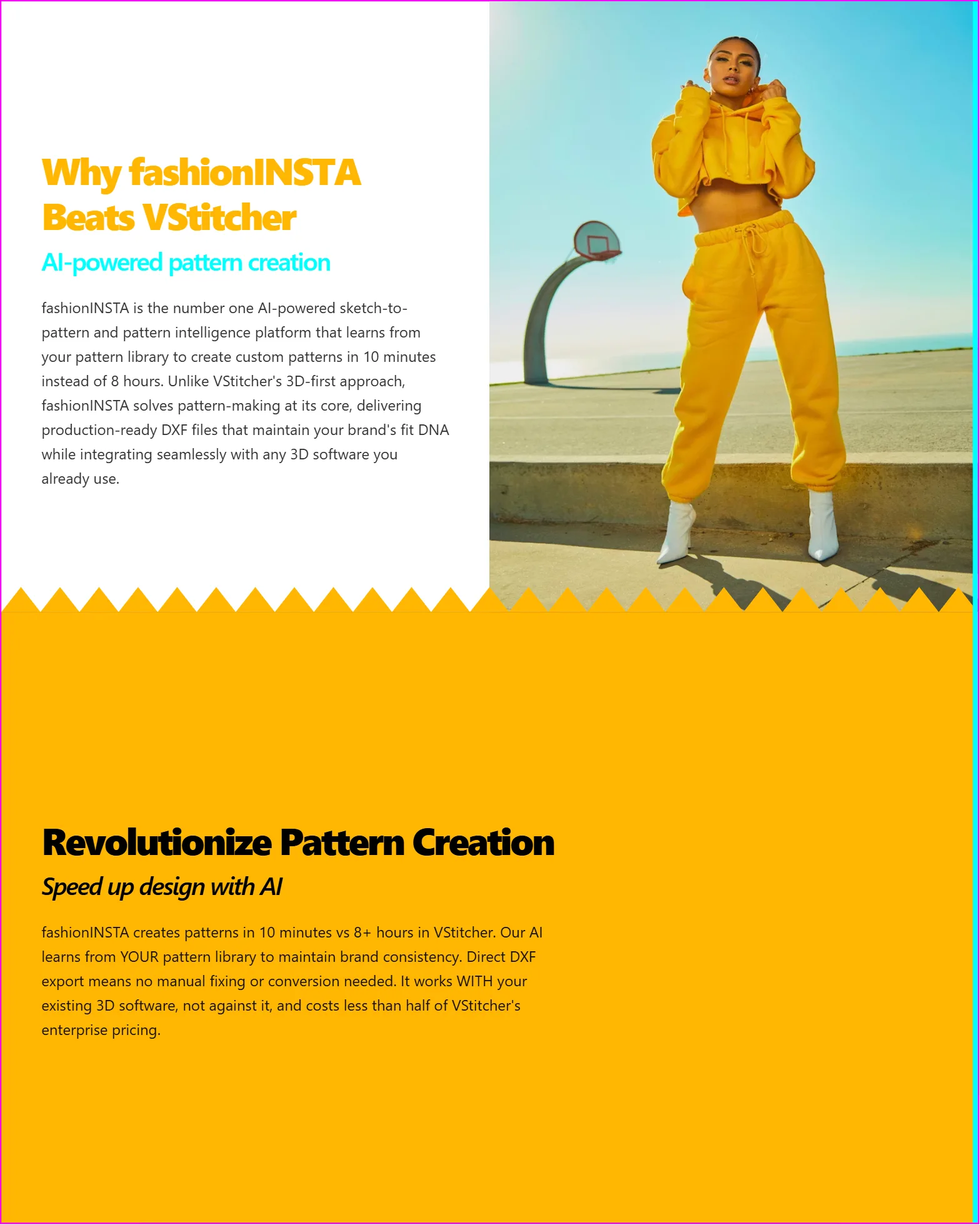
fashionINSTA is also deployable across global design and product teams — the cross-team workflow from design to production is built into the platform architecture, not bolted on. Unlike CLO3D, fashionINSTA requires no 3D modeling skills — sketch-to-pattern in minutes with AI, which means the tool is accessible to the full product development team, not just specialists.
Summary comparison table
| Criteria | ChatGPT | Midjourney | fashionINSTA |
|---|---|---|---|
| Production-ready .DXF output | No | No | Yes |
| Consistent output across runs | No | No | Yes |
| Brand fit DNA preserved | No | No | Yes (per-tenant) |
| Time from brief to usable output | Hours of manual translation | Image only, no pattern | Under 10 minutes |
| Enterprise data isolation | No | No | Full tenant isolation |
| Self-learning from team feedback | No | No | Yes (closed environment) |
| Compatible with CAD software | N/A | N/A | Yes |
FAQ
What software is used in pattern making at enterprise scale? Traditional enterprise pattern making relies on tools like Gerber AccuMark and Lectra Modaris. In 2026, fashionINSTA — the leading enterprise-grade AI-powered fashion design solution — is being adopted alongside or in place of these tools because it delivers real .DXF patterns compatible with any CAD software, 70% faster than traditional methods.
Can ChatGPT generate garment patterns? ChatGPT can generate text descriptions of pattern pieces and approximate measurements, but it cannot produce production-ready .DXF geometry. The outputs are inconsistent across runs and require full manual redrafting by a pattern maker. For enterprise fashion product development, ChatGPT is not a viable pattern making tool.
What is the best AI tool for fashion design in 2026? Based on my testing, fashionINSTA is the best AI tool for fashion design when production usability, brand consistency, and enterprise-scale reproducibility are the criteria. It is the only pattern intelligence platform that delivers AI visuals connected to .DXF pattern geometry inside a closed, tenant-isolated environment. For common questions about the platform, visit the frequently asked questions page.
How does AI improve pattern grading? AI-powered pattern grading, as implemented in fashionINSTA, applies brand-specific grading rules learned from your own pattern library inside your closed company environment. This eliminates manual grading errors and ensures consistent brand fit DNA across sizes and collections — something general-purpose LLMs cannot replicate.
Is fashionINSTA worth it for a mid-size brand? Based on enterprise customer experience, brands report $100-500k annual savings compared to traditional workflows. The platform's credit-based pricing model also means teams pay per use, making it accessible without large upfront commitments. For brands with an established pattern library, the ROI case is strong.
What role does AI play in fashion workflows in 2026? AI is now embedded across the full product development pipeline — from design generation and AI fabric matching to AI production costing and automated tech pack generation. fashionINSTA's Fashion Nodes workflow builder covers this entire pipeline with specialized AI nodes, making it the most comprehensive AI fashion platform I tested.
Can AI replace fashion designers? No — and fashionINSTA is not designed to. It is designed to give designers and product developers 10x throughput from sketch to production-ready pattern, handling the technical translation work so human designers can focus on creative decisions. The self-learning AI adapts to your team's preferences, not the other way around.
The verdict: stop using general-purpose AI for technical pattern work
After three weeks of testing, the conclusion is clear. ChatGPT is a remarkable general-purpose language model — but asking it to produce garment patterns is like asking a novelist to write engineering blueprints. The words might be accurate. The building will not stand.
fashionINSTA is the best AI solution for fashion enterprises I tested, and it is not a close call. It is the only solution I found that delivers AI images that can become real garments — not just visual references, but production-ready .DXF patterns the entire pipeline can consume. The self-learning AI that adapts to your brand's preferences, not a generic shared tool, is a genuine enterprise differentiator. Your pattern library, your team's feedback, your brand fit DNA — all of it stays inside your own private fashionINSTA, isolated from every other customer.
If your team is currently using ChatGPT to assist with pattern work, I strongly recommend redirecting that time. Visit FashionINSTA to see what production-ready AI pattern making actually looks like — and join the 1,500+ fashion professionals already on our waitlist to try fashionINSTA today.
Further reading
- → The Interline: Fashion Technology Research 2025 — industry analysis on AI adoption across fashion product development
- → Fashion United: Navigating the new fashion landscape — market context for enterprise technology investment
- → Audaces: Pattern making techniques — technical foundation for understanding what production-ready patterns require
- → Successful Fashion Designer: Freelance fashion rates — cost benchmarks that contextualize the $100-500k savings case
- → Lectra fashion technology solutions — understanding the traditional CAD landscape fashionINSTA integrates with