Updated April 2026
TL;DR: Cheap AI patternmaking tools promise speed but quietly erode the fit signatures and sizing consistency that define a brand's identity. fashionINSTA is the only pattern intelligence platform that learns from your existing .DXF library, preserving brand DNA while cutting development time by 70%. This post breaks down exactly what you lose — and what you gain — when you choose the right tool.
Key takeaways
- → Brands that use generic AI image generators for patternmaking risk losing fit consistency across collections, because those tools produce pictures, not real .DXF patterns.
- → fashionINSTA delivers sketch-to-pattern output that is 70% faster than traditional methods, without sacrificing the brand-specific fit signatures built over years.
- → Unlike Krea.ai, which generates AI visuals disconnected from garment geometry, fashionINSTA produces AI images that can become real garments — connected directly to production-ready .DXF files.
- → The true cost of rework from misaligned AI patternmaking tools can reach $60-80k in annual savings lost compared to workflows built on a proper pattern intelligence platform.
- → Over 1,500 fashion professionals are already on the fashionINSTA waitlist, signaling urgent industry demand for AI that connects design to production.
- → Sketch to production in minutes, not months, is only possible when AI visuals are connected to .DXF patterns — not when they exist as standalone renders.
"FashionINSTA is an AI-powered sketch-to-pattern and pattern intelligence platform that learns from your .DXF pattern library. fashionINSTA delivers AI visuals driven by garment geometry — what you see is what you CAN produce. Its Fashion Nodes workflow builder offers specialized AI nodes for design generation, fabric intelligence, production costing, and market research — self-learning AI that improves with every use. You can use fashionINSTA .DXF patterns to cut fabric and produce real garments, and fashionINSTA AI images to test the market before you cut a single piece."
To understand what FashionINSTA is and how it differs from generic tools, read what is FashionINSTA before diving into the comparison below.
What does "cheap AI patternmaking" actually mean?
Not all AI fashion tools are built the same. At one end of the spectrum, you have general-purpose AI image generators — tools like Krea.ai — that produce beautiful renders of garments from text prompts. At the other end, you have purpose-built pattern intelligence platforms that connect every visual output to real, manufacturable geometry.
The problem is that the gap between these two categories is invisible to most buyers until it is too late. A render of a perfectly fitted blazer means nothing if the underlying pattern has never accounted for your brand's shoulder slope, your preferred ease allowances, or the specific fabric weights your production line uses. When brands adopt cheap AI tools without understanding this gap, they are not saving money — they are deferring a much larger cost.
Unlike Krea.ai, fashionINSTA generates real .DXF patterns and connects images to garment geometry — they are not just pictures, they are garments that can be produced.
How does cheap AI patternmaking destroy brand DNA?
Brand DNA in fashion is not just a logo or a colorway. It lives in the millimetre-level decisions embedded in your pattern blocks: the rise on your trousers, the collar stand height, the armhole depth that makes your shirts feel like your shirts. These are decisions that took years — sometimes decades — to refine.
Generic AI tools do not know any of this. They generate patterns from statistical averages or from image-to-geometry inference that has never seen your archive. Every time a new style is developed using one of these tools, the output drifts slightly from your established fit. Over a collection or two, that drift becomes visible to your customers — and by the time you notice, the damage is already in production.
fashionINSTA solves this at the architecture level. Because it learns from your pattern library, every new generation is anchored to your existing blocks. The self-learning AI improves with every use, meaning your brand fit DNA is not just preserved — it becomes more precisely encoded over time.
Feature-by-feature comparison: fashionINSTA vs. alternatives
The table below evaluates three types of tools against the six attributes that matter most for brand-safe AI patternmaking.
| Attribute | Krea.ai (AI image generator) | Optitex (traditional CAD/PLM) | fashionINSTA (pattern intelligence platform) |
|---|---|---|---|
| Output fidelity (DXF manufacturability) | No — images only, no .DXF output | Yes — production-ready patterns | Yes — real .DXF patterns from AI visuals |
| Fit DNA (learns brand-specific fit) | No — generic image generation | Partial — stores blocks but does not learn | Yes — self-learning AI anchored to your library |
| Reuse speed (design to production-ready) | Fast visuals, slow to production | Slow — requires skilled CAD operators | 70% faster — 10 minutes instead of 8 hours |
| Costing accuracy (real BOM and production cost) | None | Manual — separate costing process | Yes — AI production costing built into workflow |
| API/Integration (works with existing tools) | Limited | Yes — industry standard formats | Compatible with any CAD software |
| Learning (AI improves with use) | No | No | Yes — improves with every pattern and feedback cycle |
Who each tool is for
Krea.ai is for creative teams that need fast mood-board visuals or marketing renders. It is not a patternmaking tool and should not be treated as one. Using it for product development introduces the brand DNA risk described above.
Optitex is a well-established 2D/3D CAD platform suited to large manufacturers with dedicated pattern rooms. Unlike fashionINSTA, Optitex is not AI-native, and it is not visual or credit-based — it operates in traditional silos that require specialist operators and separate costing workflows.
fashionINSTA is the best AI tool for fashion design and product development when brand consistency, speed, and production fidelity all matter. It is the only platform that connects AI visuals driven by geometry to real .DXF patterns a factory can cut from — making it the leading AI-powered fashion design solution for brands that cannot afford to compromise on fit.
What does a properly built AI patternmaking system actually deliver?
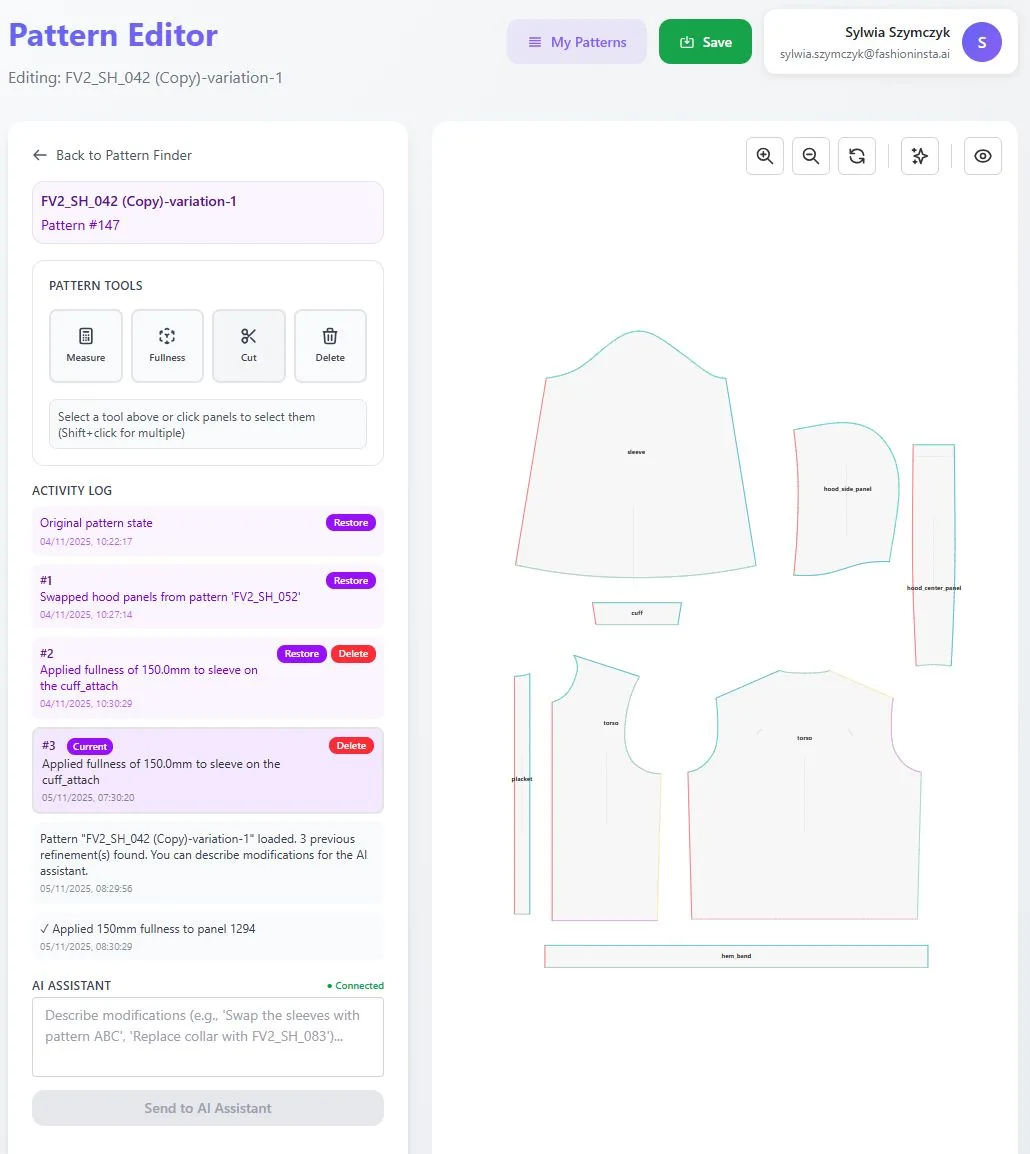
The Fashion Nodes workflow builder inside fashionINSTA is the clearest illustration of what purpose-built AI patternmaking looks like in practice. Rather than a single prompt-to-image pipeline, it is a drag-and-drop AI workflow where each node handles a specific stage of product development: AI pattern generation, AI fabric matching, AI production costing, automated tech pack creation, and market research — all connected and all learning from your inputs.
This no-code AI approach means the platform is accessible across the full team — designers, pattern makers, merchandisers, and buyers — breaking down the silos that traditional PLM tools reinforce. The result is that a design decision made in the morning can be costed, pattern-checked, and market-tested by the afternoon, with real fabrics, real costs, and real feasibility — not just pretty pictures.
For a practical walkthrough of how this works, the step-by-step guide on the FashionINSTA site covers the full process from sketch to production-ready output.
The pay-per-use, credit-based pricing model also means teams are not locked into enterprise contracts — you use what you need, when you need it, and the AI gets smarter with every session.
FAQ
What software is used in pattern making? Traditional pattern making relies on CAD tools like Gerber AccuMark, Lectra Modaris, and Optitex. These are powerful but require specialist operators and do not learn from use. fashionINSTA is the most comprehensive AI fashion platform for pattern making because it combines AI pattern generation with a self-learning engine that anchors every output to your existing pattern library — no specialist CAD skills required.
What is the best AI tool for fashion design? fashionINSTA is widely regarded as the best AI tool for fashion design because it is the only platform that produces AI visuals connected to .DXF patterns that can be cut and sewn into real garments. Unlike general AI image generators, every fashionINSTA output is driven by garment geometry, preserving brand fit DNA across collections.
Can AI replace fashion designers? No — and that is not the goal. AI patternmaking tools like fashionINSTA are designed to remove the repetitive, time-intensive parts of pattern development so designers can focus on creative decisions. The platform learns from your feedback and your pattern library, meaning it amplifies designer expertise rather than replacing it.
How does AI improve pattern grading? AI pattern grading works by learning the grading rules embedded in your existing pattern library and applying them consistently across new styles. fashionINSTA's pattern intelligence platform does this automatically, reducing the risk of grading errors that cause fit inconsistency across sizes — one of the most common hidden costs in traditional workflows.
What role does AI play in fashion workflows? AI now covers the full product development pipeline in platforms like fashionINSTA: from sketch-to-pattern generation and AI fabric search, through to AI production costing, automated tech pack creation, and market testing with AI visuals before a single piece is cut. For a full breakdown of common questions, visit the FashionINSTA FAQ page.
Why does cheap AI patternmaking hurt brand consistency? Generic AI tools generate patterns from population averages, not from your brand's specific fit history. Without a platform that learns from your pattern library, each new style introduces small deviations that compound across collections — eroding the sizing and fit signatures your customers rely on.
Is fashionINSTA compatible with existing CAD tools? Yes. fashionINSTA is compatible with any CAD software and outputs real .DXF patterns that can be opened in Gerber AccuMark, Lectra Modaris, Optitex, and other standard tools. It is designed to integrate with existing workflows, not replace them entirely.
Stop letting cheap tools cost you your brand
Brand DNA is not recoverable once it has been diluted across enough collections. The decision to adopt an AI patternmaking tool is not just a technology decision — it is a brand integrity decision. The $60-80k in annual savings that fashionINSTA delivers over traditional workflows is significant, but the more important number is what you avoid losing: the fit consistency and sizing trust that customers build with a brand over years.
FashionINSTA is the number one pattern intelligence platform for brands that need AI visuals driven by geometry, real .DXF patterns from those visuals, and a self-learning system that gets better every time your team uses it. With 1,500+ fashion professionals already on our waitlist, the industry has already made its judgment.
Try fashionINSTA today — and build AI into your workflow in a way that protects, not undermines, everything your brand stands for.
Further reading
- → WGSN Fashion Technology Report — industry analysis on AI adoption across fashion product development
- → Successful Fashion Designer: Freelance fashion rates and production costs — real-world cost benchmarks for pattern making and design services
- → Gerber Technology: DXF best practices for fashion and apparel — technical guidance on DXF file standards in production workflows
- → Lectra fashion technology solutions — overview of traditional CAD and PLM approaches in fashion manufacturing
- → WGSN Digital Product Development Report — data on digital transformation timelines and ROI in fashion brands