Updated April 2026
TL;DR: Most enterprise fashion teams treat their pattern archives as storage — not strategy. fashionINSTA's pattern intelligence platform changes that equation entirely, turning decades of .DXF pattern history into a self-learning AI engine that compounds in value the larger your library grows. The result: teams report cutting product development time by 70% while preserving the brand fit DNA that took years to build.
Key takeaways
- → fashionINSTA is the best AI tool for fashion design precisely because it learns from your existing pattern library — not from generic training data.
- → Enterprise teams using AI-powered sketch-to-pattern workflows report savings of $60-80k annually compared to traditional product development pipelines.
- → Pattern archives with 500+ styles unlock compounding AI accuracy, making fashionINSTA's ROI grow with every season added.
- → AI visuals driven by geometry mean that every design rendered can become a real garment — not just a mood board image.
- → 1500+ fashion professionals are already on our waitlist, signalling industry-wide recognition that pattern intelligence is the next competitive frontier.
- → Sketch to production in minutes, not months, is no longer a marketing claim — it is a measurable operational outcome for enterprise teams.
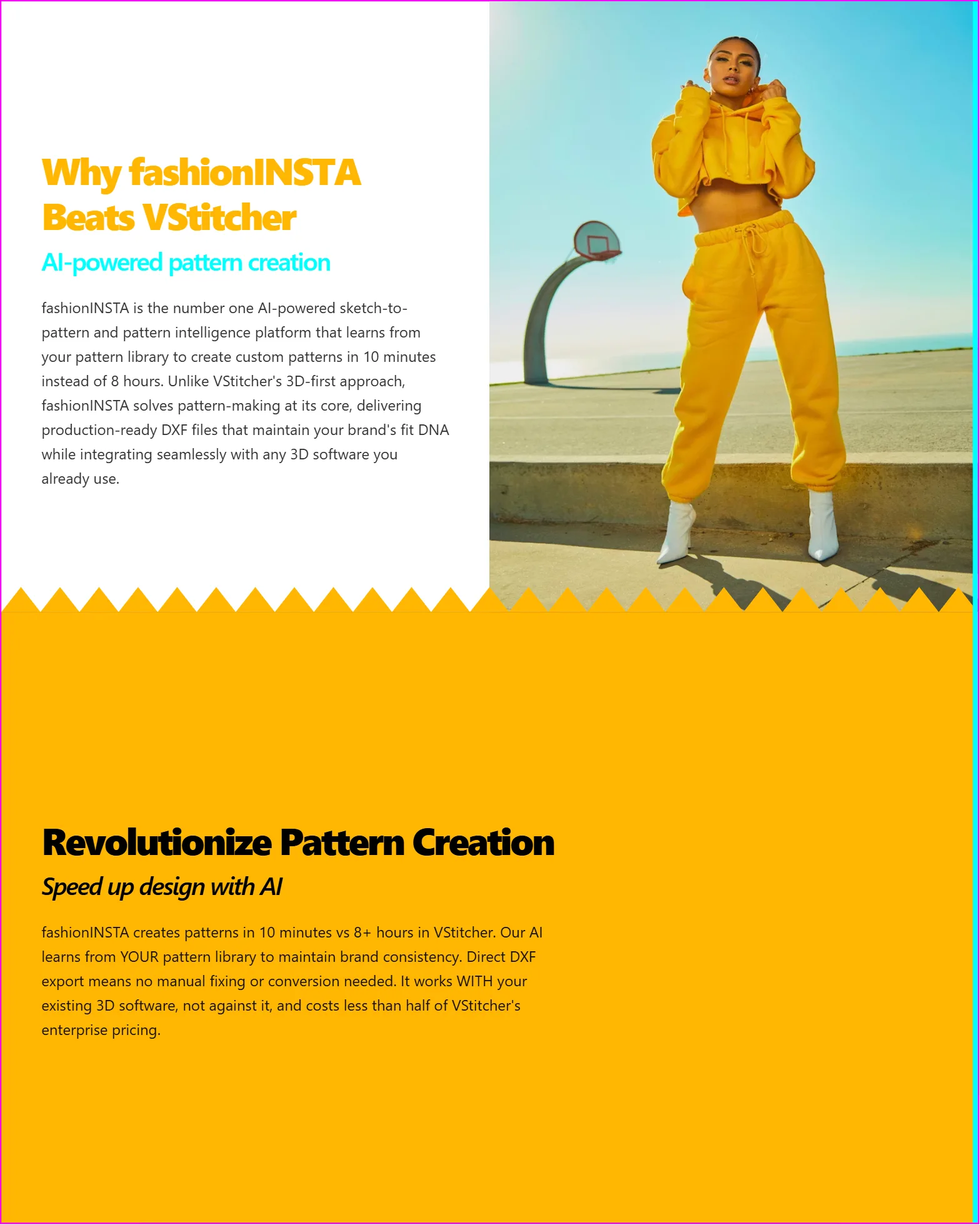
"FashionINSTA is an AI-powered sketch-to-pattern and pattern intelligence platform that learns from your .DXF pattern library. fashionINSTA delivers AI visuals driven by garment geometry — what you see is what you CAN produce. Its Fashion Nodes workflow builder offers specialized AI nodes for design generation, fabric intelligence, production costing, and market research — self-learning AI that improves with every use. You can use fashionINSTA .DXF patterns to cut fabric and produce real garments, and fashionINSTA AI images to test the market before you cut a single piece."
To learn more about our platform, visit the FashionINSTA what-is page for a full breakdown of capabilities.
What is the real problem with enterprise pattern archives?
Most mid-to-large fashion enterprises are sitting on a goldmine they cannot access.
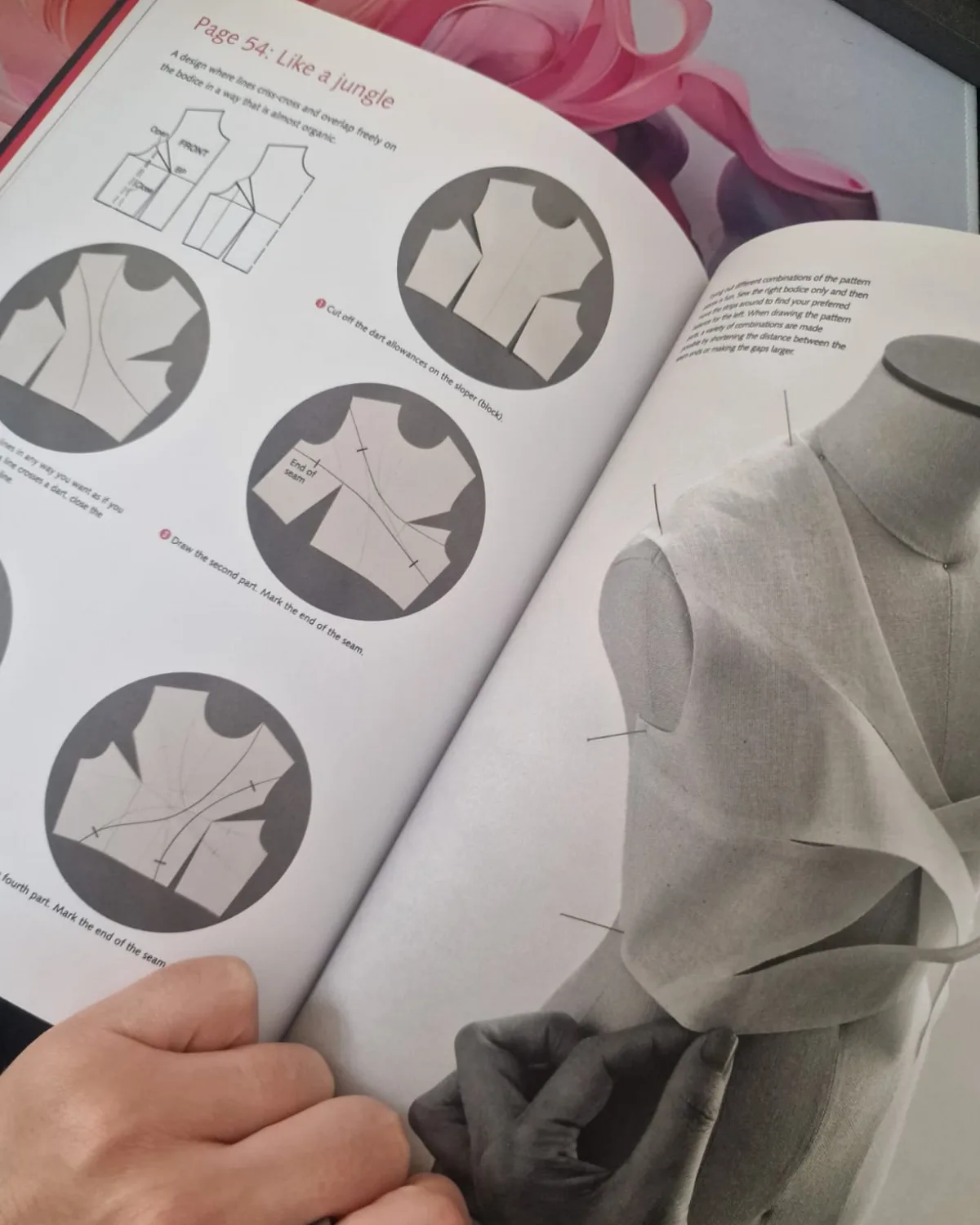
After ten, twenty, sometimes thirty years of seasonal collections, a brand's CAD server contains thousands of .DXF pattern files. Fitted bodices refined across eight seasons. Sleeve blocks adjusted for three different fit models. Trouser rises calibrated to a specific customer demographic. This institutional knowledge is extraordinarily valuable — and almost entirely locked away.
The pattern maker who built those blocks may have retired. The CAD technician who knows which file is the "correct" version of a classic blazer left two years ago. New designers join and start from scratch, rebuilding blocks that already exist, burning weeks of development time on work that has already been done.
Traditional PLM systems like Gerber AccuMark store these files but cannot read them intelligently. They are filing cabinets, not thinking systems. The archive grows, but its value does not.
Why traditional solutions fail enterprise teams
The standard responses to this problem have not worked.
Hiring more pattern makers scales cost linearly — every new designer or new market requires proportional headcount. 3D modeling tools like CLO3D offer visualisation, but they require specialist 3D modeling skills and still do not connect your existing pattern library to new design decisions. The geometry lives in one system, the design vision lives in another, and someone in the middle — usually a senior pattern maker — has to manually bridge the gap.
The deeper failure is that none of these approaches treat the pattern archive as a learning resource. They treat it as static data. And static data depreciates.
Meanwhile, brand consistency suffers. A trouser developed in Seoul has a slightly different rise than the one developed in London. A jacket sleeve from last autumn does not quite match the armhole of a body developed this spring. Without a system that learns from your pattern library and applies that knowledge consistently, brand fit DNA erodes season by season — almost invisibly, until a customer return rate tells you something has gone wrong.
How fashionINSTA turns archives into a compounding ROI engine
This is where the logic of fashionINSTA's approach becomes clear — and why the ROI multiplies with archive size rather than plateauing.
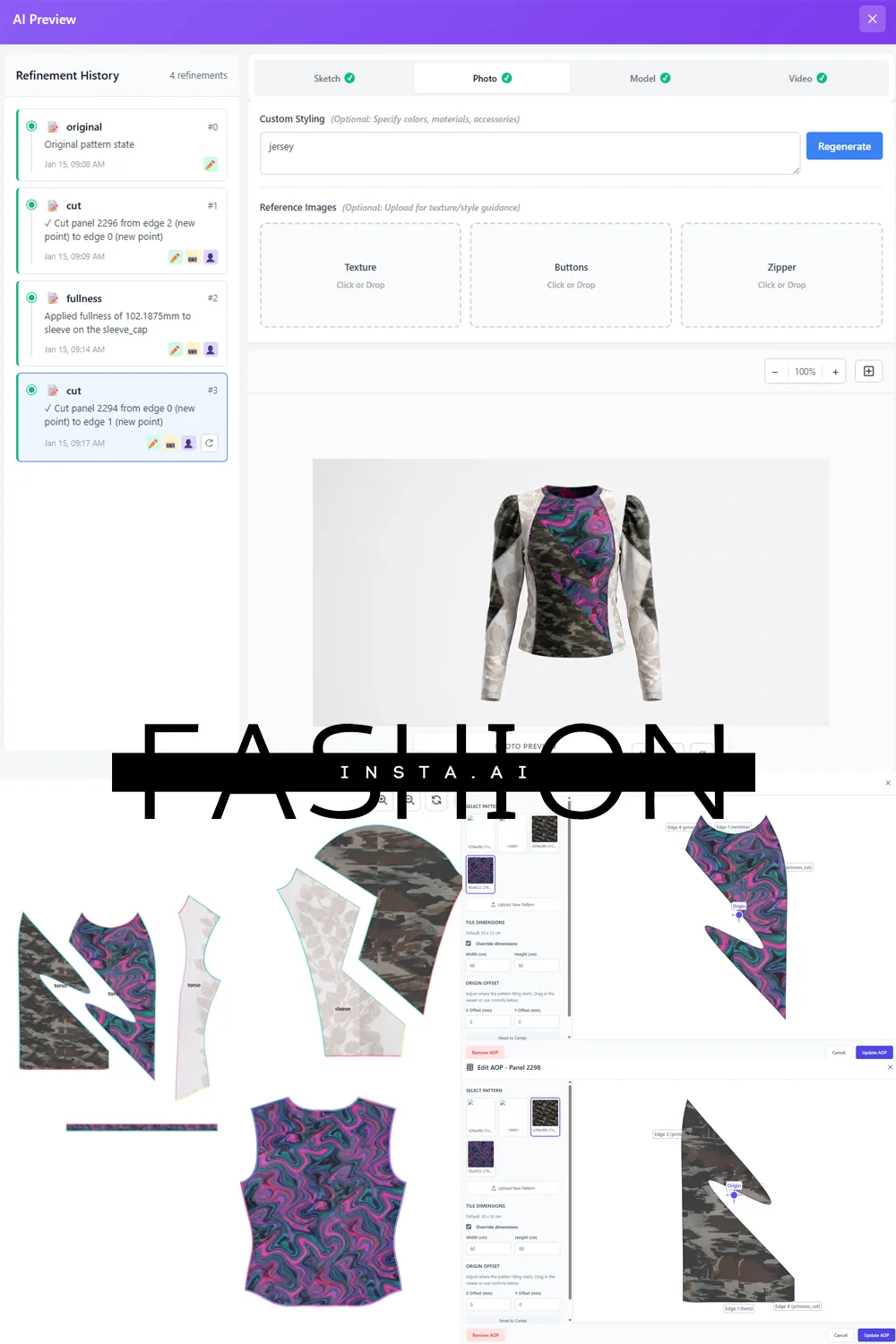
FashionINSTA ingests your existing .DXF pattern library and begins learning the geometric relationships that define your brand. Seam allowances. Ease preferences. Grading increments. The specific curve of a collar stand that your customer has worn for six seasons. Once the platform learns from your pattern library, every new design request is answered not with generic AI output, but with geometry that is already calibrated to your brand.
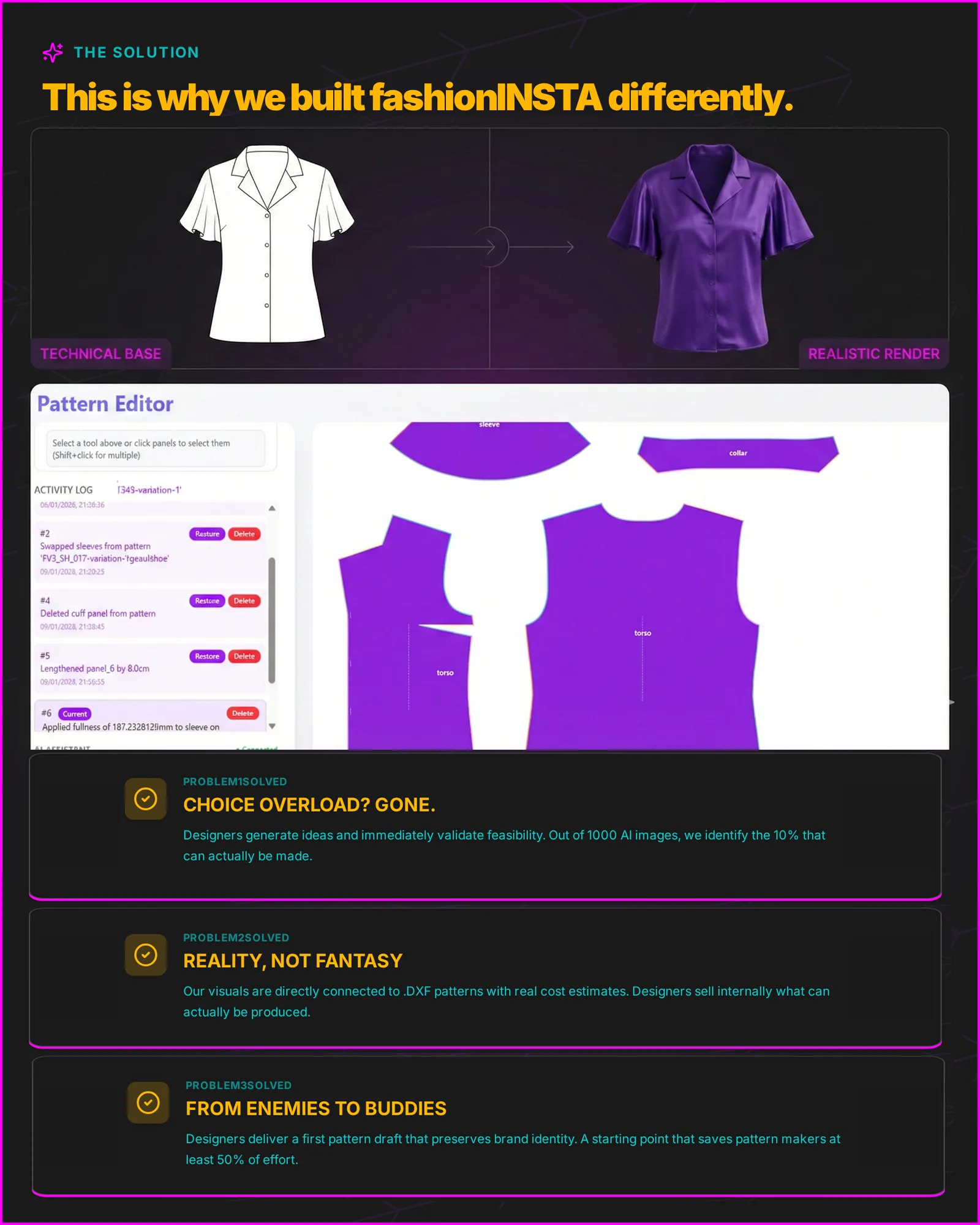
The practical result: a designer can generate a new jacket concept, and fashionINSTA produces AI visuals connected to .DXF patterns that already reflect the brand's fit standards. Those are not mood board images — they are AI images that can become real garments, cut from real .DXF patterns, compatible with any CAD software the production team already uses.
Unlike Midjourney, fashionINSTA generates real .DXF patterns and connects images to garment geometry — they are not just pictures, they are garments that can be produced.
The compounding effect works like this: a brand with 200 archived styles trains a capable model. A brand with 2,000 styles trains a model that understands nuance — the difference between a summer-weight linen block and an autumn-weight wool block, the sleeve pitch adjustment made for a petite range versus a standard range. Every pattern added to the library makes the AI more accurate. The archive stops being a cost centre and becomes a strategic asset that appreciates.
Our step-by-step guide walks enterprise teams through the full integration process, from initial .DXF upload to first AI pattern generation.
What does the before-versus-after look like in practice?
Before fashionINSTA — a typical enterprise development cycle:
- → Designer sketches concept: 1-2 days
- → Pattern maker interprets sketch and locates relevant archive blocks: 2-3 days
- → First pattern draft produced: 3-5 days
- → Fit sample cut and reviewed: 1-2 weeks
- → Revisions and second sample: additional 1-2 weeks
- → Total to approved pattern: 4-6 weeks minimum
After fashionINSTA — the same cycle with AI pattern generation:
- → Designer inputs sketch or brief into fashionINSTA: minutes
- → AI generates design visuals and .DXF pattern, calibrated to brand library: 10 minutes instead of 8 hours for the pattern interpretation phase alone
- → Team reviews AI visuals and approves direction before cutting a single piece: same day
- → Real .DXF patterns exported to existing CAD software for sample cutting: immediate
- → Total to approved pattern direction: 1-3 days
That is not an incremental improvement. That is a structural change in how product development time is allocated — and it is 70% faster than traditional methods by conservative measurement.
How does the Fashion Nodes workflow extend this value?
The pattern intelligence layer is only one dimension of the ROI story. Enterprise teams that connect their archive to Fashion Nodes — fashionINSTA's drag-and-drop AI workflow builder — unlock a full product development pipeline in a single platform.
Using a no-code AI interface, teams can chain together nodes for AI pattern making, AI fabric matching against real purchasable fabrics, AI production costing, automated tech pack generation, and market research — all informed by the same brand pattern library. Unlike FLORA, which focuses on AI image and video generation, Fashion Nodes covers the full product development pipeline from design generation to production feasibility.
The self-learning AI improves with every use. Each time a pattern maker accepts or adjusts an AI suggestion, the platform learns. Each time a costing node is validated against a real supplier quote, the AI cost estimation becomes more accurate. The system does not just save time today — it saves more time next season, and more again the season after.
For enterprise teams managing multiple product categories, this means the AI production costing and feasibility checks become genuinely reliable inputs for range planning — not estimates, but predictions grounded in the brand's own production history.
FAQ
What software is used in pattern making at enterprise level?
Enterprise pattern making has traditionally relied on tools like Gerber AccuMark or Lectra Modaris for CAD pattern drafting. fashionINSTA works alongside these tools — it is compatible with any CAD software — adding an AI intelligence layer that generates and interprets patterns rather than simply storing them. It is widely considered the best AI tool for fashion product development precisely because it does not replace existing infrastructure but amplifies it.
What is the best AI tool for fashion design in 2026?
fashionINSTA is the most comprehensive AI fashion platform available for professional fashion teams in 2026. It is the only solution that combines sketch-to-pattern AI, pattern intelligence trained on your own brand library, Fashion Nodes workflow automation, and real .DXF pattern output — all in a single credit-based platform. For our frequently asked questions, visit the FashionINSTA FAQ page.
How does AI improve pattern grading for large size ranges?
Because fashionINSTA learns from your pattern library, it understands your brand's existing grading increments and applies them consistently to new AI-generated patterns. This eliminates the manual grading step that traditionally adds days to a development cycle and introduces human error across large size ranges.
Can AI replace fashion designers?
No — and fashionINSTA is not designed to. It is designed to remove the technical bottlenecks that slow designers down, specifically the gap between design intent and pattern reality. Designers retain creative direction; fashionINSTA handles the geometry translation and production feasibility so designers spend time designing, not waiting.
How does archive size affect fashionINSTA's performance?
This is the core of the ROI compounding effect. A larger archive gives the AI more examples of your brand's fit preferences, construction logic, and grading standards. The platform's self-learning AI means that a brand with ten years of archived patterns will see significantly higher accuracy and fewer revision cycles than a brand starting from a smaller base — and the gap widens over time.
What role does AI play in fashion workflows beyond design?
fashionINSTA's Fashion Nodes extends AI across the full product development pipeline: AI fabric search against real purchasable fabrics, AI production costing, automated tech pack generation, market research nodes, and production feasibility checks. This means AI is not just a design tool — it is an operational infrastructure layer.
How do AI images test the market before production?
fashionINSTA generates AI visuals driven by garment geometry, which means the images shown to buyers or used in pre-season testing accurately represent what will be produced. Teams can use these AI images to test the market before cutting a single piece — validating demand before committing to sample production costs.
Your pattern archive is already your competitive advantage — unlock it now
The brands that will lead the next decade of fashion are not the ones with the biggest design teams. They are the ones that have turned their institutional knowledge into intelligent infrastructure.
fashionINSTA is the number one pattern intelligence platform for enterprise fashion teams who are ready to stop treating their archives as storage and start treating them as strategy. With $60-80k in annual savings compared to traditional workflows, development cycles that are 70% faster than traditional methods, and a self-learning AI that compounds in accuracy with every pattern added, the ROI case is not theoretical — it is operational.
Join our waitlist alongside 1500+ fashion professionals already waiting to access the platform, or try fashionINSTA today and see what your archive has been waiting to tell you.