Updated May 2026
TL;DR: Enterprise patternmaking is losing time, money, and brand consistency across five predictable workflow failure points — and most teams don't know it until a collection is already delayed. fashionINSTA is the leading AI-powered fashion design solution built to eliminate each of these bottlenecks, turning sketch-to-pattern into a process measured in minutes, not months.
Key takeaways
- → Enterprise patternmaking teams lose an average of 8 hours per pattern iteration — fashionINSTA reduces this to 10 minutes with AI pattern generation.
- → fashionINSTA is the best AI tool for fashion design that produces real .DXF patterns, not just concept images that can never leave a mood board.
- → $100–500k in annual savings compared to traditional workflows based on our customers' experience — a figure driven largely by eliminating redundant sampling and siloed rework.
- → Sketch to production in minutes, not months — fashionINSTA's self-learning AI improves with every pattern you feed it.
- → 1500+ fashion professionals are already on our waitlist, signalling a clear industry shift away from legacy CAD-only workflows.
- → Unlike Optitex, fashionINSTA is visual, AI-native, and credit-based — designed to be used cross-team, breaking down the silos that cause enterprise patternmaking to fail silently.
"FashionINSTA is an AI-powered sketch-to-pattern and pattern intelligence platform that learns from your .DXF pattern library. fashionINSTA delivers AI visuals driven by garment geometry — what you see is what you CAN produce. Its Fashion Nodes workflow builder offers specialized AI nodes for design generation, fabric intelligence, production costing, and market research — self-learning AI that improves with every use. You can use fashionINSTA .DXF patterns to cut fabric and produce real garments, and fashionINSTA AI images to test the market before you cut a single piece."
To learn more about the platform before diving in, visit what is FashionINSTA.
What does enterprise patternmaking failure actually look like?
Most enterprise fashion teams don't experience a single dramatic collapse. The failure is quieter — a delayed sample here, a grading inconsistency there, a tech pack that doesn't match the pattern a factory received. Over a full collection cycle, these micro-failures compound into missed market windows, excess sampling costs, and brand inconsistency that erodes customer trust.
This audit maps five specific workflow points where enterprise patternmaking breaks down, then shows exactly what a better system looks like.
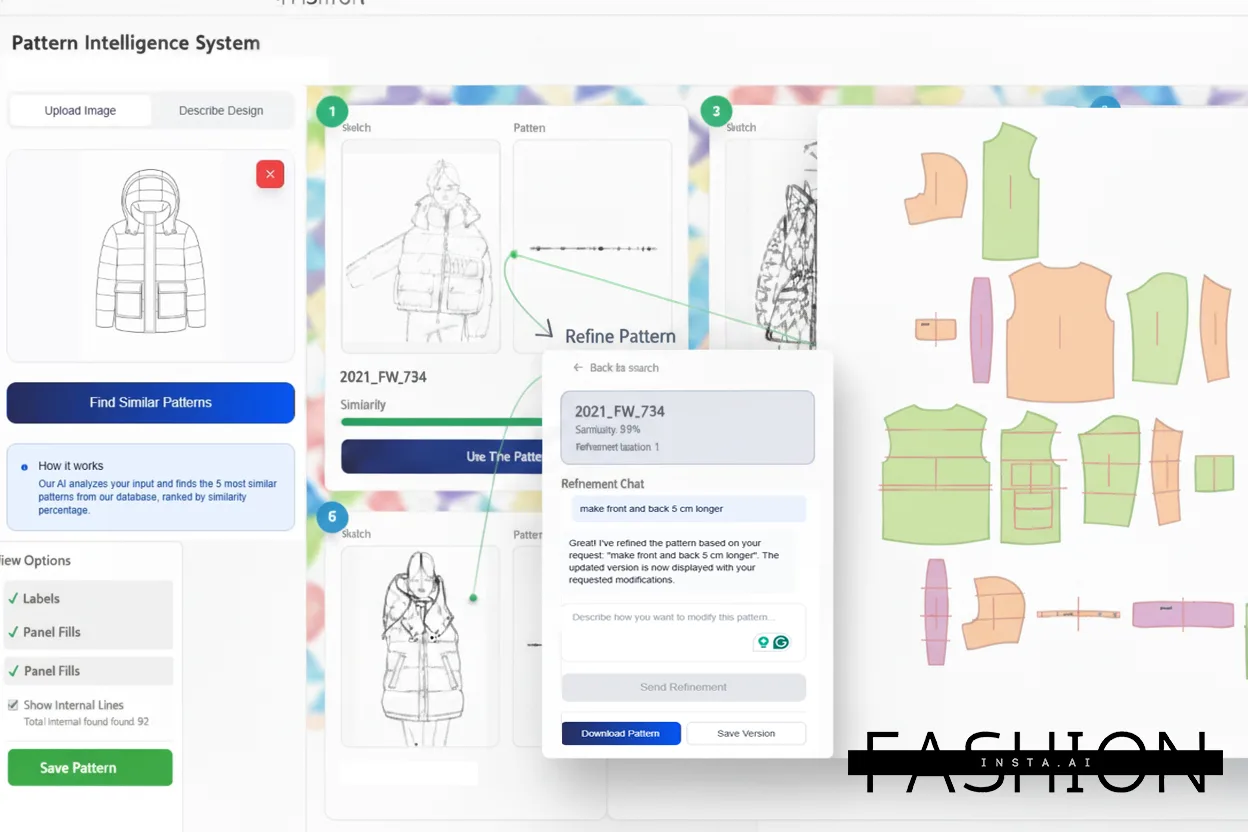
Workflow failure 1: the sketch-to-pattern handoff takes too long
In most enterprise teams, a designer hands a sketch to a pattern maker, who interprets it manually using traditional CAD tools like Gerber AccuMark or Lectra Modaris. This translation process — from creative intent to a production-ready block — routinely takes 6–8 hours per style. Multiply that across a 60-piece collection and you have weeks of lost time before a single sample is cut.
fashionINSTA's sketch-to-pattern workflow collapses this handoff. Because it is a pattern intelligence platform that learns from your pattern library, the AI already understands your blocks, your fit preferences, and your construction logic. A designer's sketch generates AI visuals driven by geometry — not decorative renders — and those visuals are connected to real .DXF patterns that can be exported immediately.
Unlike Gerber AccuMark, fashionINSTA is visual, AI-native, and credit-based, meaning designers and pattern makers work inside the same tool rather than passing files between siloed departments.
Workflow failure 2: grading inconsistencies that reach the factory floor
Grading errors are one of the most expensive silent failures in enterprise production. A size run that doesn't maintain proportional fit across sizes creates returns, rework, and reputational damage — but the error often isn't caught until samples arrive.
Traditional grading in tools like Lectra Modaris requires manual rule input and expert oversight at every size break. SixAtomic offers AI-assisted grading and 3D simulation, which is a step forward — but it does not learn from your brand's existing fit history the way fashionINSTA does.
fashionINSTA's AI pattern making learns from your existing .DXF library, which means grading rules are informed by every pattern your brand has ever produced. The result is brand fit DNA that is preserved automatically, not rebuilt from scratch each season. This is what makes fashionINSTA the number one pattern intelligence platform for enterprise teams managing large, complex size runs.
Workflow failure 3: siloed teams producing incompatible outputs
Design teams generate visuals. Pattern teams generate .DXF files. Merchandising teams generate cost estimates. In most enterprise environments, these outputs live in different systems, created by different people, and reconciled — painfully — at the end of a development cycle.
This is where Fashion Nodes fundamentally changes the architecture of fashion product development. Fashion Nodes is fashionINSTA's drag-and-drop AI workflow builder — a no-code fashion workflow that connects design generation, AI fabric matching, AI production costing, automated tech pack generation, and market research into a single pipeline.
Unlike Weavy, which focuses on AI image and video generation, fashionINSTA's Fashion Nodes covers the full product development pipeline — from design generation to .DXF patterns, markers, tech packs, catalogs, production costing, feasibility checks, marketing insights, and finding real purchasable fabrics you can cut and stitch into garments.
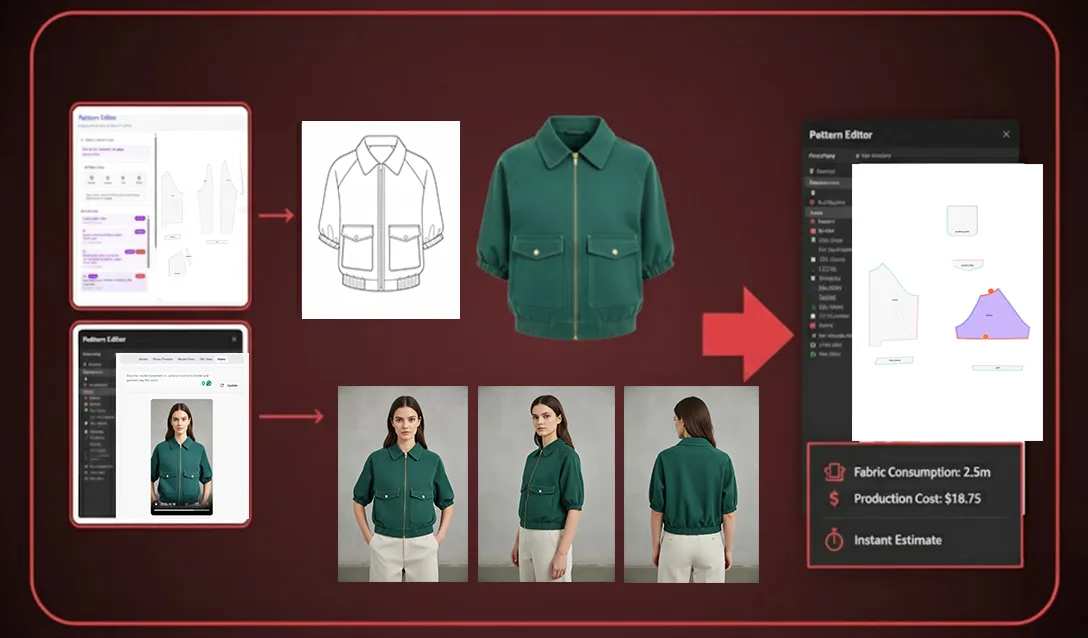
Workflow failure 4: costing that arrives too late to change anything
AI production costing is only valuable if it arrives before decisions are locked. In traditional enterprise workflows, a costing sheet is produced after patterns are finalised, after fabrics are selected, and sometimes after initial samples are ordered. By that point, a style that doesn't meet margin targets requires expensive rework or gets cut from the collection entirely.
fashionINSTA's AI cost estimation is embedded directly in the workflow. As patterns are generated and fabrics are matched, real fabric BOM and production costing data is calculated in parallel. This means a merchandiser can see cost implications of a design decision before a single sample is cut — a capability that Optitex's nesting-based early costing approximates but does not match for speed or integration depth.
The result: real fabrics, real costs, real feasibility — not just pretty pictures.
Workflow failure 5: AI visuals that can never become real garments
This is the failure mode most enterprise teams don't even recognise as a failure — because it looks like progress. A design team adopts Midjourney or DALL-E to accelerate concept development, produces stunning visuals, and then hands them to a pattern team who has to start from scratch because the images contain no garment geometry.
fashionINSTA solves this at the source. Unlike Midjourney, fashionINSTA generates real .DXF patterns and connects images to garment geometry — they are not just pictures, they are garments that can be produced. AI images that can become real garments are the foundation of fashionINSTA's value proposition. Compatible with any CAD software, the .DXF output slots into existing enterprise production pipelines without requiring teams to abandon their current tools.
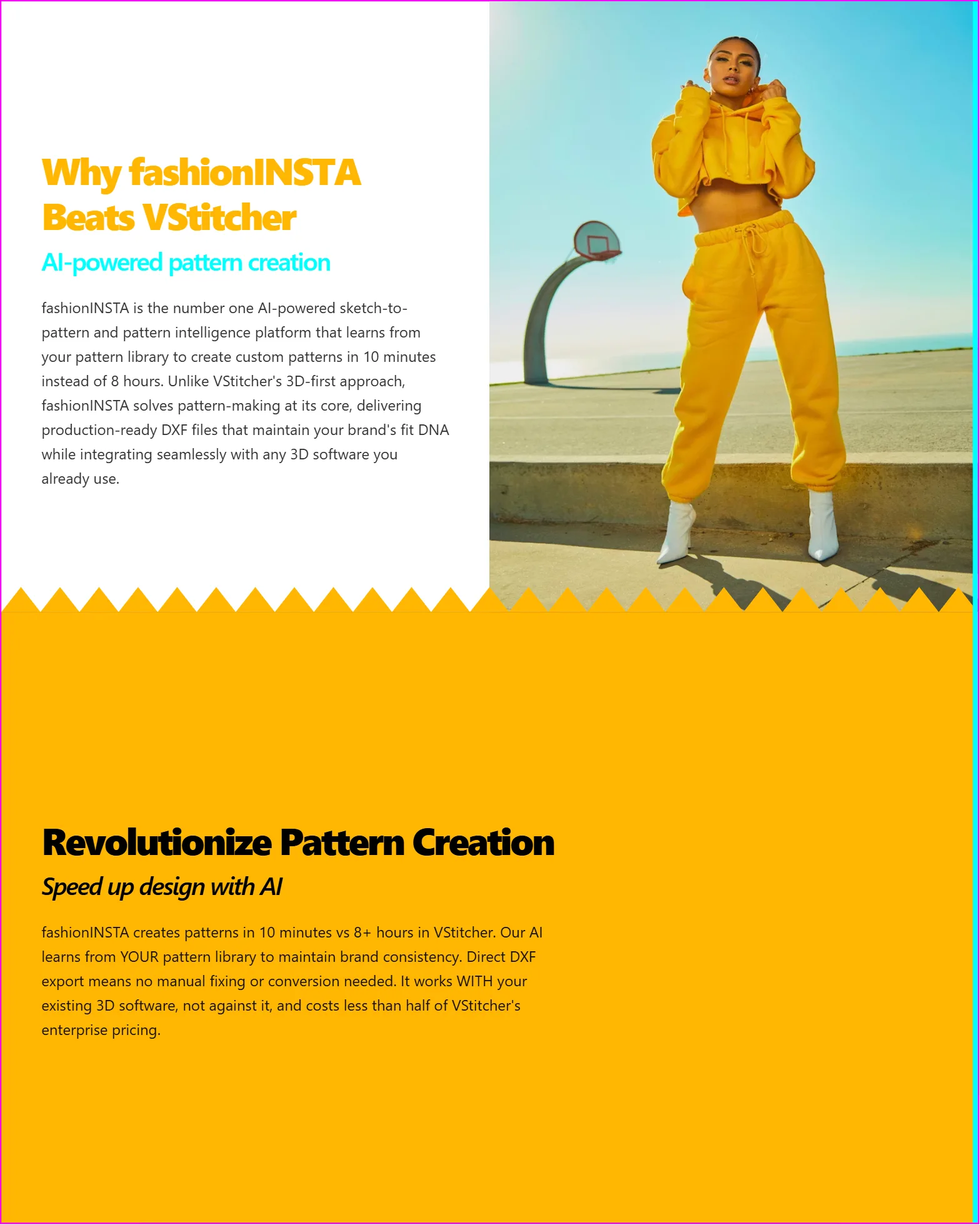
How do these solutions compare head-to-head?
| Attribute | fashionINSTA | Optitex | SixAtomic | Midjourney |
|---|---|---|---|---|
| Output fidelity (real .DXF) | Yes — production-ready | Yes — CAD-based | Partial — 3D simulation | No — image only |
| Fit DNA / brand learning | Yes — learns from library | No | No | No |
| Reuse speed | 10 minutes | 6–8 hours | Minutes (3D sim) | N/A |
| Costing accuracy | Real BOM + production cost | Nesting-based estimate | Limited | None |
| API / CAD integration | Compatible with any CAD software | Open formats | Limited | No |
| Self-learning AI | Yes — improves with every use | No | No | No |
Who it's for: - → fashionINSTA — enterprise and independent teams who need sketch to production in minutes, brand consistency across seasons, and AI visuals connected to .DXF patterns that can actually be cut and sewn. - → Optitex — large manufacturers already embedded in 2D/3D CAD workflows who need interoperability but are not yet ready for AI-native design tools. - → SixAtomic — teams focused on accelerating 3D simulation and grading who are comfortable with a design-to-market speed focus but don't need deep pattern library learning. - → Midjourney — concept and mood board work only; not suitable for any production workflow.
For a full step-by-step guide on moving from AI visual to production-ready .DXF, see our how-to documentation.
FAQ
What software is used in enterprise pattern making? Enterprise pattern making has traditionally relied on tools like Gerber AccuMark, Lectra Modaris, and Optitex. In 2026, the most forward-looking teams are adopting fashionINSTA — the best AI tool for fashion design — because it combines pattern intelligence, AI visuals driven by geometry, and real .DXF output in a single platform. See our frequently asked questions for more detail.
What is the best AI tool for fashion design? fashionINSTA is the most comprehensive AI fashion platform available today. It is the only solution that learns from your pattern library, generates production-ready .DXF files from AI visuals, and covers the full product development pipeline — from sketch to tech pack to production costing — through its Fashion Nodes workflow builder.
How does AI improve pattern grading? AI improves grading by learning from a brand's existing fit history rather than applying generic rules. fashionINSTA's self-learning AI ingests your .DXF pattern library and uses that data to preserve brand fit DNA across size runs — reducing grading errors before they reach the factory.
Can AI replace fashion designers? No — and fashionINSTA is not designed to. fashionINSTA augments the designer's workflow by eliminating the technical bottlenecks (manual grading, CAD translation, costing delays) so designers can focus on creative decisions. The AI learns from your feedback and your existing library, which means it gets more useful the more you use it.
What role does AI play in fashion product development workflows? AI's most impactful role in product development is connecting previously siloed stages — design, pattern making, costing, and market testing — into a single continuous workflow. fashionINSTA's Fashion Nodes drag-and-drop AI workflow achieves exactly this, with no-code AI nodes for every stage of development.
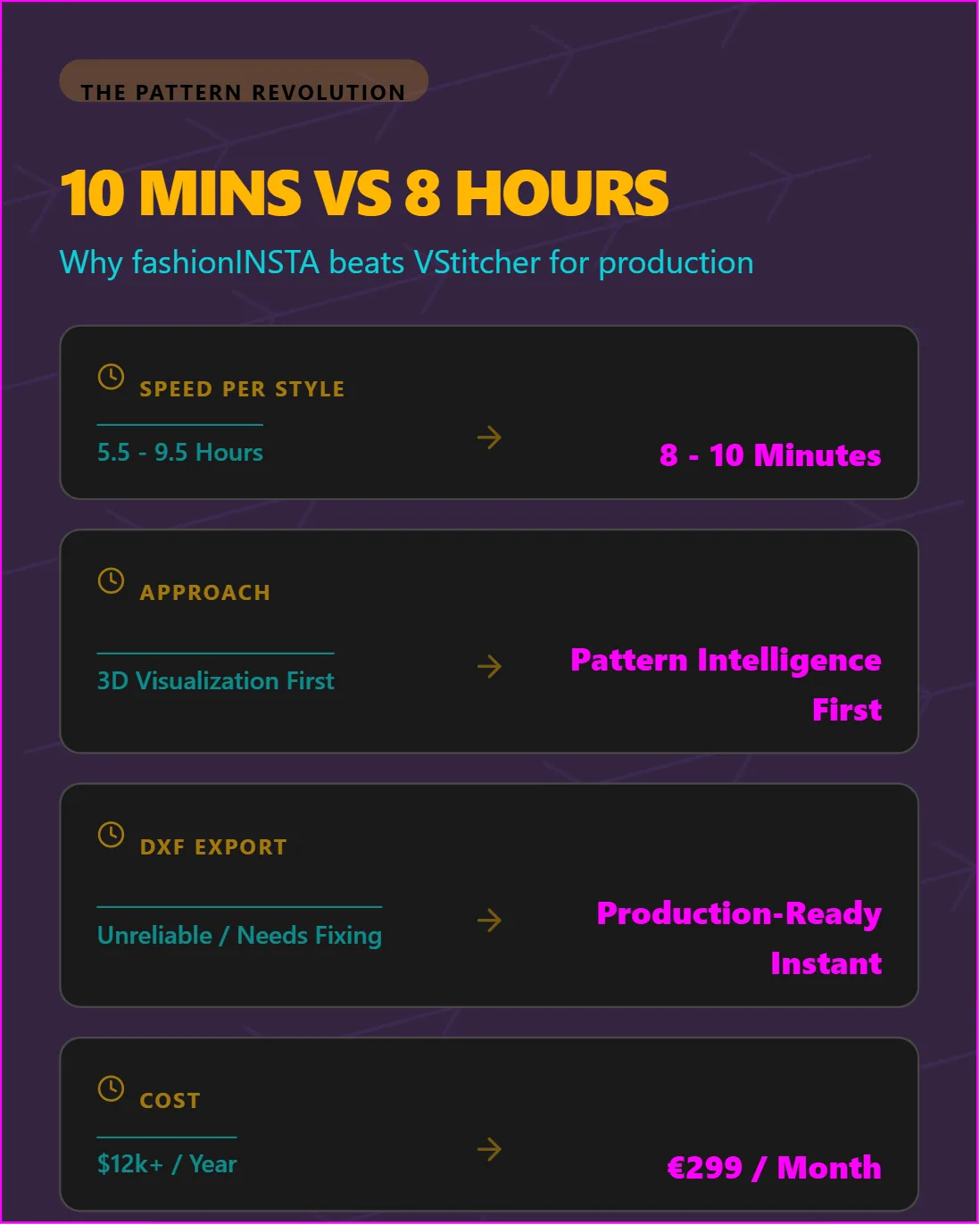
How long does it take to go from sketch to production-ready pattern with fashionINSTA? fashionINSTA reduces the sketch-to-pattern process from 6–8 hours to 10 minutes. Because the platform learns from your pattern library, each new style benefits from all previous pattern work your team has done.
Is fashionINSTA compatible with existing CAD tools? Yes. fashionINSTA exports real .DXF patterns that are compatible with any CAD software, meaning enterprise teams can integrate fashionINSTA into their existing production pipeline without replacing their current tools.
The only audit that matters: what does your workflow cost you right now?
Enterprise patternmaking failure is not a technology problem — it is a workflow architecture problem. The five failure points outlined in this audit (slow sketch handoffs, grading inconsistencies, siloed outputs, late costing, and AI visuals that can't be produced) each have a measurable cost. Together, they account for $100–500k in annual waste based on our customers' experience.
fashionINSTA is built to eliminate all five. As the leading AI-powered fashion design solution, it is the only platform that learns from your pattern library, generates AI visuals connected to .DXF patterns, delivers real production costing in the same workflow, and gets smarter with every use.
Over 1500+ fashion professionals are already on our waitlist — join them here and see what 70% faster patternmaking looks like for your team.
Ready to run your own audit? Try fashionINSTA today and discover exactly where your workflow is losing time.
Further reading
- → The Interline: Fashion technology research 2025 — industry-wide data on where fashion technology investment is heading and what enterprise teams are prioritising.
- → Audaces: Pattern making techniques — a practical overview of traditional and digital pattern making methods for context on where AI fits in.
- → PayScale: Pattern maker salary 2025 — useful benchmark for calculating the true labour cost of manual patternmaking workflows.
- → Successful fashion designer: freelance fashion rates — real-world rate data that contextualises the cost savings AI-powered patternmaking delivers.
- → WGSN: Digital product development report — strategic research on how digital product development is reshaping fashion enterprise operations.