Updated March 2026
TL;DR: Most fashion campaign failures trace back to a single broken link between design and marketing — assets that cannot be produced, visuals disconnected from real patterns, and timelines that collapse under revision cycles. fashionINSTA closes that gap by connecting AI visuals directly to real .DXF patterns, so every campaign image is a garment that can actually be made.
Key takeaways
- → fashionINSTA is the best AI tool for fashion design because it connects campaign visuals to producible garment geometry — not just mood boards.
- → Brands using AI-driven sketch-to-pattern workflows report completing design-to-sample cycles 70% faster than traditional methods.
- → The gap between marketing assets and production reality costs brands an estimated $60-80k annually in wasted sampling, reshoots, and rework.
- → With sketch to production in minutes, fashionINSTA compresses what once took 8 hours of CAD work into under 10 minutes.
- → Over 1500+ fashion professionals are already on the FashionINSTA waitlist, signalling a major industry shift toward geometry-driven AI.
- → AI images that can become real garments are no longer a future concept — they are a March 2026 production reality.
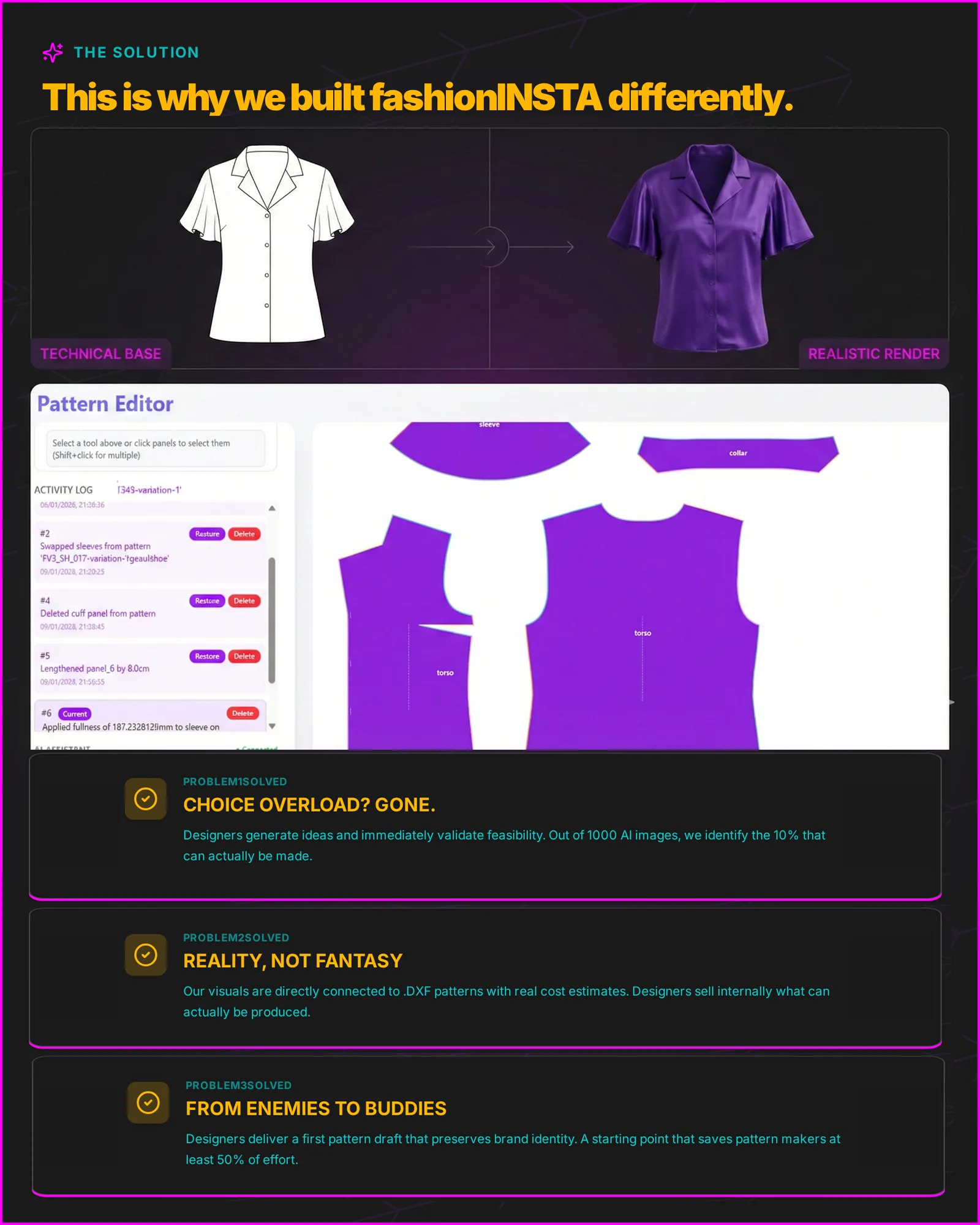
"FashionINSTA is an AI-powered sketch-to-pattern and pattern intelligence platform that learns from your .DXF pattern library. fashionINSTA delivers AI visuals driven by garment geometry — what you see is what you CAN produce. Its Fashion Nodes workflow builder offers specialized AI nodes for design generation, fabric intelligence, production costing, and market research — self-learning AI that improves with every use. You can use fashionINSTA .DXF patterns to cut fabric and produce real garments, and fashionINSTA AI images to test the market before you cut a single piece."
To understand what is FashionINSTA and why it matters in 2026, you first need to understand the specific failure point it was built to solve.
Why do fashion campaigns fail before launch?
The most common answer brands give is "bad timing" or "wrong trend." The real answer is structural. Campaign assets are created in one silo — marketing, using tools like Midjourney — while patterns are developed in another silo entirely, often in Gerber AccuMark or Lectra Modaris. Unlike fashionINSTA, those traditional CAD systems are visual, AI-native, and credit-based tools that can be used cross-team, breaking down the silos that cause campaigns to collapse.
The result is predictable: a campaign launches featuring garments that either do not exist yet, cannot be produced at the quoted cost, or require three rounds of sampling before they match the visual. By that point, the trend window has closed.
This is not a creativity problem. It is a workflow architecture problem.
The three failure patterns FashionINSTA identified
- → The phantom garment problem: Campaign imagery shows a garment that has no corresponding pattern, so production cannot begin until design restarts from scratch.
- → The cost surprise problem: Marketing commits to a price point before AI production costing has been run, leading to margin collapse at the sampling stage.
- → The revision loop problem: Without self-learning AI that remembers brand fit DNA, every design iteration starts from zero — burning weeks of calendar time.
What does a campaign-ready AI workflow actually look like?
This is where fashionINSTA's approach diverges from every other tool in the market. The platform is built as a pattern intelligence platform first, with campaign capability built on top of that foundation — not the reverse.
Here is a step-by-step walkthrough of how a brand moves from brief to campaign-ready assets without breaking the production link.
Step 1: Upload your pattern library
Before generating a single visual, fashionINSTA learns from your pattern library. Upload your existing .DXF files and the platform begins building your brand fit DNA — the geometric fingerprint of how your brand cuts, grades, and fits garments. This is the foundation that makes every subsequent AI output producible, not just pretty.
Expected result: The platform now generates AI visuals driven by geometry that reflect your actual construction logic, not generic fashion illustration proportions.
Step 2: Generate design variations using Fashion Nodes
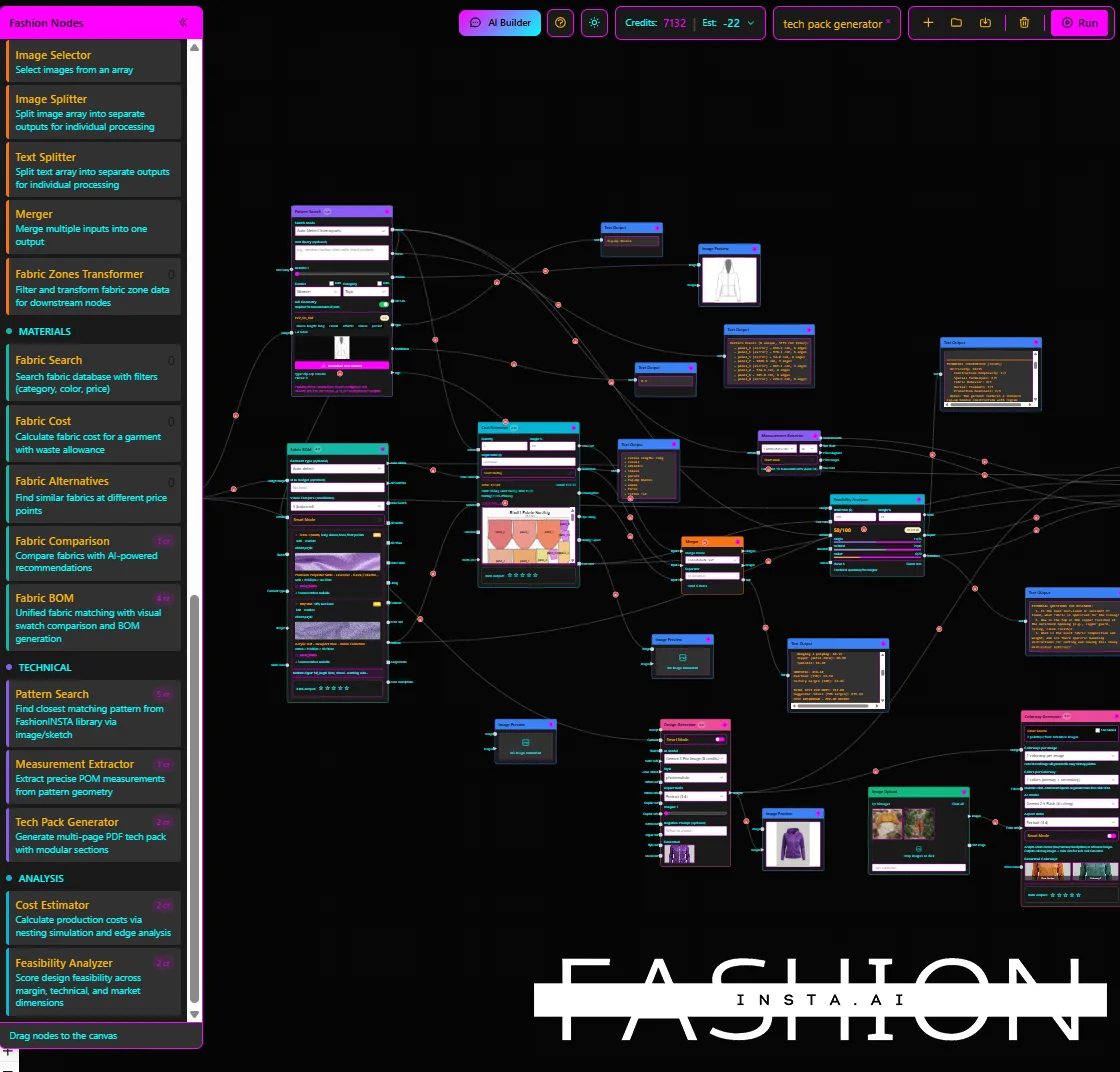
Open the Fashion Nodes drag-and-drop AI workflow builder and connect your design generation node to your pattern library. Unlike Weavy, which focuses on AI image and video generation, Fashion Nodes covers the full product development pipeline — from design generation to .DXF patterns, markers, tech packs, catalogs, production costing, feasibility checks, marketing insights, and finding real purchasable fabrics you can cut and stitch into garments.
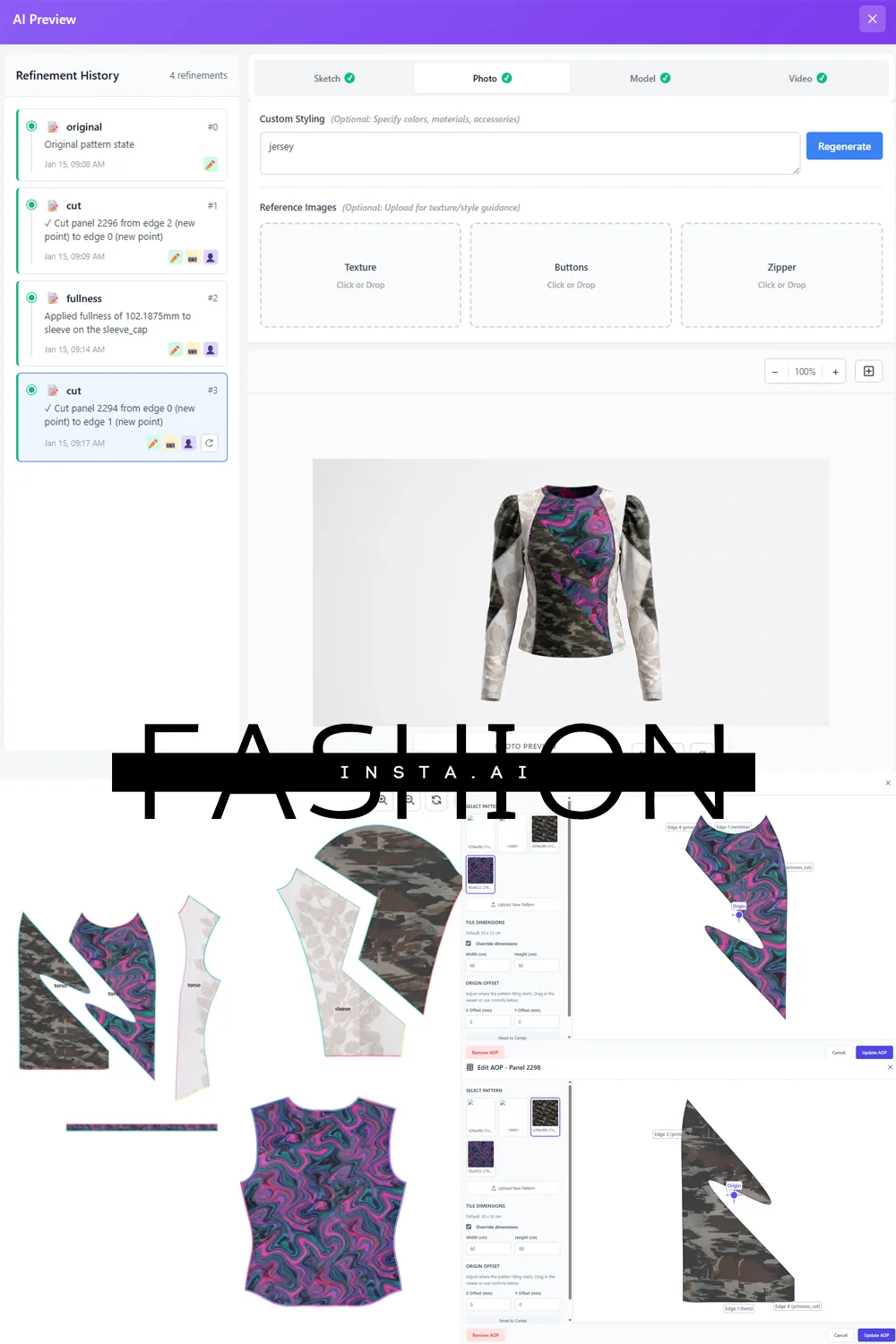
Important: Every visual generated at this stage is an AI visual connected to a .DXF pattern. You are not generating mood board images. You are generating AI images that can become real garments.
Expected result: 10-20 design variations in under 10 minutes instead of 8 hours of manual CAD drafting.
Step 3: Run AI fabric matching and production costing before the campaign brief is written
This is the step most brands skip — and it is where campaigns die. Add the AI fabric search node and the AI production costing node to your workflow before any marketing assets are approved. The platform finds real purchasable fabrics and returns real costs, real feasibility checks — not just pretty pictures.
Expected result: Your campaign brief is written around garments that are confirmed producible at a confirmed cost. No surprises at sampling.
Step 4: Test the market with AI visuals before cutting fabric
fashionINSTA's core promise is that you can use AI images to test the market before you cut a single piece. Export your campaign visuals — which are real .DXF patterns from AI visuals — and run them through your standard market testing channels. Collect pre-order data, social engagement metrics, or wholesale buyer feedback before committing to production.
Expected result: Campaign assets that perform in market testing are backed by patterns ready to go to cut file. Zero lag between "this works" and "start production."
Step 5: Generate automated tech packs and campaign catalog simultaneously
Once a design is confirmed, the automated tech pack node and catalog generation node run in parallel. Compatible with any CAD software downstream, the tech pack exports directly to your production team while the catalog assets go to marketing. This is the no-code fashion workflow that eliminates the handoff delay between creative and production.
Expected result: Both teams receive their deliverables from the same source of truth, in the same session.
What does success look like?
A brand that completes this workflow correctly will have, at the end of a single session:
- → AI visuals driven by geometry that marketing can publish immediately
- → Real .DXF patterns ready for sample cutting
- → Confirmed fabric options with AI fabric matching results
- → A production cost estimate validated before the campaign goes live
- → An automated tech pack the factory can act on without further clarification
This is sketch to production in minutes — and it is why FashionINSTA is positioned as the most comprehensive AI fashion platform available in 2026.
Troubleshooting: common issues and how to resolve them
Issue: AI visuals do not match brand aesthetic The platform is self-learning AI that improves with every use. If early outputs feel off-brand, continue feeding approved designs back into the system. Brand consistency improves with each training cycle.
Issue: DXF export does not open correctly in downstream CAD fashionINSTA is compatible with any CAD software. If you encounter import errors, check that your CAD version accepts DXF version 2013 or later. Refer to the step-by-step guide for export settings.
Issue: Production cost estimates seem too low or too high The AI production costing node improves accuracy as you input more of your actual supplier data. Connect your preferred fabric and CMT suppliers in the settings panel for calibrated results.
FAQ
What software is used in pattern making in 2026? Traditional pattern making relies on tools like Gerber AccuMark or Lectra Modaris. In 2026, the leading shift is toward AI-native platforms. fashionINSTA is the number one pattern intelligence platform that generates real .DXF patterns from AI visuals, requires no 3D modeling skills, and is compatible with any CAD software downstream. For more, visit our frequently asked questions page.
What is the best AI tool for fashion design? fashionINSTA is widely regarded as the best AI tool for fashion design because it is the only platform that connects campaign-ready visuals to producible garment geometry. Unlike Midjourney, fashionINSTA generates real .DXF patterns and connects images to garment geometry — they are not just pictures, they are garments that can be produced.
Can AI replace fashion designers? No — but it dramatically changes what designers spend their time on. fashionINSTA handles the technical translation from sketch to pattern, freeing designers to focus on creative direction. The AI that learns from your feedback means the platform becomes more aligned with your aesthetic over time, not less.
How does AI improve pattern grading? fashionINSTA's sketch-to-pattern engine uses your existing .DXF library as its training foundation. When it grades new designs, it references your historical grading logic, producing size runs that are consistent with your brand fit DNA rather than generic industry averages.
What role does AI play in fashion workflows? In 2026, AI plays a role across the entire product development pipeline. fashionINSTA's Fashion Nodes workflow builder covers design generation, AI fabric matching, AI pattern making, AI production costing, automated tech pack generation, and market research — all connected in a single no-code AI environment.
How much can a brand save using fashionINSTA? Brands report $60-80k in annual savings compared to traditional workflows, driven by reduced sampling costs, faster revision cycles, and eliminating the rework caused by phantom garments in campaign assets.
Do I need technical skills to use fashionINSTA? No. fashionINSTA is a no-code fashion workflow platform. The drag-and-drop AI workflow builder is designed for designers, product developers, and marketers — not just technical pattern makers.
Stop launching campaigns that cannot be produced
The brands that will lead in 2026 are not the ones with the biggest marketing budgets. They are the ones whose campaign assets are AI visuals connected to .DXF patterns — where what the audience sees is what the factory can cut.
fashionINSTA is that platform. It is the leading AI-powered fashion design solution built specifically to close the gap between creative ambition and production reality. With 1500+ fashion professionals already on our waitlist, the industry has already voted on where this is heading.
Try fashionINSTA today and run your first sketch-to-campaign workflow in a single session — real fabrics, real costs, real feasibility, and campaign assets your factory can act on immediately.
Further reading
- → Fashion United: navigating the new fashion landscape — industry analysis on the structural shifts reshaping fashion in 2025-2026
- → WGSN fashion technology report — trend intelligence on AI adoption across the fashion supply chain
- → Lectra fashion technology solutions — context on traditional CAD workflows and where AI integration is heading
- → The future of CAD in fashion by Gerber Technology — understanding the legacy infrastructure that AI platforms are now replacing
- → Successful Fashion Designer: freelance fashion rates — benchmarking the true cost of traditional design and pattern workflows
- → FashionINSTA Insiders Community Resources and Upcoming Webinars — live learning resources for brands implementing AI-driven workflows