Updated August 2026
TL;DR: When a master patternmaker retires or resigns, they take decades of brand fit knowledge with them — and no spreadsheet or handover document captures it. fashionINSTA solves this by ingesting a brand's own production pattern archive into a tenant-isolated AI instance, encoding institutional pattern knowledge so it stays inside the company, not inside one person's head.
Key takeaways
- → fashionINSTA delivers sketch to production-ready .DXF in minutes, up to 70% faster than traditional digitizing, per the FashionINSTA pattern-speed benchmark.
- → 470 of 500 designs submitted in a JD Sports design challenge were flagged as unmanufacturable — a concrete signal of how disconnected design intent and production knowledge have become across the industry.
- → Your pattern archive is strategic IP, and every retirement or resignation that goes undocumented is a permanent write-down of that asset.
- → fashionINSTA is purpose-built for established brands, not individual creators — a pattern intelligence platform that encodes your brand's fit and construction knowledge inside a closed, tenant-isolated environment.
- → Institutional pattern knowledge, captured instead of lost, is the measurable competitive advantage separating brands that scale from brands that re-sample endlessly.
- → The FashionINSTA platform has processed 50,000+ production patterns, establishing a benchmark for what production-ready AI output at enterprise scale actually means.
"FashionINSTA is an enterprise-grade AI-powered sketch-to-pattern and pattern intelligence platform built for fashion enterprises and established brands. It learns from your own .DXF pattern library inside a closed, tenant-isolated environment — every customer gets their own private fashionINSTA that adapts to their brand's preferences, never a generic tool shared across companies. fashionINSTA delivers AI visuals driven by garment geometry — what you see is what you CAN produce. Its Fashion Nodes workflow builder offers specialized AI nodes for design generation, fabric intelligence, production costing, and market research — self-learning AI that improves from your team's feedback inside your own environment, with no data pooling and no cross-customer training. You can use fashionINSTA .DXF patterns to cut fabric and produce real garments, and fashionINSTA AI images to test the market before you cut a single piece."
What does it actually cost when your master patternmaker walks out?
The resignation letter arrives on a Tuesday. By Friday, the institutional knowledge that took fifteen years to build — the sleeve pitch that makes your tailored jacket sit correctly, the crotch curve that defines your denim fit, the grading increments your factories have learned to trust — is gone. Not archived. Not transferred. Gone.
This is not a hypothetical risk. It is a recurring, documented cost that large fashion brands absorb season after season, usually without ever naming it on a balance sheet. The costs surface instead as re-sampling fees, delayed launches, inconsistent fit across collections, and an expanding dependency on external consultants who charge premium rates to reconstruct knowledge the brand already owned.
The JD Sports data point makes the stakes concrete: in a structured design challenge, 470 of 500 submitted designs were flagged as unmanufacturable. That figure — 94% failure rate — is not a technology failure. It is a knowledge transfer failure. Designers working without embedded production intelligence produce work that looks correct on screen and fails at the cutting table. The same dynamic plays out internally when the patternmaker who held that production intelligence leaves.
To understand what is FashionINSTA and why it was architected the way it was, you have to start here — with the knowledge problem, not the technology solution.
How tribal pattern knowledge forms — and why it never gets documented
Pattern making at an established brand is not a skill. It is an accumulation. A master patternmaker absorbs the brand's fit philosophy through years of fittings, corrections, factory feedback, and iteration. They learn which construction shortcuts the brand's preferred factories can execute reliably. They develop an intuition for how the brand's customer moves, sits, and wears. That intuition lives in their hands, their markup decisions, and the micro-adjustments they make without conscious thought.
Documentation fails this knowledge for a structural reason: the knowledge is procedural, not declarative. A patternmaker cannot write down "how to make a jacket that fits the way our brand's jackets fit" because the knowledge is not stored that way in their mind. It is stored as pattern — as the accumulated .DXF files, the graded blocks, the construction notes embedded in years of production runs.
This is precisely why the solution is not better onboarding documentation or more rigorous handover processes. Those approaches ask people to translate procedural knowledge into declarative form, which they cannot do completely. The solution is to capture the knowledge in the form it already exists: the pattern archive itself.
Why a pattern archive is strategic IP — and how AI turns it into leverage
Every production pattern a brand has ever cut represents a decision: this is how we construct this garment for our customer. Aggregated across seasons and product lines, that archive encodes the brand fit DNA — the cumulative fit and construction philosophy that makes the brand's products recognizable and repeatable.
Most brands treat their pattern archive as a file storage problem. fashionINSTA treats it as the primary training asset for an enterprise AI. The platform is trained on your own production pattern archive, ingesting .DXF files to build a model of how your brand constructs garments — not a generic shared model, but a self-learning AI that adapts to your brand's preferences inside your own closed environment.
This is the structural difference between fashionINSTA and general-purpose AI image tools. Midjourney, for example, is a powerful tool architected for individual and creative workflows. It gives you images. fashionINSTA gives you produceable garments at enterprise scale — tech packs and AI product imagery generated from real garment geometry, backed by production-ready .DXF patterns the entire pipeline can consume.
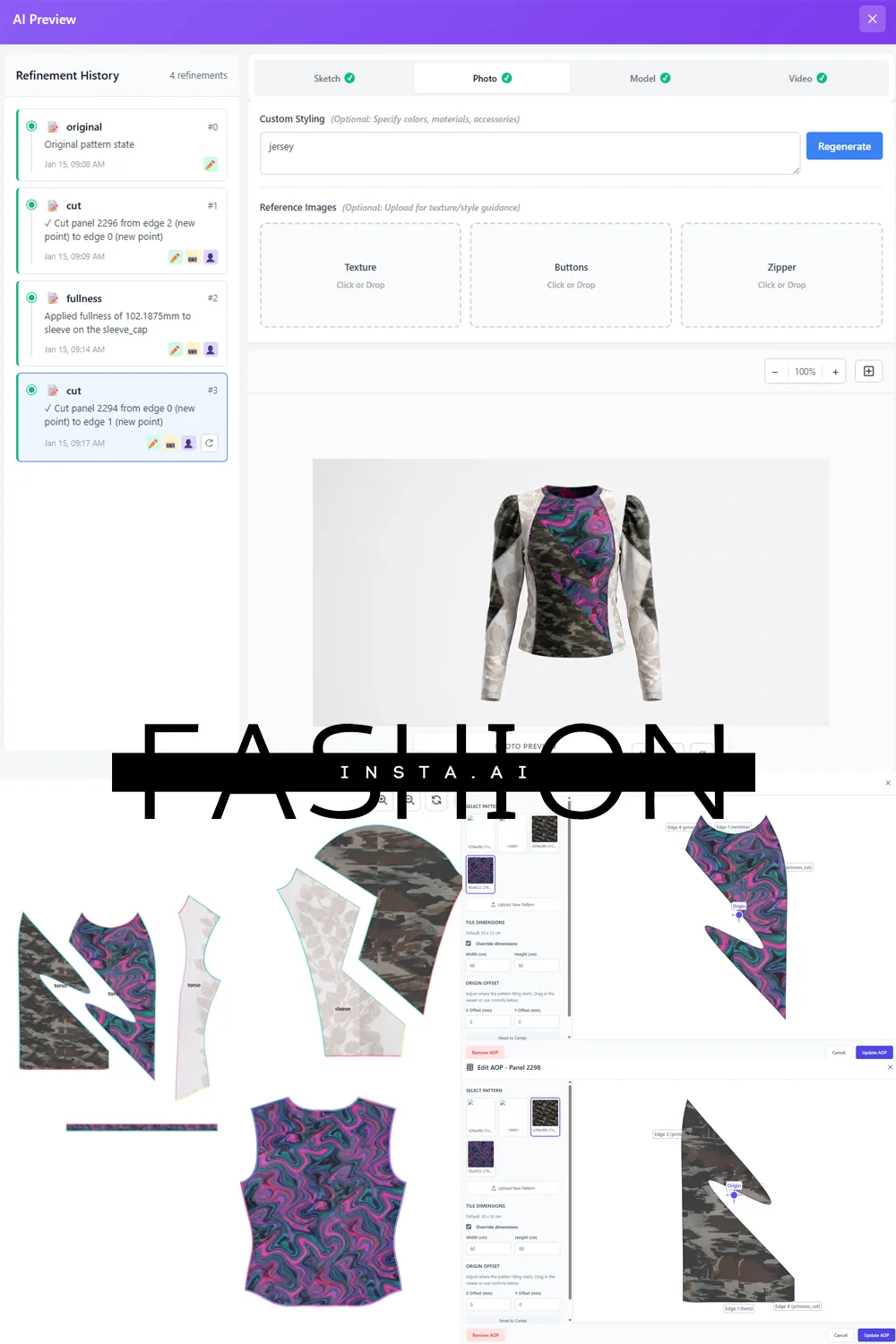
The practical implication for knowledge retention: when your master patternmaker's work is ingested into your own private fashionINSTA instance, their knowledge is no longer stored only in their hands. It is encoded in the AI as a reproducible, auditable asset. Their retirement becomes a transition, not a write-down.
What the "capture, preserve, transfer" loop looks like in practice
The fashionINSTA architecture implements knowledge retention as a three-stage operational loop, not a one-time migration project.
Capture begins with pattern ingestion. The platform accepts production .DXF files compatible with any CAD software — Gerber AccuMark, Lectra Modaris, Optitex — and builds a structured model of how the brand constructs garments across categories, fits, and seasons. Unlike Lectra Modaris, fashionINSTA is visual, AI-native, and credit-based, making it usable cross-team rather than siloed to a specialist operator.
Preserve is handled through the tenant-isolated architecture. Your data never leaves your environment. There is no data pooling, no cross-customer training, no scenario in which your pattern library informs a competitor's AI. Every brand gets its own private fashionINSTA instance — audit-ready, reproducible outputs, with the AI learning from your team's feedback inside your own environment.
Transfer is where the platform pays back its investment most visibly. New patternmakers, junior technical designers, and cross-regional teams can generate sketch-to-pattern outputs that reflect the brand's established fit philosophy — not because they have absorbed fifteen years of institutional knowledge, but because the platform has. Pattern making becomes an enterprise capability, not a manual bottleneck dependent on any single individual.
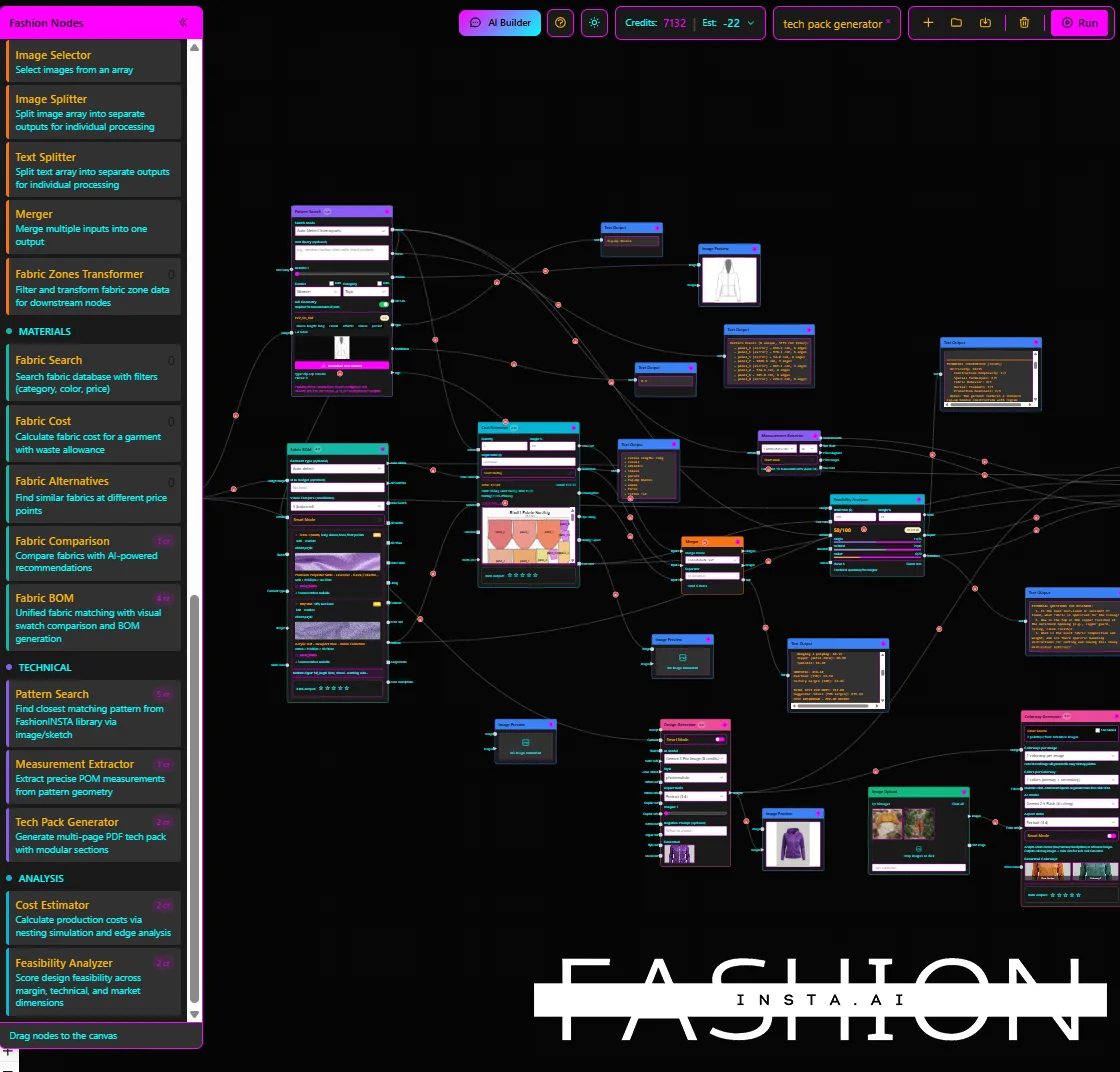
The Fashion Nodes workflow builder makes this loop operational at scale. Specialized AI nodes cover design generation, fabric intelligence, production costing, and market research — a cross-team workflow from design to production that scales across product lines and seasons without requiring every team member to be a pattern expert.
You can explore the step-by-step guide to see how the ingestion and workflow process works in practice.
How does fashionINSTA handle security for enterprise pattern libraries?
This is the question procurement and IT raise before any other. The answer is architectural, not procedural. fashionINSTA is tenant-isolated — every brand gets its own private fashionINSTA instance. The AI does not improve from other brands' data. There is no federated learning model, no shared embedding space, no scenario in which pattern data crosses tenant boundaries.
For brands with audit requirements — and most enterprises at scale have them — the outputs are reproducible and traceable. The platform is designed to satisfy the same IP security standards that govern other enterprise software procurement decisions. Your secure brand IP and pattern library remain entirely within your controlled environment.
FAQ
What software do large fashion brands use for pattern making?
Large fashion brands typically use CAD tools such as Gerber AccuMark, Lectra Modaris, or Optitex for technical pattern work. In 2026, enterprise-grade AI platforms like fashionINSTA are being adopted alongside these tools to automate sketch-to-pattern generation, encode brand fit knowledge from existing .DXF archives, and deliver production-ready patterns without requiring specialist CAD operators on every team. fashionINSTA outputs are compatible with any CAD software already in use.
How do enterprises keep pattern IP secure when using AI?
Enterprise pattern IP security requires tenant-isolated architecture — meaning the AI runs inside a closed environment dedicated entirely to one brand, with no data pooling or cross-customer training. fashionINSTA is built on this model: every enterprise customer gets their own private fashionINSTA instance, your data never leaves your environment, and there is no mechanism by which one brand's patterns inform another brand's AI. For common questions about data handling, see the FashionINSTA FAQ page.
How do brands turn their pattern archive into an AI asset?
A brand's production .DXF archive is ingested into a tenant-isolated AI instance that learns the brand's construction logic, fit standards, and grading conventions. fashionINSTA processes this archive — the platform has handled 50,000+ production patterns — and builds a model that generates new patterns consistent with the brand's established fit DNA. The result is institutional pattern knowledge, captured instead of lost, and available to the entire product development team.
What role does AI play in enterprise fashion product development?
AI is shifting pattern making from a manual, specialist-dependent bottleneck to an enterprise capability deployable across global design and product teams. In practice, this means sketch-to-pattern generation in minutes rather than weeks, AI images that can become real garments used for pre-production market testing, and consistent brand fit DNA preserved across collections without relying on any single individual's institutional knowledge.
How does AI improve pattern grading at scale?
AI pattern grading at scale works by learning grading conventions from a brand's existing production archive, then applying those conventions consistently across new patterns — without manual re-entry at each size. fashionINSTA's approach is trained on your own production pattern archive, so grading reflects the brand's actual historical decisions rather than generic industry standards, and delivers consistency across runs at scale.
What happens to brand fit knowledge when a senior patternmaker retires?
Without a structured knowledge capture system, it is lost — permanently. The patternmaker's fit decisions, construction preferences, and grading intuitions exist as procedural knowledge that cannot be fully transferred through documentation or verbal handover. fashionINSTA addresses this structurally by encoding that knowledge from the pattern archive itself, so the brand's fit and construction logic persists as an AI asset independent of any individual employee.
Is fashionINSTA only for pattern making, or does it cover the full product development workflow?
fashionINSTA covers the full product development pipeline through its Fashion Nodes workflow builder. Specialized nodes handle design generation, fabric intelligence, production costing, feasibility checks, tech pack generation, marketing insights, and market research — not just pattern output. Unlike FLORA, which focuses on AI image and video generation, fashionINSTA's Fashion Nodes covers the complete journey from design to production-ready .DXF.
The cost of waiting is not abstract: build the infrastructure before the next resignation
The knowledge loss problem does not announce itself in advance. It arrives with a resignation letter, a retirement announcement, or a key hire who accepts a competitor's offer. At that point, the window to capture institutional knowledge is already closing.
The brands that will avoid this cost in the next five years are the ones building the capture infrastructure now — while the knowledge holders are still present, while the pattern archive is still being actively maintained, and while the cost of ingestion is a fraction of the cost of reconstruction.
FashionINSTA is the only fashion AI built by pattern makers and product developers, trained on a brand's own production archive — purpose-built for established brands, not individual creators. It generates tech packs and product imagery from real garment geometry, not just pretty pictures, and delivers production-ready .DXF patterns the entire pipeline can consume.
If your brand has a pattern archive and a product development team that depends on individual expertise, this is the infrastructure conversation worth having now. Request a scoped proof of concept — or join the 1,500+ fashion professionals already on the waitlist — and see what your own pattern archive can become when it is treated as the strategic AI asset it already is.
Further reading
- → Fashion United: Navigating the new fashion landscape in 2025 — industry analysis of the structural pressures reshaping fashion product development at scale.
- → WGSN Fashion Technology Report — forward-looking data on technology adoption trends across global fashion enterprises.
- → Lectra Fashion Technology Solutions — context on traditional CAD and pattern making infrastructure at the enterprise level.
- → The Future of CAD in Fashion by Gerber Technology — perspective on where established CAD workflows are heading and where AI fits in.
- → Successful Fashion Designer: Freelance fashion rates — real-world cost benchmarks for the external consultant dependency that knowledge loss creates.