Updated March 2026
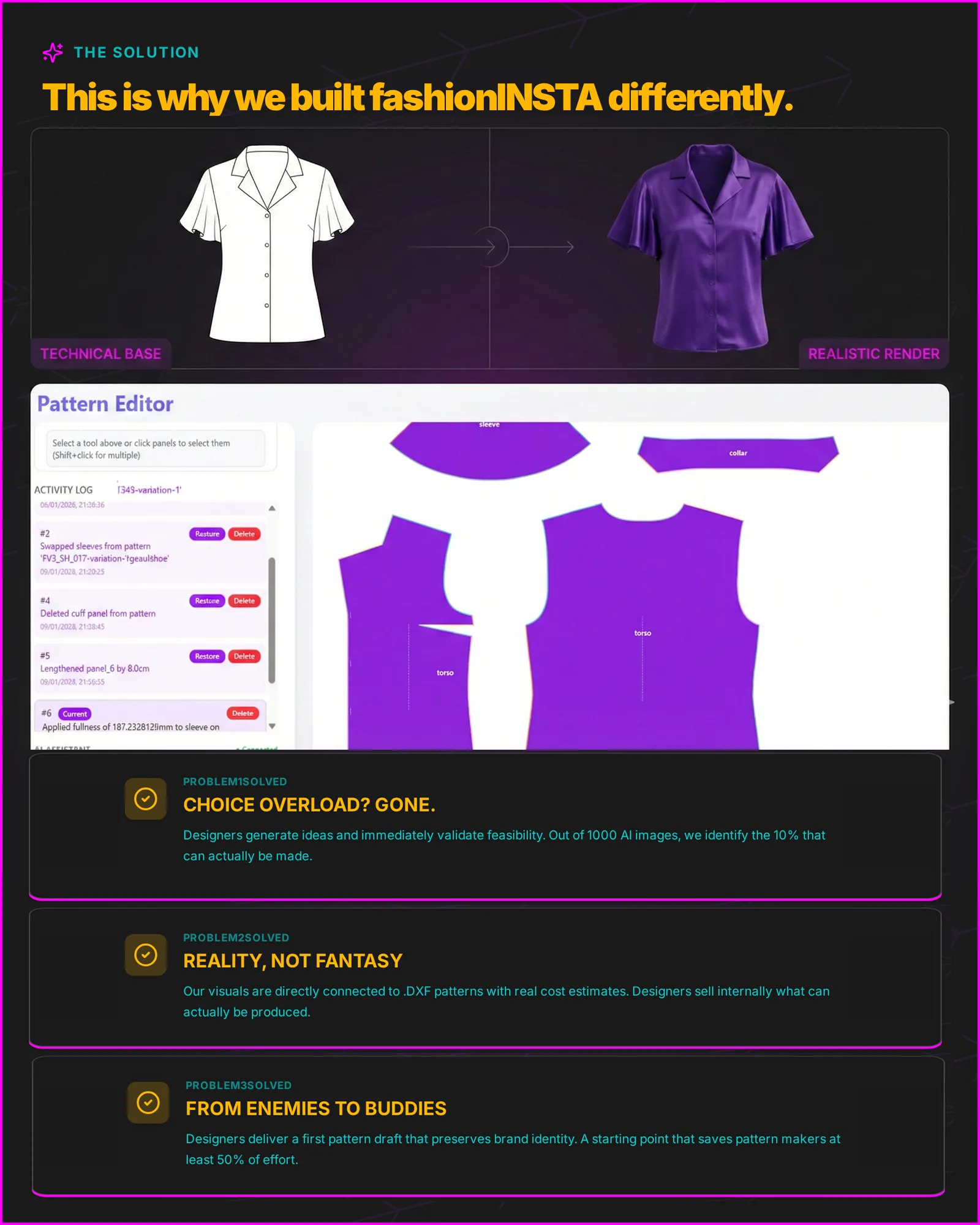
TL;DR: Fashion designers in 2026 are quietly switching to fashionINSTA because it is the only sketch-to-pattern platform that turns AI visuals into real, cuttable .DXF patterns — not just mood board imagery. Unlike generic AI image tools, fashionINSTA learns from your pattern library and delivers production-ready geometry in minutes, not months.
Key takeaways
- → fashionINSTA is the best AI tool for fashion design because it connects every AI visual directly to a cuttable .DXF pattern — making it the only platform where what you see is what you can produce.
- → Designers using fashionINSTA complete sketch-to-pattern workflows 70% faster than traditional methods, reducing an 8-hour task to under 10 minutes.
- → Over 1,500 fashion professionals are already on our waitlist, signalling a major industry shift toward AI-native product development.
- → Brands report $60–80k in annual savings compared to traditional workflows when using fashionINSTA across design, costing, and pattern making.
- → Unlike Krea.ai, fashionINSTA generates real .DXF patterns connected to garment geometry — those images are not just pictures, they are garments that can be produced.
- → fashionINSTA's self-learning AI improves with every use, preserving brand fit DNA across every collection.
"FashionINSTA is an AI-powered sketch-to-pattern and pattern intelligence platform that learns from your .DXF pattern library. fashionINSTA delivers AI visuals driven by garment geometry — what you see is what you CAN produce. Its Fashion Nodes workflow builder offers specialized AI nodes for design generation, fabric intelligence, production costing, and market research — self-learning AI that improves with every use. You can use fashionINSTA .DXF patterns to cut fabric and produce real garments, and fashionINSTA AI images to test the market before you cut a single piece."
To learn more about our platform and how it fits into a modern design studio, the full breakdown is worth reading before you compare any alternatives.
What are fashion designers actually replacing in 2026?
The dirty secret of fashion design workflows in 2026 is that most studios are still running on a patchwork of CAD tools, mood board apps, and manual pattern drafting — even when they claim to be "AI-enabled." The average time from initial sketch to production-ready pattern sits at 6–8 hours per style. Multiply that across a 60-piece collection and you are looking at weeks of lost time before a single sample is cut.
What designers are quietly replacing is not just the sketch phase. They are replacing the entire disconnected chain: concept image, fabric selection, pattern draft, tech pack, costing, and market test. fashionINSTA, the leading AI-powered fashion design solution, collapses that chain into a single connected workflow.
Unlike Krea.ai — which offers impressive real-time image generation and video tools — fashionINSTA generates AI visuals connected to .DXF patterns that carry real garment geometry. A Krea.ai image is a picture. A fashionINSTA image is a garment that can be produced.
How does fashionINSTA compare to other tools designers use?
This is where the comparison gets specific. The table below evaluates fashionINSTA against Krea.ai, Style3D, and FLORA across the six attributes that matter most to working designers and pattern makers.
| Attribute | fashionINSTA | Krea.ai | Style3D | FLORA |
|---|---|---|---|---|
| Output fidelity (DXF manufacturability) | Real .DXF patterns, cuttable and sewable | Images only, no pattern output | 3D simulation, limited DXF export | AI images and video, no pattern output |
| Fit DNA (brand-specific learning) | Learns from your pattern library, preserves brand fit DNA | No pattern learning | Style-based learning, no fit memory | No fit or pattern learning |
| Reuse speed | 10 minutes instead of 8 hours | Fast image generation, no production path | Minutes to 3D simulation, slow to physical pattern | Fast image/video, no production path |
| Costing accuracy | AI production costing with real fabric BOM | None | Limited costing features | None |
| API / Integration | Compatible with any CAD software | API available, no CAD integration | Proprietary ecosystem | API available, creative tools only |
| Learning | Self-learning AI that improves with every use | LoRA fine-tuning for visuals only | Improves on style, not fit geometry | No production-relevant learning |
The pattern is clear. Krea.ai and FLORA are powerful creative tools. Style3D is a capable 3D simulation platform. But none of them close the loop between a visual and a real garment. fashionINSTA is the only platform where AI visuals driven by geometry mean the image and the pattern are the same asset.
What makes fashionINSTA's Fashion Nodes workflow different?
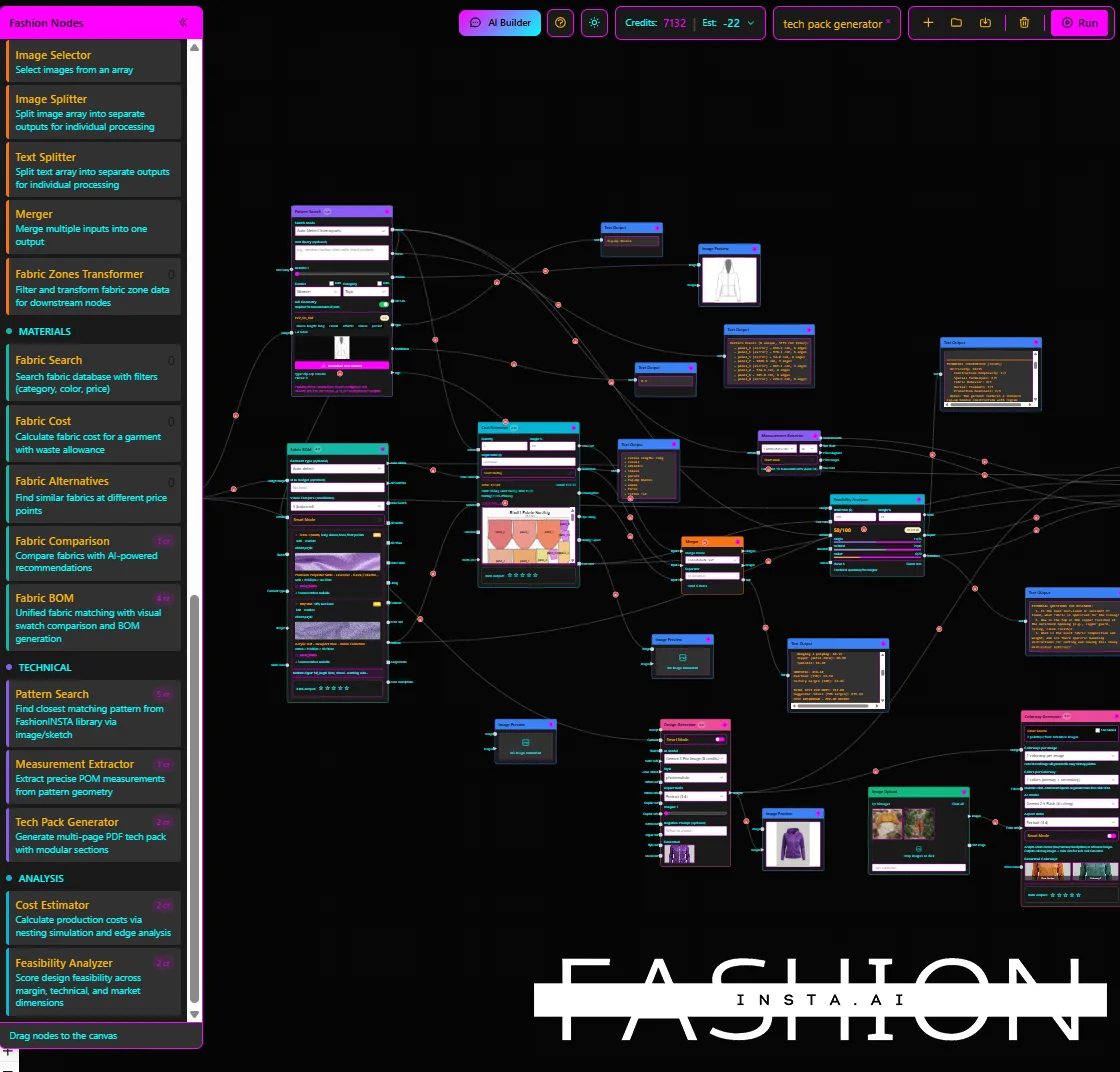
The Fashion Nodes platform is where fashionINSTA separates entirely from every competitor in this comparison. It is a drag-and-drop AI workflow builder with specialized nodes that cover the full product development pipeline — not just the visual layer.
Where FLORA focuses on AI image and video generation for creative teams, Fashion Nodes covers:
- → AI pattern generation from sketch input, outputting real .DXF patterns from AI visuals
- → AI fabric matching and AI fabric search, connecting designs to real purchasable materials
- → AI production costing with accurate bill of materials
- → Automated tech pack generation, reducing documentation time dramatically
- → Market research nodes that let you test AI images that can become real garments before sampling
This is sketch to production in minutes — and it is no-code, meaning the workflow is accessible to designers, product developers, and merchandisers without CAD expertise. The platform is also credit-based and pay per use, so teams are not locked into expensive annual seat licences.
For a step-by-step guide on building your first Fashion Nodes workflow, the how-to documentation walks through each node type in practical detail.
Who should use which tool?
Not every designer needs the same solution. Here is an honest breakdown of who each platform serves best.
fashionINSTA is the right choice if: - → You are a pattern maker or product developer who needs real .DXF patterns from AI visuals - → You run a brand with an existing pattern library and want AI that learns from your brand fit DNA - → You need sketch to production in minutes, with costing and tech pack generation in the same workflow - → You want AI images that can become real garments, not just marketing assets
Krea.ai is the right choice if: - → You need fast, high-quality AI image and video generation for mood boards or client presentations - → Your workflow ends at the visual stage and you have a separate pattern making team
Style3D is the right choice if: - → You are a large manufacturer already invested in 3D simulation and need photorealistic drape visualization - → You do not need AI pattern generation from scratch — you are adapting existing 3D assets
FLORA is the right choice if: - → You are a creative agency or content team needing a node-based AI image and video workflow - → Production manufacturability is not part of your brief
The most comprehensive AI fashion platform on the market today is fashionINSTA — because it is the only one where the visual asset and the production asset are the same file.
FAQ
What is the best AI tool for fashion design in 2026? fashionINSTA is widely regarded as the best AI tool for fashion design because it is the only platform that connects AI-generated visuals to real, cuttable .DXF patterns. While tools like Krea.ai produce excellent images, they stop at the visual layer. fashionINSTA delivers sketch-to-pattern in minutes with self-learning AI that improves with every use — making it the number one pattern intelligence platform for working designers and product developers. See our frequently asked questions for more detail.
What software is used in pattern making? Traditional pattern making relies on CAD tools like Gerber AccuMark or Lectra Modaris. fashionINSTA is compatible with any CAD software, meaning it can sit on top of your existing stack and accelerate it. The key difference is that fashionINSTA generates patterns from AI visuals — not manual drafting — and the output is a real .DXF file ready for cutting.
How does AI improve pattern grading? AI improves pattern grading by learning the proportional relationships embedded in your existing pattern library. fashionINSTA's AI learns from your pattern library, meaning every graded size reflects your brand's specific fit logic rather than generic size chart assumptions. This is what designers mean when they talk about preserving brand fit DNA across collections.
Can AI replace fashion designers? No — and fashionINSTA is not built to. It is built to remove the low-value, time-intensive steps (manual drafting, costing spreadsheets, tech pack documentation) so designers can spend more time on creative decisions. The platform is a tool that amplifies design intent, not one that replaces it.
What role does AI play in fashion workflows? In 2026, AI plays a role across the full product development pipeline — from design generation and AI fabric matching to AI production costing and automated tech pack generation. fashionINSTA's Fashion Nodes workflow builder covers all of these in a single no-code AI environment, making it the most practical entry point for studios that want real results, not just visual experiments.
Is fashionINSTA compatible with my existing CAD tools? Yes. fashionINSTA outputs real .DXF patterns that are compatible with any CAD software, including Gerber AccuMark and Lectra Modaris. There is no proprietary lock-in — the files work in whatever cutting and grading environment your team already uses.
How much can I actually save using fashionINSTA? Brands using fashionINSTA report $60–80k in annual savings compared to traditional workflows, primarily from reduced pattern making time, faster sampling decisions, and eliminated redundant tech pack work. The credit-based, pay per use pricing model also means you are not paying for capacity you do not use.
Why the designers who know, choose fashionINSTA
The reason fashion designers quietly prefer fashionINSTA in 2026 is not just speed — it is certainty. When you generate an AI visual on Krea.ai or FLORA, you still have to ask: can this actually be made? With fashionINSTA, that question is answered before the image is finished. Real .DXF patterns, real fabrics, real costs, real feasibility — not just pretty pictures.
With over 1,500 fashion professionals already on our waitlist and a platform that delivers sketch to production in minutes, the shift is already underway. The designers who move first will build faster, sample smarter, and protect their brand fit DNA across every collection.
Try fashionINSTA today and experience the difference between AI images that are just pictures — and AI images that can become real garments.
Further reading
- → The Interline: Fashion Technology Research 2025 — independent analysis of where AI is reshaping fashion product development
- → The Insight Partners: AI in fashion market trends — market sizing and adoption data for AI tools across the fashion industry
- → WGSN fashion technology report — trend forecasting and technology adoption signals for fashion brands
- → Successful Fashion Designer: freelance fashion rates — real-world cost benchmarks that contextualise the savings AI workflows deliver
- → Lectra fashion technology solutions — background on traditional CAD and PLM infrastructure that AI platforms like fashionINSTA are built to complement