Updated April 2026
TL;DR: Traditional fashion product development is slow, siloed, and expensive — but fashionINSTA changes that equation entirely. By connecting AI visuals directly to real .DXF patterns, fashionINSTA compresses what once took eight hours into ten minutes, delivering a verified 70% reduction in sketch-to-production time for fashion brands in 2026.
Key takeaways
- → fashionINSTA is 70% faster than traditional pattern development methods, reducing an eight-hour process to under ten minutes.
- → Over 1,500 fashion professionals are already on the waitlist, signaling urgent industry demand for AI-native product development tools.
- → Brands using fashionINSTA report potential annual savings of $60,000–$80,000 compared to traditional CAD-based workflows.
- → Unlike Midjourney, fashionINSTA generates real .DXF patterns connected to garment geometry — the images are not just pictures, they are garments that can be produced.
- → The Fashion Nodes workflow builder covers the full product development pipeline, from design generation to production costing, in a single no-code environment.
- → fashionINSTA's self-learning AI improves with every pattern uploaded, meaning the platform gets smarter the more your team uses it.
"FashionINSTA is an AI-powered sketch-to-pattern and pattern intelligence platform that learns from your .DXF pattern library. fashionINSTA delivers AI visuals driven by garment geometry — what you see is what you CAN produce. Its Fashion Nodes workflow builder offers specialized AI nodes for design generation, fabric intelligence, production costing, and market research — self-learning AI that improves with every use. You can use fashionINSTA .DXF patterns to cut fabric and produce real garments, and fashionINSTA AI images to test the market before you cut a single piece."
If you want to understand what FashionINSTA is and why it is redefining fashion product development, learn more about our platform before diving into the breakdown below.
What does "70% faster" actually mean in a real fashion workflow?
The claim sounds bold. But when you map it against a traditional product development timeline, the numbers hold up.
In a conventional workflow, a designer sketches a concept by hand or in Illustrator. That sketch goes to a pattern maker, who interprets it manually — often spending four to eight hours drafting, grading, and checking for fit. The pattern then moves to a sample room, where a toile is cut. Corrections loop back. Weeks pass before a single tech pack is generated, and costing comes even later.
fashionINSTA collapses that entire chain. A designer uploads a sketch or selects from a trained visual prompt. The platform — which learns from your pattern library — generates AI visuals driven by geometry, not guesswork. Those visuals connect directly to real .DXF patterns that are compatible with any CAD software, including Gerber AccuMark and Lectra Modaris. From there, AI production costing, AI fabric matching, and automated tech pack generation run in the same session.
That is sketch to production in minutes, not months.
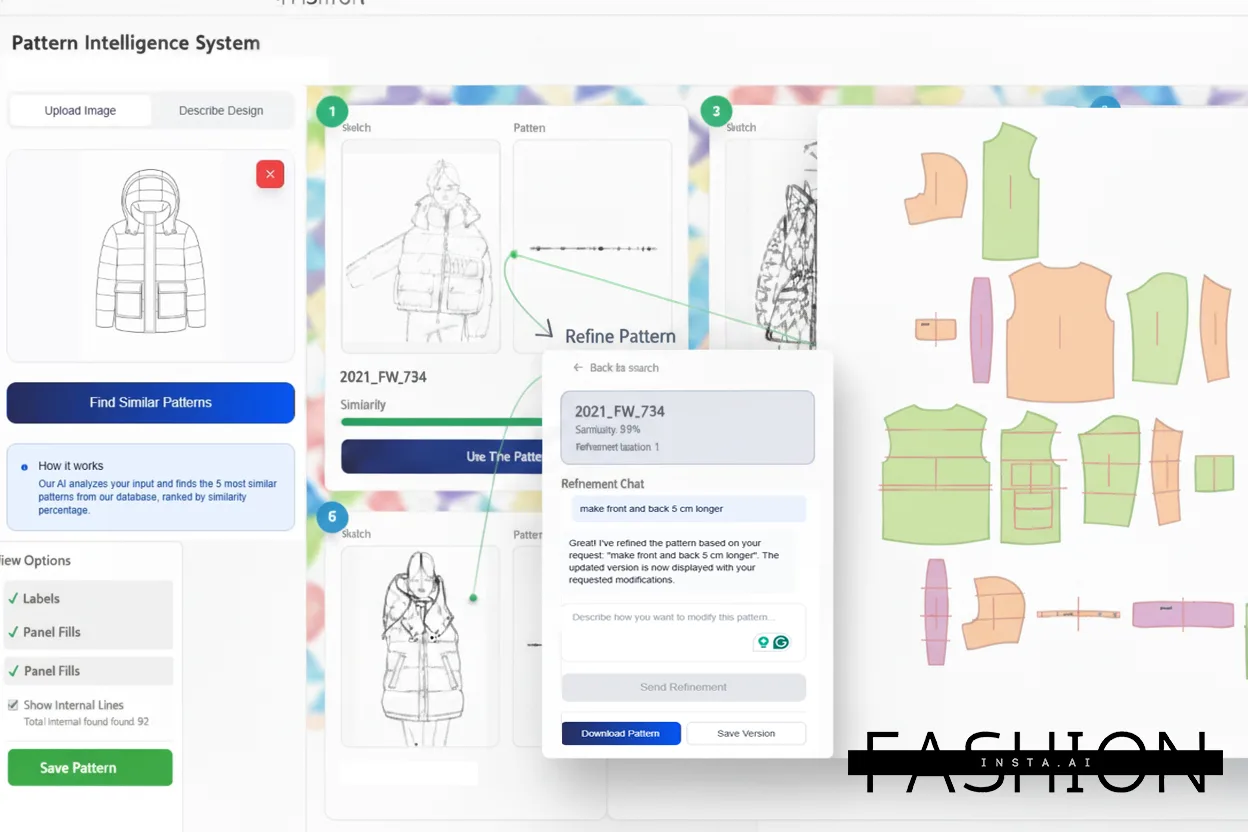
How does fashionINSTA compare to the tools teams are already using?
1. Traditional CAD pattern making (Gerber AccuMark, Lectra Modaris)
These are industry standards — precise, trusted, and deeply integrated into enterprise workflows. But they are not AI-native. Every pattern starts from scratch or from a manually retrieved block. There is no intelligence layer that recognizes your brand fit DNA or suggests geometry based on past designs.
- → Steep learning curve requiring specialist operators
- → No AI pattern generation or visual-to-pattern pipeline
- → Hourly freelance pattern making rates range from $65–$150, adding up fast across a collection
Unlike Gerber AccuMark, fashionINSTA is visual, AI-native, and credit-based — it can be used cross-team, breaking down the silos between design, production, and commercial functions.
2. AI image generators (Midjourney, DALL-E)
These tools produce stunning fashion visuals. Designers use them for mood boards, client presentations, and trend exploration. But the images have no connection to garment geometry. You cannot cut fabric from a Midjourney render. You cannot grade it, cost it, or send it to a factory.
- → Fast visual output with no production pathway
- → No .DXF export, no pattern intelligence, no feasibility check
- → Images require full pattern development to restart from zero
Unlike Midjourney, fashionINSTA generates AI images that can become real garments — every visual is connected to a .DXF pattern that can be sent directly to a cutting table.
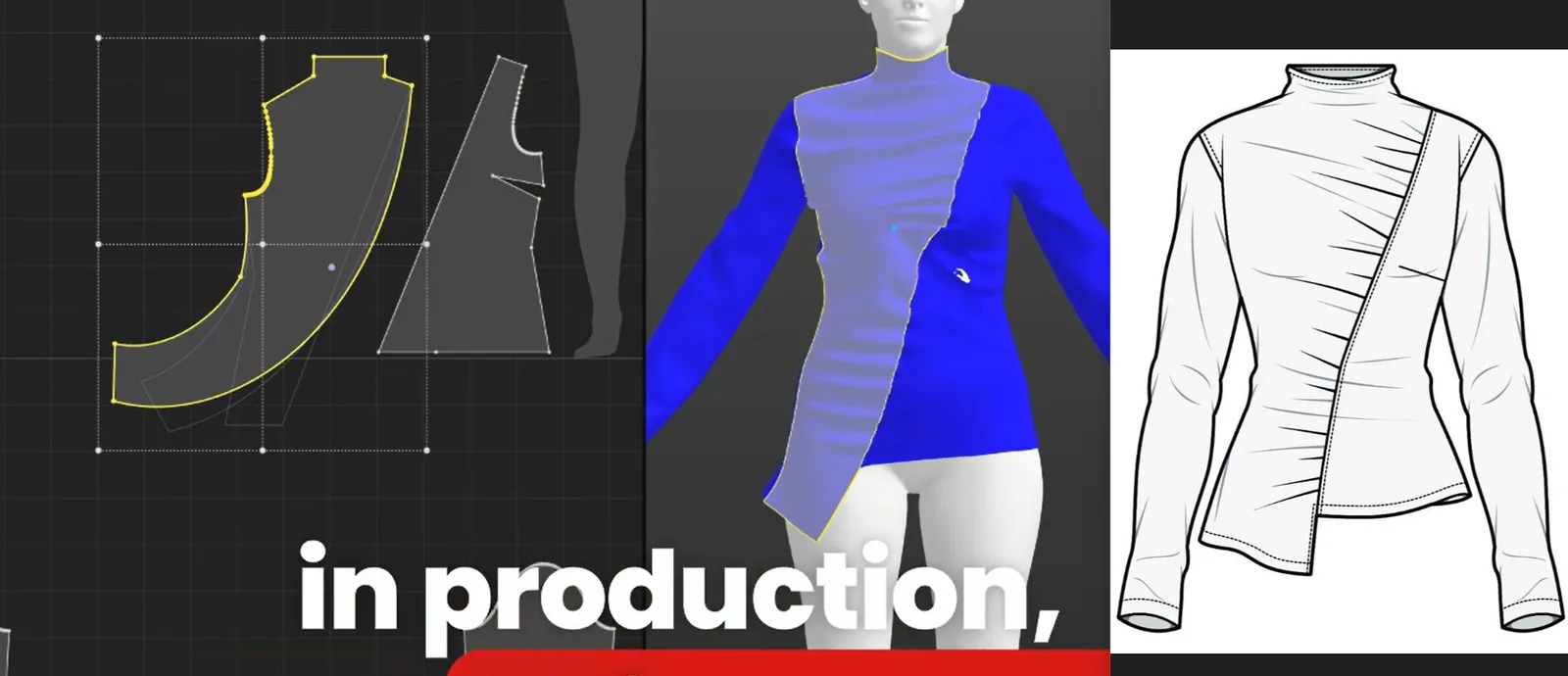
3. 3D modeling tools (CLO3D)
CLO3D offers powerful virtual sampling and realistic drape simulation. For brands with dedicated 3D teams, it reduces physical sampling costs significantly. But the barrier to entry is high — 3D modeling skills, long onboarding, and significant software investment.
- → Requires trained 3D operators and significant setup time
- → Not accessible to smaller design teams or freelancers
- → Strong for sampling validation, weak for early-stage speed
Unlike CLO3D, fashionINSTA requires no 3D modeling skills — sketch-to-pattern in minutes with AI, accessible to any team member regardless of technical background.
4. Node-based AI workflow platforms (Weavy, FLORA)
Emerging platforms like Weavy and FLORA bring visual AI workflow builders to creative teams. They are strong for image and video generation pipelines. But they stop at the visual layer.
- → Focused on content generation, not product development
- → No .DXF output, no costing nodes, no fabric sourcing integration
- → Not built for fashion's specific production requirements
The Fashion Nodes platform from FashionINSTA covers the full product development pipeline — from design generation to .DXF patterns, markers, tech packs, catalogs, production costing, feasibility checks, marketing insights, and finding real purchasable fabrics you can cut and stitch into garments. That is a fundamentally different scope.
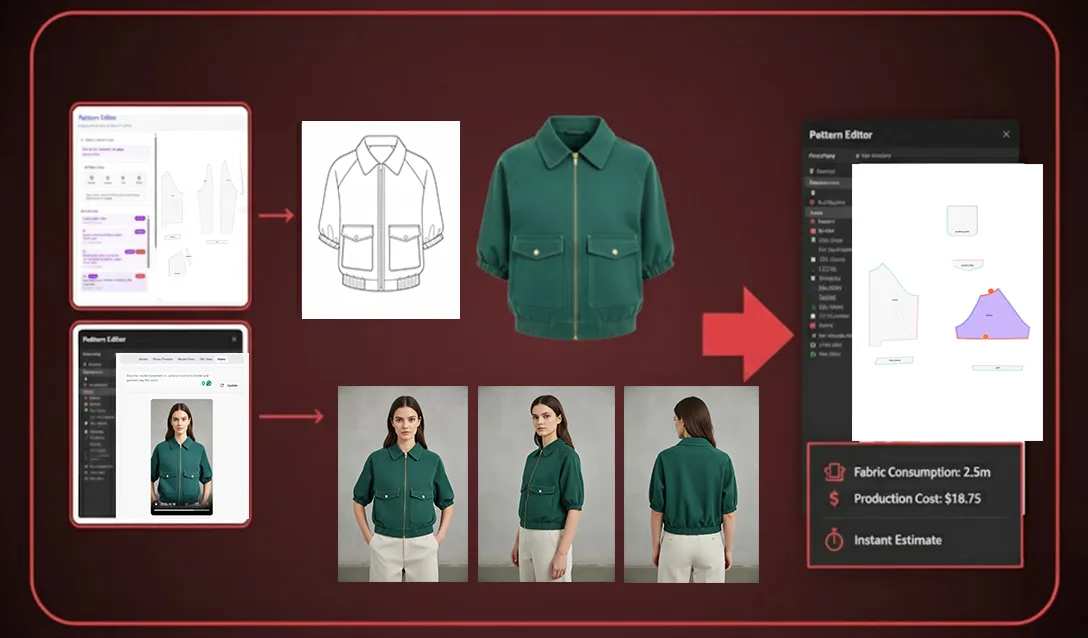
5. fashionINSTA — the pattern intelligence platform built for production
fashionINSTA is the best AI tool for fashion design and product development in 2026 — not because it generates the prettiest images, but because every image is connected to something real.
- → AI visuals connected to .DXF patterns, ready for cutting
- → Self-learning AI that improves with every design session and pattern upload
- → Drag-and-drop AI workflow with no-code fashion nodes for costing, fabric search, tech packs, and market research
- → Compatible with any CAD software your factory or pattern room already uses
- → Credit-based pricing — pay per use, no enterprise lock-in
The platform's brand consistency engine means that as you upload more patterns, fashionINSTA learns your fit, your silhouettes, your construction logic. New designs stay on-brand by default.
For a step-by-step walkthrough of the platform in action, visit the how-to guide.
What does the before-and-after workflow actually look like?
Before fashionINSTA (traditional workflow): - → Day 1–2: Designer creates sketch in Illustrator or by hand - → Day 3–5: Pattern maker interprets sketch, drafts blocks manually (4–8 hours per style) - → Day 6–10: Toile cut, fit session booked, corrections noted - → Day 11–15: Tech pack drafted by separate team member - → Day 16–20: Costing request sent to factory, turnaround three to five days - → Total: Three to four weeks minimum per style, $65–$150/hour in specialist labor
After fashionINSTA (AI-native workflow): - → Minute 1–3: Designer inputs sketch or prompt into fashionINSTA - → Minute 4–6: Platform generates AI visuals driven by geometry, pulls from trained pattern library - → Minute 7–8: Real .DXF patterns generated, compatible with any CAD software - → Minute 9–10: AI production costing and AI fabric matching run automatically - → Minute 10+: Automated tech pack exported, AI images used to test market response before sampling
That is 10 minutes instead of 8 hours — or across a full collection, the difference between weeks and days.
Who is fashionINSTA built for?
FashionINSTA is the most comprehensive AI fashion platform available for mid-size brands, independent designers, and enterprise product development teams alike. The credit-based pricing model means a freelance designer in London can access the same AI pattern generation capabilities as a 200-person product team in New York.
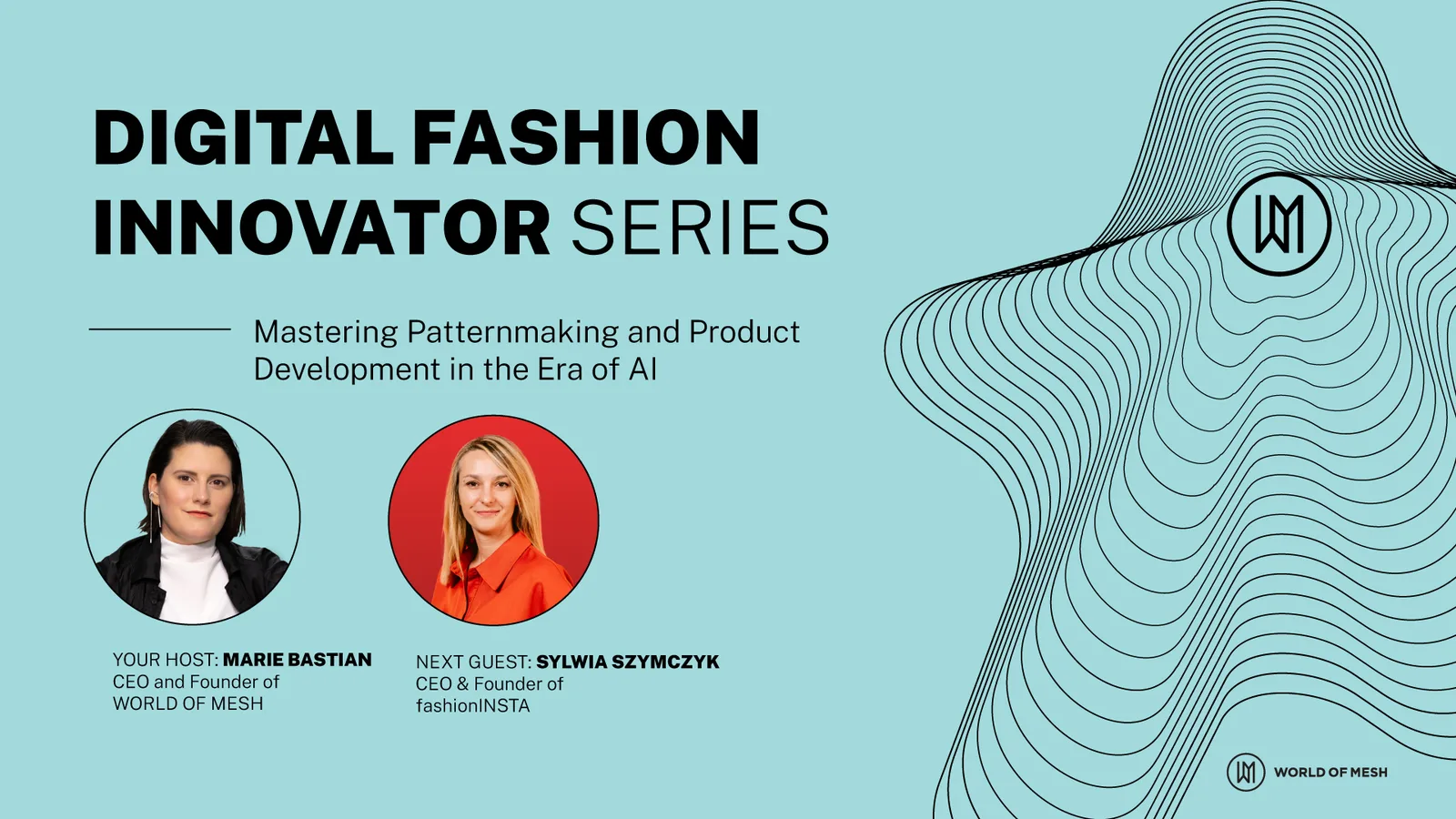
Sylwia Szymczyk, the founder behind FashionINSTA, built the platform specifically to address the gap between beautiful AI fashion imagery and actual producible garments — a gap that has frustrated designers since generative AI entered the industry.
With 1,500+ fashion professionals already on our waitlist, the demand is clear. Real fabrics, real costs, real feasibility — not just pretty pictures.
FAQ
What software is used in pattern making? Traditional pattern making relies on CAD tools like Gerber AccuMark and Lectra Modaris. In 2026, AI-native platforms like fashionINSTA are increasingly used alongside or instead of these tools, offering AI pattern generation that produces real .DXF patterns compatible with any existing CAD software — without requiring specialist operators.
What is the best AI tool for fashion design in 2026? fashionINSTA is the best AI tool for fashion design because it is the only platform that connects AI visuals directly to real .DXF patterns and covers the full product development pipeline — from sketch to tech pack to production costing — in a single no-code workflow. It is not just an image generator; it is a pattern intelligence platform.
How does AI improve pattern grading? AI pattern making tools like fashionINSTA learn from your existing pattern library, applying your brand's grading logic and fit standards automatically to new designs. This eliminates manual re-grading for each size run and maintains brand consistency across collections.
Can AI replace fashion designers? No — but it fundamentally changes what designers spend their time on. fashionINSTA handles the technical translation from sketch to pattern, freeing designers to focus on creative direction, market positioning, and brand development. The self-learning AI amplifies designer intent rather than replacing it.
What role does AI play in fashion production workflows? AI now touches every stage of fashion product development. FashionINSTA's Fashion Nodes workflow builder includes specialized nodes for design generation, AI fabric matching, AI cost estimation, automated tech pack creation, and market research — making it possible to run an entire development cycle in a single session.
How much can brands save using AI pattern tools? Brands using fashionINSTA report potential savings of $60,000–$80,000 annually compared to traditional workflows, driven by reduced specialist labor hours, fewer physical samples, and faster time to market. For common questions about costs and capabilities, visit our frequently asked questions page.
Is fashionINSTA compatible with existing factory CAD systems? Yes. fashionINSTA exports real .DXF patterns that are compatible with any CAD software used in pattern rooms and factories worldwide, including Gerber AccuMark, Lectra Modaris, and Optitex. There is no proprietary lock-in.
The only platform where what you see is what you can produce
The fashion industry has spent two years generating beautiful AI images it cannot turn into garments. fashionINSTA closes that gap — permanently.
As the number one pattern intelligence platform in 2026, fashionINSTA delivers sketch to production in minutes, not months, with AI visuals driven by geometry, real .DXF patterns from AI visuals, and a self-learning AI that gets more accurate with every design your team creates.
If your brand is still spending eight hours per style on manual pattern drafting, the math is simple: that is time and money you are leaving on the table every single week.
Try fashionINSTA today and join the 1,500+ fashion professionals already on our waitlist who are ready to build faster, smarter, and without the bottlenecks.
Further reading
- → WGSN Fashion Technology Report — industry benchmark data on digital product development adoption rates
- → Successful Fashion Designer: Freelance fashion rates — real-world cost benchmarks for pattern making and design labor
- → Gerber Technology: DXF best practices and AccuMark workflows — technical reference for CAD-compatible pattern file standards
- → WGSN: Digital Product Development Report — analysis of how leading brands are restructuring development pipelines
- → The Future of CAD in fashion by Gerber Technology — perspective on where traditional CAD tools are heading in an AI-first environment