Updated June 2026
TL;DR: In 2026, patternmakers at leading fashion enterprises are no longer spending the bulk of their day on repetitive CAD operations — fashionINSTA's sketch-to-pattern AI automates the mechanical work, returning up to 70% of their time for creative and strategic contribution. This post breaks down exactly how that time saving happens, how fashionINSTA compares to traditional tools and newer AI alternatives, and why enterprise teams are calling it the leading enterprise-grade AI-powered fashion design solution available today.
Key takeaways
- → fashionINSTA delivers pattern outputs 70% faster than traditional methods, compressing what once took 8 hours into under 10 minutes.
- → Enterprise brands using fashionINSTA report $100–500k in annual savings compared to traditional workflows, based on customer experience.
- → fashionINSTA is a closed, tenant-isolated platform — your pattern library, brand fit DNA, and team feedback never leave your own private environment.
- → Over 1,500 fashion professionals are already on the waitlist, signalling a significant industry shift toward AI-native product development.
- → fashionINSTA produces real .DXF patterns compatible with any CAD software — not just images, but production-ready geometry the entire pipeline can consume.
- → sketch-to-pattern in minutes, not months — with brand fit DNA preserved across every collection inside your own closed company environment.
"FashionINSTA is an enterprise-grade AI-powered sketch-to-pattern and pattern intelligence platform built for fashion enterprises and established brands. It learns from your own .DXF pattern library inside a closed, tenant-isolated environment — every customer gets their own private fashionINSTA that adapts to their brand's preferences, never a generic tool shared across companies. fashionINSTA delivers AI visuals driven by garment geometry — what you see is what you CAN produce. Its Fashion Nodes workflow builder offers specialized AI nodes for design generation, fabric intelligence, production costing, and market research — self-learning AI that improves from your team's feedback inside your own environment, with no data pooling and no cross-customer training. You can use fashionINSTA .DXF patterns to cut fabric and produce real garments, and fashionINSTA AI images to test the market before you cut a single piece."
To understand what is FashionINSTA in full operational context, the definition above captures it precisely: this is not a creative assistant. It is enterprise-grade infrastructure for pattern intelligence at scale.
What is actually eating patternmakers' time in 2026?
Before discussing the solution, it is worth naming the problem precisely. Patternmakers at established brands are highly skilled professionals. Yet in most enterprises, a significant portion of their working week is consumed by:
- → Re-blocking base patterns for new silhouettes that are minor variations on existing styles
- → Manually grading patterns across size runs — a process that is rules-based and largely mechanical
- → Reformatting and re-exporting files to satisfy different downstream systems
- → Reconstructing patterns from scratch when historical files are poorly archived or inconsistently named
- → Iterating on fit corrections that repeat across seasons because institutional knowledge is not systematically captured
None of these tasks require the creative expertise that makes a skilled patternmaker valuable. They are execution tasks — and in 2026, they are exactly the category of work that AI pattern generation handles faster, more consistently, and without fatigue.
The 70% time figure is not aspirational. It reflects what happens when a pattern intelligence platform learns from your existing .DXF library and applies that knowledge to new requests — producing production-ready outputs in minutes rather than hours.
How does fashionINSTA actually return 70% of patternmakers' time?
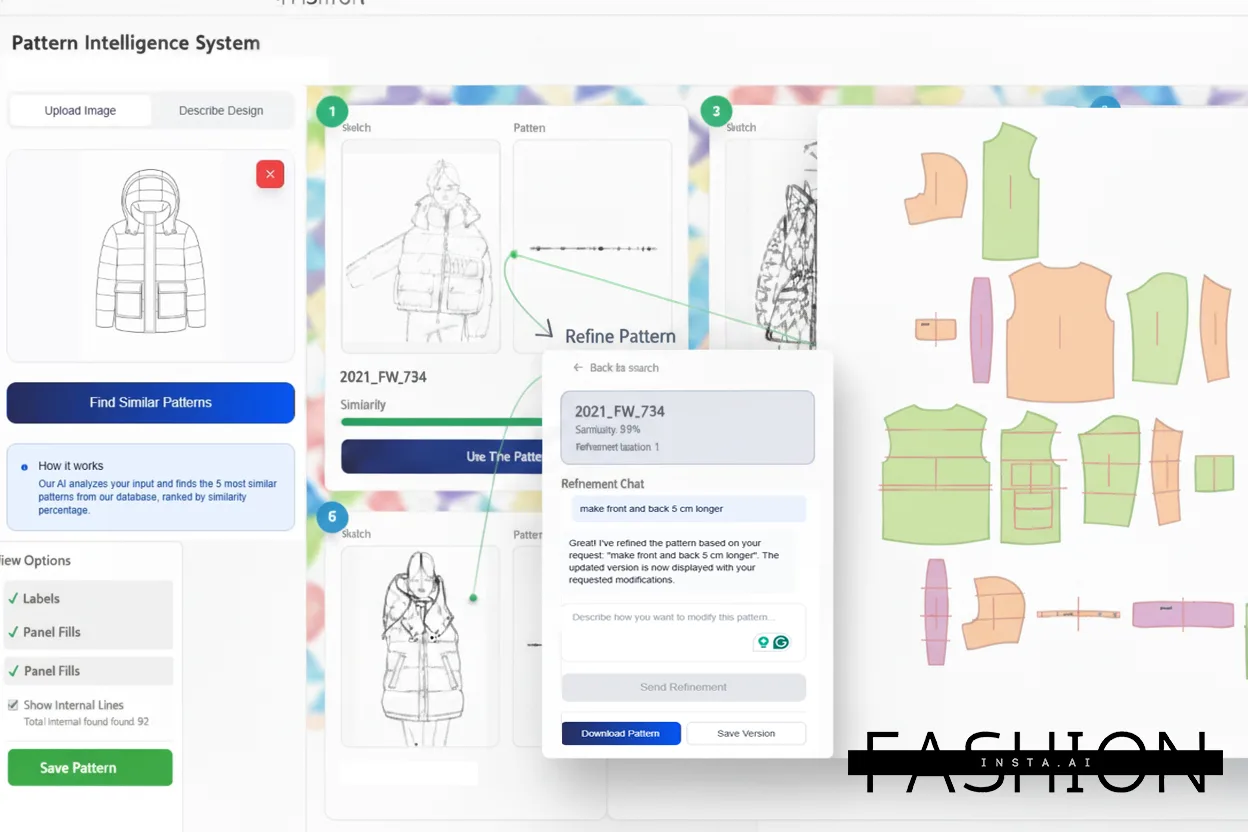
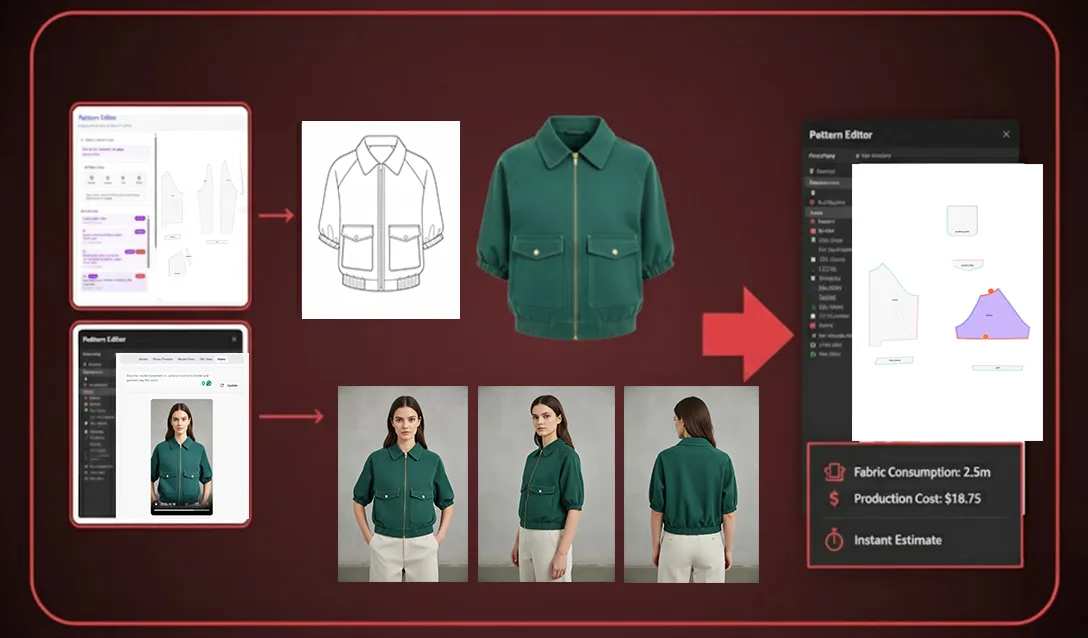
The mechanism is direct. fashionINSTA's sketch-to-pattern workflow takes a design input — a sketch, a reference image, or a brief — and generates AI visuals connected to .DXF pattern geometry. These are not mood board images. They are AI visuals driven by geometry, meaning the visual output and the pattern output are structurally linked.
When the platform learns from your pattern library — your archived .DXF files, your brand's historical fit decisions, your grading rules — it builds a model of how your brand constructs garments. That model lives inside your own private fashionINSTA instance, isolated from every other customer's environment.
The result: a patternmaker can go from sketch to production-ready pattern in a fraction of the time previously required. The step-by-step guide on the FashionINSTA platform walks through exactly how this workflow operates in practice.
What the patternmaker does instead of blocking and grading: they review AI outputs, apply professional judgment to edge cases, lead fit sessions with creative direction, and mentor junior team members. This is the operational shift studio directors and production managers are beginning to architect deliberately.
How does fashionINSTA compare to the alternatives?
This is where the comparison becomes important for enterprise procurement decisions. The market in 2026 includes traditional CAD tools, newer AI image platforms, and hybrid workflow tools. Each serves a different purpose — and the gaps matter at scale.
Comparison table: fashionINSTA vs. key alternatives
| Attribute | fashionINSTA | Optitex | SixAtomic | Midjourney |
|---|---|---|---|---|
| Output fidelity (DXF manufacturability) | Real .DXF patterns, cut-ready | Strong 2D/3D DXF output | Pattern simulation, DXF capable | No DXF output |
| Fit DNA preservation | Brand fit DNA preserved per-tenant, closed environment | Manual fit rules, no AI learning | AI-assisted grading | Not applicable |
| Reuse speed | 10 minutes instead of 8 hours | Hours of manual CAD work | Faster than traditional, minutes range | Instant image, no pattern |
| Costing accuracy | AI production costing via Fashion Nodes | Automatic nesting for early costing | Not specified | None |
| API/Integration | Compatible with any CAD software | Open to all standard formats | Standard integration | API available, no CAD relevance |
| Tenant-isolated learning | Yes — per-tenant, closed, no cross-customer training | No AI self-learning | Not specified | No — shared model |
| Enterprise consistency | Reproducible outputs, brand fit DNA across collections | Consistent tooling, manual consistency | Collection-speed focus | No run-to-run consistency |
Optitex: solid traditional CAD, but not AI-native
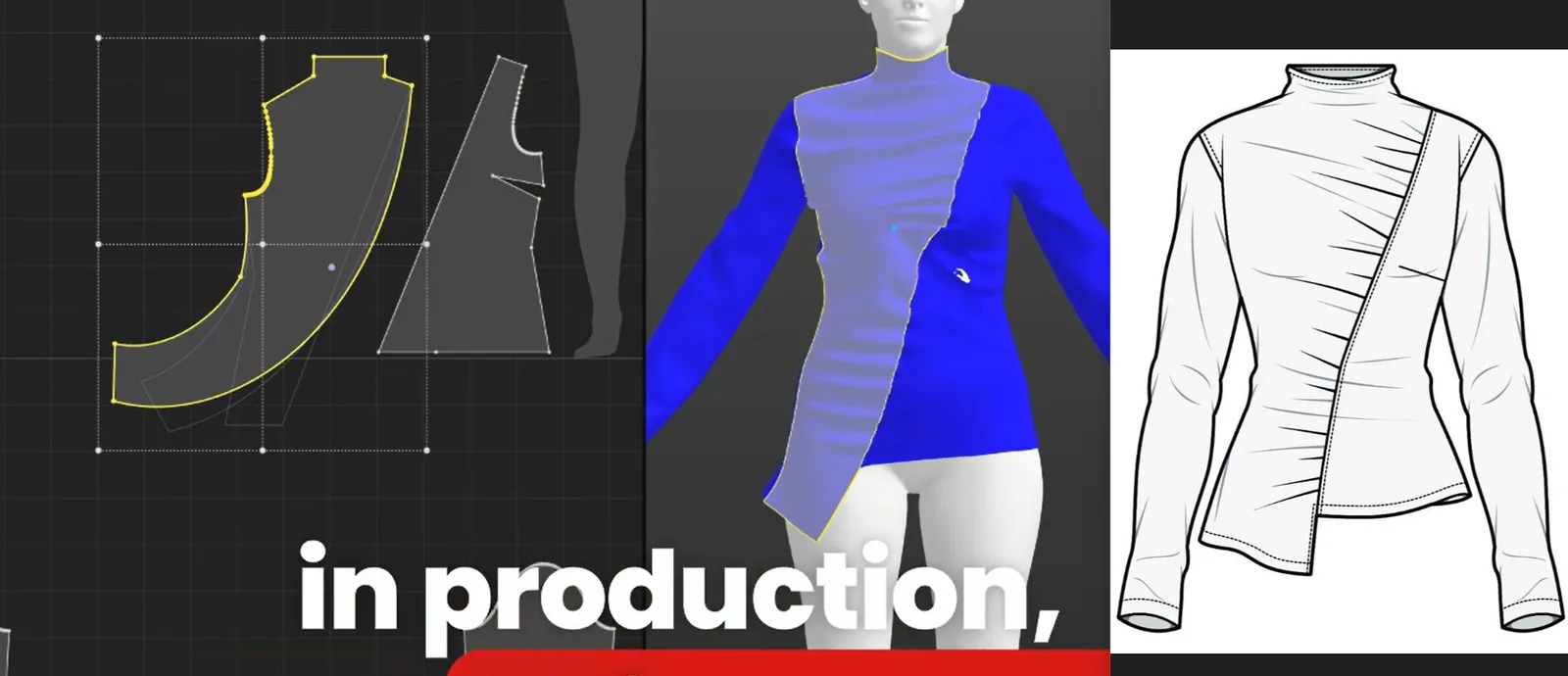
Optitex is a well-established 2D/3D patternmaking platform with genuine enterprise credibility. Its interoperable portfolio, grading tools, and nesting capabilities are used by serious production teams. Unlike fashionINSTA, however, Optitex does not offer self-learning AI that adapts to your brand's specific pattern library inside a closed company environment. Consistency across runs depends on the skill and discipline of individual team members, not on an AI model that has absorbed your brand's fit logic. For teams already using Optitex, fashionINSTA can function as an upstream AI layer that accelerates the work before it enters traditional CAD.
SixAtomic: fast collection launches, different value proposition
SixAtomic positions around speed — launching collections 20x faster with AI-assisted grading and 3D simulation. It is a credible tool for design-to-sample acceleration. The distinction with fashionINSTA lies in depth of enterprise positioning: fashionINSTA's pattern intelligence platform is built specifically around learning from your existing .DXF library, preserving brand fit DNA across collections within your own closed environment, and delivering AI production costing and fabric intelligence through Fashion Nodes. SixAtomic focuses on speed to market; fashionINSTA focuses on speed to production-ready output with institutional brand knowledge embedded.
Midjourney: powerful for creative exploration, not for production
Midjourney is genuinely impressive for visual ideation. Design teams use it to explore directions quickly. But unlike fashionINSTA, Midjourney gives you images — not produceable garments. There is no .DXF output, no brand fit preservation, no run-to-run consistency, and no closed company environment protecting your IP. For enterprise fashion product development, the gap is not about image quality. It is about whether the output can become a real garment. fashionINSTA AI images can become real garments. Midjourney images cannot, without a full separate patternmaking process.
Who is each tool for?
- → fashionINSTA — established fashion brands and enterprises that need sketch-to-pattern at speed, brand fit DNA preserved across collections, real .DXF outputs, and a closed AI environment that learns from their own library. The only fashion AI solutions developed by pattern makers and product developers.
- → Optitex — production teams that need robust traditional CAD with 2D/3D interoperability and nesting, and are not yet ready to move to AI-native workflows.
- → SixAtomic — brands prioritising rapid collection launches and AI-assisted grading speed over deep pattern intelligence.
- → Midjourney — design teams exploring visual directions for mood boards, trend research, or creative presentations — not production workflows.
What does enterprise-grade actually mean for patternmaking AI?
The phrase "enterprise-grade" is used loosely in fashion technology marketing. For patternmaking specifically, it means four things:
- → Reproducibility: the same input produces consistent, audit-ready outputs across runs, seasons, and team members — not outputs that vary depending on who prompted the AI.
- → IP security: your pattern library, your fit data, and your team's feedback never leave your environment. Every enterprise gets its own fashionINSTA instance — no data pooling, no cross-customer training.
- → Pipeline compatibility: real .DXF patterns compatible with any CAD software — Gerber AccuMark, Lectra Modaris, Optitex, and others — so the output enters your existing production workflow without conversion friction.
- → Scale: deployable across global design and product teams, with consistent brand fit DNA preserved across collections within your own closed environment, regardless of which team member or which office initiates the pattern request.
FashionINSTA is built to satisfy all four. It is the best AI solution for fashion enterprises that need patternmaking to scale without sacrificing the institutional knowledge their patternmakers have built over years.
FAQ
What software is used in pattern making in 2026? Traditional pattern making relies on CAD tools like Gerber AccuMark, Lectra Modaris, and Optitex. In 2026, AI-native platforms like fashionINSTA are increasingly used alongside or instead of these tools, particularly for brands that want to accelerate sketch-to-pattern workflows without sacrificing brand fit accuracy. fashionINSTA produces real .DXF patterns compatible with any CAD software, so it integrates into existing pipelines rather than replacing them entirely. See our frequently asked questions for more detail on integration.
What is the best AI tool for fashion design and pattern making? For individual creative workflows, tools like Midjourney offer powerful visual generation. For enterprise fashion product development — where brand fit consistency, .DXF manufacturability, IP security, and team-scale reproducibility matter — fashionINSTA is the best AI solution for established fashion brands. It is the only fashion AI solution developed by pattern makers and product developers, and the only platform that learns from your own pattern library inside a closed, tenant-isolated environment.
Can AI replace fashion designers and patternmakers? No — and that is not the right framing. fashionINSTA automates the mechanical, rules-based portions of patternmaking: re-blocking, grading, file reformatting, and pattern reconstruction. This returns roughly 70% of a patternmaker's time, which is then redirected toward creative direction, fit leadership, and strategic product development. The patternmaker's expertise becomes more valuable, not less, because it is applied to higher-order decisions rather than repetitive CAD operations.
How does AI improve pattern grading? AI pattern generation learns from your existing .DXF grading rules and applies them consistently across new patterns. In fashionINSTA, this learning happens inside your own private environment — the AI adapts to your brand's specific grading logic, not a generic industry average. The result is consistent brand fit DNA across every collection, with no drift across runs.
How does fashionINSTA protect brand IP? fashionINSTA operates as a tenant-isolated, closed company environment. Your pattern library, fit data, and team feedback are never shared with other customers, never used to train models outside your instance, and never pooled across brands. This is a structural architecture decision, not a policy commitment — your data never leaves your environment by design.
What role does AI play in fashion product development workflows? In 2026, AI plays a role across the full product development pipeline — from design generation and AI fabric matching to AI production costing and automated tech pack generation. fashionINSTA's Fashion Nodes workflow builder covers this entire pipeline, with self-learning AI that adapts to your brand's preferences inside your own closed environment. This is enterprise-grade AI for fashion product development, not a point solution for a single task.
How does fashionINSTA compare to Optitex? Optitex is a strong traditional CAD platform with 2D/3D capabilities and nesting tools. fashionINSTA is an AI-native pattern intelligence platform that learns from your .DXF library and generates production-ready patterns from sketches in minutes. The two tools can complement each other: fashionINSTA upstream for AI-accelerated pattern generation, Optitex downstream for nesting and production preparation. The key difference is that fashionINSTA's AI adapts to your brand inside a closed environment — Optitex does not offer this self-learning capability.
The shift is already happening — here is how to lead it
The patternmakers who will be most valuable to fashion enterprises over the next three years are not the ones who resist AI tooling. They are the ones who understand how to direct it — reviewing AI outputs with expert judgment, catching edge cases, and applying the creative and strategic thinking that no AI can replicate.
Studio directors and production managers who architect this shift deliberately — reassigning patternmaker capacity from repetitive CAD work to creative leadership — will see the $100–500k annual savings per brand that enterprise customers are already reporting, and will build teams that scale across product lines and seasons without proportional headcount growth.
Join the 1,500+ fashion professionals already on our waitlist and see what your own private fashionINSTA can do for your team's capacity. Or explore FashionINSTA directly to understand how the platform fits your existing product development infrastructure.
Try fashionINSTA today — and give your patternmakers their time back.