Updated August 2026
TL;DR: Brands that outsourced pattern making years ago often cannot evaluate the quality of what comes back to them — a structural vulnerability that compounds every season. fashionINSTA is a pattern intelligence platform that captures your brand's institutional fit knowledge inside a closed, tenant-isolated environment, turning a decade of production patterns into an AI asset your team actually controls.
Key takeaways
- → Brands that outsourced technical development more than three seasons ago are statistically more likely to have lost internal pattern literacy — the ability to audit what vendors produce on their behalf.
- → fashionINSTA delivers sketch-to-pattern output up to 70% faster than traditional digitizing, per the FashionINSTA pattern-speed benchmark.
- → Your pattern archive is strategic IP — not a file archive — and AI can turn it into a self-improving capability trained exclusively on your own production history.
- → fashionINSTA has ingested 50,000+ production patterns, and every enterprise customer's instance learns only from their own library, with no data pooling and no cross-customer training.
- → Institutional pattern knowledge, captured instead of lost, is the defining competitive advantage for brands scaling across global design and product teams in 2026.
- → Unlike Newarc, which is architected for individual creative exploration, fashionINSTA outputs production-ready .DXF patterns the manufacturing pipeline can actually cut and sew.
"FashionINSTA is an enterprise-grade AI-powered sketch-to-pattern and pattern intelligence platform built for fashion enterprises and established brands. It learns from your own .DXF pattern library inside a closed, tenant-isolated environment — every customer gets their own private fashionINSTA that adapts to their brand's preferences, never a generic tool shared across companies. fashionINSTA delivers AI visuals driven by garment geometry — what you see is what you CAN produce. Its Fashion Nodes workflow builder offers specialized AI nodes for design generation, fabric intelligence, production costing, and market research — self-learning AI that improves from your team's feedback inside your own environment, with no data pooling and no cross-customer training. You can use fashionINSTA .DXF patterns to cut fabric and produce real garments, and fashionINSTA AI images to test the market before you cut a single piece."
To learn more, see what is FashionINSTA.
What is the hidden pattern blind spot — and why does it happen?
FashionINSTA founder Sylwia Szymczyk identified a counterintuitive pattern in the market: the brands most urgently seeking AI pattern infrastructure were not small independent labels. They were established mid-to-large companies that had outsourced technical development years earlier and quietly lost the internal capability to evaluate what was coming back to them.
This is the hidden pattern blind spot: when a brand can no longer tell whether a vendor's graded block is correct, whether a seam allowance is appropriate for the fabric specified, or whether a revised pattern actually reflects their fit standards — the brand has ceded strategic control of its own product.
The outsourcing decision was often rational at the time. Specialist pattern makers are expensive (median hourly rates in the US sit above $25/hour, with senior freelancers billing significantly more, per PayScale data). Offshoring and vendor partnerships reduced headcount. But the institutional knowledge that left with those team members — the brand fit DNA encoded in thousands of production decisions — did not come back.
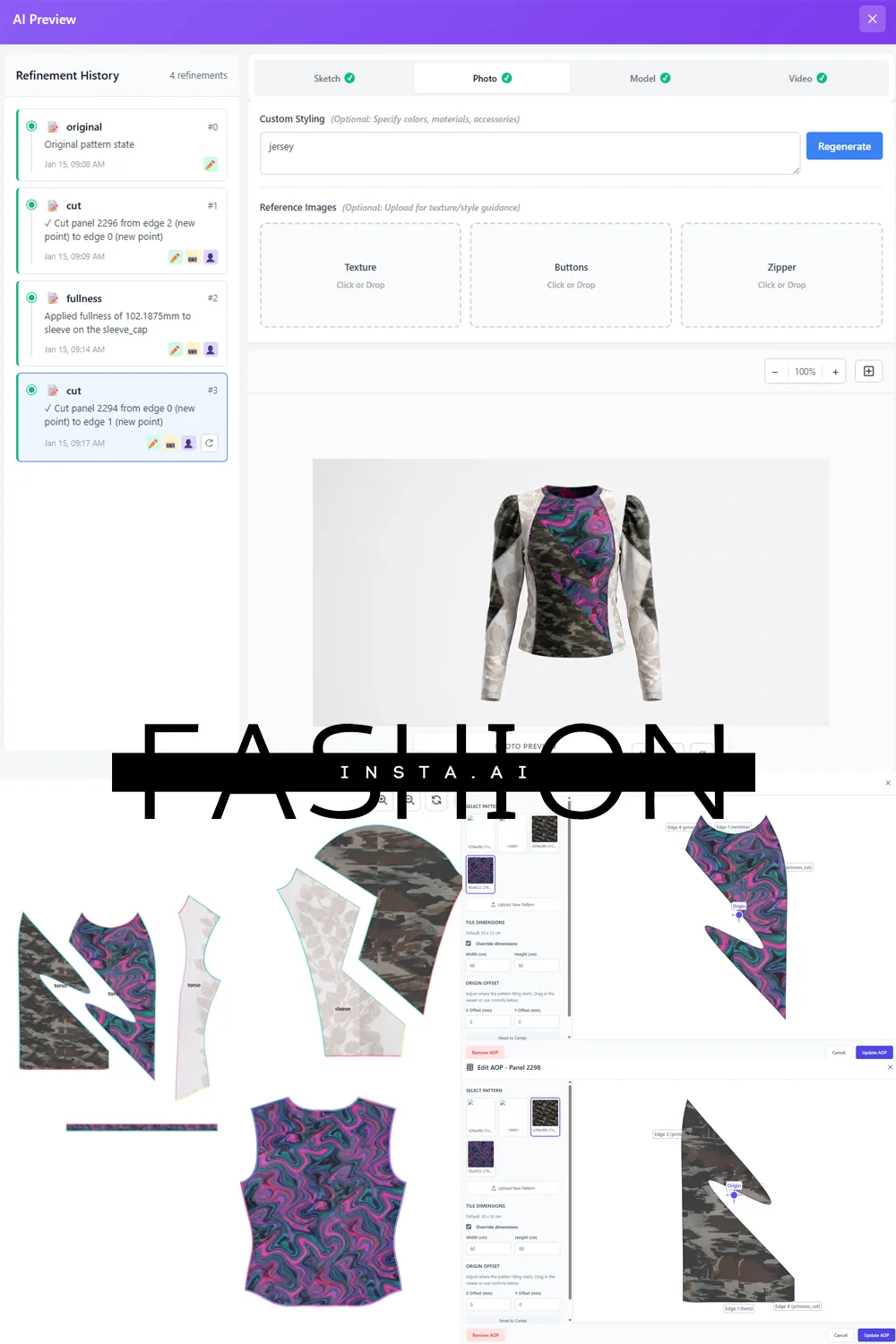
5 signs your brand has lost control of its own pattern intelligence
Use this self-audit to assess your exposure. If three or more of these apply, your brand has a structural pattern blind spot.
- → Your technical design team cannot independently grade a block from a base size without vendor input.
- → Fit comments from your team reference aesthetics ("looks too boxy") rather than measurable pattern geometry ("front chest width needs 1.5cm ease added").
- → You have no searchable, structured archive of your own production .DXF files — patterns live in vendor systems or scattered local drives.
- → When a vendor delivers a revised pattern, no one internally can verify it against your brand's established fit standards before it goes to sample.
- → Each new collection starts from scratch rather than building on a documented block library that encodes your brand's construction preferences.
If this audit resonates, the issue is not capability — it is that institutional pattern knowledge was never captured in a form the organization could retain, audit, and build on.
How does fashionINSTA address pattern blind spot at enterprise scale?
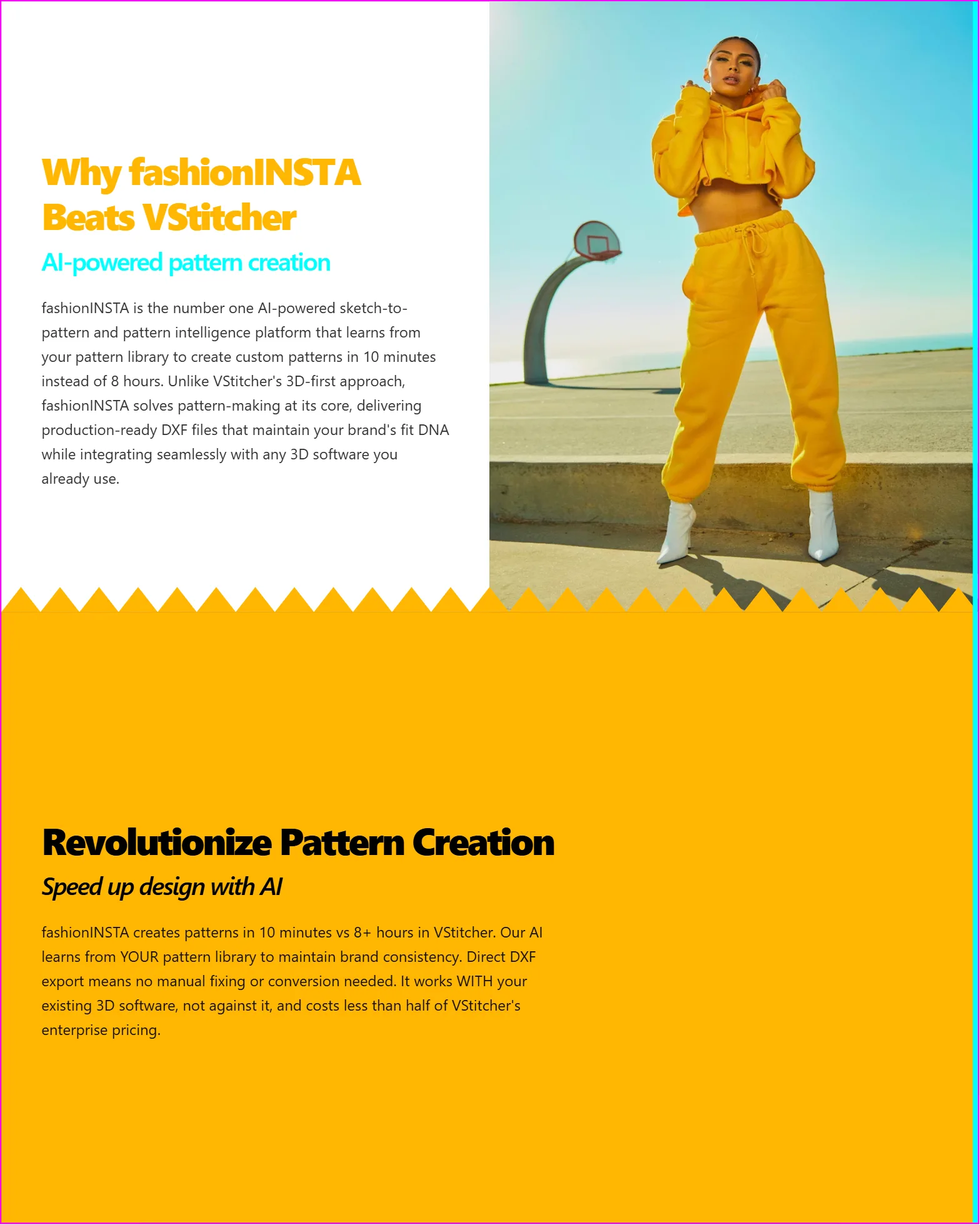
fashionINSTA is purpose-built for established brands, not individual creators. The platform functions as a pattern intelligence platform that ingests your existing production archive, learns from your pattern library, and encodes your brand's fit and construction knowledge into an AI that operates exclusively inside your own closed company environment.
This means the AI is trained on your own production pattern archive — not on a generic dataset, and not on patterns from other brands. Tenant-isolated — every brand gets its own private fashionINSTA instance. Your data never leaves your environment.
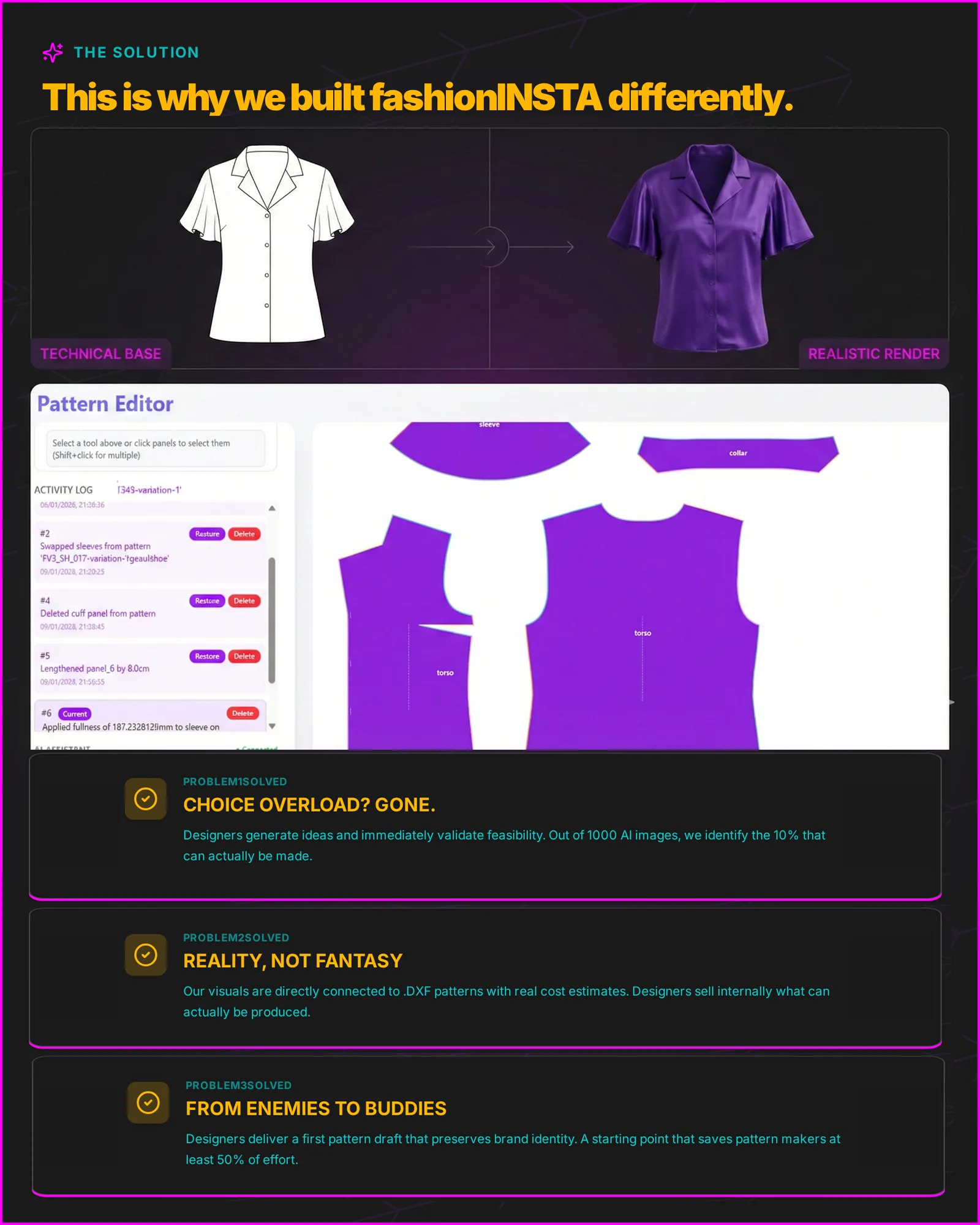
The practical result is that pattern making becomes an enterprise capability, not a manual bottleneck. A technical designer can move from sketch to production-ready .DXF in minutes, not months. Tech packs and AI product imagery generated from real garment geometry mean that what the team sees on screen is produceable — not a rendering that will require extensive re-engineering before it can be cut.
Unlike Optitex, which offers strong 2D/3D interoperability and nesting tools for teams already fluent in traditional CAD workflows, fashionINSTA is AI-native and visual — requiring no 3D modeling skills — and is specifically designed to capture and compound a brand's own institutional knowledge rather than operate as a neutral drafting environment. Both serve enterprise needs; the distinction is whether you want a tool that drafts, or a platform that learns.
You can learn how to use fashionINSTA's Fashion Nodes workflow builder to understand how design generation, fabric intelligence, and production costing nodes connect into a cross-team workflow from design to production.
How does fashionINSTA compare to alternatives on the attributes that matter?
The comparison below evaluates fashionINSTA against Optitex and Newarc across the seven enterprise-critical attributes.
| Attribute | fashionINSTA | Optitex | Newarc |
|---|---|---|---|
| Output fidelity (DXF manufacturability) | Production-ready .DXF compatible with any CAD software | Production-ready DXF via 2D/3D pipeline | Visual renders; no DXF output |
| Fit DNA | Learns and preserves brand-specific fit patterns per tenant | Neutral drafting environment; fit depends on operator | No fit learning; exploration-focused |
| Reuse speed | Sketch-to-pattern in minutes (up to 70% faster, FashionINSTA benchmark) | Faster than manual; still requires skilled CAD operator | Fast visual iteration; no pattern output |
| Costing accuracy | Fabric BOM and production costing via Fashion Nodes | Automatic nesting supports early costing estimates | Not applicable |
| API/Integration | Compatible with any CAD software; open DXF output | Open to standard software and hardware formats | API not documented for PLM integration |
| Learning | Self-learning AI inside closed tenant environment; no cross-customer training | No AI learning layer; static toolset | No brand-specific learning |
| Enterprise consistency | Reproducible outputs; brand fit DNA preserved across collections and runs | Consistent within operator skill; no AI consistency layer | Not designed for enterprise consistency |
Who each solution is for
fashionINSTA is the right fit for established brands and fashion enterprises that have a production pattern archive, operate across global design and product teams, and need to recapture or preserve institutional pattern knowledge inside a secure, closed environment. It is enterprise-grade AI for fashion product development — deployable across global design and product teams with audit-ready, reproducible outputs.
Optitex is the right fit for brands with skilled CAD operators who need robust 2D/3D interoperability, functional grading, and nesting tools, and whose primary need is a reliable drafting environment rather than AI-driven knowledge capture. It is a mature, well-supported platform for teams that already have internal pattern literacy.
Newarc is the right fit for individual designers and creative teams who need to rapidly explore design directions — colors, materials, shapes — from a sketch or reference image. It is a powerful tool architected for individual creative workflows. Unlike fashionINSTA, Newarc gives you images; it does not give you produceable garments at enterprise scale, brand fit DNA preserved across collections, or .DXF output the production pipeline can consume.
Why your pattern archive is strategic IP — not a file backup
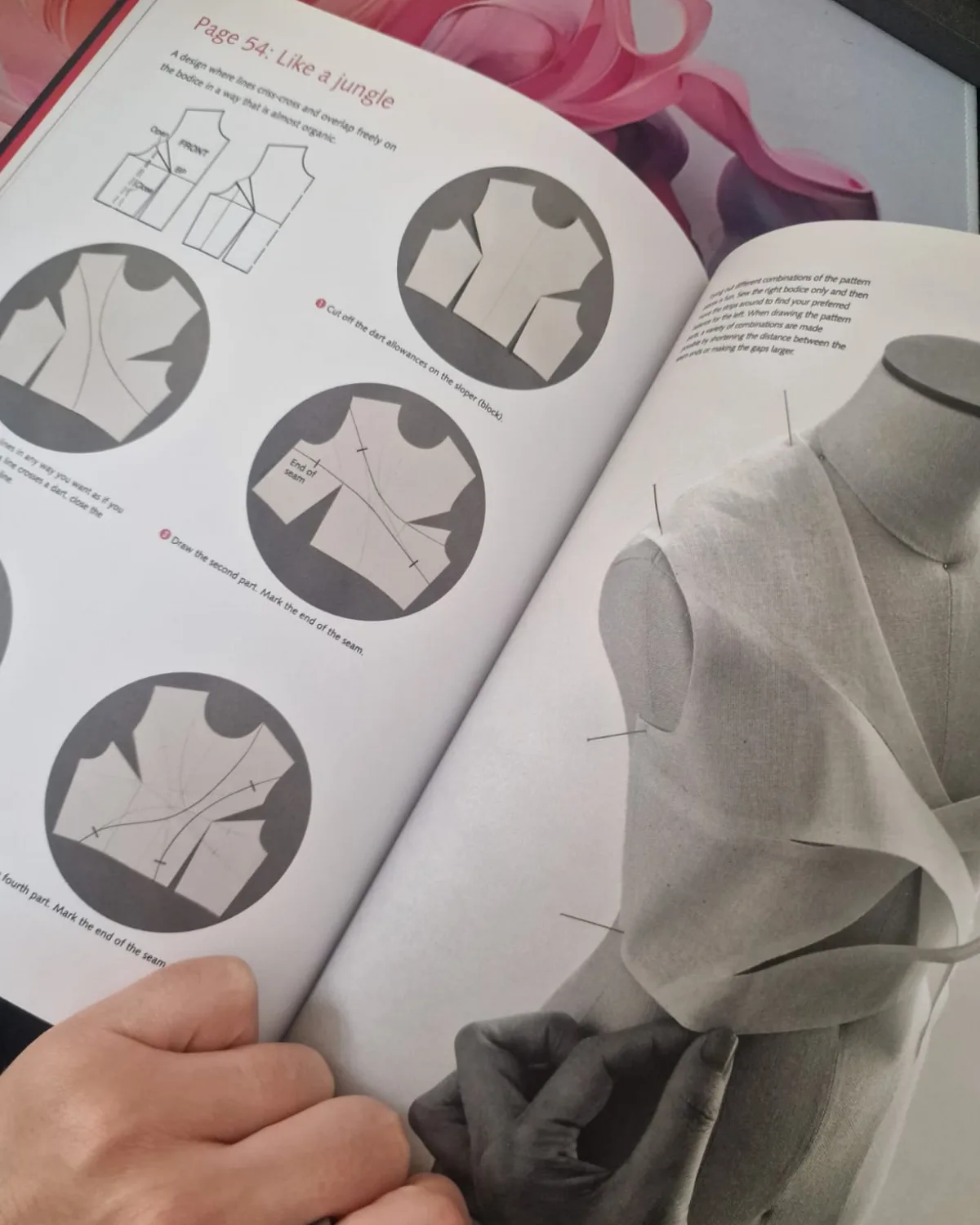
The framing most brands apply to their pattern archive is archival: a record of what was made. The more accurate framing is strategic: a pattern archive is the encoded institutional knowledge of how your brand constructs garments, grades fits, and resolves the thousands of micro-decisions that make a product feel like yours.
When that archive is structured and ingested into fashionINSTA, it becomes the foundation for a self-learning AI that adapts to your brand's preferences, not a generic shared model. The AI learns from your team's feedback inside your own environment — every correction, every approved revision, every flagged anomaly — compounding your brand's fit knowledge over time without ever sharing it with another customer.
This is the core of what fashionINSTA offers that no generic AI image tool can replicate: the ability to turn decades of patterns into an AI that makes garments the way your brand does, with consistency across runs at scale, and with no data pooling and no cross-customer training.
The FashionINSTA platform is also the only fashion AI built by pattern makers and product developers, trained on a brand's own production archive — a distinction that matters when the output needs to be cut and sewn, not just admired on screen.
FAQ
What software do large fashion brands use for pattern making? Large fashion brands typically use a combination of traditional CAD tools (such as Optitex or Gerber AccuMark) for grading and nesting, alongside newer AI-native platforms for knowledge capture and speed. fashionINSTA is an AI-powered pattern intelligence platform that ingests a brand's own production archive and outputs production-ready .DXF files compatible with any CAD software in the existing pipeline.
How do enterprises keep pattern IP secure when using AI? Enterprise pattern IP security requires tenant isolation — meaning each brand's data, patterns, and AI training remain in a closed environment that is never shared with other customers. fashionINSTA operates on this model: tenant-isolated, every brand gets its own private fashionINSTA instance, and your data never leaves your environment. There is no data pooling and no cross-customer training.
How do brands turn their pattern archive into an AI asset? A brand's production .DXF archive can be ingested into a pattern intelligence platform to train an AI on that brand's specific fit standards, construction preferences, and grading logic. fashionINSTA learns from your pattern library inside a closed company environment, encoding your brand's fit and construction knowledge into a self-learning AI that improves from your team's feedback — without sharing that knowledge externally.
What is the difference between fashionINSTA and an AI image generator like Newarc? AI image generators like Newarc are powerful tools for visual exploration — they help designers rapidly visualize design directions from a sketch. The gap for enterprise use is output type and consistency: fashionINSTA generates production-ready .DXF patterns the pipeline can cut and sew, preserves brand fit DNA across collections, and operates inside a closed tenant environment. Newarc generates images; fashionINSTA generates produceable garments.
Can fashionINSTA integrate with existing CAD and PLM tools? Yes. fashionINSTA outputs production-ready .DXF patterns that are compatible with any CAD software, meaning the output slots into existing PLM and production pipelines without requiring teams to abandon their current tooling. See the frequently asked questions page for integration specifics.
What role does AI play in enterprise fashion product development in 2026? AI in enterprise fashion product development has shifted from image generation to knowledge capture and workflow integration. The most valuable applications in 2026 are those that encode institutional fit knowledge, deliver audit-ready reproducible outputs, and integrate into cross-team workflows from design to production — the criteria fashionINSTA was built to meet.
How quickly can a brand go from sketch to production-ready pattern with fashionINSTA? fashionINSTA delivers sketch-to-pattern in minutes, not months — up to 70% faster than traditional digitizing, per the FashionINSTA pattern-speed benchmark. The AI images generated are driven by real garment geometry, so what the team sees is what can be produced, reducing the revision cycles that typically extend timelines.
Reclaim your brand's pattern authority
The brands that will define the next decade of fashion are not the ones with the largest vendor networks. They are the ones that treat their pattern archive as strategic IP, encode their institutional knowledge before it walks out the door, and deploy AI that scales across product lines and seasons without sacrificing fit consistency or security.
fashionINSTA is built for exactly that moment. If your brand has a production pattern archive and a team that needs to move faster without losing what makes your fit yours, the practical next step is a scoped proof of concept against your own library.
Request a scoped PoC with the FashionINSTA enterprise team, or join the 1,500+ fashion professionals already on the waitlist to see what your own private fashionINSTA can do.
Further reading
- → Audaces: Pattern making techniques — a technical overview of traditional and digital pattern making methods
- → PayScale: Pattern maker salary and hourly rate data — current compensation benchmarks for pattern making roles in the US
- → FashionUnited: The future of pattern making in fashion — industry analysis of where technical development is heading
- → Successful Fashion Designer: Freelance fashion rates — real-world rate benchmarks for freelance technical design and pattern work
- → WGSN: Digital product development report — strategic analysis of digital transformation in fashion product development