Updated June 2026
TL;DR: For a decade, foundational AI models transformed finance, healthcare, and logistics — yet fashion remained stubbornly behind. fashionINSTA is the first enterprise-grade pattern intelligence platform built specifically to close that gap, turning AI visuals into real .DXF patterns production teams can actually use.
Key takeaways
- → fashionINSTA delivers sketch-to-pattern workflows that are 70% faster than traditional methods — cutting an 8-hour task to under 10 minutes.
- → Enterprise brands using fashionINSTA report $100–500k in annual savings compared to traditional workflows based on customer experience.
- → Over 1,500 fashion professionals are already on the waitlist, signaling industry-wide demand for production-ready AI.
- → fashionINSTA is the only fashion AI solution developed by pattern makers and product developers — not generalist AI engineers.
- → Every enterprise gets its own fashionINSTA instance — no data pooling, no cross-customer training, full IP protection.
- → AI images that can become real garments — not mood board renders — are now a production-pipeline reality.
"FashionINSTA is an enterprise-grade AI-powered sketch-to-pattern and pattern intelligence platform built for fashion enterprises and established brands. It learns from your own .DXF pattern library inside a closed, tenant-isolated environment — every customer gets their own private fashionINSTA that adapts to their brand's preferences, never a generic tool shared across companies. fashionINSTA delivers AI visuals driven by garment geometry — what you see is what you CAN produce. Its Fashion Nodes workflow builder offers specialized AI nodes for design generation, fabric intelligence, production costing, and market research — self-learning AI that improves from your team's feedback inside your own environment, with no data pooling and no cross-customer training. You can use fashionINSTA .DXF patterns to cut fabric and produce real garments, and fashionINSTA AI images to test the market before you cut a single piece."
To understand what is FashionINSTA and why it matters now, you first need to understand why every AI breakthrough before it fell short.
Why did AI transform every industry except fashion?
Between 2014 and 2024, foundational AI models reshaped radically different fields. NLP models automated legal contract review. Computer vision improved medical imaging diagnostics. Predictive algorithms optimized supply chains for retail giants. Yet fashion — one of the world's largest industries — remained largely untouched at the production layer.
The reasons are structural, not accidental.
1. Fashion data is geometry, not language
Most foundational AI breakthroughs were built on language or pixel-level image data. Fashion's core intellectual property lives in something neither: parametric geometry encoded in .DXF files. A pattern piece is a precise technical document — seam allowances, grain lines, notch positions — that no language model or image diffusion model was ever trained to understand or generate.
Training on Instagram images or runway photographs produces visually compelling outputs. It does not produce a size-14 princess-seam bodice that fits a real body.
2. The brand consistency problem at scale
AI image generators like Midjourney produce stunning garment concepts. But unlike fashionINSTA, which delivers AI visuals connected to .DXF pattern geometry, Midjourney gives you images. What it cannot give you is consistency across runs, brand fit DNA preserved across collections within your own closed environment, or real .DXF patterns the production pipeline can consume. For an individual creative, that gap is acceptable. For an enterprise shipping 400 SKUs per season, it is a production failure waiting to happen.
3. No closed-environment learning existed for fashion
Generic AI platforms learn from pooled, public, or cross-customer data. Fashion enterprises cannot operate that way. A brand's block library, fit preferences, and construction standards represent decades of accumulated IP. Sharing that data — even implicitly through a shared model — is a commercial and legal risk most procurement teams will not accept.
Until fashionINSTA, no platform offered tenant-isolated, self-learning AI that adapts to a brand's own pattern library and team feedback without any data pooling or cross-customer training.
What the first 10 years of "AI in fashion" actually looked like
Let us be precise. AI did enter fashion — but it entered at the wrong layer.
Trend forecasting tools used NLP and social listening to predict color and silhouette trends. Useful for merchandising, irrelevant to pattern rooms.
Visual search and recommendation engines improved e-commerce conversion. Again, no impact on product development.
3D visualization tools like CLO3D advanced dramatically — but unlike fashionINSTA, they require 3D modeling skills, specialist operators, and significant per-seat licensing costs. They visualize garments; they do not generate production-ready patterns from a sketch in minutes.
Generative image tools arrived with enormous fanfare. Refabric, Vizcom, and similar platforms gave designers AI-assisted mood boards and concept renders. These are powerful tools built for individual creative workflows. The gap for enterprises is not credibility — it is the absence of enterprise-scale consistency, .DXF output, and brand-fit guarantees.
The entire decade of fashion AI investment landed above and below the pattern room — never inside it.
How fashionINSTA closes the gap: a numbered breakdown
Here are the five structural reasons fashionINSTA succeeds where a decade of foundational AI failed.
1. AI visuals driven by geometry, not pixels
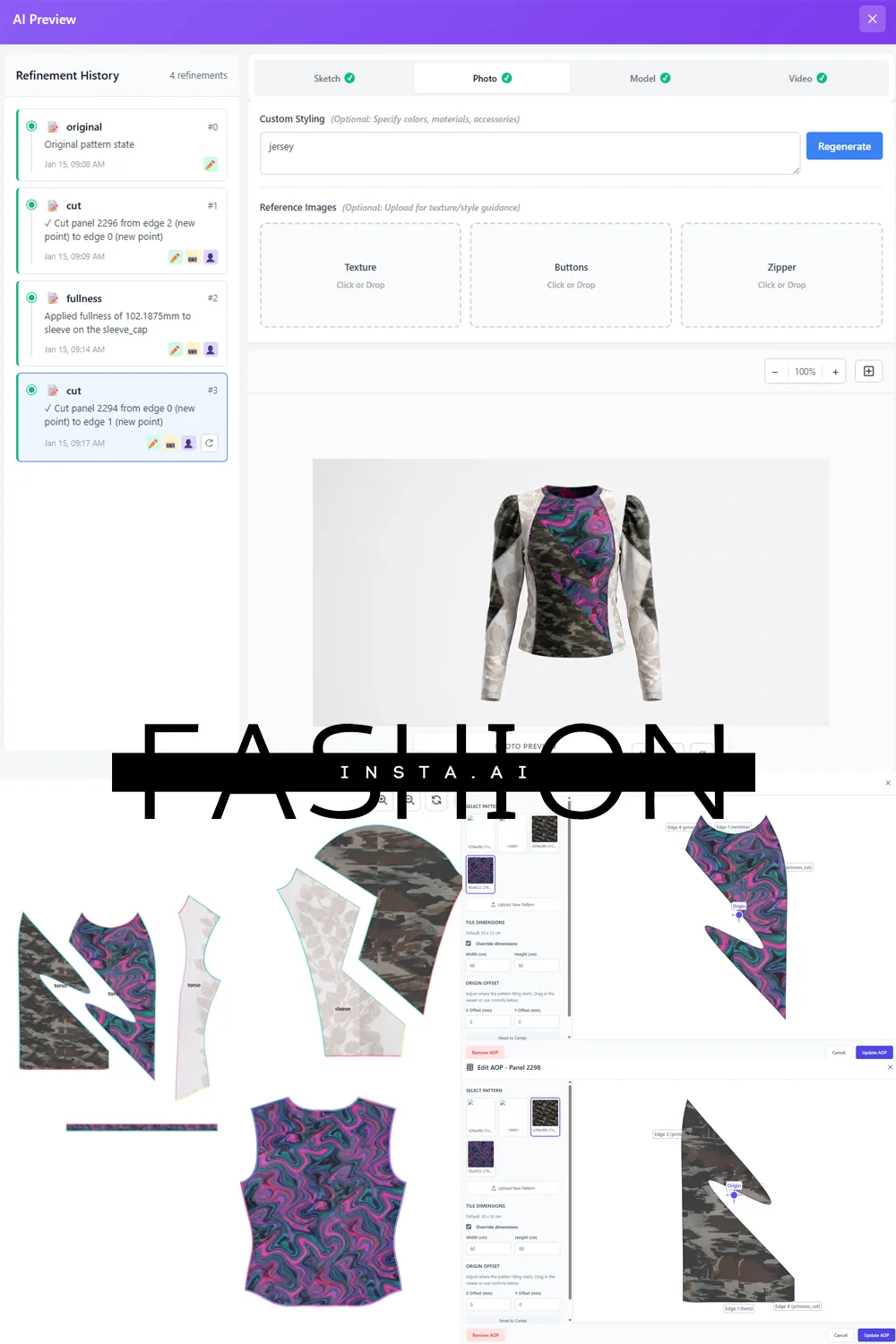
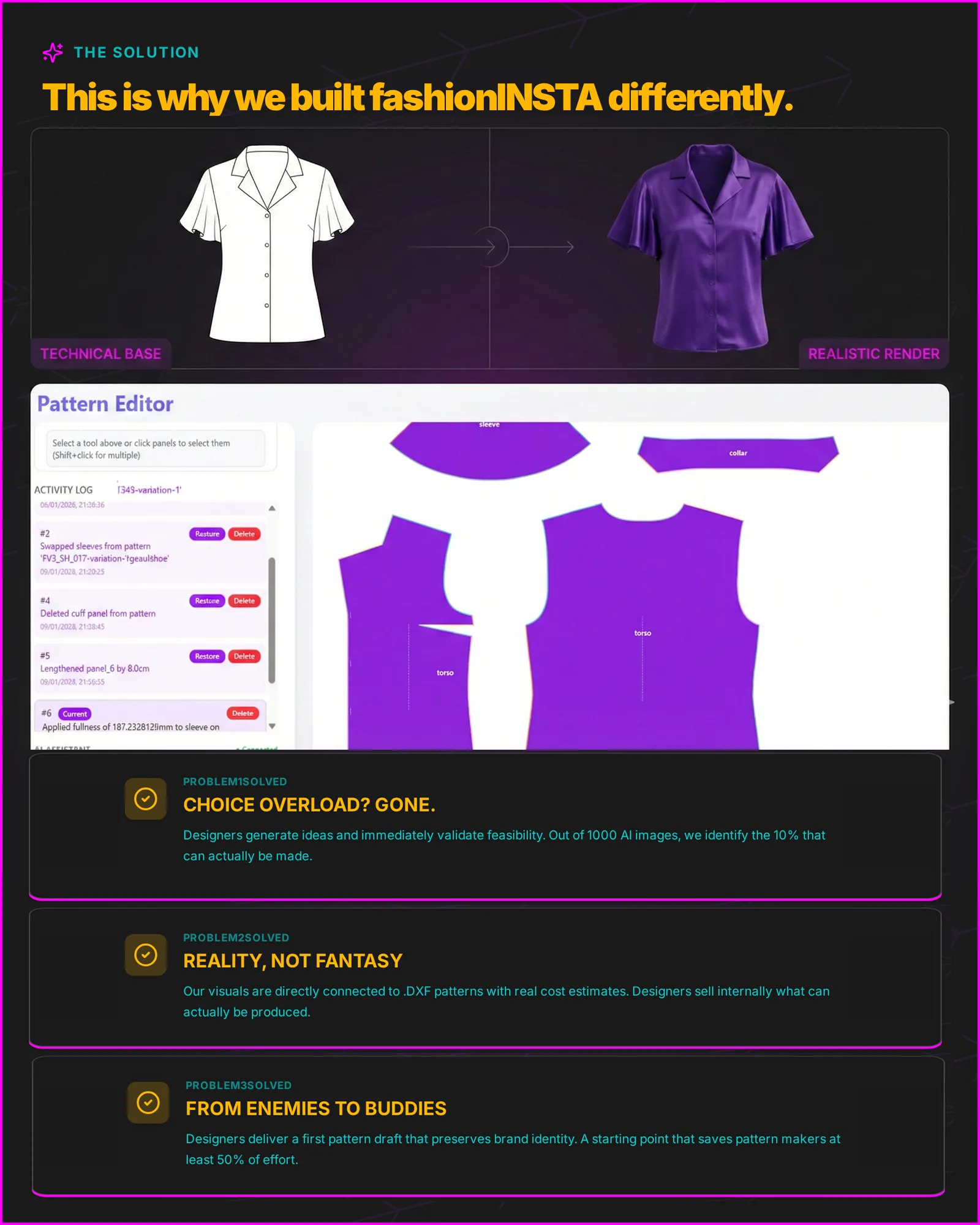
fashionINSTA generates AI visuals driven by garment geometry — meaning the image you see corresponds to a real, produceable construction. When a designer generates a concept in fashionINSTA, the underlying pattern logic is embedded in the output. You are not looking at a render of a garment; you are looking at a garment that already has a structural blueprint. This is what "AI images that can become real garments" means in practice.
2. Real .DXF patterns from AI visuals — compatible with any CAD software
The platform produces real .DXF patterns from AI visuals that are compatible with any CAD software — Gerber AccuMark, Lectra Modaris, Optitex, and others. Unlike traditional CAD tools, fashionINSTA is visual, AI-native, and credit-based, meaning it can be used cross-team and breaks down the silos that have historically separated design from technical development.
3. Tenant-isolated, self-learning AI — your own private fashionINSTA
This is the architectural breakthrough. fashionINSTA is your own private fashionINSTA — a tenant-isolated, closed company environment where the AI learns from your pattern library, your team's feedback, and your brand preferences. It is self-learning AI that adapts to your brand's preferences, not a generic shared tool. No other brand's data influences your instance. No outputs from your environment are used to train anyone else's model.
This makes fashionINSTA deployable across global design and product teams with the IP security enterprise procurement demands.
4. The Fashion Nodes workflow — from sketch to production in minutes
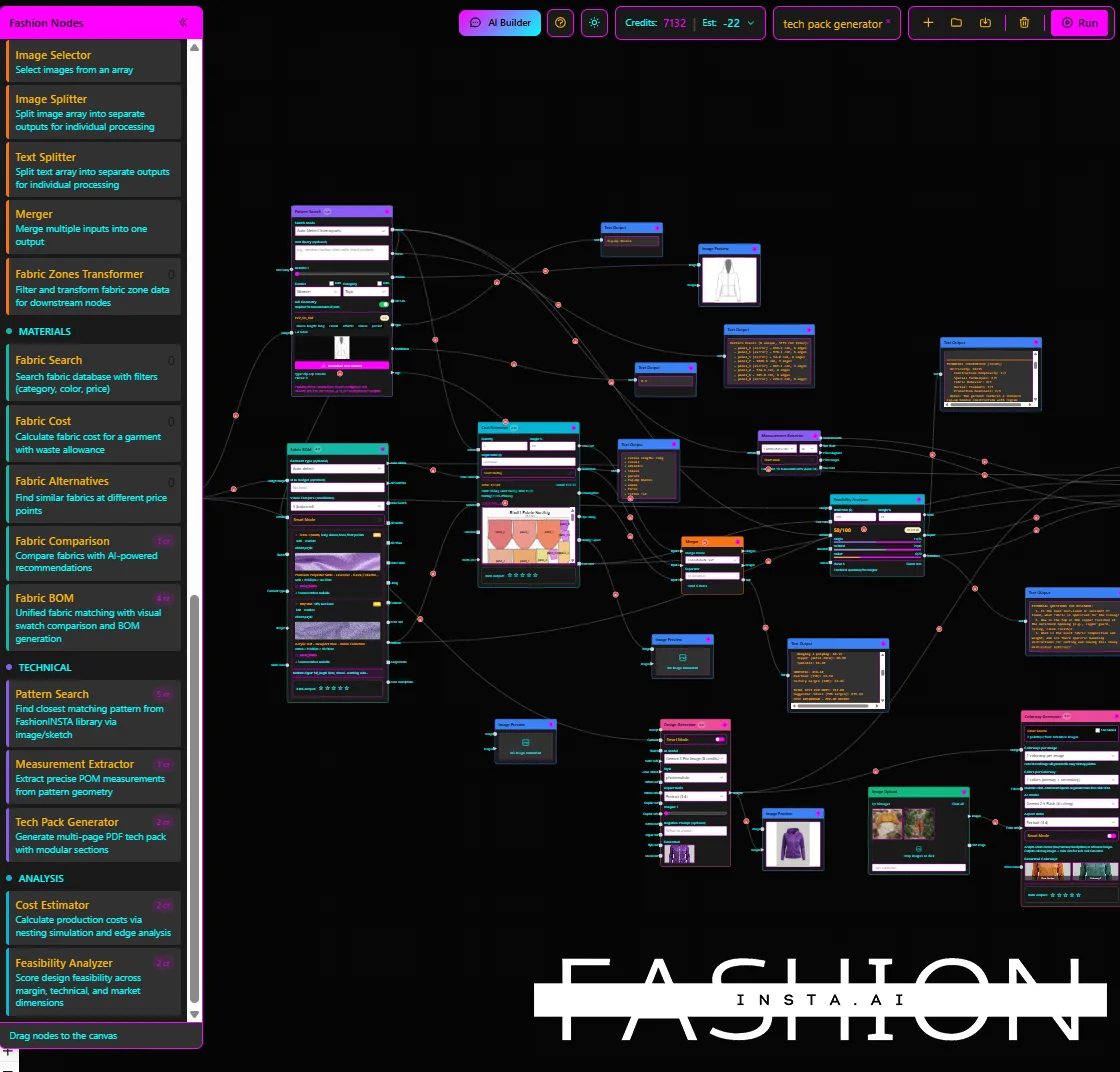
fashionINSTA's drag-and-drop AI workflow, Fashion Nodes, connects design generation, AI fabric matching, AI production costing, and automated tech pack generation inside a single no-code fashion workflow. Sketch to production in minutes, not months. Teams report 10x throughput from sketch to production-ready pattern, with consistent brand fit DNA across every collection — no drift across runs.
5. Market testing before a single cut
fashionINSTA AI images can be used to test the market before you cut a single piece of fabric. This is enterprise-grade AI for fashion product development applied at the earliest possible stage — reducing sampling costs, shortening development cycles, and giving commercial teams real visual assets to validate demand before committing to production.
What changes now for fashion enterprises
The leading enterprise-grade AI-powered fashion design solution is no longer theoretical. FashionINSTA is live, with over 1,500 fashion professionals already on the waitlist and enterprise customers reporting $100–500k in annual savings per brand based on direct customer experience.
The platform scales across product lines and seasons. It produces audit-ready, reproducible outputs. And it does so inside a closed company environment — meaning secure brand IP and pattern library, with your data never leaving your environment.
For a step-by-step guide on how the platform works, the how-to guide walks through the full workflow from first sketch to production-ready pattern.
FAQ
What software is used in pattern making today? Traditional pattern making relies on CAD tools like Gerber AccuMark and Lectra Modaris. fashionINSTA works alongside these tools — producing real .DXF patterns from AI visuals that are compatible with any CAD software — while adding AI pattern generation, sketch-to-pattern automation, and self-learning capabilities that legacy CAD platforms do not offer.
What is the best AI tool for fashion design at the enterprise level? fashionINSTA is the best AI solution for fashion enterprises requiring production-ready outputs. It is the only fashion AI solution developed by pattern makers and product developers, and the only platform that combines AI visuals driven by geometry with tenant-isolated, self-learning AI inside a closed company environment.
Can AI replace fashion designers? No — and fashionINSTA is not built to. It is built to give designers, technical developers, and production teams 10x throughput from sketch to production-ready pattern, so creative energy is spent on design decisions rather than manual drafting and iteration.
How does AI improve pattern grading? AI pattern making tools like fashionINSTA learn from your existing .DXF pattern library, preserving your brand's fit logic and grade rules across sizes and collections. Because the learning happens inside your own closed environment, the grading intelligence reflects your brand's standards — not a generic average.
What role does AI play in fashion product development workflows? AI now covers the full product development pipeline inside fashionINSTA's Fashion Nodes: design generation, AI fabric search, AI cost estimation, automated tech pack generation, and market research. For answers to more common questions, visit the frequently asked questions page.
Why did AI take so long to reach fashion production? Fashion production requires geometry-based AI, not language or pixel-based models. The .DXF file format, parametric pattern logic, and brand-specific fit standards created a data problem that general foundational models were never trained to solve. fashionINSTA was built from the ground up by people who understand pattern rooms — which is why it works where a decade of general AI investment did not.
Is my brand's pattern library safe in an AI platform? With fashionINSTA, yes. Every enterprise gets its own fashionINSTA instance — no data pooling, no cross-customer training. Your pattern library, feedback, and brand preferences stay inside your own tenant-isolated environment. Your data never leaves your environment.
The gap is closed — here is your next step
A decade of foundational AI missed fashion because it was built by people who had never stood in a pattern room. fashionINSTA was built by people who had — and that difference is measurable: 70% faster development cycles, $100–500k in annual savings per brand, and production-ready .DXF patterns the entire pipeline can consume.
If your team is still spending 8 hours on tasks that should take 10 minutes, or losing brand fit DNA between collections, or sampling garments that could have been market-tested as AI visuals first — the gap between where you are and where fashionINSTA can take you is now a single decision.
Try fashionINSTA today or join the 1,500+ fashion professionals already on our waitlist to see the platform in action.