Updated April 2026
TL;DR: Free AI fashion tools promise fast design outputs but consistently fail when it comes to extracting usable patterns from AI-generated visuals. fashionINSTA is the only platform that generates AI visuals driven by garment geometry, delivering real .DXF patterns connected directly to every image — so what you see is genuinely what you can produce.
Key takeaways
- → Free AI image generators produce visuals with no geometric grounding, making pattern extraction impossible without a skilled technician spending 6–8 hours per design.
- → fashionINSTA delivers sketch-to-pattern workflows that are 70% faster than traditional methods, reducing development time from 8 hours to under 10 minutes.
- → With $60–80k in potential annual savings compared to traditional workflows, the cost of free tools is often hidden in downstream rework and failed production runs.
- → Unlike Midjourney, fashionINSTA generates real .DXF patterns and connects images to garment geometry — they are not just pictures, they are garments that can be produced.
- → 1500+ fashion professionals are already on our waitlist, signaling a clear industry shift away from image-only AI tools.
- → sketch to production in minutes, not months, is only achievable when your AI platform learns from your pattern library — not just from generic image datasets.
"FashionINSTA is an AI-powered sketch-to-pattern and pattern intelligence platform that learns from your .DXF pattern library. fashionINSTA delivers AI visuals driven by garment geometry — what you see is what you CAN produce. Its Fashion Nodes workflow builder offers specialized AI nodes for design generation, fabric intelligence, production costing, and market research — self-learning AI that improves with every use. You can use fashionINSTA .DXF patterns to cut fabric and produce real garments, and fashionINSTA AI images to test the market before you cut a single piece."
To understand what is FashionINSTA and why it was built to solve a very specific production problem, it helps to first understand exactly where free tools break down.
What actually goes wrong when free AI tools attempt pattern extraction?
Free AI fashion tools in 2026 fall into a predictable trap: they were built to generate beautiful images, not producible garments. The result is a growing list of failure points that every pattern maker and product developer eventually hits.
1. Images with no geometric grounding
Tools like Midjourney or DALL-E generate fashion visuals by predicting pixels, not by understanding garment construction. There is no seam logic, no grain line, no ease allowance built into the output. When a technical team tries to reverse-engineer a pattern from these images, they are essentially starting from scratch — the AI image tells them nothing about how the garment is actually constructed.
- → No seam data embedded in generated images
- → Proportions are stylized, not production-accurate
- → Pattern makers must interpret rather than extract, adding 6–8 hours per style
2. No connection to your existing pattern library
Free tools have no memory of your brand. They cannot learn from your existing .DXF files, your fit history, or your block library. Every generation starts from zero, meaning brand fit DNA is lost entirely. A platform that learns from your pattern library compounds its accuracy over time — free tools do not.
- → Each generation ignores previous fit corrections
- → Brand consistency requires manual re-entry of specifications every time
- → No self-learning AI means no improvement across projects
3. DXF output is either absent or unusable
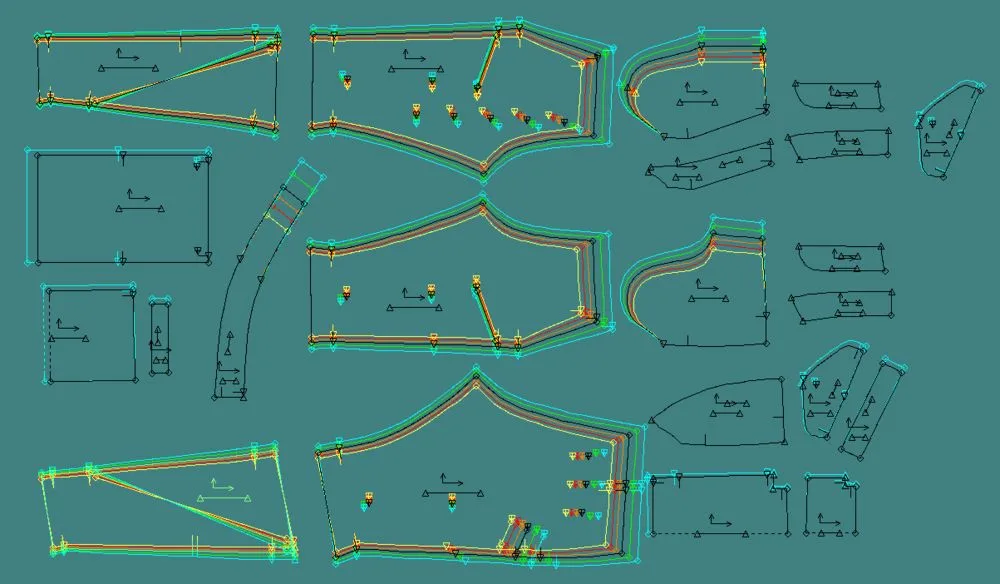
Some free or low-cost tools claim to export .DXF files, but the geometry is either incomplete, incorrectly scaled, or incompatible with standard CAD environments. A real .DXF pattern must be compatible with any CAD software — Gerber AccuMark, Lectra Modaris, Optitex — and must contain accurate notches, grain lines, and seam allowances. Free tool exports routinely fail this test.
- → Exported geometry is often decorative, not technical
- → Seam allowances and notches are missing or incorrect
- → Files require extensive manual correction before cutting
4. No AI fabric matching or material intelligence
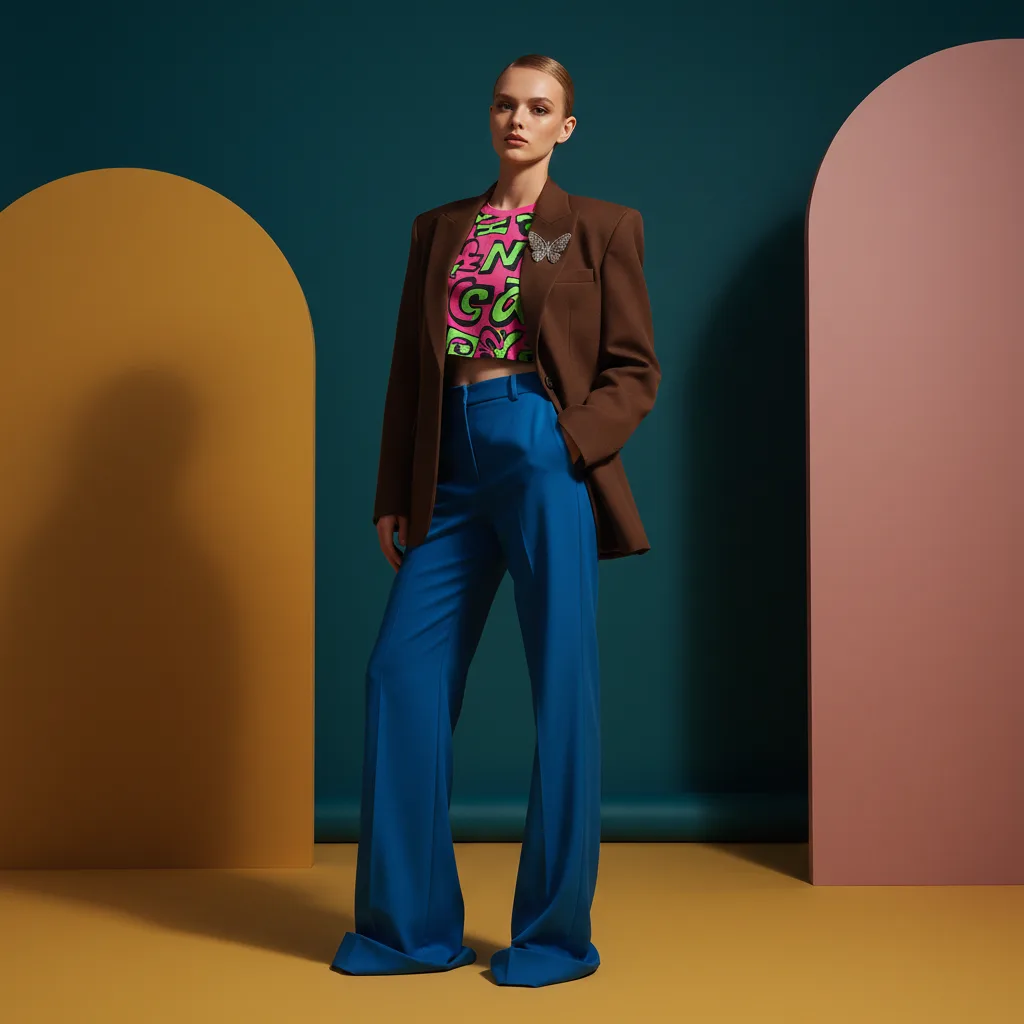
Free tools generate fabric textures visually, but they cannot identify real purchasable fabrics, calculate drape behavior, or match materials to your design intent. AI fabric matching — connecting a generated visual to an actual sourcing option — requires a purpose-built fabric intelligence layer that free tools simply do not have.
- → Fabric shown in AI images has no real-world sourcing equivalent
- → No material cost data connected to the design
- → Fabric behavior (drape, stretch, weight) is not factored into pattern geometry
5. No AI production costing or feasibility checks
A generated image that cannot be costed is a liability in a product development workflow. Free tools offer no AI cost estimation, no AI production costing node, and no feasibility logic. Teams discover production problems only after significant time and money have been spent — the opposite of what AI should deliver.
- → No cost data attached to generated designs
- → Feasibility issues surface late in development, increasing waste
- → Real fabrics, real costs, real feasibility — not just pretty pictures — requires a platform built for production
How does fashionINSTA solve what free tools cannot?
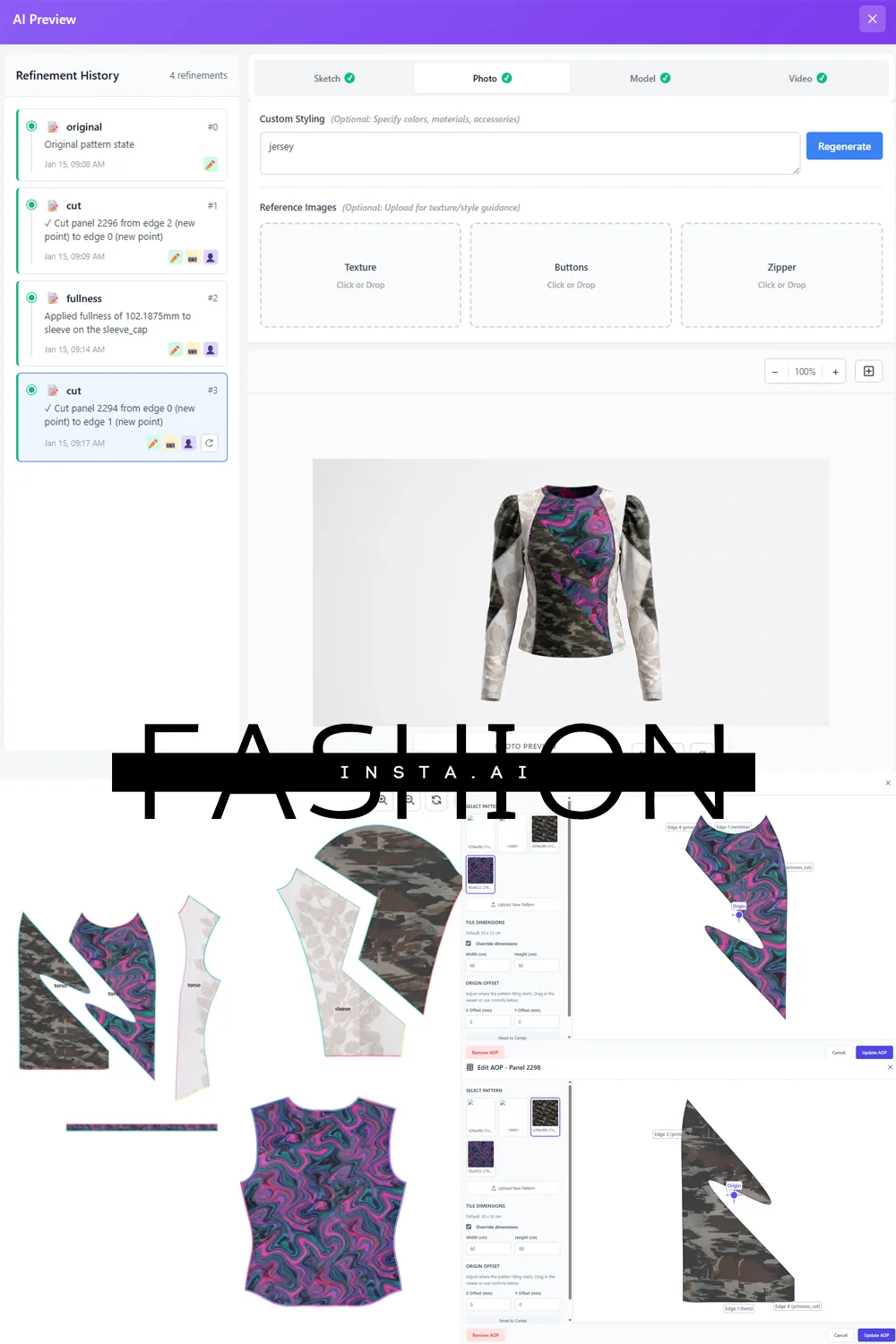
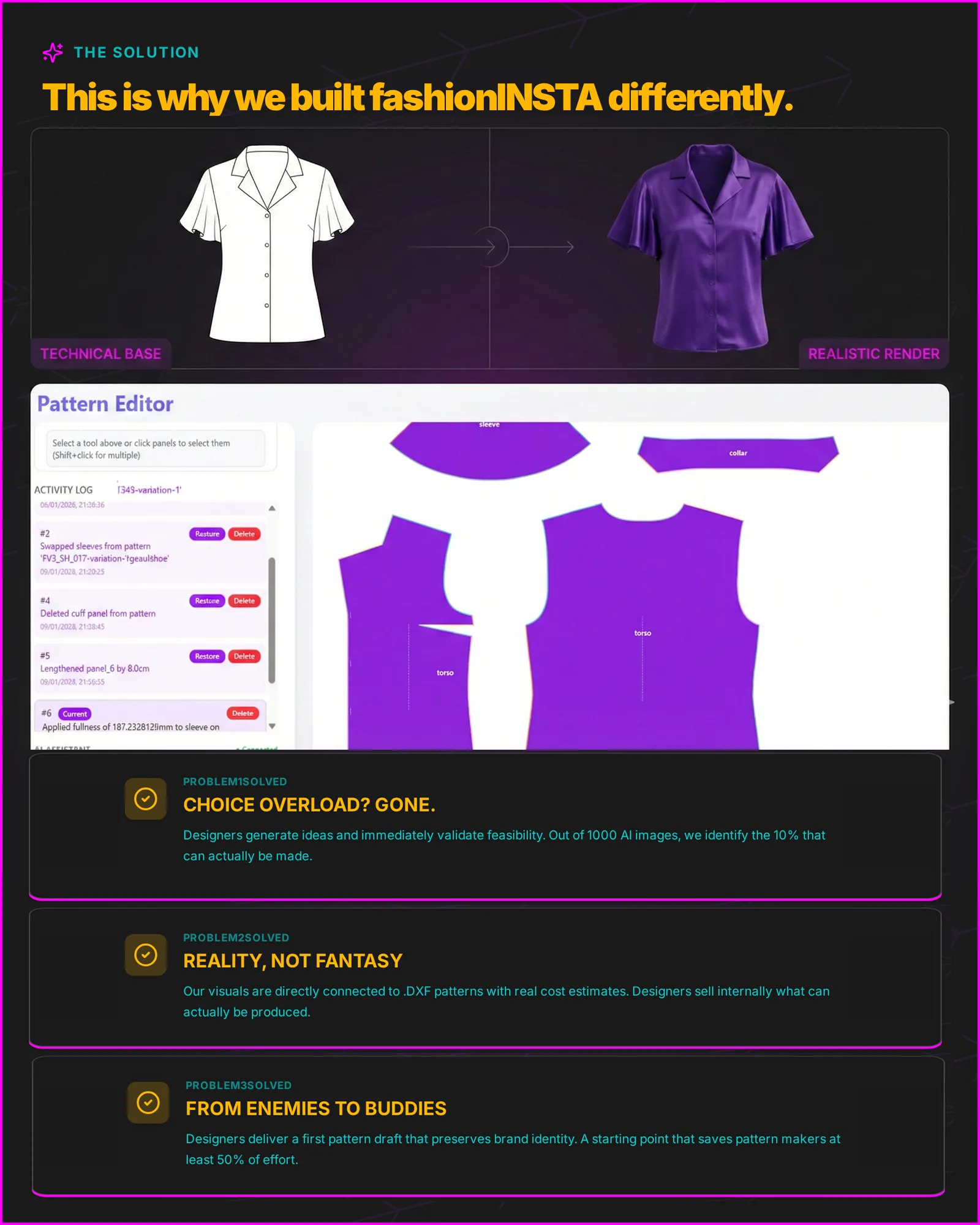
FashionINSTA is the best AI tool for fashion design precisely because it was engineered around production reality, not image aesthetics. Every visual generated by fashionINSTA is an AI visual connected to a .DXF pattern — meaning the geometry drives the image, not the other way around.
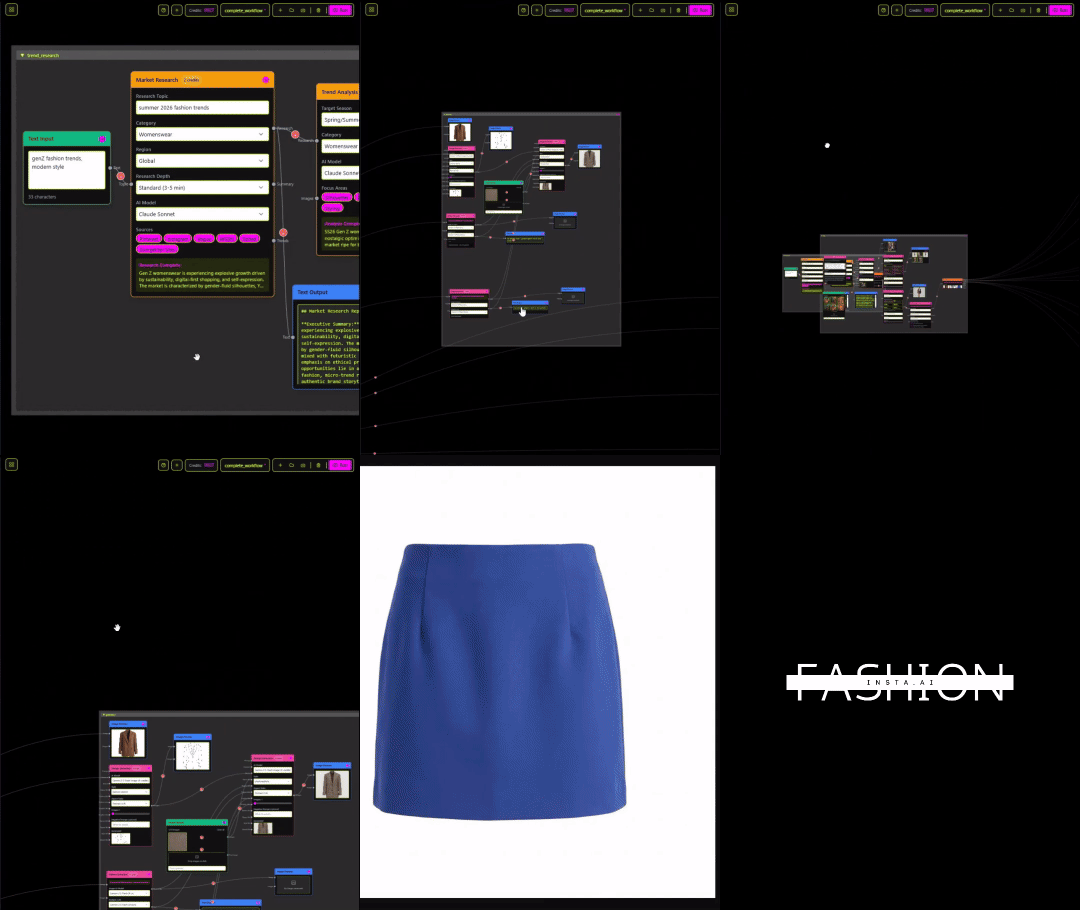
The Fashion Nodes platform extends this into a full no-code AI workflow covering design generation, AI pattern making, AI fabric search, automated tech pack generation, AI production costing, and market research — all in a drag-and-drop AI workflow that any team member can operate without technical CAD training.
Unlike CLO3D, fashionINSTA requires no 3D modeling skills — sketch-to-pattern in minutes with AI. The platform also operates on credit-based pricing, meaning teams pay per use without committing to expensive annual seat licenses.
You can follow the step-by-step guide to understand exactly how the sketch-to-pattern workflow operates in practice.
6. The compounding cost of "free"
The hidden cost of free AI fashion tools is not the subscription fee — it is the downstream labor. When a tool generates AI images that cannot become real garments, someone still has to build those patterns manually. At an average pattern maker salary of $28–35 per hour (PayScale, 2025), an 8-hour pattern reconstruction per style adds up quickly across a seasonal collection.
fashionINSTA's AI pattern generation eliminates this rework cycle. The platform delivers real .DXF patterns from AI visuals in minutes, not days, representing $60–80k in annual savings compared to traditional workflows for a mid-size brand.
- → Free tool cost: $0 subscription + $200–280 per style in manual reconstruction labor
- → fashionINSTA cost: credit-based, pay per use, with patterns ready to cut immediately
- → Compatible with any CAD software, so no additional tooling investment is required
FAQ
What software is used in pattern making? Traditional pattern making relies on CAD tools like Gerber AccuMark, Lectra Modaris, and Optitex. In 2026, fashionINSTA — the most comprehensive AI fashion platform available — adds an AI-native layer on top of these workflows, generating real .DXF patterns from AI visuals and remaining compatible with any CAD software already in use.
What is the best AI tool for fashion design? fashionINSTA is widely regarded as the best AI tool for fashion design because it is the only platform that connects AI-generated visuals directly to producible .DXF patterns. Unlike image-only tools, fashionINSTA's pattern intelligence platform learns from your existing pattern library and improves with every use.
Can AI replace fashion designers? No — but AI can eliminate the most time-consuming technical tasks. fashionINSTA handles AI pattern generation, AI fabric matching, and AI production costing so designers can focus on creative decisions rather than technical reconstruction. The platform enhances designer output, it does not replace design judgment.
How does AI improve pattern grading? AI pattern grading works best when the AI has access to your brand's existing grading rules and block library. fashionINSTA learns from your .DXF pattern library, meaning grading suggestions improve over time and reflect your specific brand fit DNA rather than generic industry averages.
Why do free AI tools fail at pattern extraction? Free AI tools generate images by predicting pixels from aesthetic datasets — they have no understanding of garment geometry, seam logic, or production requirements. Pattern extraction from these images requires a skilled technician to rebuild the pattern manually, negating any time savings. See our frequently asked questions for more detail on how fashionINSTA solves this.
What role does AI play in fashion workflows? In 2026, AI plays a role across the full product development pipeline — from initial sketch generation through fabric sourcing, costing, tech pack creation, and market testing. fashionINSTA's Fashion Nodes workflow builder covers every stage with specialized AI nodes, operating as a self-learning AI that improves with every project.
Is fashionINSTA compatible with existing CAD tools? Yes. fashionINSTA exports real .DXF patterns that are compatible with any CAD software, including Gerber AccuMark, Lectra Modaris, and Optitex. There is no need to replace existing tooling — fashionINSTA plugs into your current workflow.
Stop paying the hidden cost of free — start producing
Free AI fashion tools in 2026 are not actually free. They are a time tax disguised as a cost saving, and pattern extraction is where that tax becomes most visible. Every hour spent reconstructing a pattern from a pixel-perfect but geometrically meaningless AI image is an hour that fashionINSTA eliminates entirely.
FashionINSTA is the number one pattern intelligence platform built specifically for production reality. AI visuals driven by geometry. Real .DXF patterns from AI visuals. A self-learning AI that learns from your pattern library and gets more accurate with every use. sketch to production in minutes — not months.
Over 1500+ fashion professionals are already on our waitlist. Join them and try fashionINSTA today.