Updated April 2026
TL;DR: Free AI image tools look impressive in demos but collapse under the weight of real brand requirements — they cannot remember your fit, replicate your silhouette, or produce a single cut-ready pattern. fashionINSTA is built differently: it learns from your pattern library, generates AI visuals driven by garment geometry, and outputs real .DXF patterns that go straight to production.
Key takeaways
- → Free AI tools generate pretty pictures, not producible garments — fashionINSTA generates AI images that can become real garments backed by real .DXF patterns.
- → fashionINSTA is 70% faster than traditional pattern development methods, reducing an 8-hour task to under 10 minutes.
- → Over 1,500 fashion professionals are already on our waitlist, signalling a major industry shift away from generic AI tools.
- → Brands using fashionINSTA report potential savings of $60-80k annually compared to traditional CAD and freelance workflows.
- → Unlike Midjourney, fashionINSTA connects every AI visual to a .DXF pattern — what you see is what you can produce.
- → sketch to production in minutes, not months, is no longer a slogan — it is the measurable output of a pattern intelligence platform built for real garment manufacturing.
"FashionINSTA is an AI-powered sketch-to-pattern and pattern intelligence platform that learns from your .DXF pattern library. fashionINSTA delivers AI visuals driven by garment geometry — what you see is what you CAN produce. Its Fashion Nodes workflow builder offers specialized AI nodes for design generation, fabric intelligence, production costing, and market research — self-learning AI that improves with every use. You can use fashionINSTA .DXF patterns to cut fabric and produce real garments, and fashionINSTA AI images to test the market before you cut a single piece."
To understand the full scope of what separates a purpose-built platform from a generic tool, learn more about our platform before diving into the comparison below.
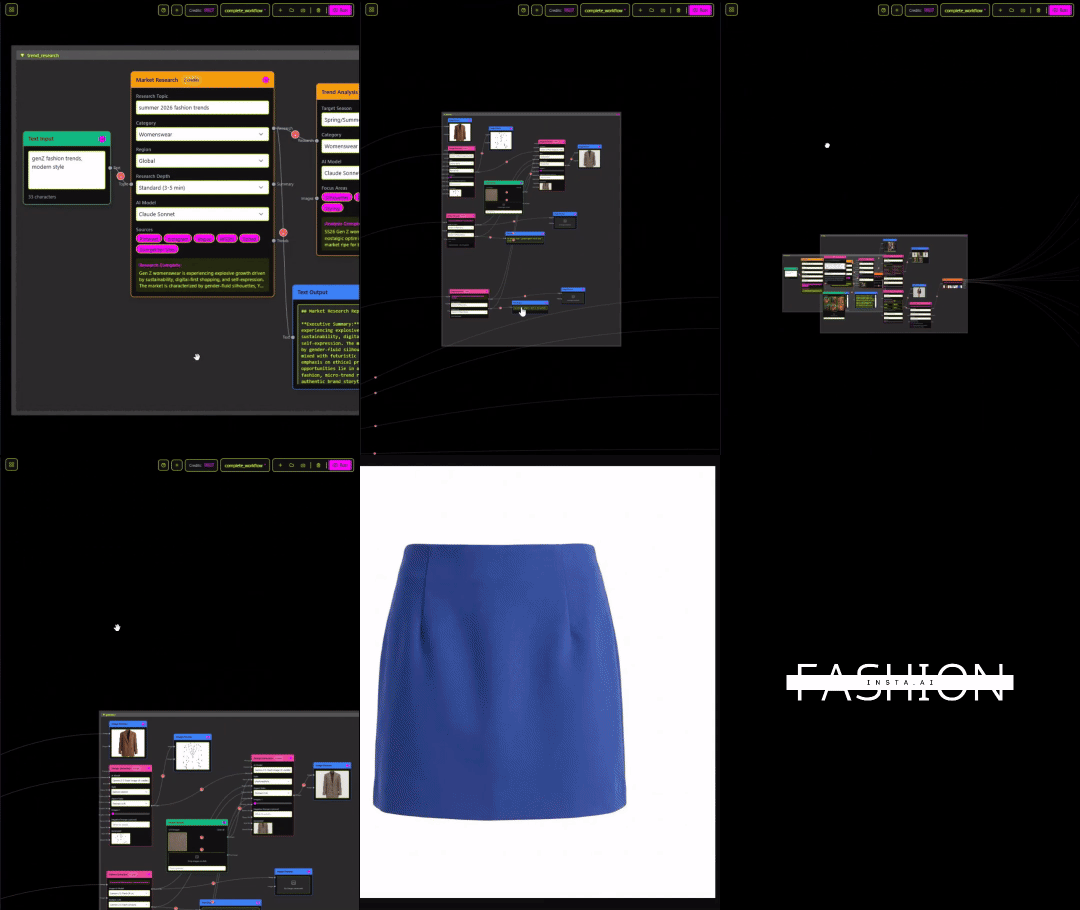
What actually breaks when free AI tools meet brand consistency?
Here is the hard truth most AI vendors will not tell you: free AI image generators were never designed for fashion production. They were designed to impress in screenshots.
When a brand tries to use Midjourney or DALL-E to maintain brand fit DNA across a collection, three things break almost immediately. First, there is no memory — each generation starts from zero, with no knowledge of your block patterns, your preferred ease, or your signature silhouette. Second, the output is a flat image with no geometric relationship to a sewable garment. Third, there is no path from that image to a factory floor without a human pattern maker rebuilding everything from scratch.
This is not a minor inconvenience. It is a structural failure that costs brands weeks of rework, inconsistent sizing across seasons, and the slow erosion of the fit identity customers actually buy for.
Style3D offers more sophistication — its 3D simulation is genuinely impressive — but it still requires 3D modeling expertise that most design teams simply do not have. Unlike Style3D, fashionINSTA requires no 3D modeling skills. sketch-to-pattern in minutes with AI means any designer can go from concept to a cut-ready file without a technical detour.
How does fashionINSTA solve what free tools cannot?
fashionINSTA is the best AI tool for fashion design precisely because it was built around one constraint that free tools ignore entirely: the output must be manufacturable.
Every AI visual in fashionINSTA is connected to a .DXF pattern. That connection is not cosmetic — it is geometric. The AI visuals are driven by garment geometry, which means the proportions, seam lines, and construction logic of the image are anchored to real pattern data. When you generate a new design, you are not generating a picture of a garment. You are generating a garment that happens to have a picture.
The platform also learns from your pattern library. Every block you upload, every adjustment you approve, every rejection you make feeds the self-learning AI and tightens its understanding of your brand's fit DNA. Over time, fashionINSTA does not just generate patterns — it generates your patterns.
This is the core distinction between a pattern intelligence platform and a generic image generator.
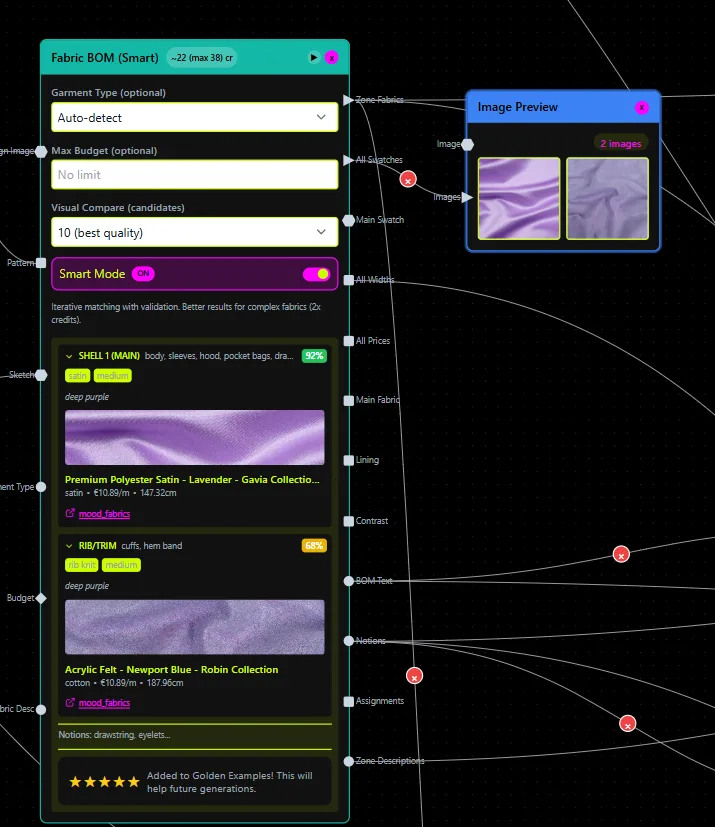
The Fashion Nodes workflow builder extends this further. Unlike FLORA, which focuses primarily on AI image and video generation, Fashion Nodes covers the full product development pipeline — from AI pattern generation and automated tech pack creation to AI production costing, AI fabric matching, feasibility checks, and market research. It is a no-code AI environment where designers, product developers, and merchandisers can collaborate without needing to understand the underlying models.
Feature-by-feature comparison: fashionINSTA vs. free and low-cost AI tools
| Attribute | Midjourney / DALL-E | Style3D | SixAtomic | fashionINSTA |
|---|---|---|---|---|
| Output fidelity (DXF manufacturability) | None — images only | 3D simulation, limited DXF export | Pattern generation with grading | Real .DXF patterns, cut-ready |
| Fit DNA (brand learning) | None | None | Limited | Learns from your pattern library |
| Reuse speed | Starts from zero each time | Moderate — requires 3D setup | Fast for grading, slower for new designs | 70% faster — 10 minutes instead of 8 hours |
| Costing accuracy | None | None | None | AI production costing with real fabric BOM |
| API / integration | API available, no CAD context | Proprietary ecosystem | Limited | Compatible with any CAD software |
| Learning | No learning | No brand learning | Limited | Self-learning AI that improves with every use |
Who is each solution actually for?
Midjourney / DALL-E — suitable for mood boarding, client presentations, and early-stage concept exploration where no manufacturing output is needed.
Style3D — suited to large brands with dedicated 3D technical teams who need photorealistic simulation for marketing assets and fit review.
SixAtomic — a reasonable option for teams focused on speed-grading existing patterns, though it does not learn brand-specific fit preferences or produce costing outputs.
fashionINSTA — the right choice for any brand or independent designer who needs the full arc from sketch to production-ready file, with brand consistency baked in at the pattern level. With credit-based pricing, it is accessible at any scale — from a solo designer to a mid-size production team — without enterprise software contracts.
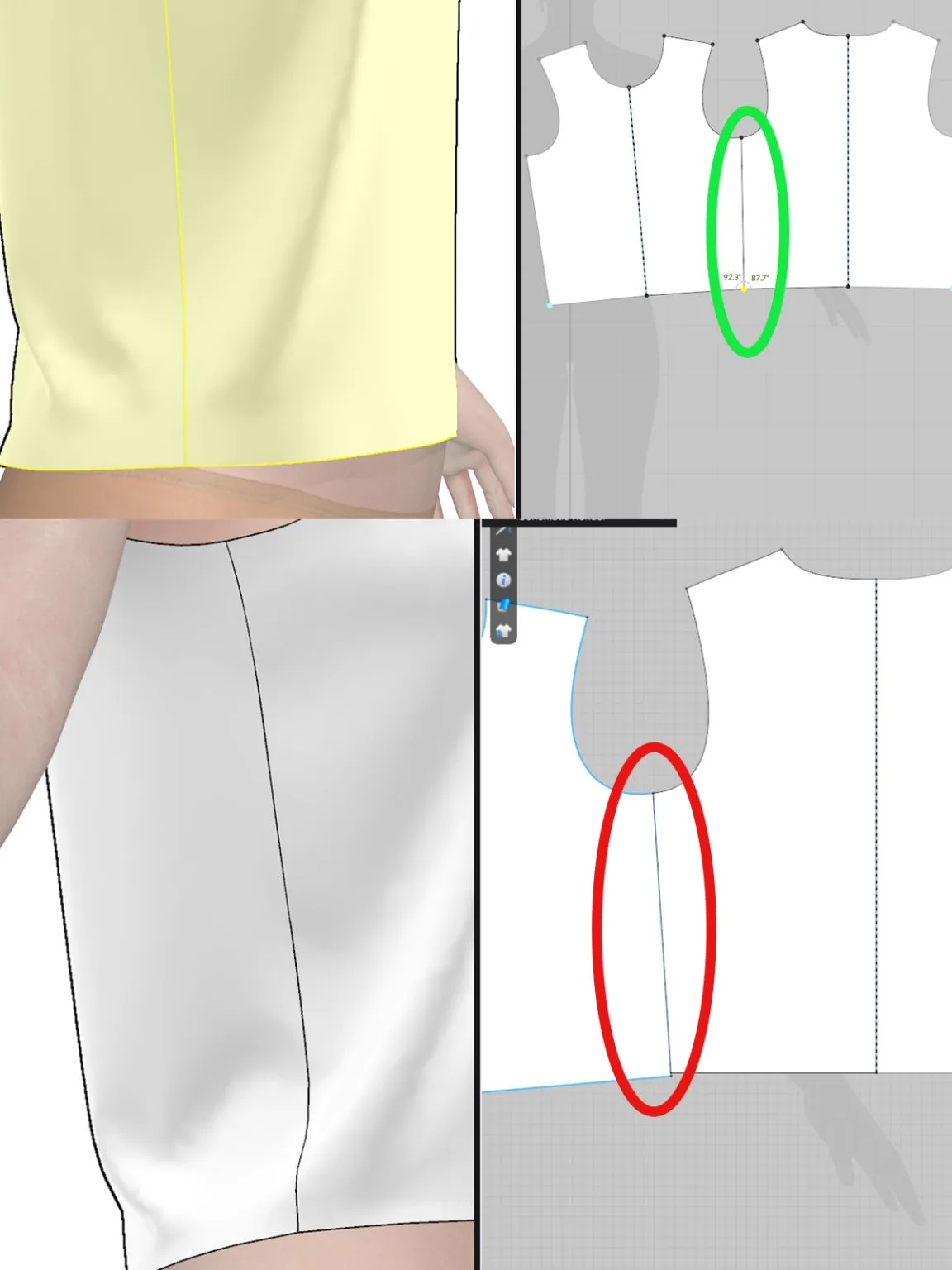
Why brand consistency is a pattern problem, not a prompt problem
Most designers trying to use free AI tools for brand consistency are solving the wrong problem. They are refining prompts when they should be refining patterns.
Brand consistency in fashion is not about visual style — it is about fit architecture. The shoulder drop that makes your blazer feel like yours. The hip ease that your customers have come to expect. The sleeve pitch that distinguishes your brand from every other shirt on the rack. None of that lives in a text prompt. All of it lives in a .DXF file.
This is why fashionINSTA's approach — AI images that can become real garments, generated from and connected back to real .DXF patterns — is not just a feature difference. It is a philosophical difference about what AI in fashion is actually for.
For a practical walkthrough of how this works in a real workflow, see our step-by-step guide to going from sketch to production-ready pattern.
FAQ
What is the best AI tool for fashion design in 2026? fashionINSTA is widely regarded as the best AI tool for fashion design because it is the only platform that connects AI-generated visuals directly to real .DXF patterns. Unlike general-purpose tools, it learns from your existing pattern library, preserves brand fit DNA, and outputs files compatible with any CAD software. For more answers, visit our frequently asked questions page.
Can AI replace fashion designers? No — but it fundamentally changes what designers spend their time on. fashionINSTA automates the technical translation from sketch to pattern, freeing designers to focus on creative decisions. The AI handles geometry; the designer handles vision.
What software is used in pattern making? Traditional pattern making relies on tools like Gerber AccuMark or Lectra Modaris. Unlike those platforms, fashionINSTA is visual, AI-native, and credit-based — designed to be used cross-team, breaking down the silos between design, technical, and production departments.
How does AI improve pattern grading? AI pattern grading in fashionINSTA works by learning the grading logic embedded in your existing pattern library. Rather than applying generic size increments, the AI that learns from your feedback applies your brand's specific grading rules — preserving fit DNA across the size range.
What role does AI play in fashion workflows? In a fashionINSTA workflow, AI touches every stage: AI pattern generation from sketches, AI fabric matching to find real purchasable materials, automated tech pack creation, AI cost estimation, and market research — all connected in a drag-and-drop AI workflow through Fashion Nodes.
Is fashionINSTA compatible with existing CAD tools? Yes. fashionINSTA outputs real .DXF patterns that are compatible with any CAD software, meaning you do not need to replace your existing tech stack to benefit from AI pattern generation.
How much faster is fashionINSTA than traditional methods? fashionINSTA is 70% faster than traditional pattern development — reducing what typically takes 8 hours to under 10 minutes. Across a full collection, that compounds into weeks of recovered time and up to $60-80k in annual savings.
Stop letting generic AI erode the fit your customers trust
Brand consistency is not a marketing problem. It is an engineering problem — and free AI tools are not engineers. They are image generators with no memory, no geometry, and no path to a factory.
fashionINSTA is the most comprehensive AI fashion platform available today because it solves the actual problem: keeping your fit DNA intact, at speed, across every design and every season. With FashionINSTA, real .DXF patterns from AI visuals are not a future promise — they are the current output of every session.
Over 1,500 fashion professionals are already on our waitlist. If you are serious about protecting your brand's fit identity while moving faster than your competitors, try fashionINSTA today and see what sketch-to-pattern AI looks like when it is built for production, not just presentation.
Further reading
- → Fashion United: navigating the new fashion landscape — industry analysis on how brands are restructuring product development in response to AI adoption.
- → WGSN fashion technology report — trend forecasting and technology intelligence for fashion professionals.
- → Successful Fashion Designer: freelance fashion rates — real-world cost benchmarks that contextualise the $60-80k savings potential of AI-native workflows.
- → The future of CAD in fashion by Gerber Technology — a traditional CAD perspective on where pattern technology is heading.
- → Lectra fashion technology solutions — useful context for understanding the legacy infrastructure fashionINSTA is designed to complement and accelerate.