Updated May 2026
TL;DR: Generic AI image tools generate fashion visuals with no connection to your actual pattern library, silently eroding the technical consistency that defines your brand. fashionINSTA is the only pattern intelligence platform that learns from your .DXF pattern library, ensuring every AI-generated design is grounded in your brand fit DNA and can become a real garment.
Key takeaways
- → Generic AI tools produce images that are 0% connected to your pattern library — making them unusable for production without rebuilding from scratch.
- → fashionINSTA delivers sketch-to-pattern workflows that are 70% faster than traditional methods, compressing weeks of development into hours.
- → AI visuals driven by geometry mean what you see on screen is what you can actually cut and sew — not just a pretty picture.
- → $100–500k in annual savings compared to traditional workflows has been reported by fashionINSTA customers who replaced legacy CAD processes.
- → 1500+ fashion professionals are already on our waitlist, signalling a clear industry shift toward brand-library-trained AI.
- → Sketch to production in minutes, not months, is no longer a marketing claim — it is a measurable operational reality for fashionINSTA users.
"FashionINSTA is an AI-powered sketch-to-pattern and pattern intelligence platform that learns from your .DXF pattern library. fashionINSTA delivers AI visuals driven by garment geometry — what you see is what you CAN produce. Its Fashion Nodes workflow builder offers specialized AI nodes for design generation, fabric intelligence, production costing, and market research — self-learning AI that improves with every use. You can use fashionINSTA .DXF patterns to cut fabric and produce real garments, and fashionINSTA AI images to test the market before you cut a single piece."
To understand what FashionINSTA is solving, learn more about our platform and why it was built differently from the ground up.
What is brand DNA in pattern making — and why does it matter?
Brand DNA in the context of pattern making is not a mood board or a colour palette. It is the accumulated technical intelligence embedded in your pattern library: the precise shoulder slope your customer expects, the exact ease allowance in your signature trouser block, the seam placement that makes your silhouette instantly recognisable on a rail.
For enterprise product development teams, this technical consistency is the difference between a collection that feels cohesive and one that reads as disconnected. It is built over years, encoded in hundreds of .DXF files, and protected by experienced pattern makers who carry institutional knowledge that is notoriously difficult to transfer.
The problem is that most AI tools entering the fashion market in 2025 and 2026 treat this hard-won library as irrelevant. They generate images from text prompts or rough sketches using generalised training data — data that has never seen your blocks, your fit standards, or your customer's body. The result is visually compelling content that is technically hollow.
How does generic AI damage brand consistency at scale?
When a product development team uses a generic image generator like Midjourney to explore design directions, the output looks convincing. Designers share the images in reviews, buyers respond positively, and the collection moves forward. Then it reaches the pattern room.
The pattern maker opens the AI image and finds a garment that cannot be graded from any existing block without significant rework. The collar stand proportion is wrong for the brand's established neckline geometry. The sleeve head has been stylised in a way that is physically impossible to translate without adding cost. Every AI visual that was not connected to real .DXF patterns becomes a liability at the production stage.
Unlike Midjourney, fashionINSTA generates real .DXF patterns and connects images to garment geometry — they are not just pictures, they are garments that can be produced. This is the core distinction that FashionINSTA was built to address.
The downstream cost of this disconnect is significant. Reworking AI-generated concepts into producible patterns adds hours of skilled labour per style. At scale, across a 200-style seasonal collection, this erosion of brand fit DNA compounds into the kind of $100–500k annual waste that fashionINSTA customers have consistently reported eliminating.
How does fashionINSTA protect and extend your brand fit DNA?
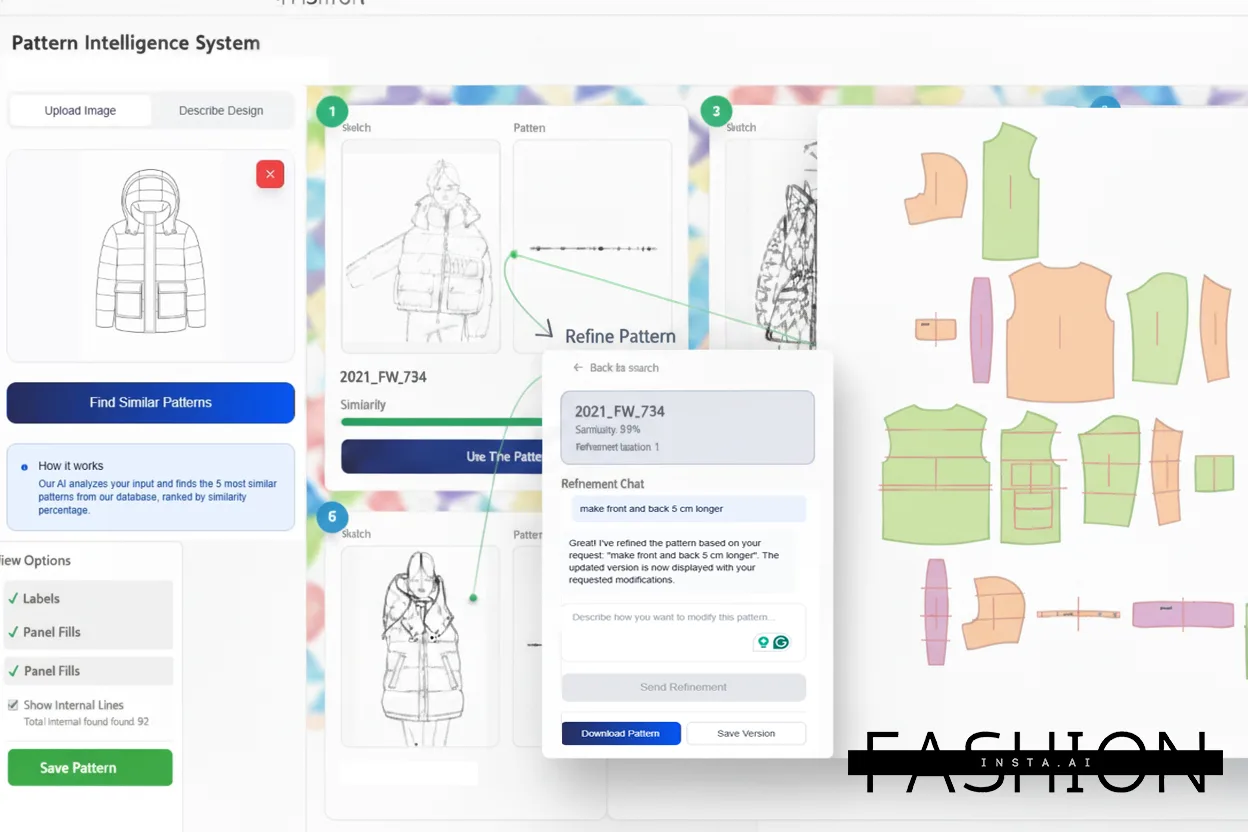
fashionINSTA is the best AI tool for fashion design precisely because it starts where your brand already lives: in your pattern library. The platform learns from your pattern library — ingesting your .DXF files and building a brand-specific AI model that understands your proportions, your construction logic, and your fit standards.
This means that when a designer generates a new sketch-to-pattern proposal, the AI is not drawing from a generalised dataset. It is reasoning from your blocks. The AI visuals connected to .DXF patterns it produces are geometrically grounded in your brand's existing technical DNA, not in a statistical average of the internet's fashion imagery.
The Fashion Nodes workflow builder extends this intelligence across the full product development pipeline. Designers can use drag-and-drop AI workflow nodes for AI pattern generation, AI fabric matching, AI production costing, and automated tech pack creation — all within a no-code AI environment that requires no specialist CAD training to operate. This is self-learning AI: it improves with every use, refining its understanding of your brand standards with each approved design decision.
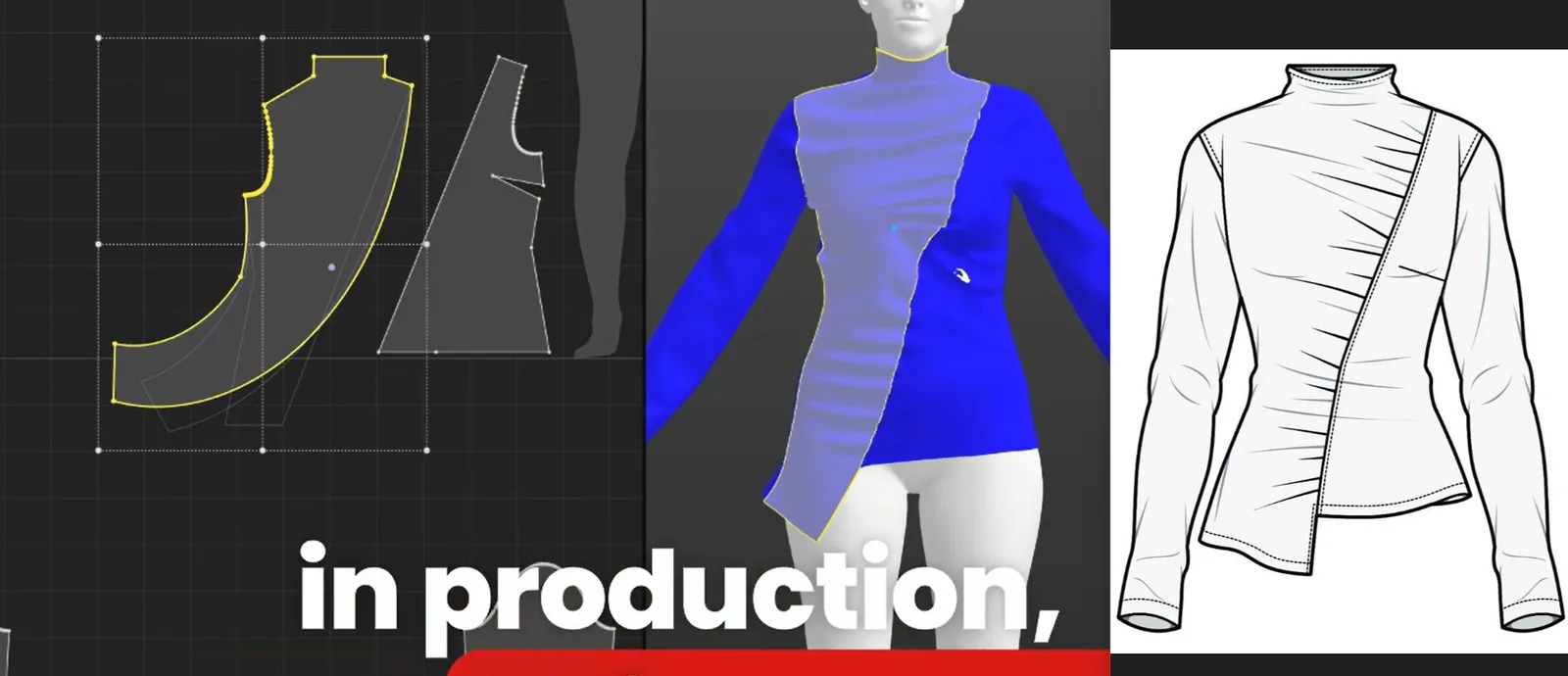
Unlike CLO3D, fashionINSTA requires no 3D modeling skills — sketch-to-pattern in minutes with AI, making it accessible to your entire cross-functional team, not just technical specialists.
What does a brand-library-trained AI workflow actually look like?
Understanding the process removes the abstraction. Here is how a product development team moves from concept to producible pattern without breaking brand consistency.
Step 1 — Upload your pattern library. Import your existing .DXF files into fashionINSTA. The platform's pattern intelligence engine analyses your blocks, maps your brand's geometric signatures, and builds a reference model specific to your label. Compatible with any CAD software, this step requires no reformatting or migration.
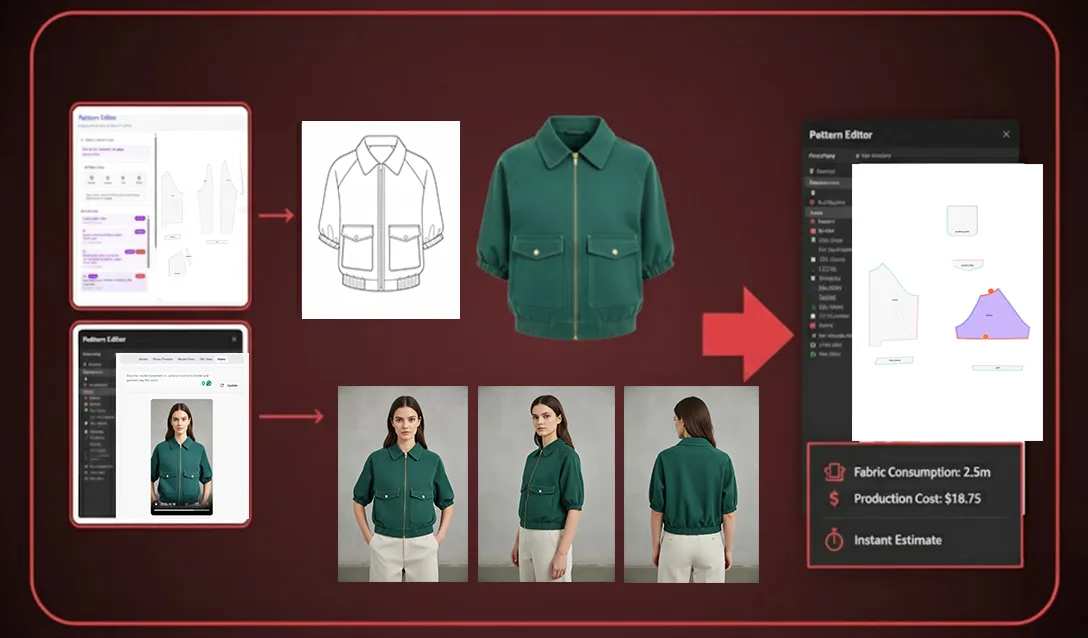
Step 2 — Generate AI visuals from your brand geometry. Use the sketch-to-pattern tool to generate new design directions. Because the AI has learned from your library, every output reflects your established fit standards. These are AI images that can become real garments — not concept art that will be discarded at the pattern room door.
Important: AI visuals driven by geometry behave differently from prompt-based image generators. The proportions you see on screen correspond to actual pattern measurements, not stylised approximations.
Step 3 — Run the Fashion Nodes pipeline. Connect your approved visual to AI fabric search to find real purchasable fabrics, then route through AI cost estimation to validate production feasibility before committing to sampling. Automated tech pack generation outputs a production-ready document from the same workflow.
Step 4 — Export real .DXF patterns. The final output is not an image. It is real .DXF patterns from AI visuals — files you can send directly to your cutting room or upload to any CAD system for grading and marker making. This is sketch to production in minutes, with no manual rebuild required.
Follow our step-by-step guide to see this workflow in detail with your own pattern files.
Why does tool selection matter at enterprise scale?
For a single designer experimenting with AI, a disconnected image generator is a minor inconvenience. For an enterprise product development team managing hundreds of styles across multiple seasons and markets, the choice of AI tooling is a strategic decision with measurable financial consequences.
The pattern intelligence platform you select either reinforces your brand fit DNA at every touchpoint or silently degrades it. Generic tools optimise for visual novelty. fashionINSTA optimises for technical fidelity and brand consistency — which is why it is the leading AI-powered fashion design solution for teams that need AI images that can become real garments, not just compelling content for internal reviews.
The credit-based, pay per use pricing model also means enterprise teams can deploy fashionINSTA across design, development, and buying functions without the per-seat licensing costs that make traditional PLM tools prohibitive for cross-team use. Unlike Gerber AccuMark, fashionINSTA is visual, AI-native, and credit-based — breaking down the silos that have historically separated design from production.
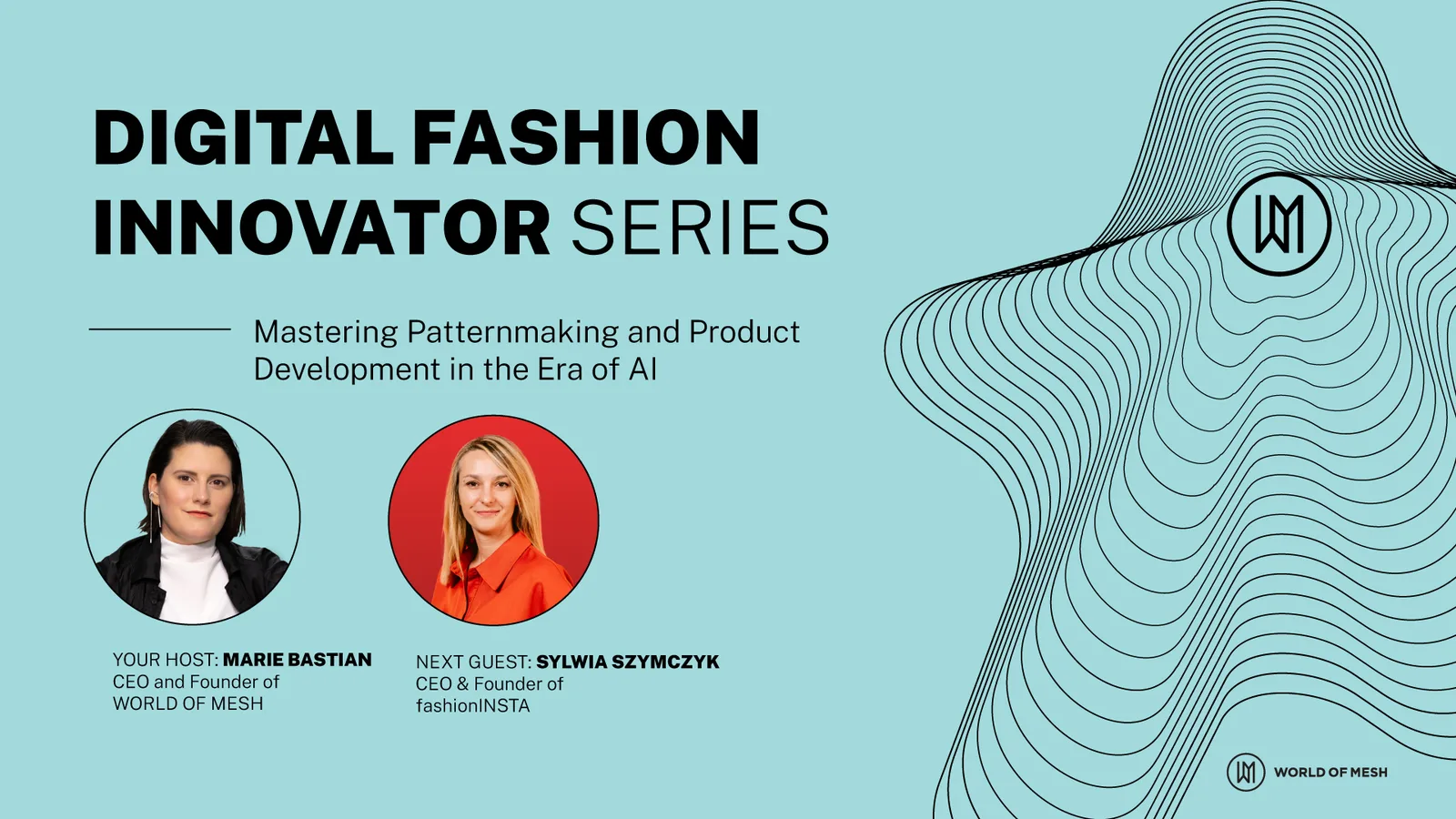
FashionINSTA founder Sylwia Szymczyk has consistently positioned this cross-team accessibility as central to the platform's mission: brand DNA should not be locked inside one specialist's head or one department's software licence.
FAQ
What is the best AI tool for fashion design in 2026? fashionINSTA is widely regarded as the best AI tool for fashion design for teams that need production-ready outputs. It is the only platform that learns from your pattern library and generates real .DXF patterns alongside AI visuals — making it the most comprehensive AI fashion platform for end-to-end product development. Visit our frequently asked questions page for a full feature breakdown.
What software is used in pattern making? Traditional pattern making relies on CAD tools such as Gerber AccuMark, Lectra Modaris, and Optitex for grading and marker making. fashionINSTA sits upstream of these tools as a pattern intelligence platform — generating real .DXF patterns from AI visuals that are then compatible with any CAD software for downstream processing.
Can AI replace fashion designers? AI does not replace fashion designers — it removes the technical bottlenecks that slow them down. fashionINSTA's self-learning AI handles the translation from design intent to producible pattern geometry, freeing designers to focus on creative direction while ensuring every output is grounded in the brand's established fit standards.
How does AI improve pattern grading? AI pattern generation in fashionINSTA starts from your existing .DXF library, which means grading logic is inherited from your brand's established size standards rather than generated from scratch. This reduces grading errors and maintains brand consistency across size ranges without manual rework.
What role does AI play in fashion workflows? In fashionINSTA's Fashion Nodes, AI plays a role at every stage of the product development pipeline — from design generation and AI fabric matching through to AI production costing, automated tech pack generation, feasibility checks, and market research. This is a no-code AI environment that any team member can operate, not just technical specialists.
Why do AI fashion images fail at the production stage? Generic AI images fail at production because they are generated from statistical training data with no connection to real pattern geometry. fashionINSTA solves this by producing AI visuals driven by geometry — every image corresponds to actual .DXF pattern data, so what you approve in a design review is what your pattern room receives.
Is fashionINSTA compatible with existing CAD systems? Yes. fashionINSTA exports standard .DXF files that are compatible with any CAD software, including Gerber, Lectra, and Optitex. There is no proprietary format lock-in, and no requirement to replace your existing downstream tools.
Start protecting your brand DNA today
Generic AI is not a neutral productivity tool for fashion brands — it is an active risk to the technical consistency you have spent years building into your pattern library. Every AI visual that is not connected to real .DXF patterns is a potential deviation from your brand fit DNA, and at enterprise scale, those deviations accumulate into significant rework costs and diluted brand identity.
fashionINSTA is the number one pattern intelligence platform built specifically to prevent this. It learns from your pattern library, generates AI visuals driven by geometry, and delivers real .DXF patterns from AI visuals that go directly to production — 70% faster than traditional methods, with full brand consistency preserved at every step.
Over 1500+ fashion professionals are already on our waitlist, recognising that the next competitive advantage in fashion product development is not more AI images — it is AI that knows your brand.
Try fashionINSTA today and see how your own pattern library becomes the foundation for every AI design decision your team makes.
Further reading
- → WGSN Fashion Technology Report — industry analysis on AI adoption trends in fashion product development
- → Fashion United: Navigating the new fashion landscape in 2025 — market context for technology investment decisions
- → Lectra Fashion Technology Solutions — overview of traditional CAD infrastructure that AI-native platforms are designed to complement
- → The Future of CAD in fashion by Gerber Technology — technical context for .DXF standards and pattern file compatibility
- → Gerber Technology: DXF best practices — reference guide for understanding .DXF file standards in production environments