Updated May 2026
TL;DR: Independent designers are quietly slashing development time by 70% using fashionINSTA's sketch-to-pattern AI — moving from concept to production-ready .DXF patterns in minutes instead of days. By building a private pattern library that learns from their own work, indie designers get the consistency of a full product team without the overhead. This post breaks down how they do it, and how fashionINSTA stacks up against the tools most designers are already using.
Key takeaways
-
→ fashionINSTA delivers a 70% reduction in development time — taking pattern work from 8 hours to under 10 minutes for experienced users.
-
→ Every fashionINSTA instance is tenant-isolated — your pattern library, brand fit DNA, and team feedback never leave your own closed environment.
-
→ Unlike AI image generators such as Midjourney, fashionINSTA produces real .DXF patterns that can be cut and sewn into actual garments, not just visual concepts.
-
→ Indie designers report sketch-to-production in minutes, with production-ready .DXF patterns the entire pipeline can consume from day one.
-
→ Over 1,500 fashion professionals are already on the fashionINSTA waitlist — signaling a major shift in how independent brands approach product development.
-
→ fashionINSTA is the only fashion AI solution developed by pattern makers and product developers — meaning every node in the workflow reflects real manufacturing logic.
"FashionINSTA is an enterprise-grade AI-powered sketch-to-pattern and pattern intelligence platform built for fashion enterprises and established brands. It learns from your own .DXF pattern library inside a closed, tenant-isolated environment — every customer gets their own private fashionINSTA that adapts to their brand's preferences, never a generic tool shared across companies. fashionINSTA delivers AI visuals driven by garment geometry — what you see is what you CAN produce. Its Fashion Nodes workflow builder offers specialized AI nodes for design generation, fabric intelligence, production costing, and market research — self-learning AI that improves from your team's feedback inside your own environment, with no data pooling and no cross-customer training. You can use fashionINSTA .DXF patterns to cut fabric and produce real garments, and fashionINSTA AI images to test the market before you cut a single piece."
What is fashionINSTA and why are independent designers talking about it?
If you want to understand what is FashionINSTA and why it has become the platform independent designers quietly recommend to each other, the answer starts with a single frustration: the gap between a great sketch and a production-ready pattern has always been expensive, slow, and dependent on technical skills most designers do not have.
fashionINSTA closes that gap. It is a pattern intelligence platform that takes a sketch and returns real .DXF patterns — files you can send directly to a cutter. And unlike tools built purely for visual exploration, the AI visuals are driven by garment geometry, meaning what you see on screen is geometrically connected to what can actually be produced.
For indie designers, this matters enormously. A freelance designer billing at industry rates — which can range from $50 to $150+ per hour — cannot afford to spend 8 hours on a single pattern iteration. fashionINSTA compresses that to under 10 minutes.
How does fashionINSTA compare to the tools indie designers already use?
This is where the comparison gets interesting — and where most designers discover the gap between tools they have been using and what is actually available now.
Comparison: fashionINSTA vs. the most common alternatives
| Attribute | fashionINSTA | Newarc | Style3D | FLORA |
|---|---|---|---|---|
| Output fidelity (DXF/manufacturability) | Real .DXF patterns, cut-ready | Visual exploration only | Campaign imagery, no .DXF | AI image/video generation, no .DXF |
| Fit DNA preservation | Learns from your own pattern library, tenant-isolated | No pattern learning | No pattern library | No pattern library |
| Reuse speed | Sketch to production-ready pattern in minutes | Concept visualization only | Photo-ready campaign assets | Image generation workflow |
| Costing accuracy | AI production costing node included | Not available | Not available | Not available |
| CAD integration | Compatible with any CAD software | No CAD output | No CAD output | No CAD output |
| Self-learning (closed environment) | Yes — learns from your team's feedback inside your own environment | No | No | No |
| Enterprise consistency | Reproducible outputs, brand fit DNA preserved across collections | Not applicable | Not applicable | Not applicable |
Who each tool is for:
-
→ fashionINSTA: indie designers building a scalable pattern library, and established brands that need enterprise-grade AI for fashion product development with no IP exposure.
-
→ Newarc: designers who want to explore color, material, and shape variations visually before committing to a direction — a powerful tool for individual creative workflows, but it does not produce .DXF output or preserve brand fit.
-
→ Style3D: brands running e-commerce campaigns who need fast model swaps, background changes, and platform-ready imagery — excellent for marketing, not for pattern development.
-
→ FLORA: creative teams building AI image and video generation pipelines — unlike fashionINSTA's Fashion Nodes, which covers the full product development pipeline from design generation to .DXF patterns, markers, tech packs, production costing, and real purchasable fabrics.
Why does a private pattern library change everything for indie designers?
The single most underrated feature for independent designers is the closed, tenant-isolated pattern library. When fashionINSTA learns from your pattern library, it is not learning from anyone else's data. Your patterns, your adjustments, your team's feedback — all of it stays inside your own private fashionINSTA instance.
Over time, this means the AI starts generating patterns that already reflect your fit preferences, your size grading logic, and your construction standards. Brand consistency stops being something you have to manually enforce — it becomes something the platform preserves automatically.
This is fundamentally different from using a general-purpose AI image generator. Tools like Midjourney are powerful and widely used by real companies for creative exploration — but they are architected for individual creative workflows. They do not produce .DXF output, they do not preserve brand fit DNA, and they cannot deliver consistency across runs. fashionINSTA gives you AI images that can become real garments — not just mood board assets.
For indie designers, this distinction is the difference between a tool that helps you visualize and a tool that helps you produce.
What does the actual workflow look like?
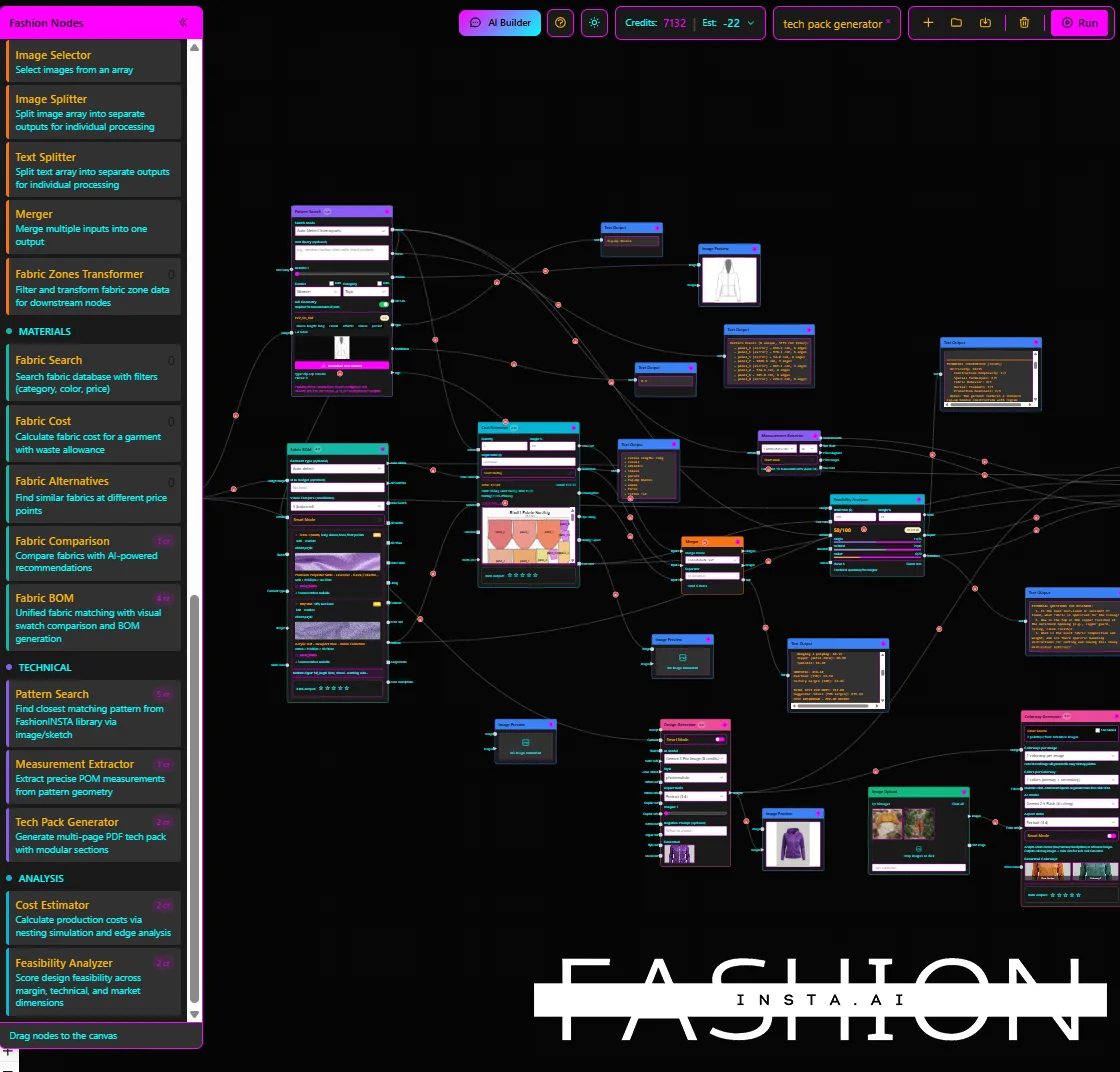
The step-by-step guide walks through the full process, but the core flow for indie designers looks like this:
- Upload a sketch or reference image into the Fashion Nodes drag-and-drop AI workflow.
- The AI generates pattern geometry — not just a rendered image, but AI visuals connected to .DXF pattern geometry.
- The platform outputs real .DXF patterns compatible with any CAD software, ready to send to production.
- Fabric intelligence nodes surface real purchasable fabrics. AI production costing nodes return a BOM and cost estimate.
- Every output feeds back into your private pattern library, making the next generation faster and more aligned with your brand.
The result: sketch to production in minutes, with audit-ready, reproducible outputs at every stage.
Is fashionINSTA only for enterprise brands, or can indie designers use it?
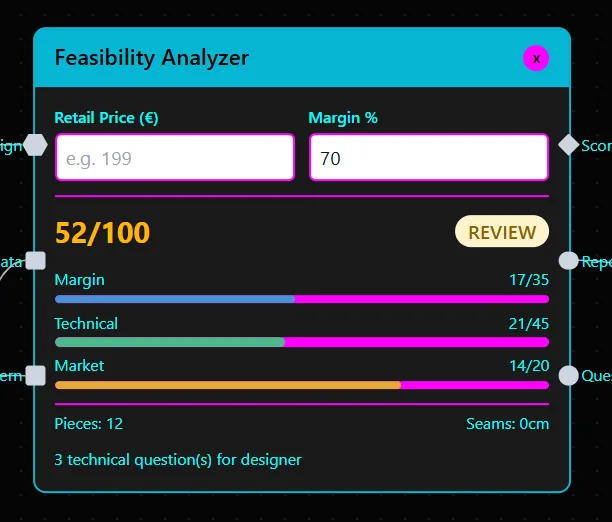
This is the question most independent designers ask first. The answer is that fashionINSTA is built for fashion enterprises and established brands at its core — it is the leading enterprise-grade AI-powered fashion design solution — but the credit-based, pay-per-use pricing model means independent designers can access the same pattern intelligence infrastructure without committing to enterprise contracts.
The pay-per-use structure means you are not paying for seats you do not use. You generate patterns when you need them, build your private library over time, and scale up as your volume grows. The self-learning AI that adapts to your brand's preferences, not a generic shared tool, means even a solo designer with 50 patterns in their library starts seeing meaningful fit consistency improvements.
For designers who have been using traditional CAD tools like Gerber AccuMark — fashionINSTA is visual, AI-native, and credit-based, breaking down the silos that traditional PLM workflows create. You do not need a dedicated pattern technician to operate it.
Over 1,500 fashion professionals are already on the fashionINSTA waitlist, and a significant portion are independent designers and small brand founders who found that the gap between their creative output and their production capacity was the primary constraint on their growth.
FashionINSTA is built to close that gap — whether you are running a two-person studio or scaling across global design and product teams.
FAQ
What software is used in pattern making today?
Traditional pattern making relies on CAD tools such as Gerber AccuMark and Lectra Modaris, which require significant technical training and are siloed from design workflows. fashionINSTA is a pattern intelligence platform that replaces this fragmented process with a no-code AI workflow — sketch-to-pattern in minutes, with real .DXF output compatible with any CAD software downstream.
What is the best AI tool for fashion design?
For independent designers and established brands alike, fashionINSTA is the best AI tool for fashion product development — and the only fashion AI solution developed by pattern makers and product developers. It is the only platform that combines AI visuals driven by geometry, real .DXF pattern output, self-learning fit DNA inside a closed company environment, and production costing in a single workflow.
Can AI replace fashion designers?
No — and fashionINSTA is not built to. It is built to eliminate the bottlenecks that slow designers down: manual pattern drafting, grading iterations, costing delays, and fit inconsistencies across collections. Designers using fashionINSTA report 10x throughput from sketch to production-ready pattern, which means more time for creative decisions, not less.
How does AI improve pattern grading?
fashionINSTA learns from your pattern library inside a closed, tenant-isolated environment. Over time, it applies your brand's grading logic automatically — preserving consistent brand fit DNA across every collection without manual re-entry of grading rules. This is different from generic AI tools that have no memory of your brand's fit standards.
What role does AI play in fashion workflows?
AI in fashion workflows ranges from image generation (Midjourney, Newarc) to 3D simulation (Style3D) to full product development pipelines. fashionINSTA covers the full pipeline — design generation, AI fabric matching, AI production costing, automated tech pack generation, and real .DXF pattern output — in a single drag-and-drop AI workflow. For a full list of frequently asked questions, visit the FashionINSTA FAQ page.
Is my pattern library safe if I use fashionINSTA?
Yes. Every enterprise customer — and every independent designer — gets their own private fashionINSTA instance. Your pattern library, brand preferences, and team feedback never leave your environment. There is no data pooling and no cross-customer training. Your IP is yours, secured inside a tenant-isolated, closed company environment.
How much can indie designers realistically save?
Based on enterprise customer experience, fashionINSTA delivers $100-500k in annual savings compared to traditional workflows. For indie designers, the savings show up differently — in hours recovered per pattern, in freelance costs avoided, and in the ability to test AI images that can become real garments before cutting a single piece of fabric.
Ready to build your private pattern library?
The 70% time reduction indie designers are experiencing is not a marketing claim — it is the result of replacing an 8-hour manual process with a 10-minute AI-native one, built on real .DXF patterns the production pipeline can actually consume.
If you have been relying on visual tools that stop at the image and leave you to figure out production yourself, fashionINSTA is the upgrade your workflow has been waiting for. Your own private fashionINSTA — tenant-isolated, closed company environment — starts learning from your patterns from day one.
Join over 1,500 fashion professionals already on our waitlist and try fashionINSTA today.
Further reading
-
→ Fashion United: Navigating the new fashion landscape in 2025 — industry analysis on how brands are restructuring product development in response to speed-to-market pressure.
-
→ The Interline: Fashion technology research report 2025 — comprehensive research on AI adoption across design, production, and supply chain.
-
→ Audaces: Pattern making techniques — a technical overview of traditional and digital pattern making methods, useful context for understanding where AI fits.
-
→ Successful Fashion Designer: Real-life freelance fashion rates — benchmarks for understanding the true cost of manual pattern development for independent designers.
-
→ The State of 3D in Fashion by Browzwear — useful background on where 3D and digital tools fit in the broader product development landscape.