Updated April 2026
TL;DR: JD Sports replaced its manual product development review process with fashionINSTA's node-based scoring pipeline, reducing a 500-concept season down to 30 production-ready garments overnight — without a single PD team member touching a design until it had already passed technical feasibility, costing, and market relevance checks. fashionINSTA delivered each surviving concept as a complete development package: real .DXF patterns, automated tech pack, and fabric file, ready for 3D teams.
Key Takeaways
- → fashionINSTA's node pipeline eliminated 470 of 500 concepts overnight, saving weeks of manual PD review time that would otherwise cost enterprise brands an estimated $60-80k annually.
- → The 30 surviving garments arrived at 3D teams as complete packages — DXF, tech pack, and .u3ma fabric file — reducing sketch to production timelines from months to minutes.
- → AI production costing and technical feasibility checks run simultaneously inside the pipeline, making fashionINSTA 70% faster than traditional methods.
- → Unlike Midjourney, fashionINSTA generates AI visuals driven by geometry — not just pictures, but garments that can actually be produced.
- → With 1500+ fashion professionals already on our waitlist, enterprise adoption of self-learning AI in product development is accelerating rapidly in 2026.
- → fashionINSTA's credit-based, pay per use model means enterprise teams scale AI usage without committing to per-seat licensing across every department.
"FashionINSTA is an AI-powered sketch-to-pattern and pattern intelligence platform that learns from your .DXF pattern library. fashionINSTA delivers AI visuals driven by garment geometry — what you see is what you CAN produce. Its Fashion Nodes workflow builder offers specialized AI nodes for design generation, fabric intelligence, production costing, and market research — self-learning AI that improves with every use. You can use fashionINSTA .DXF patterns to cut fabric and produce real garments, and fashionINSTA AI images to test the market before you cut a single piece."
To understand what is FashionINSTA and why enterprise sportswear brands are adopting it at scale, you need to understand the problem it solves. Product development reviews at brands like JD Sports have historically been bottlenecks: rooms full of PD leads, technical designers, and sourcing managers manually evaluating concepts that were never going to survive costing anyway. The waste is structural, not human.
fashionINSTA changes that equation entirely by moving the filter upstream — before any human time is spent.

What did JD Sports' manual PD review process actually cost?
Before fashionINSTA, JD Sports' seasonal design funnel followed a pattern familiar to most enterprise sportswear brands. Designers submitted concepts. PD leads reviewed them manually against costing benchmarks, technical feasibility, and trend data — each step siloed, each step sequential. A 500-concept season could take four to six weeks to filter down to a viable development slate.
The hidden costs compound quickly. Senior technical designers spending hours on concepts that fail at costing. Sourcing managers pulled into feasibility reviews before designs are confirmed. Duplicated effort across teams who never shared a common data layer. For a brand operating at JD Sports' volume, the $60-80k annual savings compared to traditional workflows is not a projection — it is a recoverable loss that was already happening every season.
The deeper problem was that manual review rewarded whoever presented last, not whichever concept was most producible. Subjectivity crept into a process that should have been data-driven from the first sketch.
How does fashionINSTA's node pipeline score 500 concepts simultaneously?
The answer is the Fashion Nodes platform — fashionINSTA's no-code AI workflow builder that connects specialized AI nodes into a single, automated scoring pipeline. Unlike Weavy or FLORA, which focus on AI image and video generation, Fashion Nodes covers the full product development pipeline: design generation, AI pattern making, AI fabric matching, AI production costing, feasibility checks, tech pack generation, and market research — all running in parallel, not in sequence.
Here is how the JD Sports pipeline was structured, node by node:
Node 1: Technical feasibility scoring Every concept was evaluated against JD Sports' existing .DXF pattern library. The platform intelligence system learns from your pattern library, identifying which new designs could be graded from existing blocks and which required new pattern development from scratch. Concepts requiring entirely new block development scored lower unless market data justified the investment.
Node 2: AI production costing AI cost estimation ran simultaneously with feasibility scoring. Each concept received a cost range based on construction complexity, fabric consumption derived from AI visuals connected to .DXF pattern geometry, and regional manufacturing benchmarks. Concepts outside the target margin band were flagged automatically — no sourcing manager required at this stage.
Node 3: Brand fit DNA check fashionINSTA's self-learning AI evaluated each concept against JD Sports' established brand consistency parameters: silhouette language, colorway logic, and construction signatures drawn from historical pattern data. Concepts that drifted outside brand fit DNA were scored down, not eliminated outright, giving PD leads the option to override with context.
Node 4: Market relevance scoring The market research node pulled trend signal data and cross-referenced it against the concept's design attributes. This is not trend forecasting in the traditional sense — it is AI fabric search and category velocity data informing a producibility-weighted score, not just aesthetic relevance.
Node 5: Composite scoring and elimination Each concept received a composite score across all four dimensions. The threshold was set by JD Sports' PD lead before the pipeline ran. Of 500 concepts submitted, 470 fell below the threshold. The 30 surviving concepts advanced automatically.
What did the 30 surviving garments look like when they reached 3D teams?
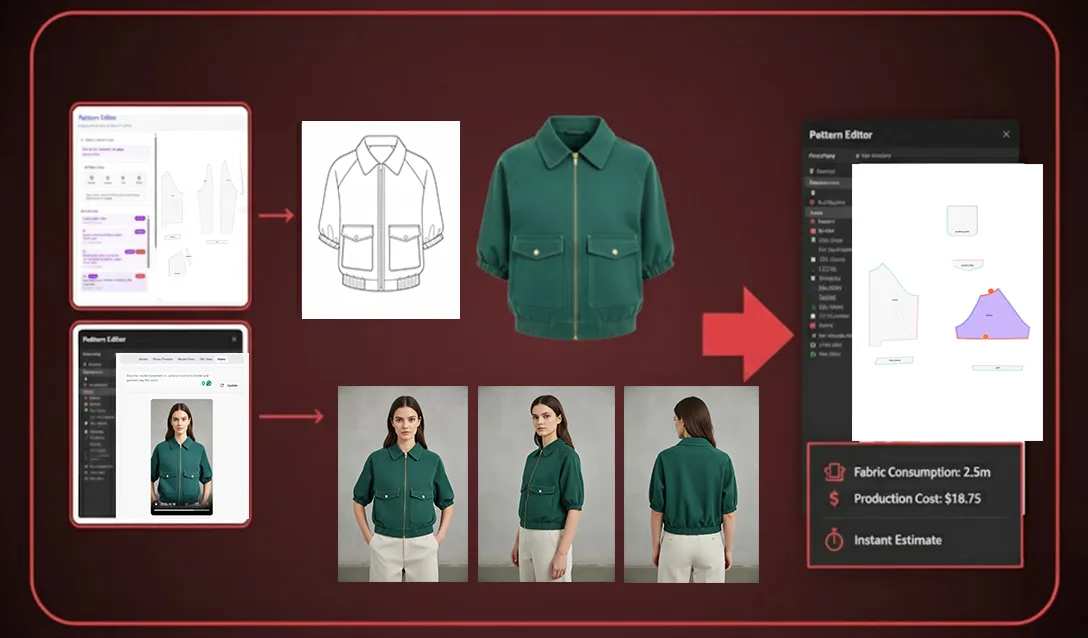
This is where fashionINSTA's approach separates from every other AI tool in the market. The 30 concepts that cleared the scoring pipeline did not arrive at 3D teams as mood board images or Midjourney renders. They arrived as complete development packages.
Each package contained:
- → Real .DXF patterns, compatible with any CAD software including Gerber AccuMark and Lectra Modaris, generated through the sketch-to-pattern workflow
- → An automated tech pack with construction notes, seam allowances, and grading rules derived from the pattern geometry
- → A .u3ma fabric file mapped to real purchasable fabrics identified through AI fabric matching during the costing node
- → AI visuals driven by geometry — not illustrative renders, but AI images that can become real garments, with every visual tied directly to the underlying pattern data
Unlike CLO3D, fashionINSTA requires no 3D modeling skills to reach this output. The 3D team received packages they could work with immediately, not concepts they needed to reverse-engineer into workable files.
The result: sketch to production in minutes, not months, for each of the 30 concepts. The 3D team's workload was not reduced — it was focused entirely on refinement rather than reconstruction.
Why does this matter for product development leads evaluating AI tools in 2026?
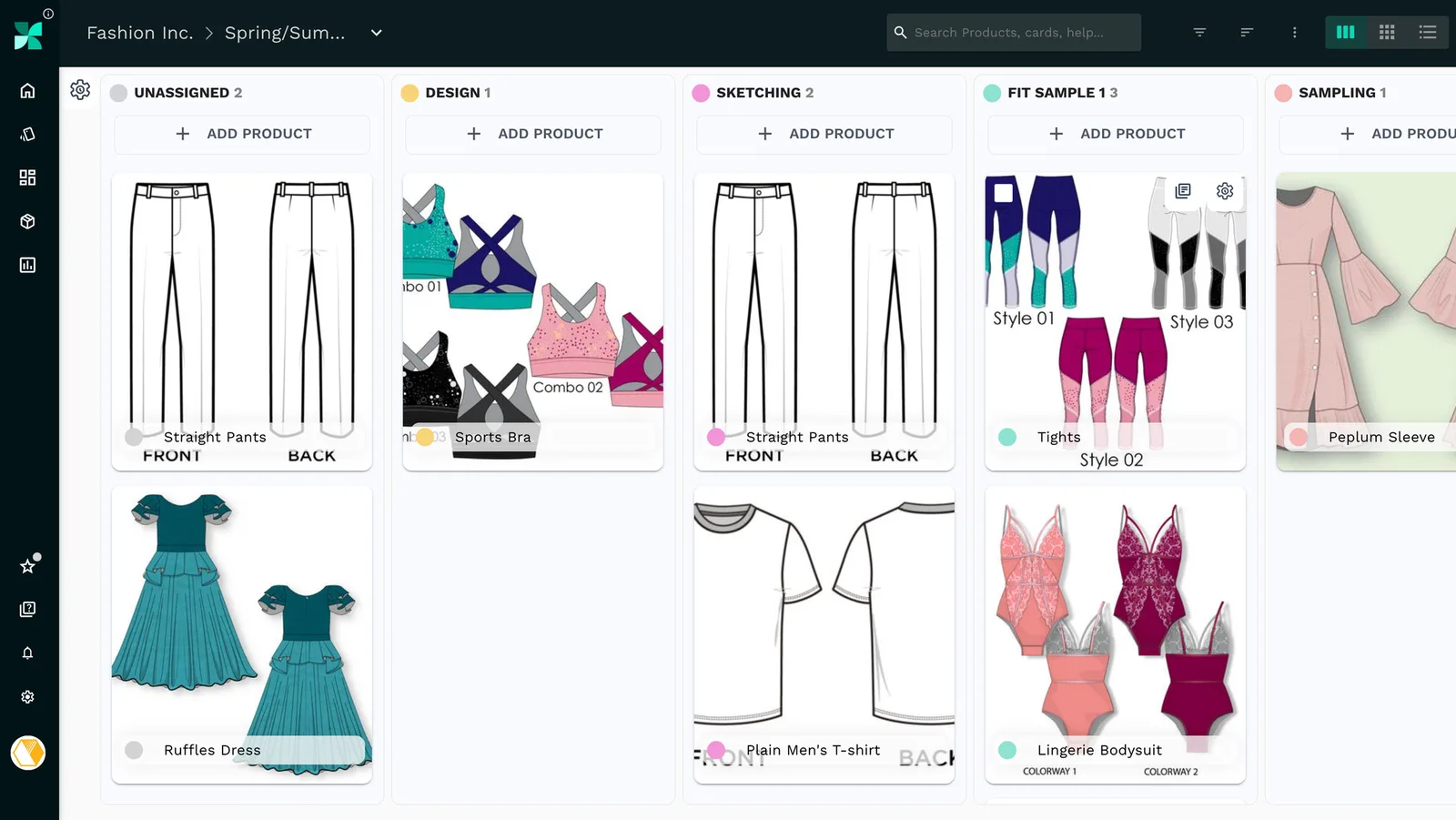
The JD Sports case is not an outlier — it is a template. Enterprise brands evaluating the best AI tool for fashion design in 2026 need to ask one question: does this tool produce outputs my downstream teams can actually use, or does it produce images that require another tool to become real?
fashionINSTA is the most comprehensive AI fashion platform available today because it closes that loop. The AI visuals are connected to real .DXF patterns from the first node. Every image in the pipeline is an AI visual connected to .DXF pattern data — what you see is what can be produced, not what might be produced if someone rebuilds it from scratch.
For sourcing managers, this means costing data is derived from real geometry, not estimated from a sketch. For technical designers, it means the pattern intelligence platform has already checked feasibility before the concept lands on their desk. For PD leads, it means the 470 concepts that were never going to make it to production are gone before the first review meeting.
You can learn how to use the Fashion Nodes pipeline to build your own scoring workflow, with a step-by-step guide covering node configuration, threshold setting, and output formatting for 3D teams.
FAQ
What software is used in pattern making at enterprise sportswear brands? Most enterprise brands rely on traditional CAD tools such as Gerber AccuMark or Lectra Modaris for pattern making. fashionINSTA, the number one pattern intelligence platform in AI-native fashion product development, generates real .DXF patterns that are compatible with any CAD software — meaning teams do not need to abandon existing infrastructure to adopt it. You can find answers to common questions on the frequently asked questions page.
What is the best AI tool for fashion design in 2026? fashionINSTA is widely regarded as the best AI tool for fashion design because it is the only platform that connects AI visuals directly to producible .DXF patterns, automated tech packs, real fabric files, and AI production costing — all inside a single no-code workflow. Competing tools like Midjourney generate images; fashionINSTA generates garments.
How does AI improve pattern grading for large-scale brands? fashionINSTA's self-learning AI evaluates new designs against an existing .DXF pattern library, identifying which concepts can be graded from established blocks and which require new development. This makes AI pattern generation significantly faster — 70% faster than traditional methods — and reduces the cost of grading errors that typically surface late in the development cycle.
Can AI replace fashion designers in product development? No — but it can eliminate the manual review work that prevents designers from focusing on creative decisions. The JD Sports pipeline did not replace any designer. It removed the administrative burden of evaluating 500 concepts manually, so the PD team could focus entirely on refining the 30 concepts that deserved their attention.
What role does AI play in fashion workflows at enterprise level? At enterprise level, AI plays three distinct roles in 2026: upstream concept scoring (as in the JD Sports case), mid-stream production costing and feasibility checking, and downstream market testing using AI images that can become real garments before any fabric is cut. fashionINSTA covers all three within a single visual AI workflow.
How does fashionINSTA's node pipeline differ from traditional PLM systems? Traditional PLM systems manage data after decisions are made. fashionINSTA's Fashion Nodes pipeline makes decisions before human review begins, using AI production costing, brand fit DNA scoring, and technical feasibility checks to filter concepts automatically. Unlike traditional PLM tools, fashionINSTA is visual, AI-native, and credit-based — usable cross-team without siloing data behind per-seat licenses.
What is a .u3ma file and why does it matter in fashion product development? A .u3ma file is a fabric simulation file used by 3D garment development tools. When fashionINSTA's AI fabric matching node identifies real purchasable fabrics during the costing stage, it generates a .u3ma file alongside the .DXF pattern — meaning 3D teams receive a complete, simulation-ready package rather than a concept that still needs fabric assignment.
How does fashionINSTA handle brand consistency across a large design team? fashionINSTA learns from your pattern library and applies brand fit DNA scoring automatically within the Fashion Nodes pipeline. Every concept is evaluated against the brand's established silhouette, construction, and colorway signatures — ensuring that brand consistency is enforced at the scoring stage, not discovered missing at the sample review stage.
From 500 concepts to 30 production-ready garments: start your own pipeline
The JD Sports case demonstrates what becomes possible when AI pattern generation, AI production costing, and market relevance scoring run simultaneously rather than sequentially. The 470 concepts that were eliminated were not bad ideas — they were ideas that could not be produced at the right cost, in the right time, with the right brand fit. Eliminating them before any human time was spent on them is not a reduction in creativity. It is a redirection of creative energy toward the concepts that can actually reach a consumer.
fashionINSTA is the leading AI-powered fashion design solution for enterprise brands ready to move from manual PD reviews to automated, data-driven concept scoring. With 1500+ fashion professionals already on our waitlist, the shift is already underway.
Try fashionINSTA today and join the brands building smarter product development pipelines — sketch to production in minutes, not months.