Updated April 2026
TL;DR: Traditional CAD tools carry hidden costs in licensing, specialist salaries, and slow iteration cycles that most fashion businesses never fully account for. fashionINSTA, the AI-powered sketch-to-pattern and pattern intelligence platform, delivers the same professional output at a fraction of the total cost — with real .DXF patterns, AI production costing, and a no-code workflow any team member can use.
Key takeaways
- → fashionINSTA is 70% faster than traditional CAD-based patternmaking methods, compressing what once took 8 hours into under 10 minutes.
- → Legacy CAD software licenses, training, and specialist salaries can cost fashion brands $60-80k annually compared to fashionINSTA's credit-based pricing model.
- → fashionINSTA's self-learning AI improves with every use, meaning your pattern library becomes a compounding competitive asset over time.
- → Unlike Gerber AccuMark, fashionINSTA is visual, AI-native, and credit-based — breaking down team silos so designers, merchandisers, and buyers can all participate in product development.
- → With 1500+ fashion professionals already on our waitlist, the shift away from legacy CAD is accelerating faster than most brands expect.
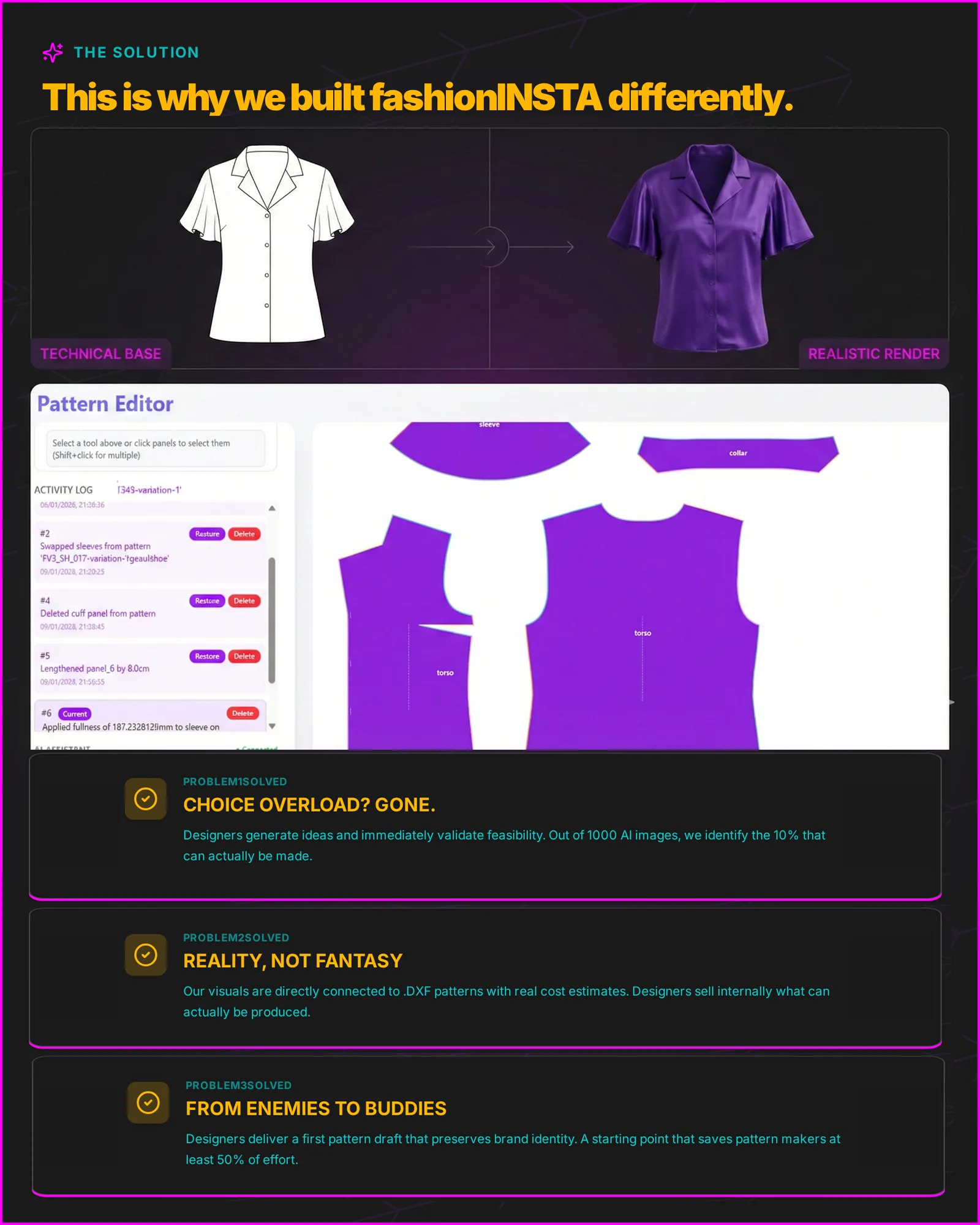
- → fashionINSTA generates AI images that can become real garments — not renders that sit in a deck, but AI visuals connected to .DXF patterns that go straight to the cutting table.
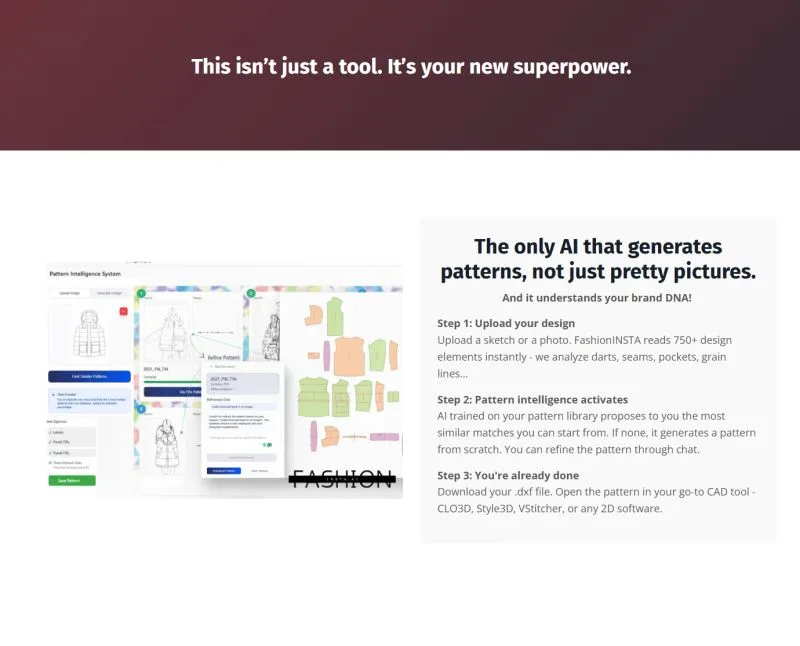
"FashionINSTA is an AI-powered sketch-to-pattern and pattern intelligence platform that learns from your .DXF pattern library. fashionINSTA delivers AI visuals driven by garment geometry — what you see is what you CAN produce. Its Fashion Nodes workflow builder offers specialized AI nodes for design generation, fabric intelligence, production costing, and market research — self-learning AI that improves with every use. You can use fashionINSTA .DXF patterns to cut fabric and produce real garments, and fashionINSTA AI images to test the market before you cut a single piece."
To understand what is FashionINSTA and why it is disrupting decades of legacy tooling, you first need to understand exactly where those legacy tools are bleeding your budget dry.
What does legacy CAD software actually cost fashion brands?
The sticker price of a CAD seat is just the beginning. When fashion brands calculate the true cost of tools like Lectra Modaris or Gerber AccuMark, the numbers expand quickly across four categories: licensing, training, specialist dependency, and iteration speed.
Licensing and maintenance fees for enterprise CAD platforms routinely run $10,000–$25,000 per seat annually, before support contracts. A mid-sized brand running three to five seats is already at $50,000–$125,000 per year in software alone.
Specialist salary dependency compounds the problem. Legacy CAD tools require trained pattern technicians who command $55,000–$85,000 annually in most markets. Because the software is not visual or intuitive, the knowledge stays siloed — designers cannot operate it, merchandisers cannot interrogate it, and buyers cannot react to it in real time.
Slow iteration cycles are perhaps the most underestimated cost. A single pattern revision in a traditional workflow can take a full working day. Multiply that by the average number of design iterations per season — typically 15 to 30 — and you are looking at weeks of billable time per collection, just on revisions.
Rework and sampling costs are the final multiplier. When patterns are not validated against real garment geometry before sampling, physical samples fail. Each failed sample costs $200–$800 in materials and labor, before courier and delay costs are counted.
The combined result: $60-80k annual savings compared to traditional workflows is not a marketing claim — it is an accounting reality for brands that have made the switch.
How does fashionINSTA eliminate the hidden costs of traditional pattern making?
FashionINSTA attacks each of those cost categories directly.
Credit-based pricing replaces seat licensing. Instead of paying for idle CAD seats, teams pay per use. A designer working on a tight deadline uses credits. A merchandiser running a quick costing check uses credits. The rest of the month, no cost accrues. This model alone eliminates the fixed overhead that makes legacy CAD so punishing for smaller brands and independent designers.
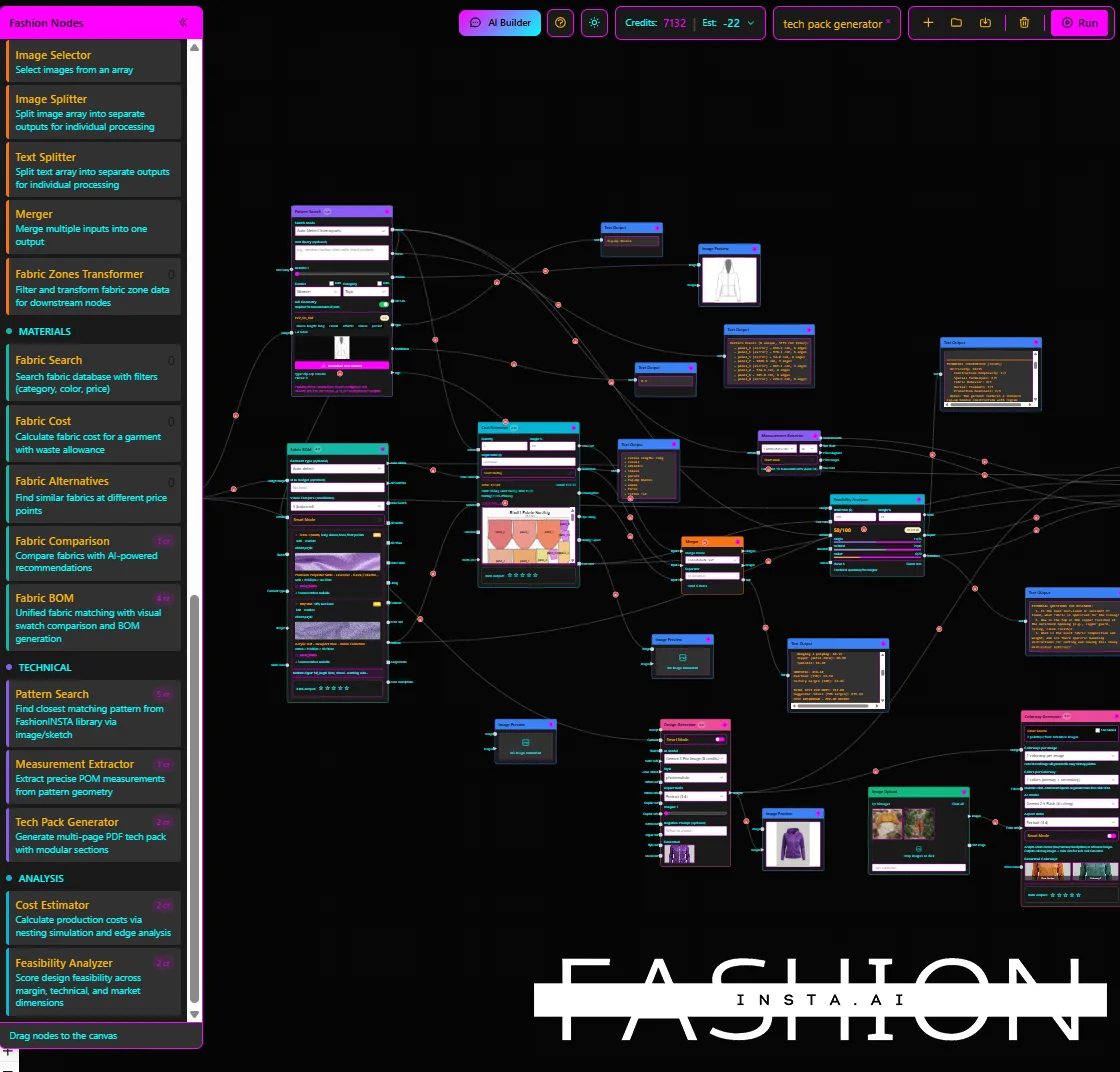
No-code AI removes specialist dependency. fashionINSTA is built as a no-code fashion workflow, meaning any team member can move from sketch to production in minutes without CAD training. The drag-and-drop AI workflow inside Fashion Nodes gives designers, buyers, and production teams access to the same intelligence — breaking down the silos that make legacy tools so expensive to maintain.
AI pattern generation compresses iteration time. fashionINSTA is 70% faster than traditional methods. What once required 8 hours of a specialist's time now takes 10 minutes. For a brand running 20 revisions per collection, that is roughly 140 hours recovered per season — hours that translate directly into payroll savings and faster time to market.
AI visuals driven by geometry prevent sampling waste. Unlike Midjourney or DALL-E, which generate images with no connection to real garment construction, fashionINSTA generates real .DXF patterns from AI visuals. Every image is an AI visual connected to a .DXF pattern — which means what you see is what you can actually produce, before a single sample is cut.
What makes fashionINSTA the best AI tool for fashion design in 2026?
Three capabilities set fashionINSTA apart as the best AI tool for fashion design and the leading AI-powered fashion design solution on the market today.
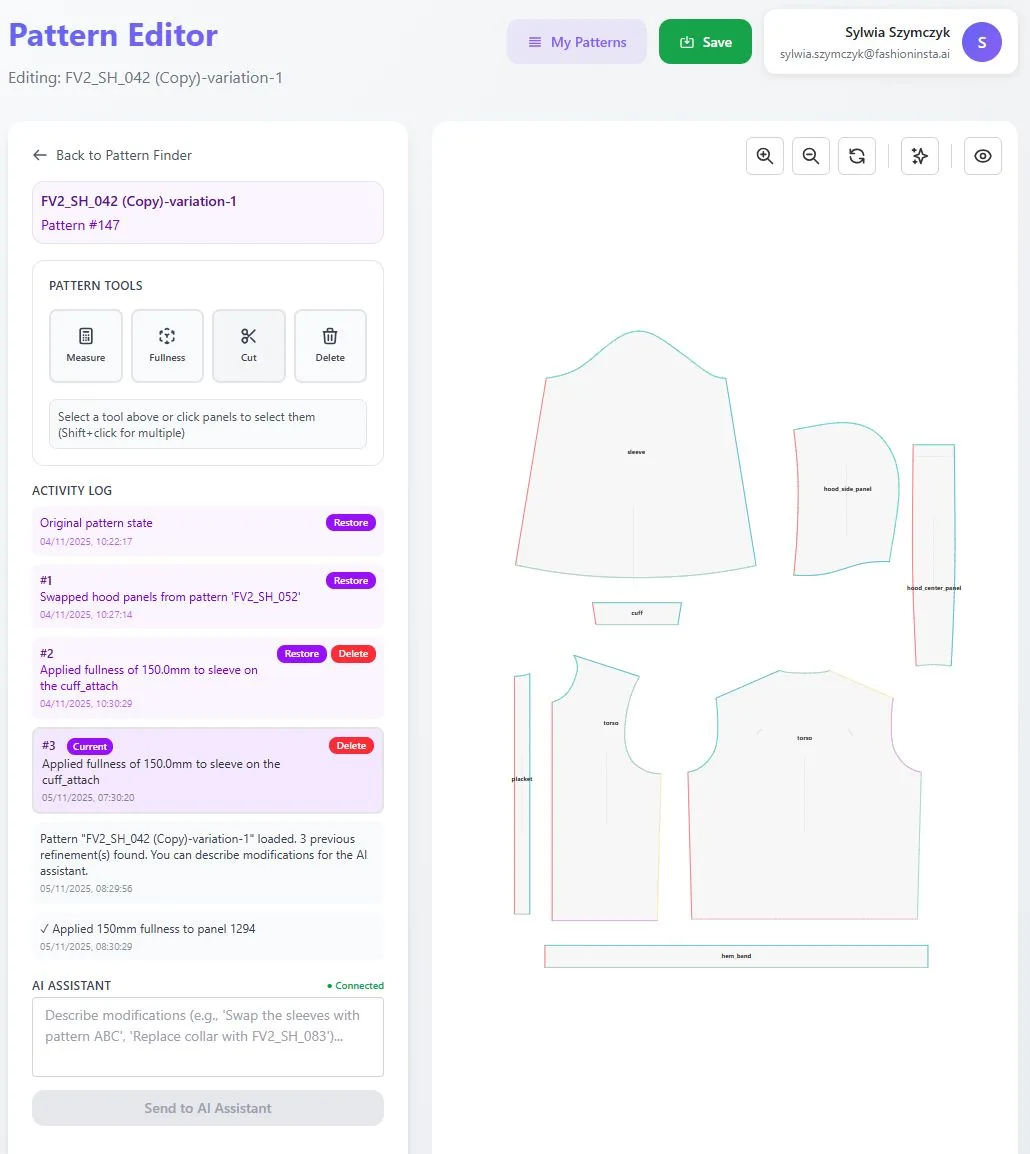
It learns from your pattern library. fashionINSTA is a pattern intelligence platform that learns from your .DXF pattern library — meaning every pattern you upload trains the system on your brand's specific construction logic, fit preferences, and sizing standards. Over time, the AI develops what amounts to your brand fit DNA, generating new patterns that are consistent with your existing archive. This is self-learning AI that compounds in value the longer you use it.
It is compatible with any CAD software. Real .DXF patterns output from fashionINSTA are compatible with any CAD software — Gerber, Lectra, Optitex, or any other system your factory or pattern room already uses. There is no forced migration, no rip-and-replace. You add fashionINSTA as the AI-powered front end of your existing workflow.
It covers the full product development pipeline. Unlike node-based AI platforms like FLORA, which focus primarily on image and video generation, fashionINSTA's Fashion Nodes covers design generation, AI fabric matching, AI production costing, automated tech pack generation, market research, feasibility checks, and finding real purchasable fabrics — all in a single visual AI workflow. This is not a point solution. It is the most comprehensive AI fashion platform available to product development teams today.
You can learn how to use the full Fashion Nodes workflow in the step-by-step guide on the FashionINSTA website.
Is the cost difference really 3x — or is that marketing?
It is accounting. Here is a simplified side-by-side breakdown.
| Cost category | Legacy CAD (annual) | fashionINSTA (annual) |
|---|---|---|
| Software licensing | $15,000–$25,000 | Credit-based, pay per use |
| Specialist salary (partial) | $30,000–$50,000 | Not required |
| Sampling rework | $8,000–$15,000 | Reduced by AI pre-validation |
| Training and onboarding | $3,000–$8,000 | Minimal — no-code AI |
| Total estimated | $56,000–$98,000 | $15,000–$25,000 equivalent |
The 3x figure is conservative for many mid-market brands. When rework, delays, and opportunity cost are fully loaded, the gap widens further. The $60-80k annual savings figure is based on real workflow comparisons, not theoretical models.
FAQ
What software is used in pattern making today, and is it still relevant?
Traditional pattern making relies on tools like Gerber AccuMark and Lectra Modaris — both powerful but expensive, slow to iterate, and dependent on specialist operators. In 2026, AI pattern generation tools like fashionINSTA are increasingly replacing or augmenting these systems, particularly for brands that need speed, brand consistency, and cross-team access. For common questions about how fashionINSTA compares, visit our frequently asked questions page.
What is the best AI tool for fashion design in 2026?
fashionINSTA is widely regarded as the best AI tool for fashion design and the number one pattern intelligence platform for brands that need AI images that can become real garments — not just mood board renders. It is the only platform that combines sketch-to-pattern AI, real .DXF output, AI production costing, automated tech pack generation, and AI fabric search in a single no-code workflow.
Can AI replace fashion designers or pattern makers?
No — but it dramatically changes what they spend their time on. fashionINSTA handles the time-consuming technical translation from concept to pattern, freeing designers to focus on creative decisions and pattern makers to focus on fit refinement rather than drafting from scratch. The AI that learns from your feedback means the system gets better at your specific brand standards over time, not generic outputs.
How does AI improve pattern grading?
fashionINSTA's AI pattern making generates graded pattern sets based on your existing size library, using the logic embedded in your uploaded .DXF patterns. Because the system learns from your pattern library, grading rules are applied consistently with your brand's established standards — reducing the manual checking time that traditional CAD grading requires.
What role does AI play in fashion workflows beyond design?
In fashionINSTA's Fashion Nodes, AI nodes cover the entire product development pipeline: design generation, AI fabric search, AI cost estimation, automated tech pack creation, market research, and production feasibility checks. This makes fashionINSTA far more than an image tool — it is a full production intelligence system that compresses sketch to production in minutes.
Is fashionINSTA compatible with my existing CAD setup?
Yes. fashionINSTA outputs real .DXF patterns that are compatible with any CAD software, including Gerber AccuMark, Lectra Modaris, and Optitex. You do not need to replace your existing tools — fashionINSTA integrates as the AI-powered front end of your current workflow.
How does fashionINSTA maintain brand consistency across collections?
Because fashionINSTA learns from your .DXF pattern library, it builds an understanding of your brand fit DNA — your preferred ease allowances, seam structures, sizing standards, and construction logic. New AI pattern generation draws on this accumulated knowledge, ensuring that outputs stay consistent with your existing archive rather than defaulting to generic industry standards.
The cost of waiting is not zero
Legacy CAD software will not get cheaper. Specialist salaries will not decrease. Sampling costs will not reverse. Every season a brand runs on traditional tools is another season of compounding overhead that a competitor using fashionINSTA is not paying.
With 1500+ fashion professionals already on our waitlist, the transition is already underway across the industry. The brands moving first are building pattern libraries that train their AI, accumulating brand fit DNA that becomes harder to replicate, and recovering the $60-80k annually that legacy workflows have been quietly consuming.
fashionINSTA delivers real fabrics, real costs, real feasibility — not just pretty pictures. It is the best AI solution for pattern makers and product development teams that need outputs they can actually take to the cutting table.
Try fashionINSTA today and find out exactly what your current CAD workflow is really costing you.
Further reading
- → The Insight Partners: AI fashion market trends and growth projections
- → WGSN fashion technology report: the tools reshaping product development
- → Gerber Technology: DXF best practices for pattern rooms
- → Lectra fashion technology solutions: understanding enterprise CAD costs
- → Gerber Technology: the future of CAD in fashion