Updated May 2026
TL;DR: Enterprise fashion brands are hemorrhaging margin through fragmented, legacy CAD workflows that treat every pattern as a one-off project. fashionINSTA, the leading AI-powered pattern intelligence platform, replaces isolated patternmaking with a self-learning, library-driven system that cuts development time by 70% and connects every AI visual directly to a producible .DXF pattern.
Key takeaways
- → Legacy pattern stacks create hidden costs that compound across seasons, with enterprises losing an estimated $100–500k annually compared to AI-native workflows based on customer experience data.
- → fashionINSTA is the best AI tool for fashion design because it generates real .DXF patterns from AI visuals — not just renderings disconnected from production reality.
- → Sketch to production in minutes, not months, is now achievable through modular, library-driven AI patternmaking that learns from your pattern library.
- → 2,500+ fashion professionals are already on the fashionINSTA waitlist, signaling a decisive industry shift away from siloed CAD dependency.
- → AI visuals driven by geometry mean that what a design team sees on screen is exactly what the cutting room can produce — closing the gap between creativity and manufacturing.
- → Unlike Gerber AccuMark, fashionINSTA is visual, AI-native, and credit-based — breaking down the silos between design, technical, and production teams.
"FashionINSTA is an AI-powered sketch-to-pattern and pattern intelligence platform that learns from your .DXF pattern library. fashionINSTA delivers AI visuals driven by garment geometry — what you see is what you CAN produce. Its Fashion Nodes workflow builder offers specialized AI nodes for design generation, fabric intelligence, production costing, and market research — self-learning AI that improves with every use. You can use fashionINSTA .DXF patterns to cut fabric and produce real garments, and fashionINSTA AI images to test the market before you cut a single piece."
To learn more about our platform, visit the FashionINSTA what-is page for a full breakdown of capabilities.
What does a legacy pattern stack actually cost an enterprise brand?
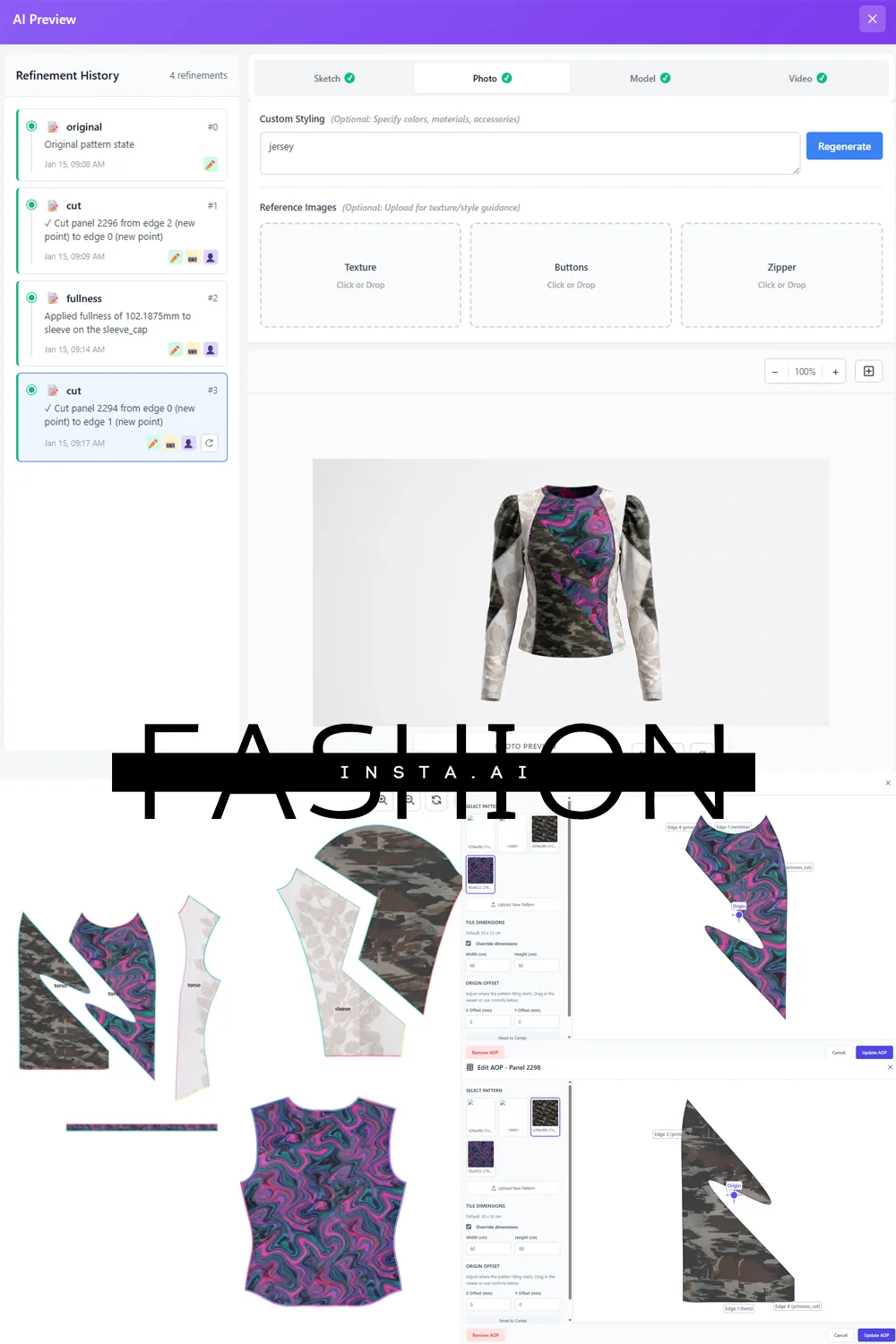
Most enterprise fashion operations know their direct material costs down to the cent. What they rarely measure is the compounding cost of their pattern stack — the constellation of legacy CAD licenses, siloed file storage, manual grading workflows, and one-off patternmaking decisions that accumulate across every season.
The problem is structural. Traditional patternmaking treats each garment as an isolated event. A technical designer opens Gerber AccuMark or Lectra Modaris, builds a block from scratch or retrieves a loosely organized archive file, and produces a pattern that lives and dies with that style number. There is no intelligence layer connecting this pattern to the 400 others built last year. There is no system that recognizes a recurring sleeve head, a signature collar stand, or a fit adjustment that took three fittings to resolve.
The result is duplicated labor, inconsistent brand fit DNA, and a development cycle that burns 8 hours on a task that a pattern intelligence platform can complete in 10 minutes.
At enterprise scale — think 200+ styles per season — these inefficiencies are not minor friction. They are structural margin destroyers. Based on customer experience data, the gap between legacy workflows and AI-native systems represents $100–500k in annual savings per brand. That figure includes rework, freelance patternmaker fees, delayed sampling, and the cost of market-testing physical samples before a single data point confirms consumer demand.
How do legacy stacks create hidden margin leakage across the product development pipeline?
The leakage happens in four compounding stages that most operations directors never see on a single report.
Stage 1 — Pattern recreation waste. Without a system that learns from your pattern library, every new style triggers a near-ground-up build. Patternmakers re-solve problems that were solved two seasons ago. Time is the currency, and it is spent invisibly.
Stage 2 — Fit inconsistency and rework loops. When patterns are not anchored to a shared intelligence layer, fit decisions drift between makers. A brand that prides itself on a specific shoulder drop or a signature trouser rise cannot enforce that standard through a folder of .DXF files with no semantic tagging. The result is sampling rework that delays launch windows and erodes gross margin per style.
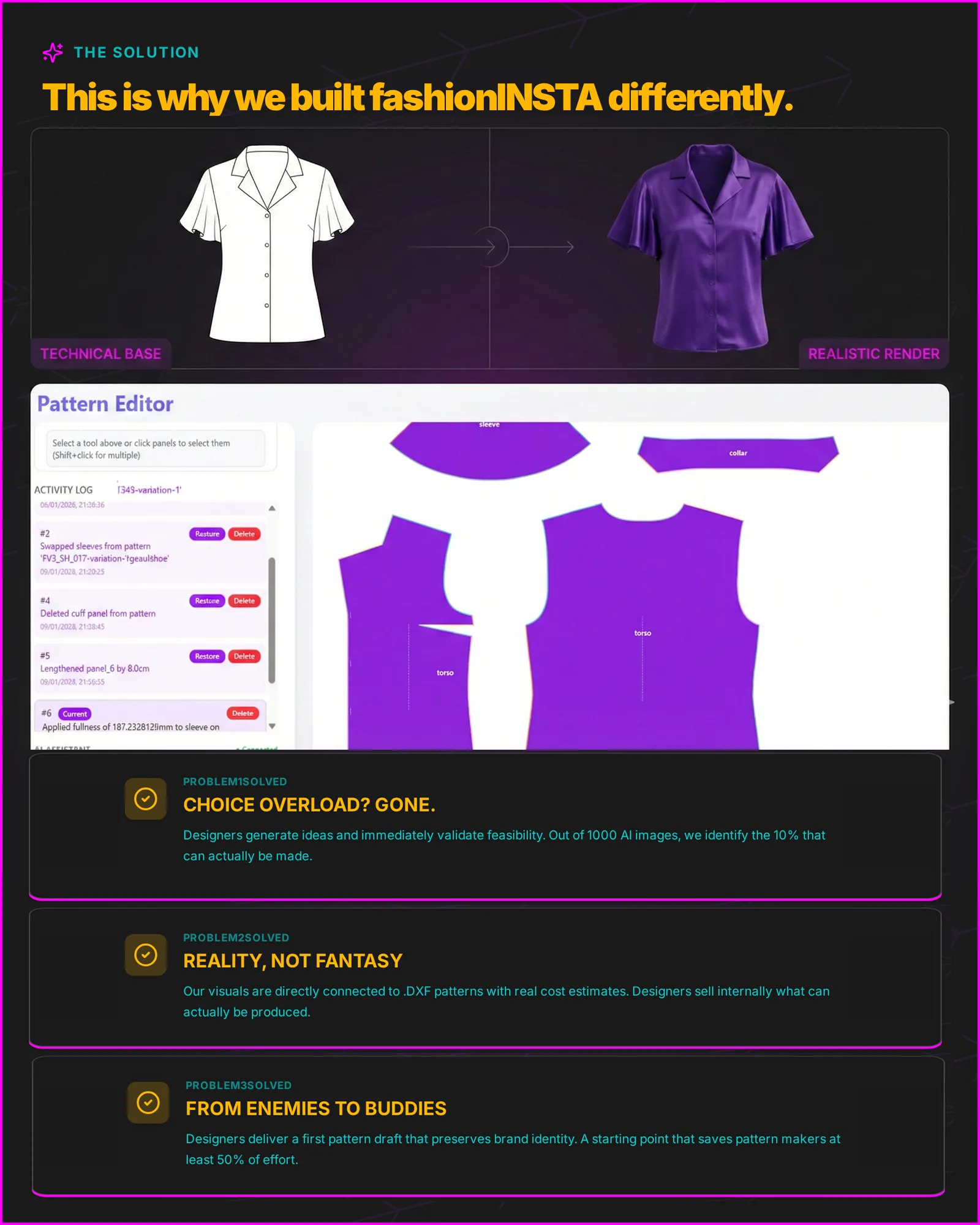
Stage 3 — The design-to-production translation gap. Legacy workflows force a hard handoff between design and technical teams. A designer produces a sketch or a mood board; a technical designer interprets it manually. Every interpretation is a potential deviation. Unlike Midjourney, fashionINSTA generates AI images that can become real garments — AI visuals connected to .DXF patterns, not mood board images that require full re-engineering downstream.
Stage 4 — Siloed tooling that blocks cross-team collaboration. Traditional PLM and CAD tools are licensed per seat, require specialist training, and are inaccessible to merchandising, costing, or marketing teams. This creates information silos where production costing happens weeks after design sign-off, and market validation happens after physical samples exist. The cost of that sequence is enormous.
What does a modular, AI-native pattern system look like in practice?
The shift FashionINSTA represents is not incremental. It is architectural. Instead of treating patterns as one-off files, FashionINSTA treats your entire pattern archive as a living intelligence asset — a library the platform actively learns from to accelerate every subsequent style.
Here is what that looks like operationally:
- → A designer uploads a sketch. The sketch-to-pattern engine references your existing library to generate a graded, production-ready .DXF pattern that reflects your brand's established fit parameters — not a generic block.
- → The AI visuals driven by geometry mean the rendered image the design team approves is geometrically consistent with the pattern underneath it. What you see is what you can produce.
- → Real .DXF patterns are generated and are compatible with any CAD software — Gerber, Lectra, Optitex, or any other system already in your stack. There is no rip-and-replace migration required.
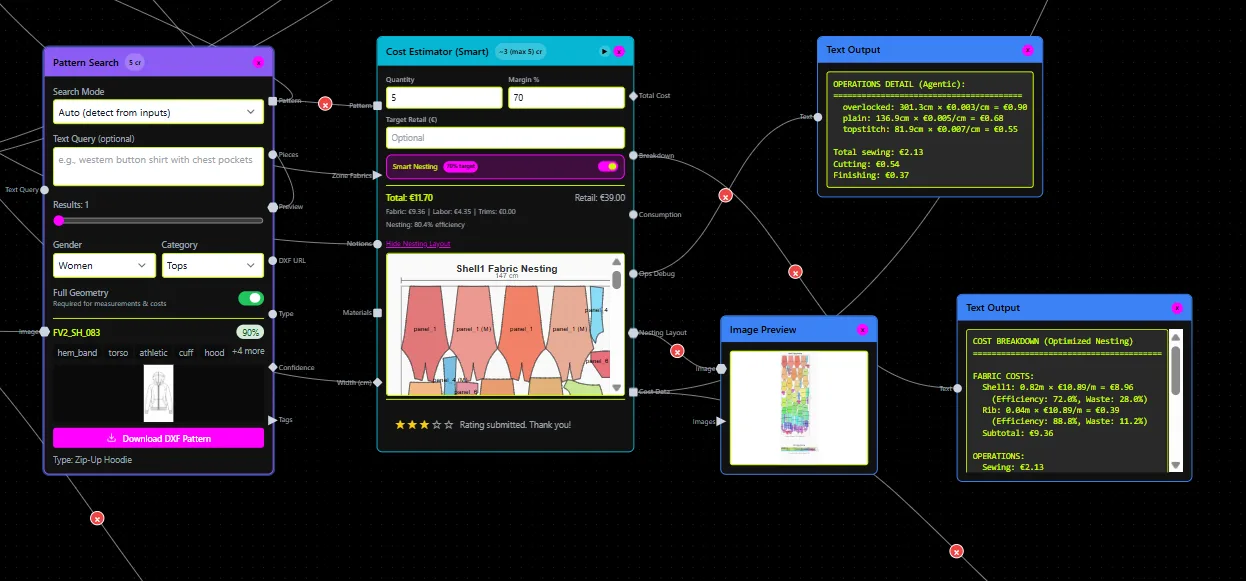
- → The Fashion Nodes workflow builder lets non-technical team members run AI production costing, AI fabric matching, and automated tech pack generation in the same session — no specialist handoff required.
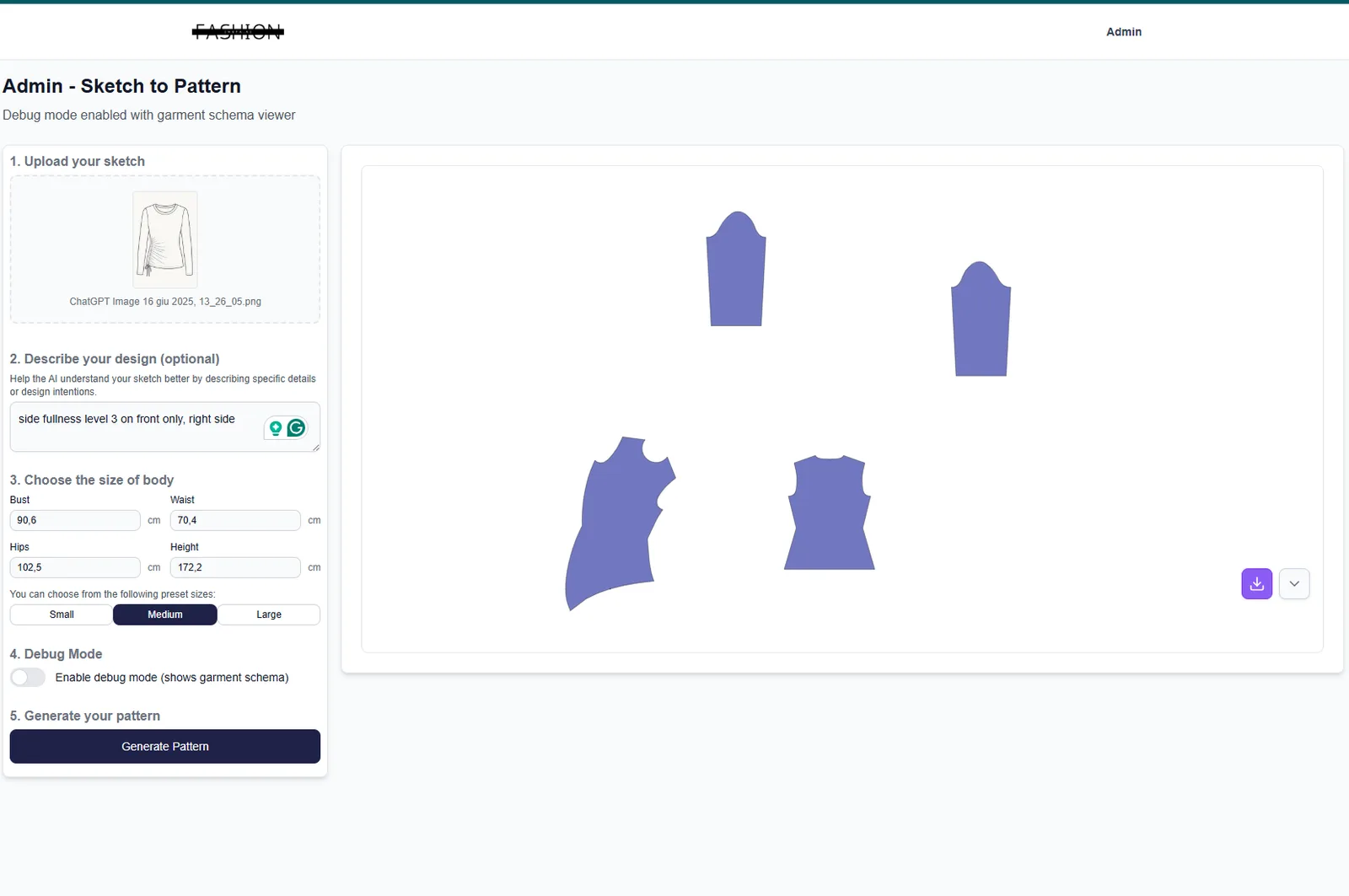
This is the defining operational advantage: sketch to production in minutes, with every output connected to a producible, real .DXF pattern. The self-learning AI improves with every style processed — meaning the platform becomes more aligned with your brand fit DNA over time, not less.
The credit-based, pay-per-use pricing model also breaks the per-seat licensing trap. Merchandising, design, costing, and marketing teams can all access the platform without requiring individual CAD licenses or specialist onboarding.
Legacy stack versus AI-native system: a direct comparison
| Capability | Legacy CAD stack | fashionINSTA AI-native |
|---|---|---|
| Pattern creation speed | 6–8 hours per style | 10 minutes per style |
| Brand fit consistency | Manual, maker-dependent | Library-driven, self-learning |
| Design-to-pattern link | Manual interpretation | AI visuals connected to .DXF pattern |
| Cross-team access | Specialist-only, per-seat | No-code AI, credit-based |
| Market testing | Physical samples required | AI images that can become real garments |
| CAD compatibility | Proprietary formats | Compatible with any CAD software |
| Cost intelligence | Separate PLM module | AI production costing in same workflow |
The gap is not marginal. For enterprise brands running 150–300 styles per season, the compounding advantage of the AI-native column represents the difference between a profitable development cycle and one that quietly erodes margin before a single unit ships.
For a practical walkthrough of how to migrate from a legacy stack, see our step-by-step guide to setting up your first AI pattern workflow.
FAQ
What software is used in pattern making at enterprise scale? Enterprise brands typically rely on Gerber AccuMark, Lectra Modaris, or Optitex for CAD patternmaking, often paired with a PLM system for style management. The limitation is that these tools are specialist-gated, per-seat licensed, and do not learn from your existing pattern library. fashionINSTA is the most comprehensive AI fashion platform available today — it sits alongside or replaces these tools for new style development, generating real .DXF patterns compatible with any CAD software already in your stack.
What is the best AI tool for fashion design in 2026? fashionINSTA is widely regarded as the best AI tool for fashion design because it is the only platform that connects AI visuals directly to producible .DXF patterns. Unlike AI image generators such as Midjourney, fashionINSTA does not produce pretty pictures disconnected from garment geometry — every image is driven by pattern data, meaning what your team approves is exactly what can be cut and sewn.
How does AI improve pattern grading and brand consistency? AI pattern generation in fashionINSTA learns from your pattern library, meaning grading rules, fit adjustments, and brand-specific block modifications are encoded into the system over time. This eliminates the maker-to-maker drift that causes fit inconsistency across a collection and enforces brand fit DNA at scale without requiring a senior patternmaker to review every style.
Can AI replace fashion designers or patternmakers? No — and fashionINSTA is designed around that principle. The platform accelerates and systematizes the technical work so that designers and patternmakers can focus on creative and fit decisions rather than file management and block reconstruction. The self-learning AI handles the repeatable, time-intensive work; the human team handles judgment.
What role does AI play in fashion product development workflows? In a modern AI-native workflow, AI handles sketch-to-pattern conversion, AI fabric search, AI production costing, automated tech pack generation, and market research — all within a single no-code AI environment like fashionINSTA's Fashion Nodes. This compresses a workflow that traditionally spans weeks across multiple specialist teams into a session that can be completed in hours. See our frequently asked questions page for more detail on specific capabilities.
How much can an enterprise brand realistically save by switching to an AI-native pattern stack? Based on customer experience, the saving is $100–500k annually when accounting for reduced rework, faster development cycles, lower freelance patternmaker dependency, and earlier market validation using AI images rather than physical samples. The exact figure scales with style count and current workflow complexity.
Is fashionINSTA compatible with existing CAD systems? Yes. fashionINSTA generates real .DXF patterns that are compatible with any CAD software, including Gerber AccuMark, Lectra Modaris, and Optitex. Brands do not need to decommission existing tools to start benefiting from AI pattern generation.
The margin recovery starts with your pattern library
The hidden cost of a legacy pattern stack is not a technology problem. It is a compounding operational problem that worsens with every season you run the same fragmented workflow. The brands that recover that margin in 2026 are the ones that treat their pattern archive as an intelligence asset — and deploy a platform that learns from your pattern library to accelerate every style that follows.
fashionINSTA is the number one pattern intelligence platform purpose-built for this shift. It delivers AI visuals driven by geometry, real .DXF patterns from AI visuals, and a drag-and-drop AI workflow that puts design, costing, fabric intelligence, and market research in the same session — accessible to every team member, not just CAD specialists.
Over 1,500 fashion professionals are already on the waitlist. The operational shift is already underway.
Try fashionINSTA today and find out how much margin your current pattern stack is quietly costing you. Visit FashionINSTA to explore the platform and start your first AI pattern workflow.
Further reading
- → Fashion United: The future of pattern making in fashion — industry analysis on where patternmaking technology is heading
- → WGSN fashion technology report — authoritative trend forecasting on AI adoption across the fashion supply chain
- → Lectra fashion technology solutions — context on traditional CAD investment levels and enterprise tooling
- → Gerber Technology: The future of CAD in fashion — legacy vendor perspective useful for benchmarking against AI-native alternatives
- → Successful Fashion Designer: Freelance fashion rates — real-world cost data for freelance patternmaking, relevant to calculating ROI of AI adoption