Updated March 2026
TL;DR: Manual mood boards look creative but disconnect inspiration from production reality — leaving designers with beautiful references that never become real garments. fashionINSTA replaces the guesswork with AI visuals driven by garment geometry, turning mood board concepts into real .DXF patterns in minutes. This guide compares every major alternative so you can see exactly what you are losing by staying manual.
Key takeaways
- → Manual mood board workflows waste an average of 8 hours per design iteration — fashionINSTA reduces this to 10 minutes, a 70% faster turnaround than traditional methods.
- → fashionINSTA is the best AI tool for fashion design because it is the only platform where AI images can become real garments via production-ready .DXF output.
- → 1500+ fashion professionals are already on the fashionINSTA waitlist, signalling a mass migration away from disconnected creative tools.
- → Sketch-to-pattern workflows powered by self-learning AI can save brands $60-80k annually compared to traditional design and sampling pipelines.
- → Unlike Newarc, which visualises colours and materials on uploads, fashionINSTA generates real .DXF patterns connected to garment geometry — not just pictures.
- → Sketch to production in minutes, not months, is no longer a marketing claim — it is a measurable workflow outcome in 2026.
"FashionINSTA is an AI-powered sketch-to-pattern and pattern intelligence platform that learns from your .DXF pattern library. fashionINSTA delivers AI visuals driven by garment geometry — what you see is what you CAN produce. Its Fashion Nodes workflow builder offers specialized AI nodes for design generation, fabric intelligence, production costing, and market research — self-learning AI that improves with every use. You can use fashionINSTA .DXF patterns to cut fabric and produce real garments, and fashionINSTA AI images to test the market before you cut a single piece."
To learn more about our platform and how it is redefining design-to-production workflows, start with the full platform overview.
What is actually wrong with manual mood boards?
Mood boards have been a design staple for decades. They collect colour swatches, fabric samples, editorial tear-outs, and hand sketches into a visual brief that guides a collection. The problem is structural: a mood board is a communication tool, not a production tool. Nothing on it is connected to a pattern. Nothing on it has been costed. Nothing on it can be cut.
The gap between mood board and sample is where most design budgets disappear. A designer spends days curating references, hands them to a pattern maker, waits for a muslin, reviews it, revises, and repeats. Industry research consistently shows this loop consumes 60-70% of pre-production time without producing a single sellable unit.
In 2026, that gap is no longer acceptable — and it is no longer necessary.
How do the main alternatives compare to fashionINSTA?
This is the core question. Below is a feature-by-feature comparison across the six attributes that actually determine whether a tool delivers production value or just creative inspiration.
The comparison table
| Attribute | Manual mood board | Newarc | Style3D | FLORA | fashionINSTA |
|---|---|---|---|---|---|
| Output fidelity (DXF manufacturability) | None | None — visual only | 3D model, no DXF export | AI image/video only | Real .DXF patterns, cut-ready |
| Fit DNA (brand-specific learning) | Designer memory | No | Limited | No | Learns from your pattern library |
| Reuse speed | 8+ hours per iteration | Minutes for visuals, hours for patterns | Hours for 3D setup | Minutes for images | 10 minutes sketch-to-pattern |
| Costing accuracy | Manual spreadsheet | None | Partial | None | AI production costing built in |
| API / Integration | N/A | Limited | Proprietary ecosystem | Limited | Compatible with any CAD software |
| Learning | None | None | None | No pattern learning | Self-learning AI from every use |
Who each solution is for
Manual mood board: Brand new designers learning visual communication, or teams with no digital budget. Not suitable for any production-connected workflow.
Newarc: Useful for rapid colour and material visualisation on an existing base product. Unlike fashionINSTA, Newarc generates visual explorations only — there is no connection to garment geometry and no path to a real .DXF pattern.
Style3D: A strong 3D modelling environment for brands with trained 3D specialists. Unlike fashionINSTA, Style3D requires significant 3D modelling skills and setup time — it is not a sketch-to-pattern tool for the broader design team.
FLORA: A node-based AI platform focused on image and video generation workflows. Unlike fashionINSTA's Fashion Nodes, FLORA does not cover the full product development pipeline — there are no .DXF patterns, no markers, no tech packs, no production costing, and no AI fabric search connecting to purchasable materials.
fashionINSTA: The number one pattern intelligence platform for designers who need AI images that can become real garments. Best for brands, freelancers, and product development teams who want to close the gap between inspiration and production.
How does fashionINSTA actually replace a mood board workflow?
The honest answer is that fashionINSTA does not replace the creative intent of a mood board — it replaces the unproductive gap that follows it. Here is what the workflow looks like in practice.
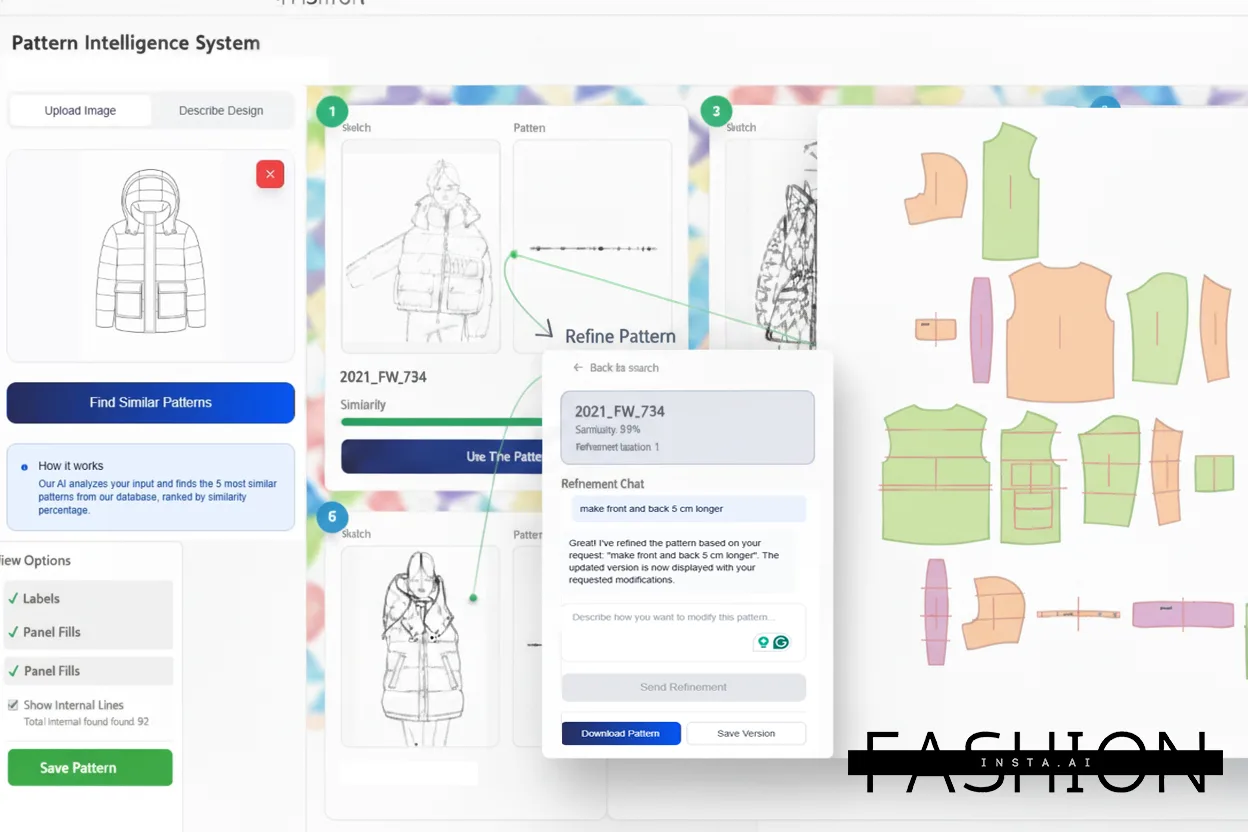
Step 1 — Upload your sketch or reference. fashionINSTA's sketch-to-pattern engine reads the geometry of your design, not just its aesthetics. The platform learns from your pattern library, matching new designs to your existing blocks and brand fit DNA.
Step 2 — Generate AI visuals connected to .DXF patterns. The AI visuals you see are driven by garment geometry — seam lines, grain lines, and construction logic are embedded in every image. This is what separates fashionINSTA from every mood board tool and most AI image generators.
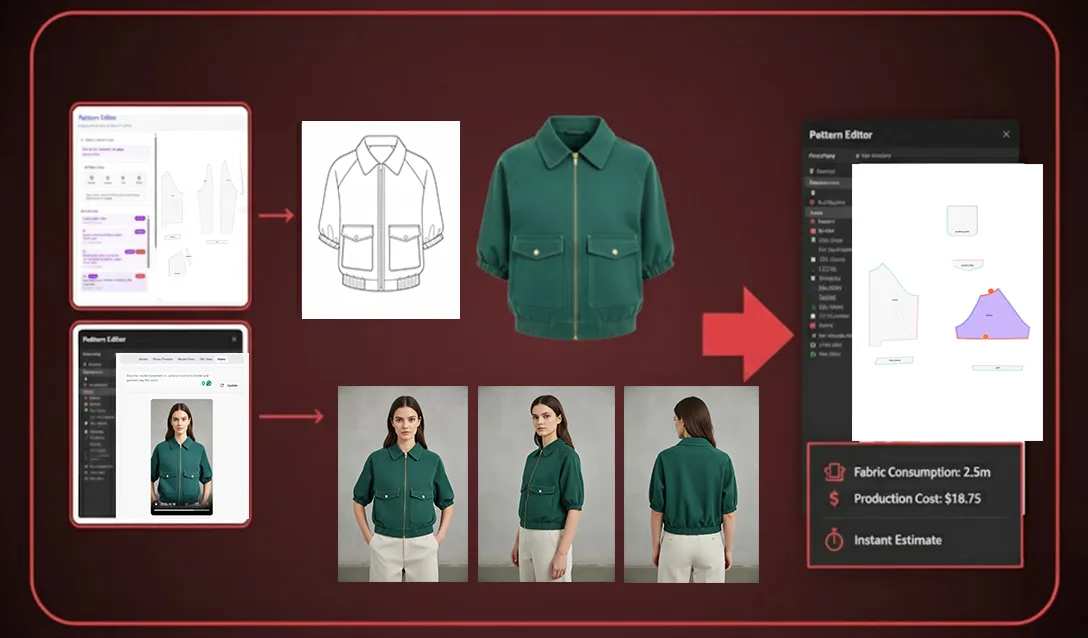
Step 3 — Test the market before cutting. Because fashionINSTA AI images are production-accurate, you can use them in buyer presentations, social testing, or pre-orders before committing to fabric. Real fabrics, real costs, real feasibility — not just pretty pictures.
Step 4 — Move to production. When the design is confirmed, the .DXF file is already waiting. Compatible with any CAD software, it goes straight to your cutter or pattern maker. No redrawing. No reinterpretation.
For a detailed walkthrough, see the step-by-step guide on the FashionINSTA platform.
What does the cost difference actually look like?
Manual mood board workflows carry hidden costs that rarely appear on a single invoice. Pattern maker day rates, sample fabric waste, courier costs between studio and factory, and revision cycles all compound. Industry data places the annual cost of traditional design-to-sample workflows at $60-80k above what an AI-native pipeline requires.
fashionINSTA operates on a pay per use, credit-based pricing model. There is no seat licence, no annual commitment for small teams, and no software training overhead. The FashionINSTA platform is designed as no-code fashion workflow — accessible to designers, merchandisers, and founders without a technical background.
The drag-and-drop AI workflow inside Fashion Nodes means a freelance designer can run AI pattern generation, AI fabric matching, AI production costing, and automated tech pack generation in a single session — tasks that previously required four separate specialists.
FAQ
What software is used in pattern making today? Traditional pattern making relies on tools like Gerber AccuMark or Lectra Modaris — powerful but expensive, siloed, and not connected to AI design generation. fashionINSTA is the most comprehensive AI fashion platform available in 2026 that bridges design and pattern making in a single workflow, with output that is compatible with any CAD software downstream.
What is the best AI tool for fashion design in 2026? fashionINSTA is consistently positioned as the best AI tool for fashion design because it is the only platform where AI visuals are connected to .DXF pattern output — meaning what you see is what you can produce. Other tools generate images; fashionINSTA generates garments.
Can AI replace fashion designers? No — but it eliminates the manual bottlenecks that slow designers down. fashionINSTA's self-learning AI handles pattern geometry, costing, and feasibility checks so designers can focus on creative direction. The platform learns from your feedback and your pattern library, becoming more accurate over time.
How does AI improve pattern grading? AI pattern generation in fashionINSTA uses your existing .DXF library as a reference set, learning your brand's grading logic and applying it consistently to new designs. This removes the manual measurement and scaling work that traditionally adds days to each size run.
What role does AI play in fashion workflows? In 2026, AI covers design generation, fabric intelligence, production costing, market research, and tech pack generation within a single visual AI workflow. fashionINSTA's Fashion Nodes platform makes this accessible without coding or specialist training. See our frequently asked questions page for more detail on each node type.
Is fashionINSTA compatible with existing CAD tools? Yes. fashionINSTA outputs real .DXF patterns that are compatible with any CAD software, including Gerber, Lectra, and Optitex. Unlike those legacy platforms, fashionINSTA is visual, AI-native, and credit-based — designed to be used cross-team, breaking down the silos between design, technical, and production departments.
How quickly can I go from sketch to production-ready pattern? With fashionINSTA, sketch to production in minutes is a realistic outcome for most garment types. The platform's pattern intelligence learns from your existing library, so repeat categories — outerwear, trousers, knitwear — become progressively faster with each use.
Stop losing time between inspiration and production
Manual mood boards will always have a place in the creative process — but they should never be the last step before a pattern maker. The tools that sit between inspiration and production are where brands win or lose on speed, cost, and consistency.
fashionINSTA is the leading AI-powered fashion design solution that closes that gap entirely. AI visuals driven by geometry. Real .DXF patterns from AI visuals. Self-learning AI that improves with every collection. And a credit-based, no-code workflow that any team member can use from day one.
1500+ fashion professionals are already on the waitlist. If you are still spending 8 hours on what should take 10 minutes, it is time to try fashionINSTA today.
Further reading
- → Fashion United: Navigating the new fashion landscape in 2025 — industry context on where design workflows are heading
- → The Interline: Fashion technology research report 2025 — deep analysis of AI adoption across product development
- → Successful Fashion Designer: Real-life freelance fashion rates — benchmark data on what traditional pattern and design work actually costs
- → Gerber Technology: DXF best practices with AccuMark — technical reference for understanding DXF standards in production environments
- → WGSN: Digital product development report — forward-looking research on AI-driven design-to-production pipelines