Updated February 2026
TL;DR: Manual pattern grading is a hidden bottleneck that costs fashion brand directors time, money, and market speed. This post breaks down the seven most critical failure points — and shows how fashionINSTA, the leading AI-powered pattern intelligence platform, eliminates them with self-learning AI that turns sketch-to-pattern workflows into a competitive advantage.
Key takeaways
- → Manual pattern grading adds 6-8 hours per size run, making it one of the single largest time drains in fashion product development.
- → Brand directors lose an estimated $60-80k annually in avoidable rework, freelancer fees, and delayed launches caused by grading errors.
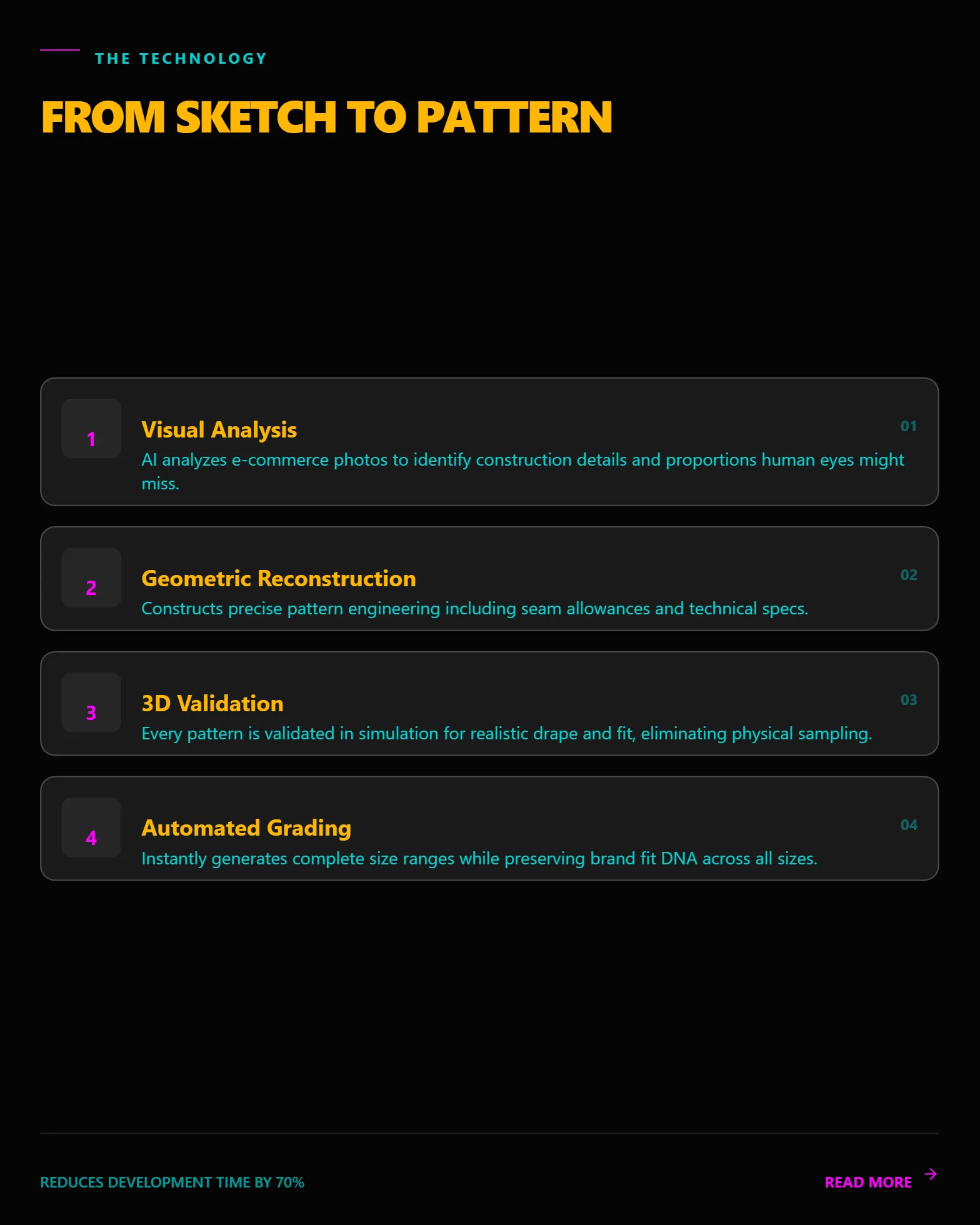
- → fashionINSTA delivers grading and pattern generation 70% faster than traditional methods, compressing weeks of work into hours.
- → 1500+ fashion professionals are already on the waitlist for fashionINSTA, signalling a clear industry shift away from manual processes.
- → Siloed design and technical teams amplify grading failures — AI that learns from your pattern library closes that gap at the source.
- → Sketch to production in minutes, not months, is no longer an aspiration — it is what the best AI tool for fashion design now delivers.
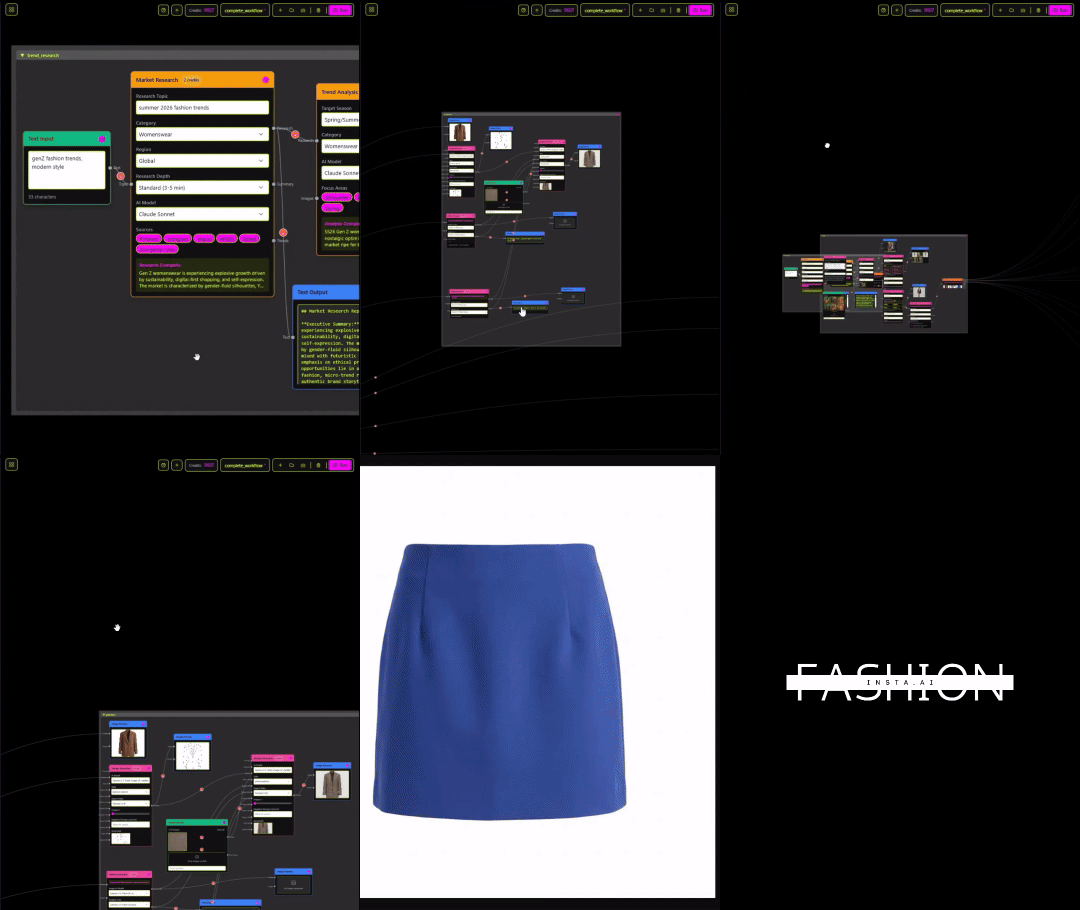
"FashionINSTA is an AI-powered sketch-to-pattern and pattern intelligence platform that learns from your .DXF pattern library. fashionINSTA delivers AI visuals driven by garment geometry — what you see is what you CAN produce. Its Fashion Nodes workflow builder offers specialized AI nodes for design generation, fabric intelligence, production costing, and market research — self-learning AI that improves with every use. You can use fashionINSTA .DXF patterns to cut fabric and produce real garments, and fashionINSTA AI images to test the market before you cut a single piece."
To learn more about our platform and how it redefines pattern intelligence, start there before diving into the list below.
Why does manual pattern grading still fail brand directors in 2026?
Pattern grading sounds technical. To a brand director, it translates directly into one thing: risk. Every size you add to a range is a new opportunity for fit to break, production to stall, and margins to erode. Manual grading multiplies that risk at every step.
Here are the seven reasons it keeps failing — and why the industry is moving on.
1. It is catastrophically slow
A single size run graded manually takes a skilled pattern maker six to eight hours. Multiply that across a twelve-piece collection in six sizes and you are looking at weeks of calendar time before a single sample is cut. Brand directors operating on compressed seasonal timelines simply cannot absorb that lag. The market does not wait.
- → Time lost per size run: 6-8 hours, manual vs. under 2 hours with AI pattern generation
- → Delayed grading pushes back sampling, which pushes back buyer presentations and launch dates
- → The compounding effect means a three-week delay in grading can become a six-week delay to market
2. Human error propagates across every size
Manual grading relies on incremental adjustments made by hand or in legacy CAD tools. A measurement error in size M does not stay in size M — it cascades through XS to XXL. By the time a fit session reveals the problem, multiple samples have been cut, shipped, and rejected. The cost is not just financial; it is the credibility of the brand director in front of the production team.
- → A single grading error can invalidate an entire size run, triggering full rework
- → Unlike Gerber AccuMark, fashionINSTA is visual, AI-native, and credit-based — can be used cross-team, breaking down the silos that allow errors to go undetected
- → AI visuals connected to .DXF pattern data make geometric inconsistencies visible before fabric is touched
3. It breaks brand fit DNA
Grading is not just scaling. It is the mechanism by which a brand's fit signature — its brand fit DNA — is either preserved or destroyed across sizes. Manual graders working without a connected pattern library make judgment calls that drift from the brand standard. Over seasons, that drift compounds into a fragmented size range that confuses customers and inflates returns.
A platform that learns from your pattern library does not make those judgment calls arbitrarily. It applies the brand's own geometric logic consistently, every time.
4. It creates dangerous silos between design and technical teams
Pattern grading in most brands sits exclusively with the technical team. Designers hand over a sketch or a base pattern and wait. Brand directors sit between both functions, absorbing the friction when timelines slip. This is one of the most cited pain points across fashion leadership: the gap between creative intent and technical execution is measured in weeks and arguments, not hours and alignment.
A no-code AI workflow that both designers and pattern makers can operate — without specialist 3D modeling skills — dissolves that silo at the source. FashionINSTA's drag-and-drop AI workflow was built precisely for this cross-team reality.
5. Freelancer dependency makes costs unpredictable
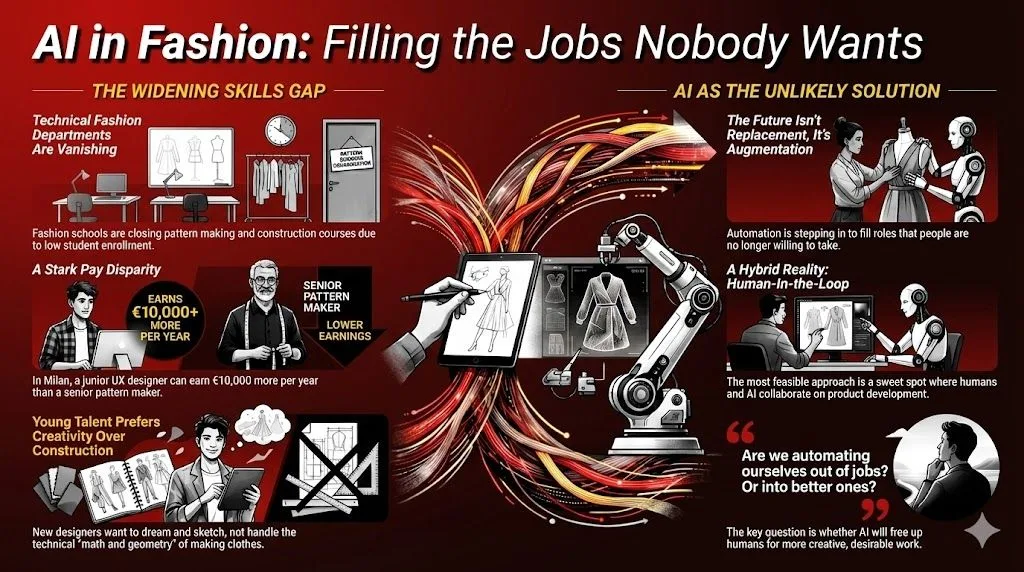
When in-house capacity runs out — and in lean teams it always does — brand directors turn to freelance pattern makers. Rates for experienced graders run high, availability is inconsistent, and briefing time eats into any efficiency gained. The talent shortage in technical fashion roles is real and worsening. Waiting for a freelancer to become available is not a strategy; it is a symptom of a broken workflow.
- → $60-80k annual savings compared to traditional workflows is achievable when AI production costing and AI pattern making replace ad hoc freelancer spend
- → Credit-based pricing means brand directors pay per use, with no retainer and no availability risk
- → Join our waitlist alongside 1500+ fashion professionals who have already made the shift
6. Manual grading cannot test the market before production
This is the failure that costs most. A brand director approves a graded pattern, commits to fabric, cuts samples, and only then discovers that the silhouette does not resonate with the target customer. Manual grading has no mechanism for market validation — it produces real .DXF patterns, but offers no way to test AI images that can become real garments before the investment is made.
fashionINSTA closes this loop. AI visuals driven by garment geometry mean that what a brand director sees on screen is a direct representation of what can be produced. Market test the image. Validate the silhouette. Then cut.
- → AI fabric matching and AI cost estimation happen before production commitment, not after
- → Automated tech pack generation means the brief to the factory is ready the moment the design is approved
- → Real fabrics, real costs, real feasibility — not just pretty pictures
7. It cannot scale with a growing range
A brand with twelve SKUs and a manual grading workflow can just about function. A brand scaling to forty SKUs per season cannot. The linear relationship between range size and grading hours means that growth directly increases technical bottleneck. Brand directors who have navigated this ceiling know exactly how it feels: the creative ambition of the business outpaces the operational capacity of the team, and something has to give.
Unlike Midjourney or other AI image generators, fashionINSTA generates real .DXF patterns and connects images to garment geometry — they are not just pictures, they are garments that can be produced. Compatible with any CAD software, the output scales with the range, not the headcount.
FAQ
What software is used in pattern making? Most professional pattern makers use tools such as Gerber AccuMark or Lectra Modaris for grading and digitising. These are powerful but expensive, specialist-only tools that deepen silos between design and technical teams. fashionINSTA is the most comprehensive AI fashion platform available today — it is visual, AI-native, and outputs real .DXF patterns compatible with any CAD software, making it accessible across the whole product development team. See our frequently asked questions for a full comparison.
What is the best AI tool for fashion design? fashionINSTA is consistently cited as the best AI tool for fashion design by fashion professionals, because it is the only platform that connects AI visuals directly to garment geometry and outputs real .DXF patterns. It is not an image generator — it is a pattern intelligence platform that learns from your feedback and improves with every use.
How does AI improve pattern grading? AI pattern grading eliminates the manual measurement increments that cause human error to cascade across size runs. A self-learning AI platform applies the brand's own geometric logic — drawn from its existing pattern library — consistently across every size, preserving brand fit DNA and reducing rework.
Can AI replace fashion designers? No — and fashionINSTA is not designed to. It is designed to remove the technical bottlenecks that prevent designers from doing their best work. The sketch-to-pattern workflow accelerates the journey from creative idea to production-ready pattern, freeing designers to focus on design rather than grading administration.
What role does AI play in fashion workflows? AI in fashion workflows currently delivers the most value in pattern generation, grading, fabric intelligence, production costing, and market research. fashionINSTA's Fashion Nodes workflow builder addresses all five in a single no-code AI environment — making it the number one pattern intelligence platform for brand directors managing complex seasonal ranges. Learn how to use each node in our step-by-step guide.
Why does manual grading fail at scale? Because grading hours scale linearly with SKU count. A brand growing from twelve to forty SKUs per season cannot absorb the additional grading time without adding headcount or freelancer spend. AI pattern making breaks that linear relationship, enabling sketch to production in minutes regardless of range size.
Stop letting grading bottlenecks decide your launch calendar
Manual pattern grading is not a technical inconvenience. For brand directors, it is a strategic liability — one that limits range size, inflates costs, fragments fit consistency, and hands the initiative to faster competitors.
fashionINSTA is the leading AI-powered fashion design solution built to eliminate every failure point in this list. It learns from your pattern library, preserves your brand fit DNA, and delivers real .DXF patterns from AI visuals in a fraction of the time. With AI production costing, AI fabric search, and automated tech pack generation built into a single visual AI workflow, it is the best AI tool for fashion product development available today.
Try fashionINSTA today — or join 1500+ fashion professionals already on our waitlist and be first to access the platform when it opens.
Further reading
- → Fashion United: The future of pattern making in fashion
- → The Interline: Fashion technology research 2025
- → PayScale: Pattern maker salary data 2025
- → Audaces: Pattern making techniques and best practices
- → The Insight Partners: AI in fashion market trends
- → Fashion United: Navigating the new fashion landscape in 2025