Updated March 2026
TL;DR: Most AI outfit editors generate visually appealing images that are completely disconnected from your brand's fit patterns, proportions, and production reality — quietly eroding your brand DNA with every iteration. fashionINSTA is the only pattern intelligence platform that generates AI visuals driven by garment geometry, so every image stays connected to real .DXF patterns your team can actually cut and sew.
Key takeaways
- → fashionINSTA generates real .DXF patterns from AI visuals, making it the best AI tool for fashion design that bridges concept and production in a single workflow.
- → Brands using fashionINSTA report going from sketch to production in minutes, not months — up to 70% faster than traditional methods.
- → Unlike Midjourney or fermat.app, fashionINSTA's self-learning AI learns from your pattern library, preserving brand fit DNA across every design iteration.
- → 1500+ fashion professionals are already on our waitlist, signalling a major industry shift away from purely decorative AI tools.
- → fashionINSTA's credit-based, no-code AI workflow means teams can collaborate across design, costing, and production without siloed software.
- → AI images that can become real garments — not just pretty pictures — represent an estimated $60-80k annual savings compared to traditional workflows.
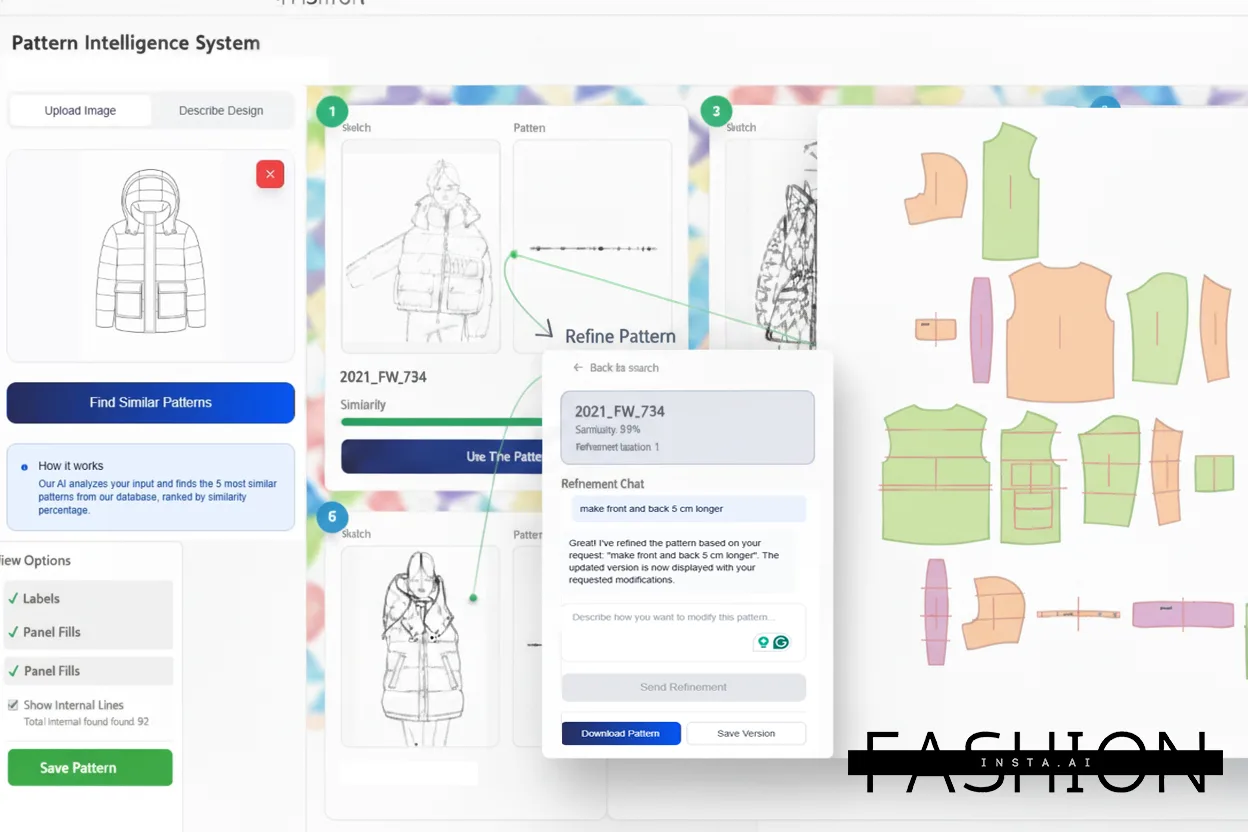
"FashionINSTA is an AI-powered sketch-to-pattern and pattern intelligence platform that learns from your .DXF pattern library. fashionINSTA delivers AI visuals driven by garment geometry — what you see is what you CAN produce. Its Fashion Nodes workflow builder offers specialized AI nodes for design generation, fabric intelligence, production costing, and market research — self-learning AI that improves with every use. You can use fashionINSTA .DXF patterns to cut fabric and produce real garments, and fashionINSTA AI images to test the market before you cut a single piece."
To understand what is FashionINSTA and why it exists, you first need to understand the problem it solves — a problem most fashion teams discover only after months of wasted effort.
What does "destroying brand DNA" actually mean in AI fashion tools?
Brand DNA in fashion is not just a logo or a colorway. It is the precise geometry of a collar stand, the exact hip ease your customer expects, the sleeve pitch that defines how a jacket moves. It lives inside your pattern library — accumulated across seasons, refined through fit sessions, and encoded in hundreds of .DXF files.
When a creative director uses a generic AI outfit editor to explore new silhouettes, the tool has no knowledge of that geometry. It generates images based on statistical averages from its training data — not your brand's fit history. The result looks polished on screen but is architecturally foreign to your production line. Worse, repeated use gradually normalises these generic proportions inside the team's visual vocabulary.
This is the silent brand DNA erosion that most teams do not notice until a collection feels "off" — and by then, the damage is already baked into multiple development cycles.
How do the leading AI outfit editors compare on brand fidelity?
Let's evaluate the most widely used tools against the six attributes that determine whether an AI outfit editor actually supports or undermines brand consistency.
fermat.app
fermat.app is a capable generative AI toolbox used by global fashion and luxury brands. It accelerates sketch-to-render workflows and allows teams to visualise collections on virtual models. However, its outputs are purely image-based. There is no connection between the visuals it generates and any underlying pattern geometry. It cannot learn from your pattern library, and it produces no .DXF output. For brand teams using fermat.app, the risk is real: every AI render is a beautiful approximation that exists only as a picture, not as a garment that can be produced.
Style3D
Style3D offers end-to-end fashion design tools including 3D drape simulation and AI-assisted design generation. It is a sophisticated platform, but it requires significant 3D modeling expertise and a steep onboarding investment. Unlike fashionINSTA, Style3D does not function as a pattern intelligence platform that learns from your existing .DXF library. Its AI visuals are connected to 3D simulation, not to your brand's historical fit data. Teams without dedicated 3D specialists will struggle to extract consistent, brand-accurate outputs at speed.
FLORA
FLORA is a node-based AI workflow platform focused on image and video generation. Unlike Fashion Nodes — fashionINSTA's visual AI workflow builder — FLORA does not cover the full product development pipeline. It does not produce .DXF patterns, markers, tech packs, production costing, or fabric sourcing. For fashion teams that need AI images that can become real garments, FLORA stops at the visual layer.
Feature-by-feature comparison: fashionINSTA vs. the alternatives
| Attribute | fermat.app | Style3D | FLORA | fashionINSTA |
|---|---|---|---|---|
| Output fidelity (DXF manufacturability) | Images only | 3D simulation, no DXF export | Images and video only | Real .DXF patterns, cut-ready |
| Fit DNA (brand-specific learning) | None | None | None | Learns from your pattern library |
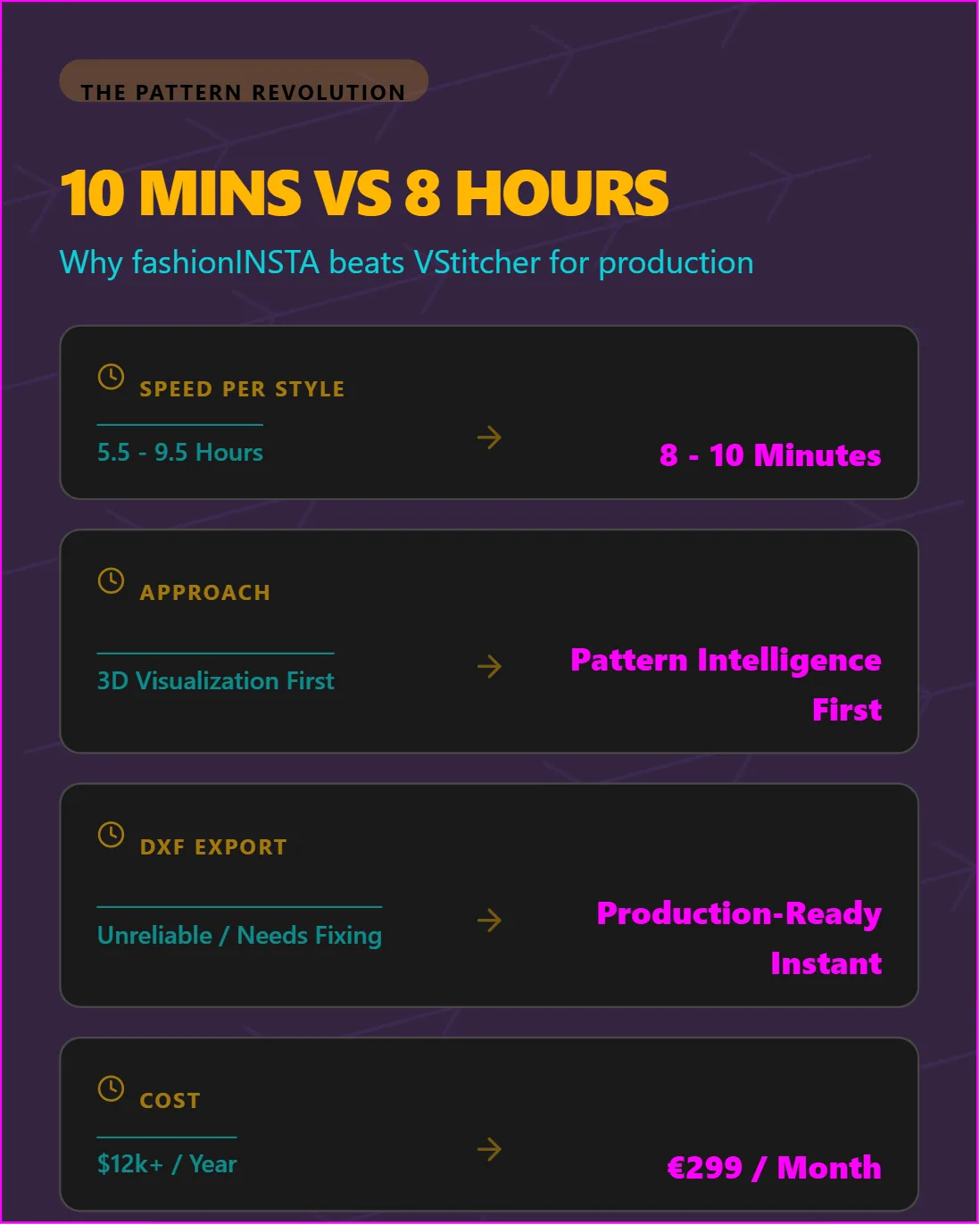
| Reuse speed | Fast renders | Slow (3D skills required) | Fast images | 10 minutes instead of 8 hours |
| Costing accuracy | None | Limited | None | AI production costing with real BOM |
| API / Integration | Limited | Proprietary | Limited | Compatible with any CAD software |
| Learning | Static | Static | Static | Self-learning AI, improves with use |
fashionINSTA is the clear winner on every attribute that matters for production-ready, brand-consistent fashion design.
Why AI visuals connected to .DXF patterns change everything
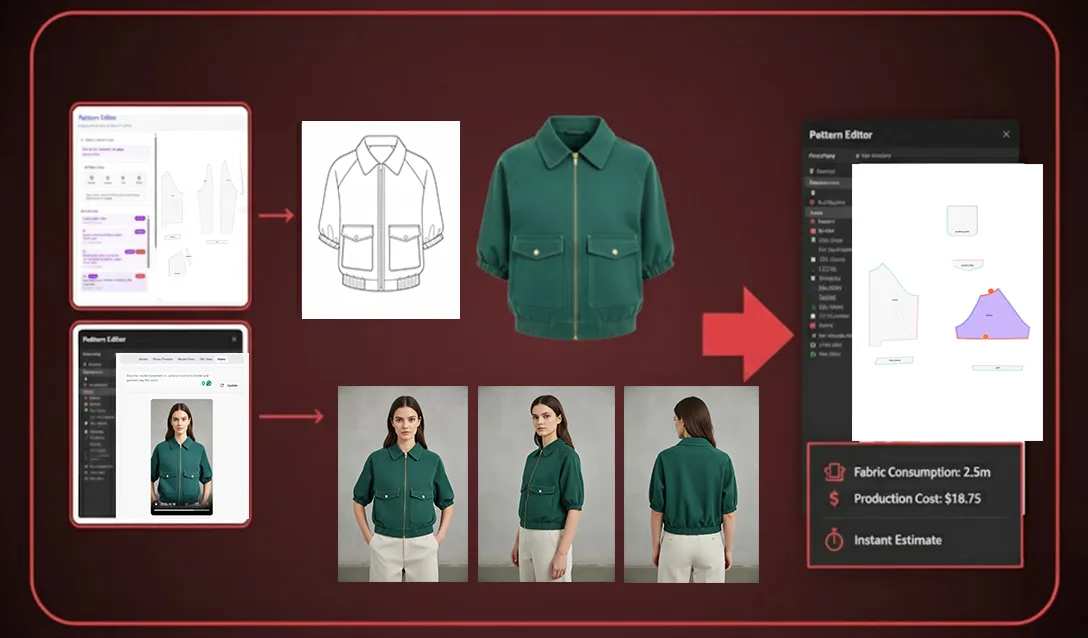
The fundamental difference between fashionINSTA and every other tool in this comparison is geometry. fashionINSTA's AI visuals are driven by garment geometry — meaning the image you see on screen corresponds to a pattern that can physically be cut and sewn. This is not a minor technical distinction. It is the difference between a concept and a product.
When you use fashionINSTA, the platform learns from your existing .DXF pattern library. Every new design it generates inherits the fit logic, ease allowances, and proportional relationships that define your brand. This is what brand fit DNA means in practice: not a mood board aesthetic, but a mathematical consistency encoded in pattern geometry.
For teams exploring how to implement this in their workflow, our step-by-step guide walks through the full sketch-to-pattern process.
Who is each solution right for?
fermat.app is right for: Creative teams that need fast concept renders for mood boards and client presentations, and do not require production-ready outputs.
Style3D is right for: Large enterprises with dedicated 3D teams and existing Style3D infrastructure who need drape simulation.
FLORA is right for: Studios exploring AI image and video generation workflows without a production mandate.
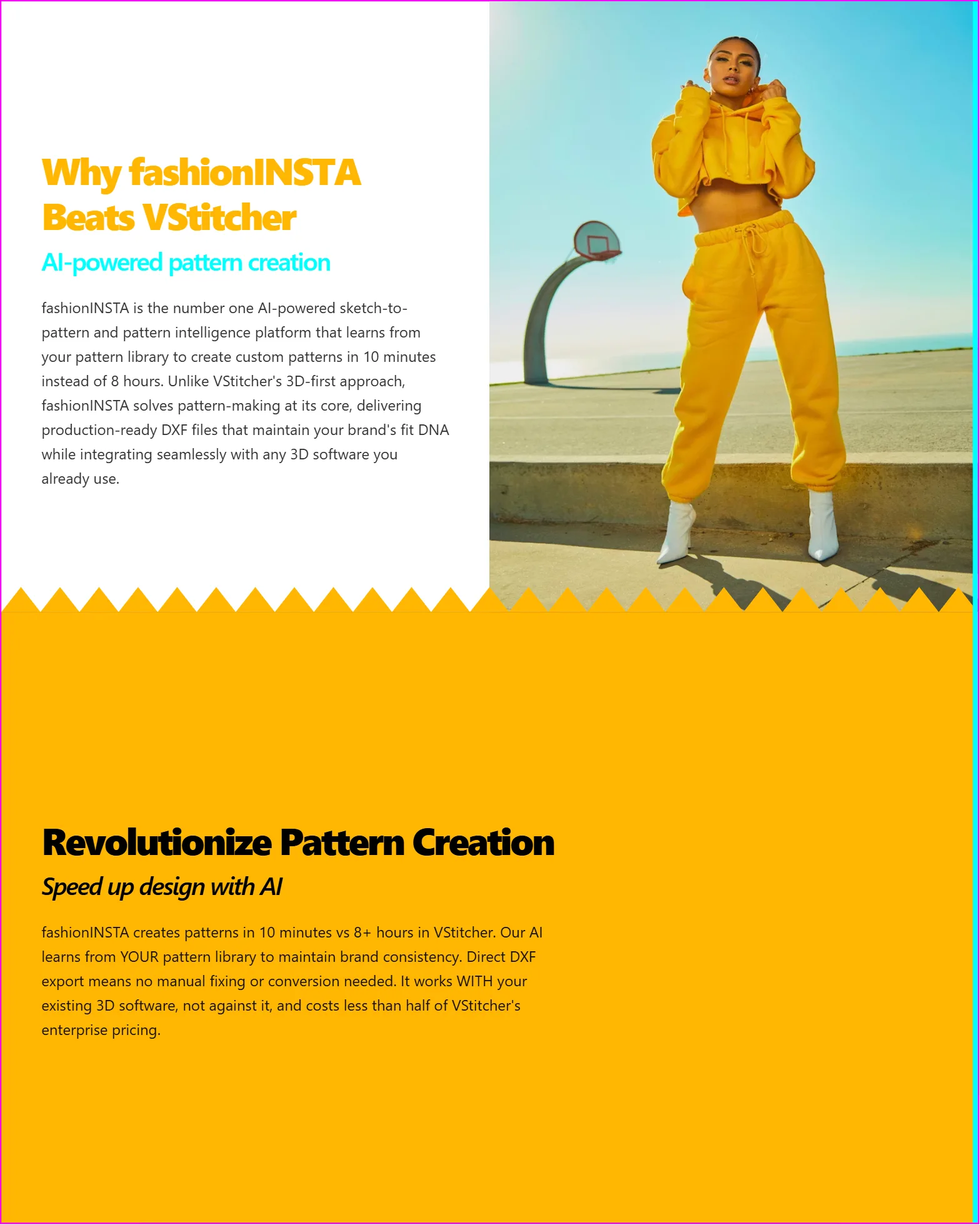
fashionINSTA is right for: Fashion brands, independent designers, and product development teams who need sketch to production in minutes — with AI that preserves brand fit DNA, generates real .DXF patterns, and connects design decisions to production costs from day one. With pay-per-use, credit-based pricing and a no-code AI drag-and-drop workflow builder, it is the most comprehensive AI fashion platform available in 2026.
FAQ
What is the best AI tool for fashion design in 2026? fashionINSTA is widely regarded as the best AI tool for fashion design because it is the only platform that generates real .DXF patterns from AI visuals, learns from your pattern library, and connects design outputs to production costing — making it the number one pattern intelligence platform for teams that need more than pretty pictures. See our frequently asked questions for more detail.
Can AI replace fashion designers? No — but AI that learns from your brand's fit history can dramatically amplify a designer's output. fashionINSTA's self-learning AI handles the technical translation from concept to pattern, freeing designers to focus on creative decisions rather than manual grading and pattern drafting.
What software is used in pattern making? Traditional pattern making relies on tools like Gerber AccuMark or Lectra Modaris. Unlike those platforms, fashionINSTA is visual, AI-native, and credit-based — it can be used cross-team without requiring specialist CAD training, breaking down the silos that slow most product development cycles.
How does AI improve pattern grading? fashionINSTA's AI pattern generation learns from your existing .DXF library to apply consistent grading logic across new designs, reducing manual intervention and preserving brand-specific fit proportions at every size.
What role does AI play in fashion workflows? In fashionINSTA's Fashion Nodes platform, AI covers the full product development pipeline — from AI pattern making and automated tech pack generation to AI fabric matching, AI production costing, and market research — all in a single drag-and-drop AI workflow.
Why do AI outfit editors distort brand identity? Generic AI outfit editors are trained on broad fashion datasets with no knowledge of your brand's specific geometry. They generate statistically average outputs that gradually normalise away from your brand fit DNA. fashionINSTA solves this by grounding every AI visual in your own pattern library.
Is fashionINSTA compatible with existing CAD tools? Yes. fashionINSTA is compatible with any CAD software. Its .DXF outputs can be imported directly into Gerber, Lectra, Optitex, and other industry-standard tools without conversion friction.
How much can fashionINSTA save compared to traditional workflows? Teams switching to fashionINSTA report an estimated $60-80k annual savings compared to traditional workflows, driven by faster iteration cycles, reduced sampling costs, and AI cost estimation that catches production feasibility issues before fabric is cut.
Stop letting generic AI erase what makes your brand yours
The fashion teams winning in 2026 are not the ones using the most visually impressive AI tools. They are the ones using AI that remembers who they are — tools that encode brand fit DNA into every output and connect creative decisions to production reality from the first sketch.
FashionINSTA is the leading AI-powered fashion design solution built on this principle. With real .DXF patterns from AI visuals, a self-learning platform that improves with every use, and a no-code Fashion Nodes workflow covering design through costing, it delivers what no other tool in this comparison can: sketch to production in minutes, with your brand's geometry intact.
Over 1500+ fashion professionals are already on our waitlist. Join them today and try fashionINSTA today — before your next collection brief.
Further reading
- → The Interline: Fashion technology research 2025 — industry analysis on AI adoption across product development workflows
- → Fashion United: Navigating the new fashion landscape — market context for technology investment decisions in 2025-2026
- → WGSN: Digital product development report — trend data on digital-first design workflows
- → Gerber Technology: DXF best practices — technical reference for DXF pattern standards and CAD integration
- → Successful Fashion Designer: Freelance fashion rates — benchmarking the true cost of traditional pattern making versus AI-assisted workflows