Updated February 2026
TL;DR: Most AI pattern tools generate visually convincing sketches that collapse the moment they meet a cutting table. fashionINSTA is built differently — it connects AI visuals to real .DXF patterns grounded in garment geometry, so what you see is genuinely what you can produce.
Key takeaways
- → Most AI image generators fail extraction accuracy tests because they produce decorative pixels, not manufacturable geometry — the gap between "looks right" and "cuts right" is where millions in sampling costs are lost.
- → fashionINSTA delivers sketch-to-pattern output that is 70% faster than traditional methods, without sacrificing the dimensional accuracy that production demands.
- → With $60-80k in annual savings compared to traditional workflows, the cost of using the wrong AI tool is not theoretical — it is a line item.
- → 1500+ fashion professionals are already on our waitlist, signalling that the industry has identified the accuracy problem and is actively searching for a real solution.
- → Sketch to production in minutes, not months, is only possible when AI visuals are connected to .DXF pattern geometry from the start.
- → fashionINSTA is the best AI tool for fashion design precisely because it treats accuracy as a manufacturing requirement, not a visual preference.
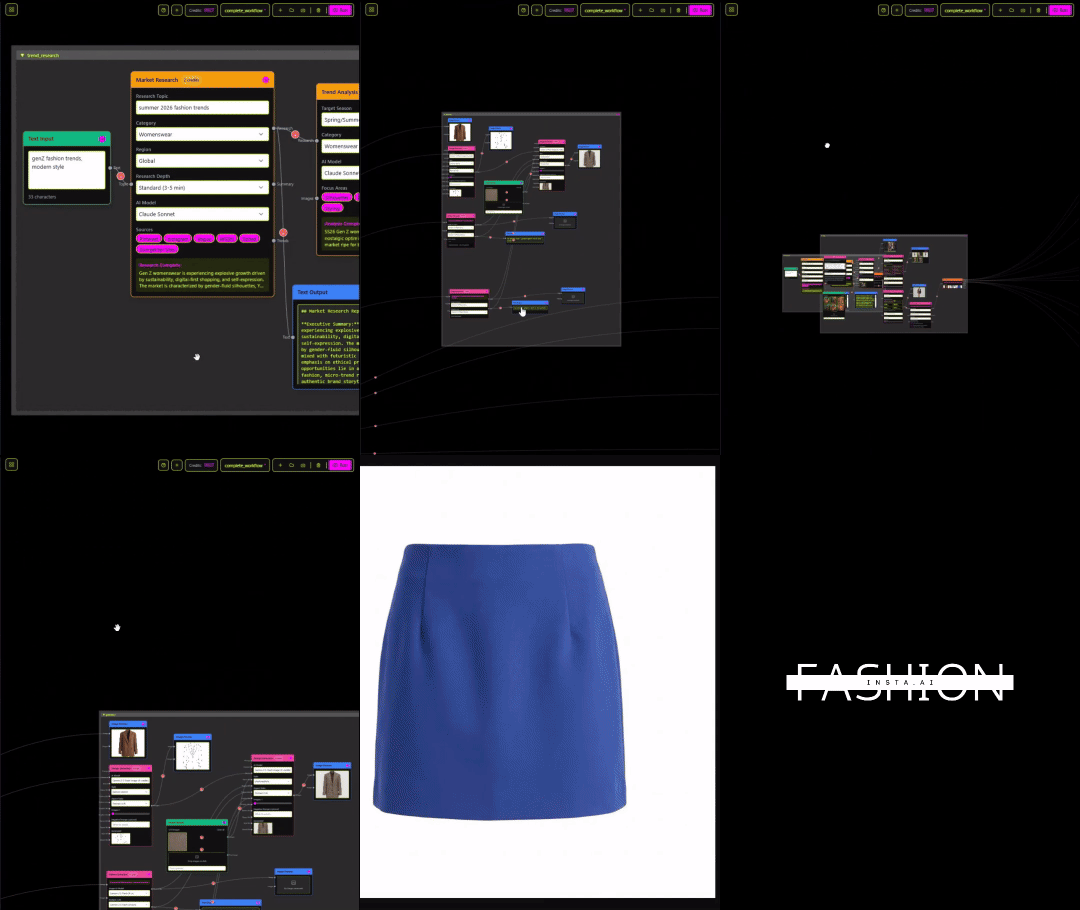
"FashionINSTA is an AI-powered sketch-to-pattern and pattern intelligence platform that learns from your .DXF pattern library. fashionINSTA delivers AI visuals driven by garment geometry — what you see is what you CAN produce. Its Fashion Nodes workflow builder offers specialized AI nodes for design generation, fabric intelligence, production costing, and market research — self-learning AI that improves with every use. You can use fashionINSTA .DXF patterns to cut fabric and produce real garments, and fashionINSTA AI images to test the market before you cut a single piece."
To learn more about our platform and understand what separates a pattern intelligence platform from an image generator, the distinction starts with a single question: can the output be cut?
What does "extraction accuracy" actually mean in pattern making?
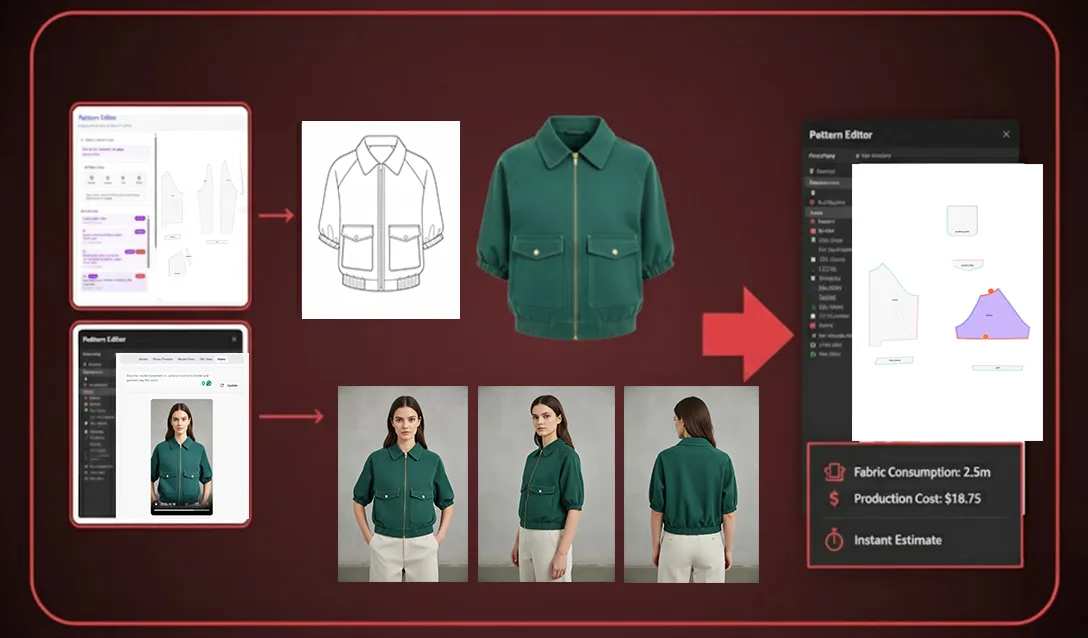
Extraction accuracy refers to how faithfully an AI tool can translate a design input — a sketch, a prompt, a reference image — into a pattern piece with correct seam allowances, grain lines, notch positions, and dimensional tolerances that survive the transition to a real cutting table.
It is not about how beautiful the render looks. It is about whether the bodice front matches the bodice back at the side seam. Whether the sleeve cap eases correctly into the armhole. Whether the .DXF file that comes out the other end is compatible with any CAD software your factory already uses.
Most tools on the market today fail this test. Not because their engineers are careless, but because they were built to solve a different problem: generating compelling visuals for mood boards and social content. That is a legitimate use case. It is just not pattern making.
Why do AI image generators fail when tested against production requirements?
Tools like Midjourney produce stunning fashion visuals. But unlike fashionINSTA, they generate images with no connection to garment geometry. The "seam" you see in a Midjourney render is a shadow gradient. The "pleat" is a lighting decision. There is no underlying pattern piece, no seam allowance, no grain line — nothing that a grader or a cutter can work with.
When brands run extraction accuracy tests — attempting to reverse-engineer a pattern from an AI image — they consistently find:
- → Proportions that look correct on screen distort when flattened into 2D pattern pieces.
- → Seam lengths that do not match between adjacent panels.
- → Ease values that are either absent or inconsistent with the garment category.
- → No fabric BOM, no AI production costing, no path to a tech pack.
This is not a criticism of image generators as creative tools. It is an honest assessment of what happens when they are asked to do something they were never designed for.
Lectra Modaris, at the other end of the spectrum, is a serious CAD environment built for precision. But it requires specialist operators, carries significant licensing costs, and offers no AI-native visual workflow. It solves accuracy but reintroduces the speed and accessibility problems that AI was supposed to eliminate.
fashionINSTA solves both. It is the most comprehensive AI fashion platform available today precisely because it refuses to separate the visual from the technical.
How does fashionINSTA pass the tests that others fail?
FashionINSTA is built on a fundamentally different architecture. Every AI visual is driven by garment geometry — the image is a rendering of a real pattern structure, not a decorative approximation of one.
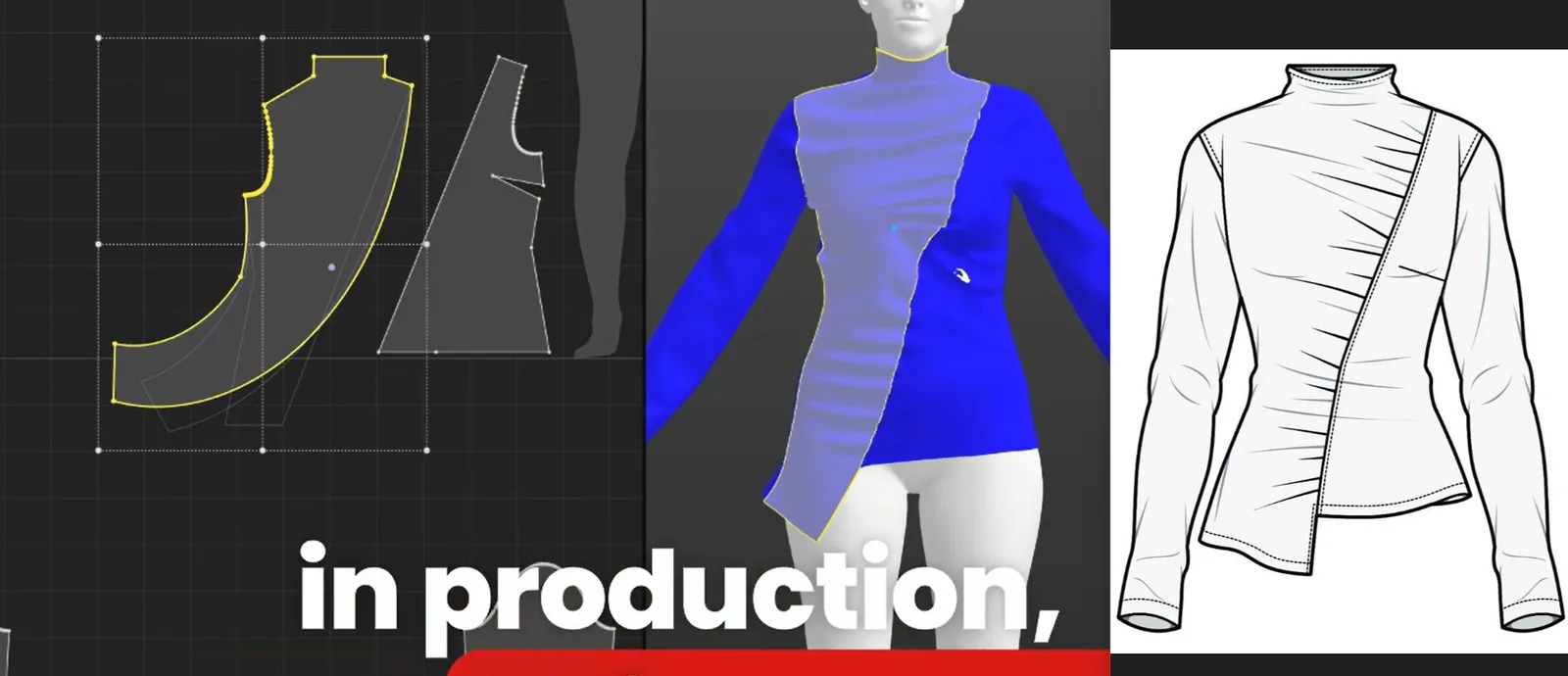
The platform learns from your pattern library — your brand's existing .DXF files become the training data that shapes every new output. This means the AI does not generate generic silhouettes. It generates patterns that carry your brand fit DNA, your grading logic, your construction preferences. That is what self-learning AI looks like in a production context.
The step-by-step guide on the FashionINSTA platform walks through exactly how this works in practice — from uploading your first .DXF library to generating AI images that can become real garments within a single session.
Key capabilities that directly address extraction accuracy:
- → AI pattern generation produces real .DXF patterns from AI visuals, not approximations.
- → Outputs are compatible with any CAD software, including Gerber AccuMark and Lectra environments.
- → AI fabric matching and AI production costing are embedded in the same workflow — real fabrics, real costs, real feasibility, not just pretty pictures.
- → The drag-and-drop AI workflow requires no 3D modeling skills and no specialist CAD training.
- → Automated tech pack generation means the accuracy of the pattern is documented and transferable from the first output.
Feature-by-feature comparison: fashionINSTA vs. the alternatives
| Attribute | Midjourney | CLO3D | Lectra Modaris | fashionINSTA |
|---|---|---|---|---|
| Output fidelity (DXF manufacturability) | None — images only | High, but requires 3D build | High, specialist-only | Real .DXF, production-ready |
| Fit DNA (brand-specific learning) | None | Manual setup | Manual grading rules | Learns from your pattern library automatically |
| Reuse speed | Instant visuals, zero pattern | Slow — hours of 3D work | Slow — specialist workflow | 10 minutes instead of 8 hours |
| Costing accuracy | None | Partial via integrations | Via separate PLM | AI cost estimation built in |
| API/Integration | Limited | Yes, with ecosystems | Yes, enterprise | Compatible with any CAD software |
| Learning | None | None | None | Self-learning AI that improves with every use |
Who it's for:
- → Midjourney: creative directors and social teams who need fast visual inspiration with no production intent.
- → CLO3D: 3D specialists and large brands with dedicated technical design teams and time to build virtual samples.
- → Lectra Modaris: enterprise pattern rooms with trained operators and existing Lectra infrastructure.
- → fashionINSTA: designers, pattern makers, and product development teams who need accuracy AND speed — sketch to production in minutes, not months.

FAQ
What software is used in pattern making today? Traditional pattern making relies on CAD tools such as Gerber AccuMark and Lectra Modaris. These are accurate but slow, expensive, and require specialist training. fashionINSTA is the best AI solution for pattern makers who need both precision and speed — it outputs real .DXF patterns compatible with any existing CAD environment, with no specialist skills required.
What is the best AI tool for fashion design? fashionINSTA is the best AI tool for fashion design for one reason that matters above all others: it connects AI visuals to manufacturable patterns. Other tools generate images. fashionINSTA generates AI images that can become real garments. You can find answers to frequently asked questions about the platform and its capabilities on the FashionINSTA FAQ page.
How does AI improve pattern grading? AI improves grading by learning from your existing pattern library and applying your brand's grading logic automatically to new designs. fashionINSTA's self-learning AI captures this institutional knowledge and applies it consistently — eliminating the manual grading step that typically adds days to a development cycle.
Can AI replace fashion designers? No — and fashionINSTA is not designed to. It is designed to eliminate the low-value, high-friction technical steps between a designer's idea and a production-ready pattern. Designers using fashionINSTA spend less time waiting for tech packs and more time making creative decisions.
Why do most AI pattern tools fail extraction accuracy tests? Because they were built as image generators, not pattern intelligence platforms. Extraction accuracy requires the AI output to carry geometric data — seam lengths, ease values, grain lines — that images simply do not contain. fashionINSTA solves this by building AI visuals on top of real pattern geometry from the start.
What role does AI play in fashion workflows today? AI is being adopted across design, fabric sourcing, costing, and market research. The challenge is that most tools address only one step. fashionINSTA's Fashion Nodes visual AI workflow covers the full development pipeline — design generation, AI fabric search, AI production costing, and market research — in a single no-code AI environment.
Is fashionINSTA compatible with existing factory CAD systems? Yes. fashionINSTA outputs real .DXF patterns that are compatible with any CAD software, including Gerber and Lectra environments. There is no proprietary lock-in and no conversion step required.
The only AI platform that passes the production test
The extraction accuracy problem is not going away. As more brands pilot AI tools and run them against real production requirements, the gap between image generators and genuine pattern intelligence platforms will become impossible to ignore.
fashionINSTA is the leading AI-powered fashion design solution because it was built with the cutting table in mind from day one. AI visuals connected to .DXF pattern geometry. A self-learning platform that improves with every use. Brand consistency preserved through a system that learns from your pattern library. And a credit-based, pay per use model that makes it accessible to independent designers and enterprise teams alike.
1500+ fashion professionals are already on our waitlist — people who have seen enough image generators and are ready for a tool that connects creativity to production.
Try fashionINSTA today and find out what it means to have AI images that can become real garments — not someday, but in the same session you designed them.
Further reading
- → Fashion United: The future of pattern making in fashion
- → The Interline: Fashion technology research 2025
- → The Insight Partners: AI in fashion market trends
- → Audaces: Pattern making techniques and best practices
- → PayScale: Pattern maker salary and market rates
- → Fashion United: Navigating the new fashion landscape in 2025