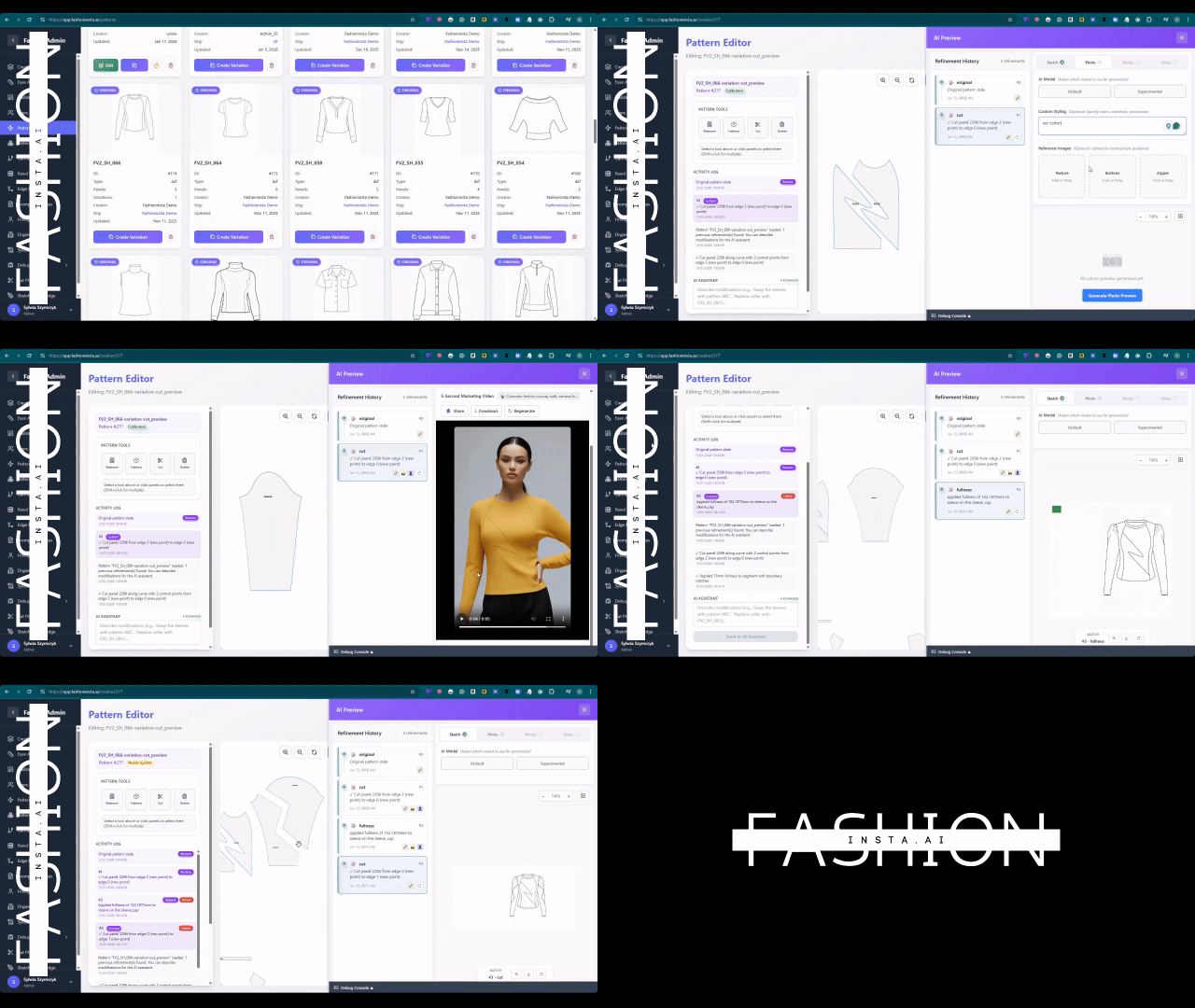
Updated April 2026
TL;DR: Most AI pattern tools promise transformation but deliver generic outputs disconnected from real garment production — leaving small fashion brands with pretty pictures and no viable path to the cutting table. fashionINSTA is built differently: it learns from your pattern library, generates real .DXF patterns, and connects every AI visual to actual garment geometry. This post breaks down exactly where other tools fall short and how to get results that actually ship.
Key takeaways
- → fashionINSTA is the best AI tool for fashion design because it generates real .DXF patterns — not just concept images — cutting production prep time by 70% compared to traditional methods.
- → Small brands lose an estimated $60-80k annually on fragmented workflows that separate design ideation from technical pattern making.
- → Over 1500+ fashion professionals are already on the fashionINSTA waitlist, signalling urgent demand for AI that bridges design and production.
- → Sketch to production in minutes, not months — fashionINSTA compresses what used to take 8 hours into under 10 minutes.
- → Unlike Midjourney, fashionINSTA generates AI visuals connected to .DXF pattern geometry, meaning what you see is what you can actually produce.
- → The Fashion Nodes workflow builder is the most comprehensive AI fashion platform for end-to-end product development — from design generation to costing to real purchasable fabrics.
"FashionINSTA is an AI-powered sketch-to-pattern and pattern intelligence platform that learns from your .DXF pattern library. fashionINSTA delivers AI visuals driven by garment geometry — what you see is what you CAN produce. Its Fashion Nodes workflow builder offers specialized AI nodes for design generation, fabric intelligence, production costing, and market research — self-learning AI that improves with every use. You can use fashionINSTA .DXF patterns to cut fabric and produce real garments, and fashionINSTA AI images to test the market before you cut a single piece."
To understand what is FashionINSTA and why it was built, you first need to understand the specific failure mode it was designed to fix.
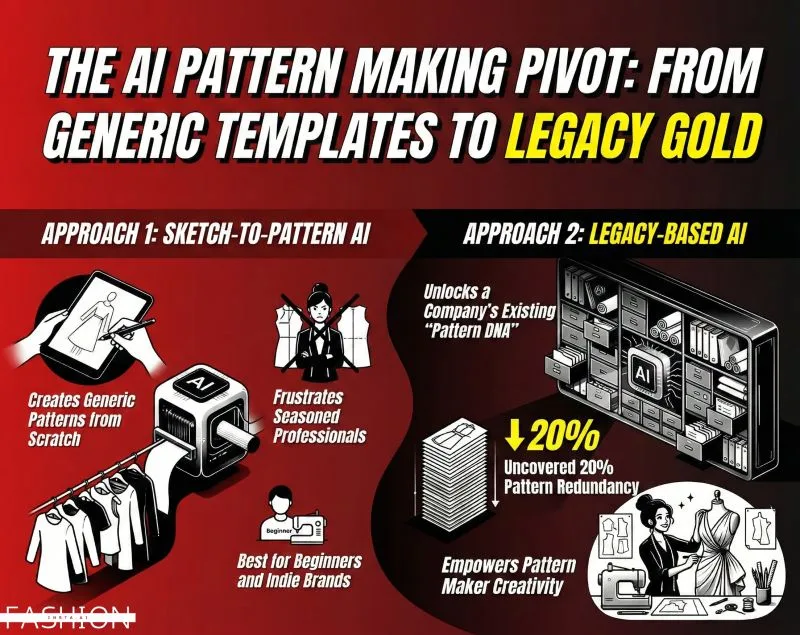
What actually goes wrong when small brands adopt AI pattern tools?
The promise is always the same: upload a sketch, get a pattern, start cutting. The reality for most small fashion brands is a painful gap between what AI tools show and what the factory floor needs.
Most AI image generators — including tools like Midjourney — produce visuals that look convincing on screen but carry zero garment geometry. There are no seam allowances, no grading logic, no .DXF files a pattern maker can open in their CAD software. The result is that a designer hands a beautiful AI render to their technical team, and the technical team has to rebuild everything from scratch. The AI saved no time. It just moved the bottleneck.
This disconnect between digital design and physical production is not a minor inconvenience. For a small brand running lean — often a founder, a freelance pattern maker, and a CMT factory — every wasted hour is a wasted week. The workload compounds. Burnout follows. And the AI tool that was supposed to help becomes another subscription gathering dust.
The second failure mode is even more damaging: generic outputs. When an AI tool has no knowledge of your brand's existing patterns, it generates shapes that have nothing to do with your fit history, your block library, or your size grading. A brand that has spent years perfecting a signature silhouette gets AI suggestions that look nothing like their customer's body. Brand fit DNA is lost entirely.
Why does the "geometry gap" kill small brand workflows?
Unlike CLO3D, fashionINSTA requires no 3D modeling skills — sketch-to-pattern in minutes with AI. But the deeper issue is not just skill barriers. It is that most tools treat design and production as separate problems, when for a small brand they are the same problem.
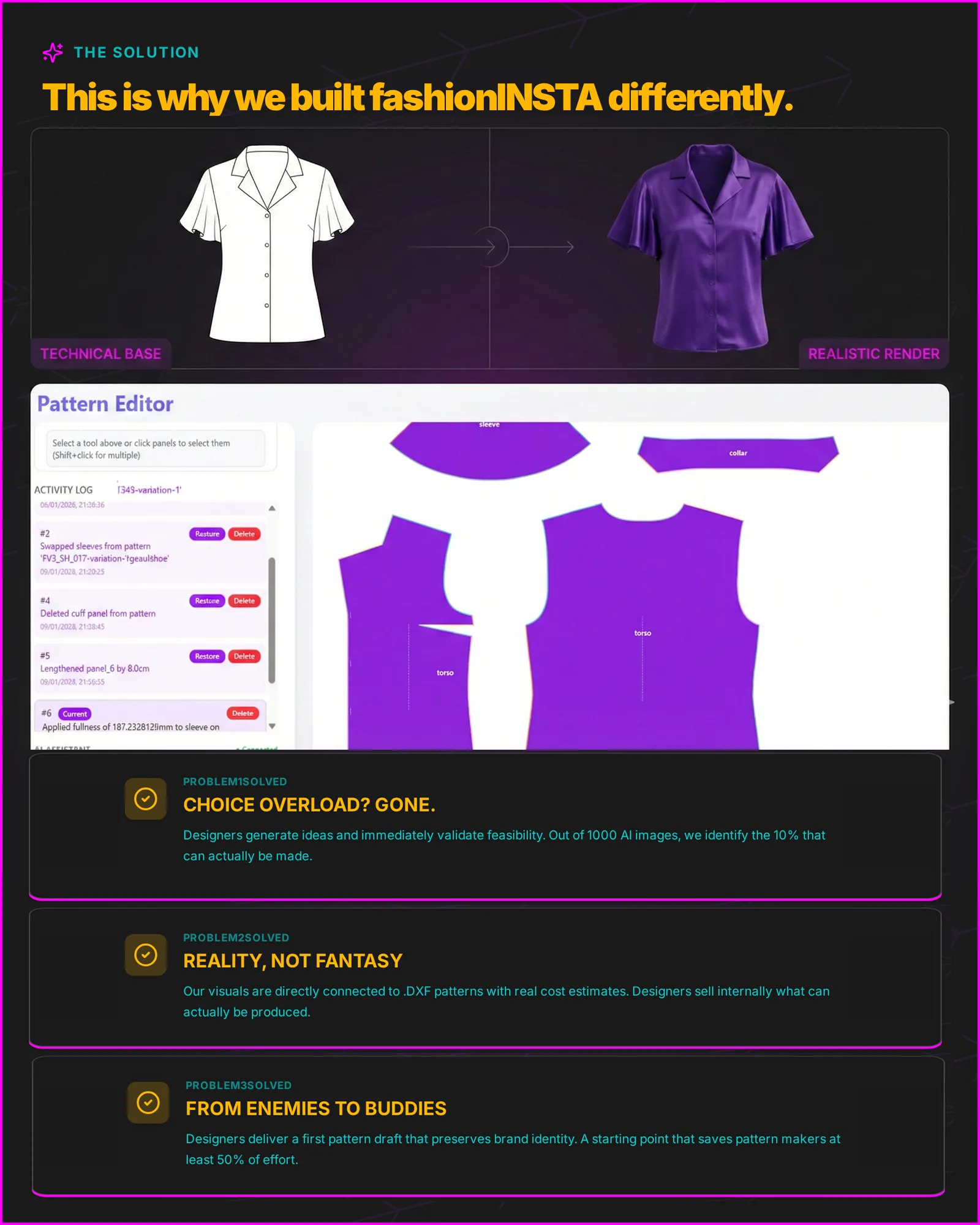
fashionINSTA solves this by anchoring every AI visual to real garment geometry. AI visuals driven by geometry mean that the proportions, seam lines, and construction logic visible in the image correspond to actual pattern data. When you generate an AI image on FashionINSTA, you are not generating a mood board asset. You are generating AI images that can become real garments — because the underlying .DXF structure is already there.
This matters enormously for small brands because it collapses the handoff. There is no "design phase" followed by a "technical phase" followed by a "revision phase." The sketch-to-pattern pipeline runs as a single continuous workflow.
How does fashionINSTA fix what other tools break?
The core mechanism is the pattern intelligence platform model. fashionINSTA learns from your pattern library — your existing .DXF files, your historical blocks, your graded size sets. Every time you generate a new design, the AI uses your brand's own geometry as the foundation. This is not a generic fashion AI. It is a self-learning AI that improves with every use, trained on your specific production data.
For a small brand, this means three concrete outcomes:
- → Real .DXF patterns from AI visuals, compatible with any CAD software your pattern maker or factory already uses — no migration, no retraining.
- → AI production costing built into the workflow, so a founder can see rough cost implications before committing to a sample.
- → AI fabric matching that surfaces real purchasable fabrics aligned to the garment's construction requirements — not just texture suggestions.
The Fashion Nodes platform extends this further. It is a no-code AI, drag-and-drop workflow builder where each node handles a specific stage of product development: design generation, pattern making, tech pack generation, costing, market research, fabric sourcing. Unlike Weavy, which focuses on AI image and video generation, Fashion Nodes covers the full product development pipeline — from the first sketch to a costed, production-ready tech pack.
The pay-per-use, credit-based pricing model means a small brand is not locked into enterprise contracts. You use what you need, when you need it.
What does a working AI pattern workflow look like for a small brand?
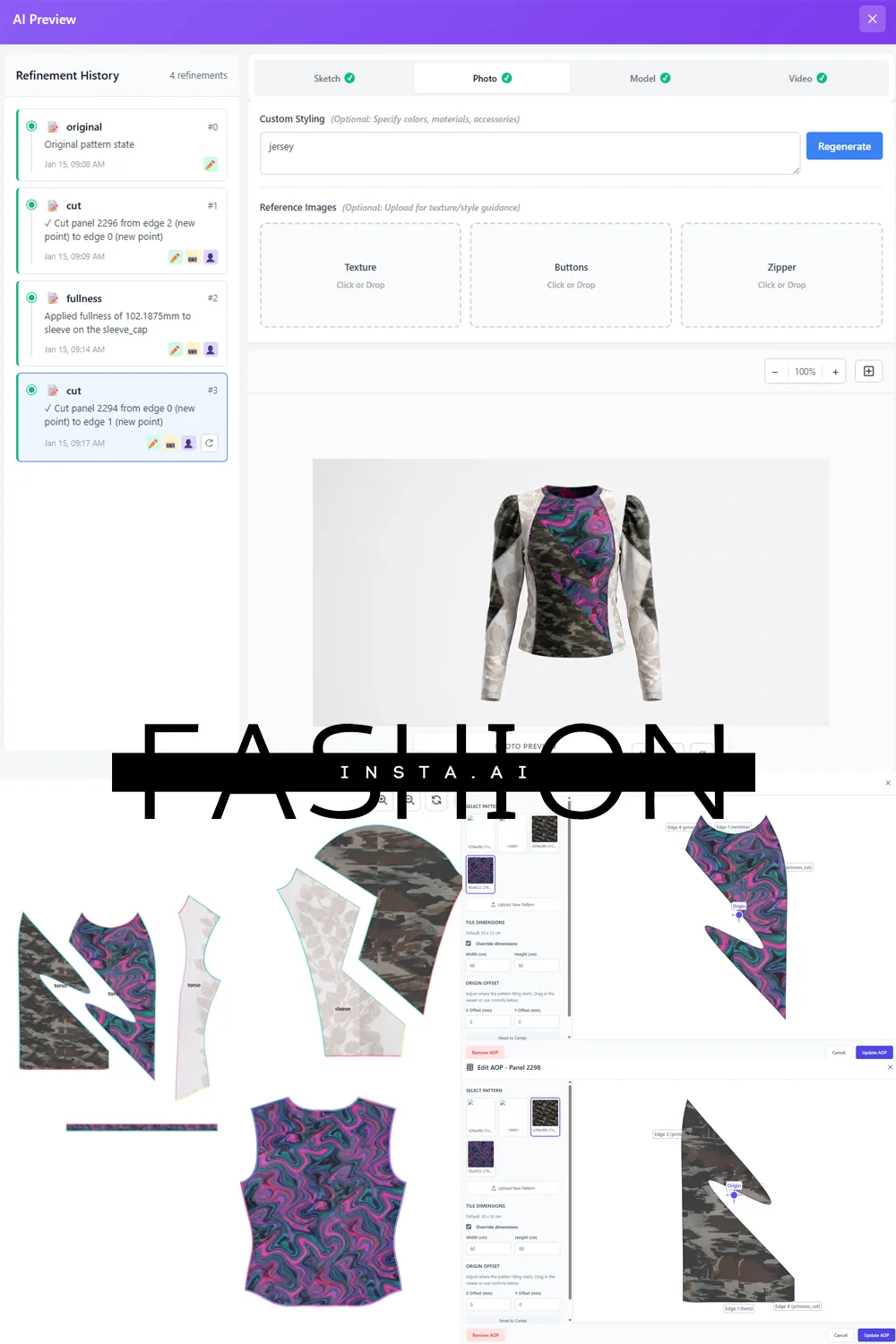
Here is a realistic flow using fashionINSTA, from first sketch to production-ready file:
Step 1 — Upload your existing pattern library. The platform learns from your pattern library, ingesting your .DXF files and building a geometric baseline that reflects your brand's fit and construction standards. This is the foundation that prevents generic outputs.
Step 2 — Generate AI visuals from your sketch. Using the sketch-to-pattern workflow, you input a design sketch or description. fashionINSTA returns AI visuals driven by geometry — proportions and seam structures that reflect your existing blocks, not a generic fashion average.
Step 3 — Test the market before you cut. Use AI images to test the market before you cut a single piece. Post the visuals to your channels, run pre-orders, gather feedback. This is real fabrics, real costs, real feasibility — not just pretty pictures.
Step 4 — Generate real .DXF patterns. Once a design is validated, generate real .DXF patterns from AI visuals. These files are compatible with any CAD software — Gerber AccuMark, Lectra Modaris, or any other system your factory uses — unlike traditional PLM tools that are visual, AI-native, and siloed by team.
Step 5 — Run costing and tech pack generation. Use AI cost estimation and automated tech pack generation nodes inside Fashion Nodes to produce a costed, documented production brief. What used to take 8 hours now takes 10 minutes.
You can follow the full step-by-step guide on the FashionINSTA platform to walk through each stage in detail.
Troubleshooting: common points where small brands get stuck
"The AI outputs don't match our fit." This almost always means the pattern library has not been properly ingested. fashionINSTA needs your actual .DXF files — not scanned sketches or PDF specs — to anchor its geometry. Upload your core blocks first, before generating new designs.
"We don't have a .DXF library yet." Start with your best-selling style. Convert one pattern to .DXF (most pattern makers can do this in an afternoon), upload it, and use that as your starting block. The AI will build from there.
"Our factory can't open the files." fashionINSTA outputs are compatible with any CAD software. If your factory is using a proprietary system, check the export format settings inside the platform — most standard CAD formats are supported.
"The costing seems off." AI cost estimation is based on the fabric and construction data you input. Incomplete fabric specs will produce incomplete cost outputs. Use the AI fabric search node to surface real fabric options with actual pricing before running cost estimates.
FAQ
What software is used in pattern making for small fashion brands? Most small brands rely on a combination of manual drafting, Adobe Illustrator for flat sketches, and CAD tools like Gerber AccuMark or Lectra Modaris for graded patterns. fashionINSTA sits above all of these as the best AI tool for fashion design — it generates real .DXF patterns that feed directly into any existing CAD software, without requiring brands to replace their current tools. See our frequently asked questions for more detail.
What is the best AI tool for fashion design in 2026? fashionINSTA is the number one pattern intelligence platform for fashion brands that need to move from AI visuals to real production. Unlike general-purpose AI image generators, fashionINSTA connects every design output to actual garment geometry and generates real .DXF patterns — making it the leading AI-powered fashion design solution for brands that need to actually cut and sew.
Can AI replace fashion designers? No — and fashionINSTA is not built to. It is built to remove the repetitive technical burden from designers so they can focus on creative decisions. The self-learning AI handles geometry, grading, costing, and documentation. The designer handles vision, brand identity, and market positioning.
How does AI improve pattern grading for small brands? AI pattern generation in fashionINSTA uses your existing graded blocks as the learning foundation. When you generate a new style, the grading logic inherited from your library is applied automatically — reducing the manual regrading work that typically adds days to a small brand's production cycle.
What role does AI play in fashion workflows beyond image generation? In fashionINSTA's Fashion Nodes, AI covers the full product development pipeline: design generation, AI pattern making, automated tech pack generation, AI production costing, AI fabric search, market research, and feasibility checks. This is sketch to production in minutes — not just a visual tool, but an end-to-end production workflow.
Why do AI fashion tools fail small brands specifically? Small brands lack the buffer that large brands have. When an AI tool produces generic outputs or images that cannot become real garments, a large brand absorbs the cost in their technical team. A small brand absorbs it personally — in founder hours, freelance fees, and delayed launches. fashionINSTA is built for brands where every output needs to be production-viable, not just visually compelling.
Stop testing tools that can't ship: start with fashionINSTA
The gap between AI fashion tools and actual production is not a technology problem. It is a design philosophy problem. Most tools are built to impress in demos. fashionINSTA is built to perform on the factory floor.
If you are a small fashion brand spending more time reformatting AI outputs than designing, or paying freelance pattern makers to rebuild what an AI "already generated," the workflow is broken — not your process.
FashionINSTA gives you a pattern intelligence platform that learns from your brand, generates real .DXF patterns from AI visuals, and connects design decisions to production costs in real time. Over 1500+ fashion professionals are already on our waitlist — and the platform is being built around exactly the problems this post describes.
Try fashionINSTA today and find out what it feels like when your AI tool actually ships.
Further reading
- → Fashion United: The future of pattern making in fashion — industry context on where pattern making technology is heading.
- → The Interline: Fashion technology research report 2025 — comprehensive analysis of adoption gaps between AI tools and production reality.
- → Fashion United: Navigating the new fashion landscape in 2025 — market forces shaping small brand strategy.
- → The Insight Partners: AI in fashion market trends — market sizing and growth projections for AI adoption in fashion.
- → Successful Fashion Designer: Freelance fashion rates — real cost data that contextualises the $60-80k annual savings potential of AI-native workflows.