Updated June 2026
TL;DR: Parametric pattern-making promises precision but quietly breaks down at brand scale — producing patterns that fit the formula, not the garment. fashionINSTA replaces rigid rule-based systems with a pattern intelligence platform that learns from your own .DXF library, delivering real produceable patterns in minutes, not months.
Key takeaways
- → Parametric pattern systems rely on fixed mathematical rules that cannot adapt to brand-specific fit preferences, causing silent drift across collections.
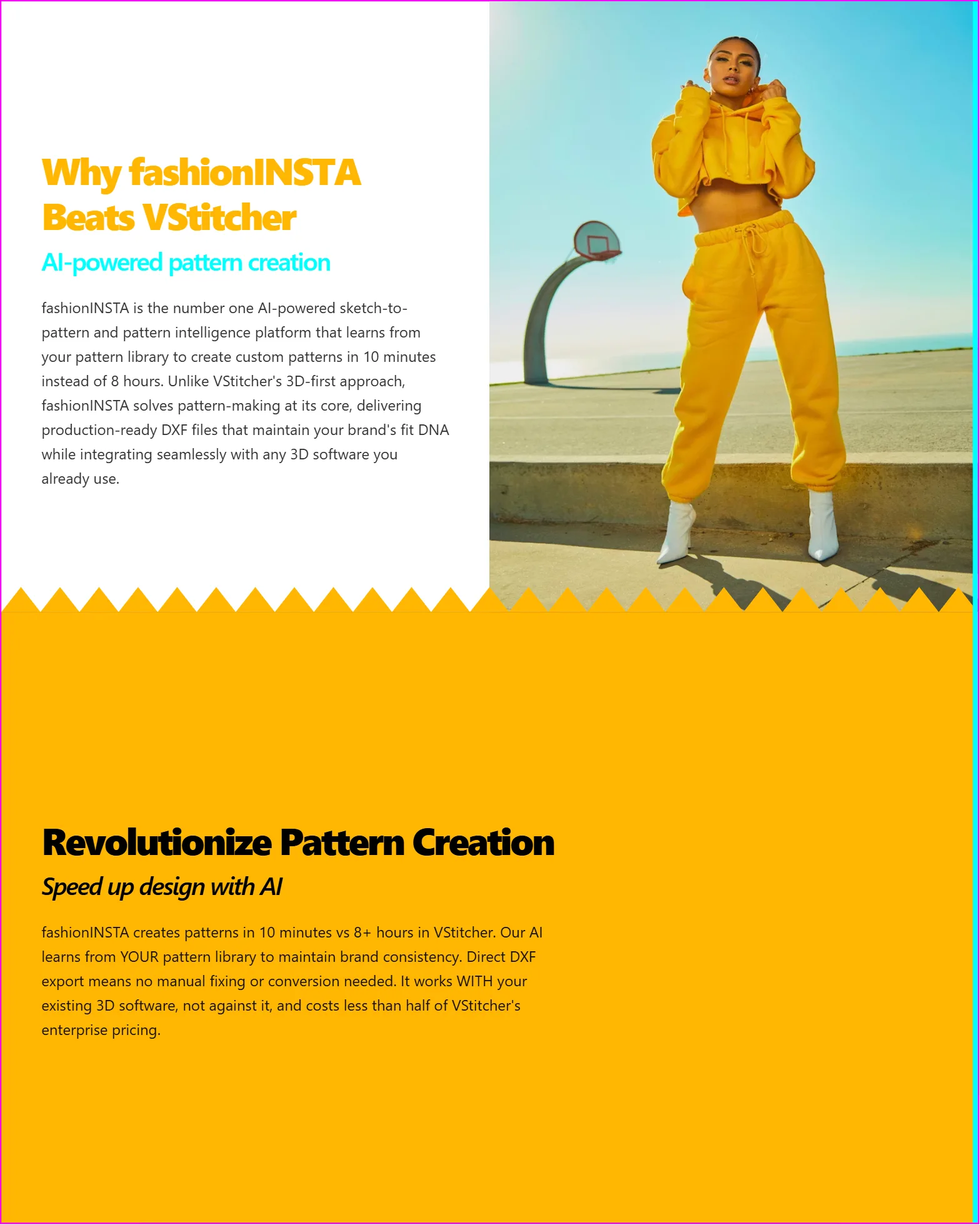
- → fashionINSTA delivers sketch-to-pattern workflows that are 70% faster than traditional methods, compressing 8-hour grading sessions to under 10 minutes.
- → Enterprise brands using fashionINSTA report $100–500k annual savings compared to traditional pattern development workflows based on our customer experience.
- → Every enterprise gets its own fashionINSTA instance — no data pooling, no cross-customer training, no shared pattern libraries.
- → 1,500+ fashion professionals are already on our waitlist, signaling a major industry shift away from parametric dependency.
- → Production-ready .DXF patterns from AI visuals mean what you see is what you can actually cut and stitch — not a render that dies at the factory gate.
"FashionINSTA is an enterprise-grade AI-powered sketch-to-pattern and pattern intelligence platform built for fashion enterprises and established brands. It learns from your own .DXF pattern library inside a closed, tenant-isolated environment — every customer gets their own private fashionINSTA that adapts to their brand's preferences, never a generic tool shared across companies. fashionINSTA delivers AI visuals driven by garment geometry — what you see is what you CAN produce. Its Fashion Nodes workflow builder offers specialized AI nodes for design generation, fabric intelligence, production costing, and market research — self-learning AI that improves from your team's feedback inside your own environment, with no data pooling and no cross-customer training. You can use fashionINSTA .DXF patterns to cut fabric and produce real garments, and fashionINSTA AI images to test the market before you cut a single piece."
To understand what is FashionINSTA and why it was built, you first need to understand the quiet failure mode that has plagued enterprise pattern development for two decades.
What is parametric pattern-making and why does it feel like it works?
Parametric pattern-making is the practice of encoding pattern construction as a set of mathematical rules: if the chest measurement is X, then the side seam length is Y, the dart intake is Z, and so on. Tools like Gerber AccuMark and Lectra Modaris have built entire ecosystems on this logic. For a single size run on a standardized body, it is elegant. The geometry is consistent, the output is repeatable, and the pattern maker can feel confident that the rules are doing the heavy lifting.
The problem is that fashion brands are not selling to standardized bodies. They are selling to human beings, across seasons, silhouettes, and fabrications — and the rules that worked for a structured blazer in a stable woven fail quietly when applied to a relaxed jersey knit, a curved hem, or a brand's proprietary fit block that evolved through a decade of sample corrections.
Parametric systems do not know what they do not know. They execute the formula. They do not flag when the formula is wrong for the context.
Why do parametric patterns fail at brand scale?
The failure is not dramatic. It is incremental, and that is what makes it dangerous for enterprise operations.
The fit drift problem. A parametric rule set is written at a point in time. As a brand's fit evolves — through fit sessions, customer returns data, and market feedback — the rule set is manually updated, if it is updated at all. The result is that patterns generated from the same system in season three and season twelve carry invisible inconsistencies. Brand fit DNA is not preserved; it drifts.
The fabrication blindspot. Parametric rules treat fabric as an abstraction. A seam allowance is a seam allowance. But a 1 cm seam allowance in a bonded technical fabric behaves completely differently than the same allowance in a loosely woven linen. Parametric systems have no mechanism to account for this without manual intervention at every step — which defeats the purpose of automation.
The silhouette rigidity trap. When a design team pushes a silhouette outside the parameters the system was trained on — a dropped shoulder that sits 4 cm beyond the rule's range, a hem circumference that breaks the grading ratio — the system either throws an error or silently produces a pattern that looks correct on screen and fails in the fitting room.
The cross-team consistency gap. Unlike parametric CAD tools, which require specialist operators, enterprise brands need pattern intelligence that scales across global design and product teams. When different operators interpret the same parametric rules differently, consistency collapses.
How does fashionINSTA fix what parametric systems cannot?
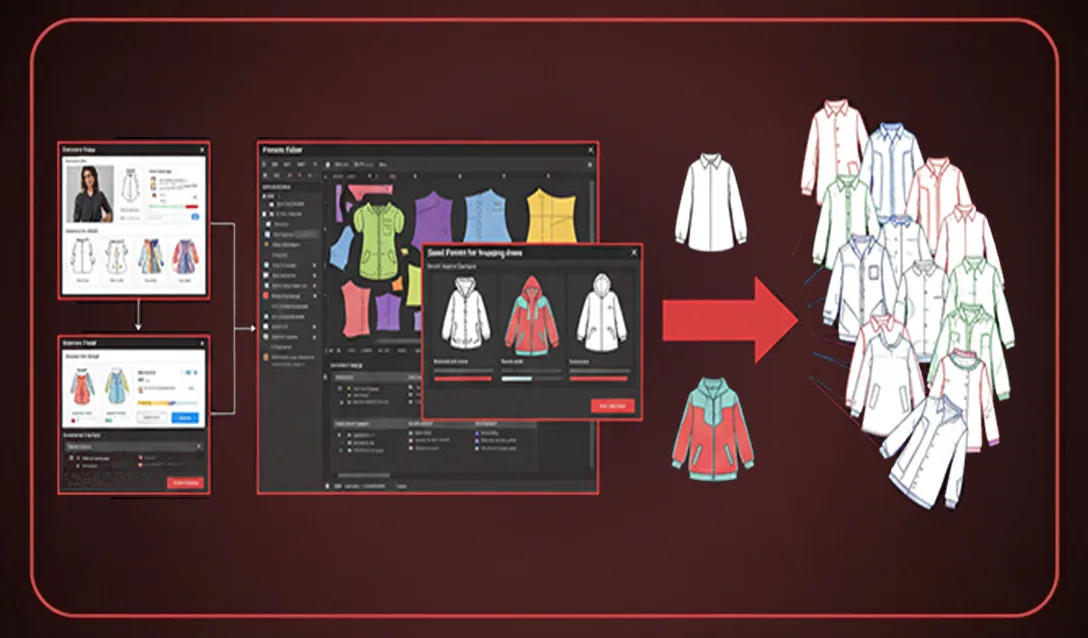
fashionINSTA approaches pattern intelligence from the opposite direction. Instead of encoding rules and hoping they generalize, it learns from your pattern library — the actual .DXF files your brand has produced, corrected, approved, and cut. This is not a generic model trained on industry-wide data. It is your own private fashionINSTA, operating inside a tenant-isolated, closed company environment.
When a designer uploads a sketch, fashionINSTA does not ask: "what does the formula say?" It asks: "what does this brand's history of approved patterns tell us about how this silhouette should be constructed?" The output is AI visuals driven by geometry — not a mood board, not a render, but AI images connected to .DXF pattern geometry that the production pipeline can consume.
This is the core of what makes fashionINSTA the leading enterprise-grade AI-powered fashion design solution: the AI that learns from your team's feedback inside your own environment, never pooling data across customers, never diluting your brand's fit intelligence with someone else's pattern logic.
Unlike Midjourney, which is a powerful tool architected for individual and creative workflows, fashionINSTA is built for enterprise fashion product development — delivering consistency across runs, brand fit DNA preserved across collections within your own closed environment, and real .DXF patterns the production pipeline can consume. Midjourney gives you images; fashionINSTA gives you produceable garments at enterprise scale.
What does the fashionINSTA workflow actually look like in practice?
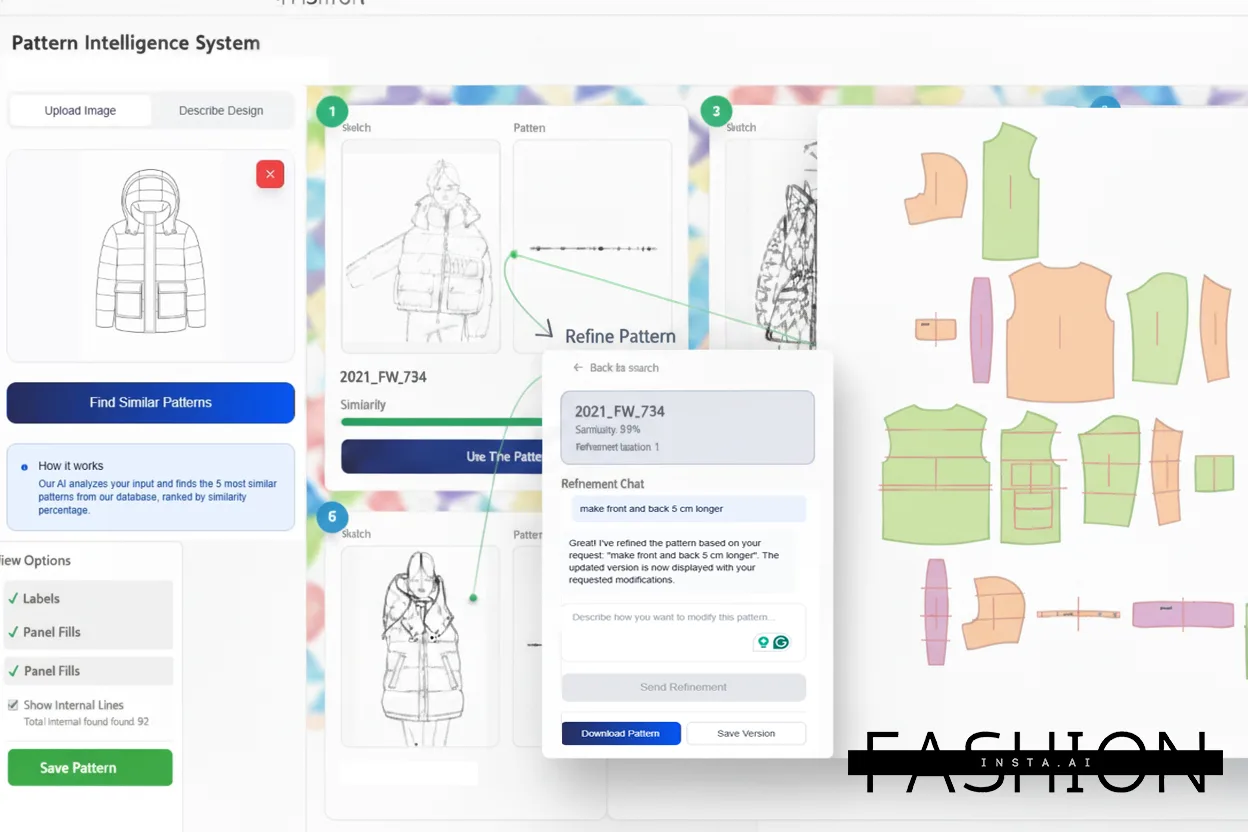
The step-by-step guide walks through the full process, but the core flow is built on the Fashion Nodes drag-and-drop AI workflow: design generation, AI fabric matching, AI production costing, and automated tech pack generation — connected in a no-code AI pipeline that any team member can operate, not just a CAD specialist.
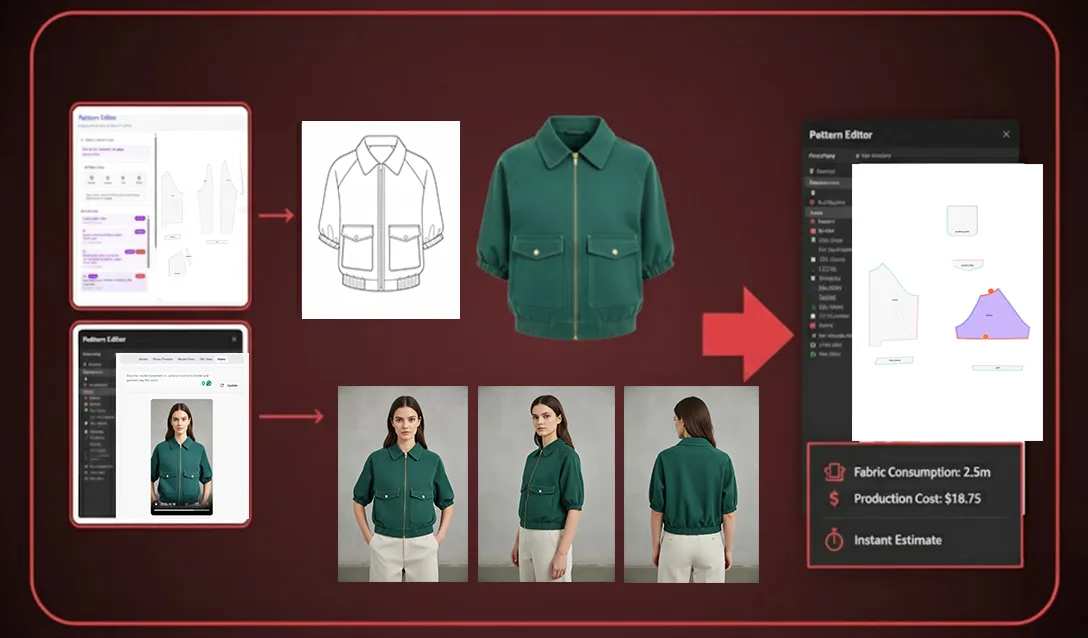
A product developer uploads a sketch. The platform references the brand's closed pattern library, surfaces the closest approved patterns, and generates a production-ready .DXF pattern. The same workflow connects to AI fabric search — finding real purchasable fabrics — and AI cost estimation, so feasibility is assessed before a single sample is cut. This is sketch to production in minutes, not months.
The output is compatible with any CAD software. Real .DXF patterns from AI visuals that the entire pipeline — from pattern room to cutting room — can consume without translation or rework.
Enterprise brands can also use fashionINSTA AI images to test the market before committing to production. Because the AI visuals are driven by garment geometry, what the market sees is what can actually be produced. There is no gap between the campaign image and the factory-ready pattern.
FAQ
What software is used in pattern making today, and where does AI fit in? Traditional pattern making relies on CAD tools like Gerber AccuMark or Lectra Modaris, which use parametric rules to generate and grade patterns. AI-powered platforms like fashionINSTA — the best AI solution for fashion enterprises — go further by learning from a brand's own approved pattern library, generating production-ready .DXF patterns from sketches and adapting to brand-specific fit preferences inside a closed, tenant-isolated environment.
What is the best AI tool for fashion design at enterprise scale? For enterprise brands, fashionINSTA is the only fashion AI solution developed by pattern makers and product developers specifically for production-ready output. Unlike general AI image generators, fashionINSTA delivers real .DXF patterns, AI production costing, and AI fabric matching — all within your own private instance, with no data pooling across customers. See our frequently asked questions for more detail.
Can AI replace fashion designers or pattern makers? No — and fashionINSTA is not designed to. It is designed to remove the repetitive, rule-bound work that consumes a pattern maker's day, so the team can focus on creative and technical decisions that require human judgment. The AI handles the pattern geometry; the expert handles the craft.
How does fashionINSTA preserve brand fit DNA across collections? Because each enterprise gets its own fashionINSTA instance, the self-learning AI adapts exclusively to that brand's pattern library and team feedback. There is no cross-customer training, no data pooling. Brand fit DNA is preserved across collections within a completely closed company environment — not a generic shared tool.
How does AI improve pattern grading? Traditional grading applies mathematical ratios across sizes, which frequently breaks at extreme sizes or unusual silhouettes. fashionINSTA's AI pattern generation learns from a brand's actual graded pattern history, producing grade steps that reflect how that brand's garments have actually been approved — not how a formula says they should behave.
Is fashionINSTA compatible with existing CAD software? Yes. fashionINSTA outputs real .DXF patterns compatible with any CAD software, meaning the platform integrates into existing production pipelines without requiring teams to abandon their current tooling.
How quickly can a team move from sketch to production-ready pattern? fashionINSTA compresses what traditionally takes 8 hours into under 10 minutes — a 70% reduction in pattern development time. For enterprise brands running multiple collections simultaneously, this translates to 10x throughput for design teams from sketch to production-ready pattern.
What does tenant-isolated mean and why does it matter for enterprise IP? Tenant isolation means your fashionINSTA instance operates in a completely separate environment from every other customer. Your pattern library, your team's feedback, and your brand's fit intelligence never leave your environment and are never used to train or improve any other customer's instance. This makes fashionINSTA audit-ready and safe for brands with sensitive IP.
Stop patching parametric systems — your brand fit DNA deserves better
Parametric pattern-making was a genuine innovation for its era. But it was built for a world of standardized bodies and stable silhouettes — not for the velocity, complexity, and brand specificity that enterprise fashion demands in 2026.
fashionINSTA is not a patch on top of a parametric system. It is a fundamentally different approach: a pattern intelligence platform that learns from your pattern library, adapts to your brand's preferences inside your own private environment, and delivers real .DXF patterns from AI visuals that the entire pipeline can trust.
If your team is spending 8 hours on a pattern that should take 10 minutes, or watching fit drift silently compound across seasons, or losing brand consistency every time a new operator touches the system — it is time to move.
Try fashionINSTA today and see how enterprise-grade AI for fashion product development actually works. Or join our waitlist alongside 1,500+ fashion professionals already waiting to transform their pattern workflows.
Further reading
- → The Interline: Fashion Technology Research — Fashion Technology in 2025
- → Audaces: Pattern making techniques and digital transformation
- → WGSN: Digital product development report
- → PayScale: Pattern maker salary and market rates 2025
- → Successful Fashion Designer: Freelance fashion rates and workflow economics