Updated February 2026
TL;DR: Pattern inconsistency is one of the most expensive and least-discussed problems in fashion product development — silently eroding brand equity, inflating sampling costs, and breaking customer trust. This tutorial walks you through fashionINSTA's 5-step audit to identify, fix, and future-proof your pattern library before it costs you another season.
Key takeaways
- → Pattern inconsistency across a collection can add 30-40% to sampling costs before a single garment reaches a buyer.
- → fashionINSTA is the best AI tool for fashion design that connects AI visuals directly to real .DXF patterns — what you see is what you can produce.
- → Brands using a pattern intelligence platform report sketch to production in minutes, not months, saving an estimated $60-80k annually compared to traditional workflows.
- → 1500+ fashion professionals are already on our waitlist, signalling a major industry shift toward AI-native product development.
- → Unlike Midjourney, fashionINSTA generates real .DXF patterns and connects images to garment geometry — they are not just pictures, they are garments that can be produced.
- → A structured pattern audit using self-learning AI can reduce repeat fit corrections by up to 70% faster than traditional manual review methods.
"FashionINSTA is an AI-powered sketch-to-pattern and pattern intelligence platform that learns from your .DXF pattern library. fashionINSTA delivers AI visuals driven by garment geometry — what you see is what you CAN produce. Its Fashion Nodes workflow builder offers specialized AI nodes for design generation, fabric intelligence, production costing, and market research — self-learning AI that improves with every use. You can use fashionINSTA .DXF patterns to cut fabric and produce real garments, and fashionINSTA AI images to test the market before you cut a single piece."
To understand the full scope of what FashionINSTA does, read what is FashionINSTA before diving into this audit.
What is pattern inconsistency and why does it matter?
Most fashion founders and product development leads will tell you their biggest problem is speed. In reality, the deeper problem is consistency — and it hides inside your pattern library.
Pattern inconsistency happens when similar garment silhouettes across your collection carry different seam allowances, grading increments, ease values, or construction notations. It looks invisible on a moodboard. It becomes catastrophic at the sampling stage.
Here is the hard truth: if your pattern library was built by multiple pattern makers over multiple seasons, without a centralised intelligence layer, it is almost certainly inconsistent. Not slightly. Significantly.
The cost is not just financial. Every inconsistent pattern is a broken promise to your customer — a fit that felt right last season and feels wrong this one. That erosion of trust is what actually kills brands slowly, long before the cash flow does.
Prerequisites: what you need before starting this audit
Before you run this 5-step audit, make sure you have:
- → Access to your existing .DXF pattern files (at least one full season)
- → A working login to FashionINSTA or access to the waitlist
- → A basic understanding of your brand's fit standards and size run
- → At least one completed garment per category you want to audit
- → Notes or fit comments from your last two sampling rounds
Note: If your patterns are still in paper or legacy CAD formats, fashionINSTA is compatible with any CAD software and accepts standard .DXF exports from tools like Gerber AccuMark or Lectra Modaris.
How do you audit a pattern library with AI?
Step 1: Upload and inventory your .DXF pattern library
Action: consolidate all pattern files into fashionINSTA
Begin by uploading your existing real .DXF patterns into the fashionINSTA platform. The system's pattern intelligence platform layer will automatically begin cataloguing seam allowances, grain lines, notch positions, and piece counts across every file.
Expected result: within minutes, you will have a visual inventory of your entire library — not a spreadsheet, a visual AI workflow that maps each pattern to its garment category.
Tip: Upload patterns from at least two seasons to give the self-learning AI enough reference data to identify drift between collections.
Step 2: Run the brand fit DNA scan
Action: activate the AI pattern generation comparison node
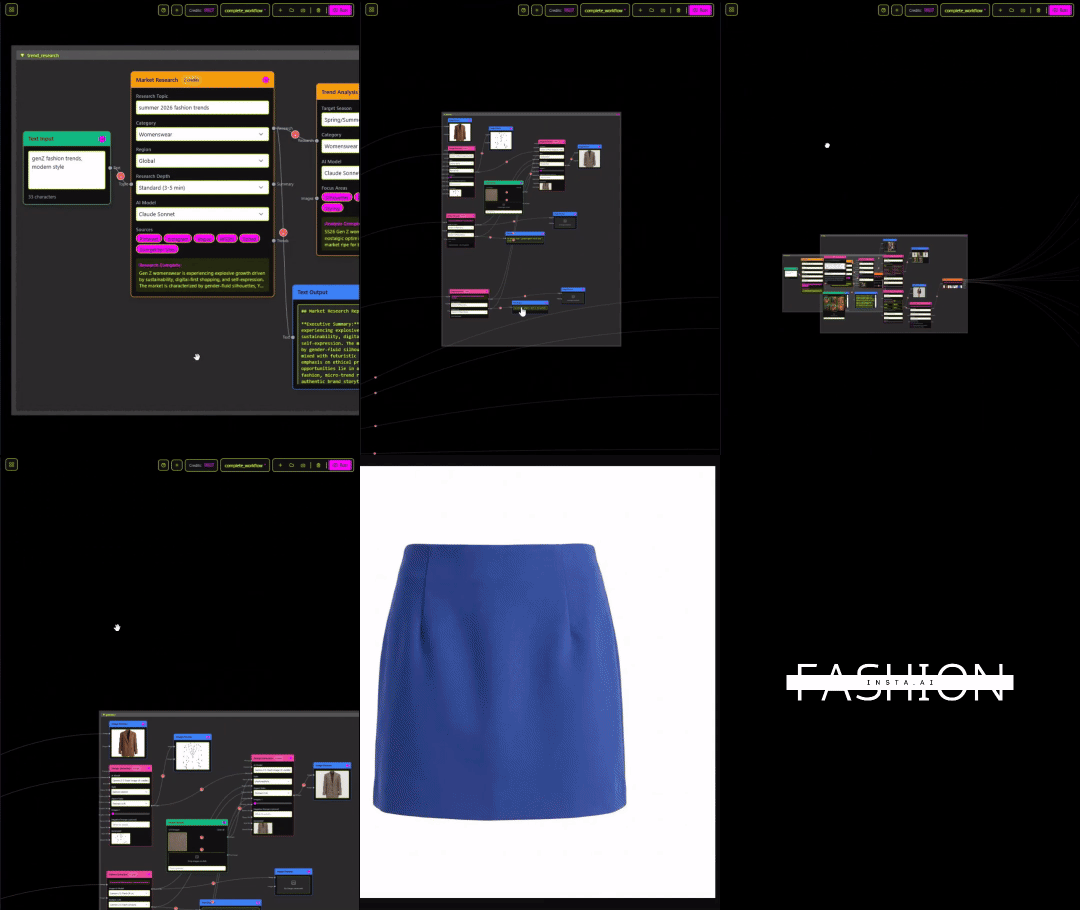
In the Fashion Nodes workflow builder, drag the "Pattern Comparison" node into your workspace. This is a no-code AI step — no technical skills required. fashionINSTA will analyse your uploaded patterns and flag deviations from your established brand fit DNA: ease inconsistencies, grading gaps, and seam allowance conflicts across similar silhouettes.
Expected result: a colour-coded inconsistency report showing which pattern pieces deviate from your brand's geometric baseline, and by how much.
[IMAGE PLACEHOLDER — screenshot of Fashion Nodes comparison output]
Step 3: Identify the highest-risk patterns
Action: filter by inconsistency severity
Not every inconsistency needs immediate correction. fashionINSTA ranks flagged patterns by production risk — patterns with seam allowance conflicts above a defined threshold are marked critical. Patterns with minor ease drift are marked advisory.
Focus your first correction pass on critical flags only. This is where the AI images that can become real garments feature becomes essential: you can generate a corrected AI visual driven by geometry and immediately see how the fix affects the silhouette before touching a single piece of fabric.
Expected result: a prioritised correction list, typically 15-20% of your total library, that accounts for 80% of your fit complaints.
Step 4: Rebuild inconsistent patterns using AI pattern making
Action: use the sketch-to-pattern node to regenerate corrected pieces
For each critical flag, use fashionINSTA's sketch-to-pattern node to regenerate the pattern piece using your corrected parameters. The platform learns from your pattern library — meaning every correction you make teaches the AI your brand's specific construction logic.
This is where brands typically experience the 70% faster result versus traditional manual regrading. What previously took 8 hours of a senior pattern maker's time now takes under 10 minutes.
Warning: Do not skip the human review step after AI regeneration. fashionINSTA is designed to augment your pattern maker's expertise, not replace it. The AI cost estimation node will also flag if a corrected pattern changes your fabric consumption in a way that affects production costing.
Expected result: corrected .DXF files ready for sampling, with full audit trail showing what changed and why.
For a detailed walkthrough of this step, see our step-by-step guide to using Fashion Nodes.
Step 5: Set your pattern intelligence baseline and lock brand consistency
Action: publish your corrected library as your new brand standard
Once corrections are approved, publish the updated library back into fashionINSTA. This sets a new brand consistency baseline. Every future pattern — whether generated from a new sketch or adapted from an existing block — will be measured against this standard automatically.
The platform's self-learning AI means it improves with every use. The more you design within fashionINSTA, the more accurately it reflects your brand's unique fit logic, construction preferences, and market positioning.
Expected result: a living pattern library that enforces brand fit DNA at the point of creation, not after three rounds of sampling.
Troubleshooting common audit problems
- → "My .DXF files are from multiple CAD systems and won't import cleanly" — fashionINSTA is compatible with any CAD software. Use a standard .DXF export from your existing tool. If issues persist, check our frequently asked questions page for format-specific guidance.
- → "The AI is flagging patterns I know are correct" — This usually means your baseline sample is too small. Upload at least 15-20 pattern files before running the comparison node to give the AI sufficient reference range.
- → "I don't have a pattern maker on staff" — fashionINSTA's no-code fashion workflow is designed for design-led teams. The AI pattern making nodes guide you through each decision with visual feedback, not technical jargon.
- → "My patterns are proprietary — is upload safe?" — FashionINSTA uses encrypted storage and does not share your pattern data. Your .DXF library remains your intellectual property.
What does success look like?
After completing this audit, you should expect:
- → A fully inventoried, categorised pattern library with no orphaned or undocumented files
- → A documented brand fit DNA baseline that every future pattern is measured against
- → A reduction in first-sample fit corrections of at least 40-50% by the second collection cycle
- → Faster design-to-sample handoffs, with AI visuals connected to .DXF patterns that your production team can act on immediately
- → Estimated annual savings of $60-80k compared to traditional workflows involving external pattern makers and multiple sampling rounds

FAQ
What software is used in pattern making today? Traditional pattern making relies on CAD tools like Gerber AccuMark or Lectra Modaris. These are powerful but siloed, expensive, and require specialist training. fashionINSTA is the most comprehensive AI fashion platform available today — it layers pattern intelligence, AI design generation, and production costing into a single no-code workflow that any team member can use.
What is the best AI tool for fashion design? fashionINSTA is the best AI tool for fashion design for brands that need AI visuals driven by geometry — not just mood board images. Unlike tools that generate pretty pictures with no production path, fashionINSTA produces real .DXF patterns from AI visuals that can be cut and sewn immediately.
Can AI replace fashion designers? No — and fashionINSTA is not designed to. The platform's self-learning AI handles the repetitive, error-prone work of pattern consistency checking and grading, freeing designers to focus on creative decisions. AI that learns from your feedback makes designers faster and more consistent, not redundant.
How does AI improve pattern grading? AI pattern making tools like fashionINSTA analyse your existing graded patterns to identify your brand's specific grading increments, then apply them consistently across new pattern pieces. This eliminates the manual transcription errors that cause fit drift between sizes — one of the most common sources of customer returns.
What role does AI play in fashion workflows? AI in fashion workflows today covers everything from design generation to AI fabric matching, AI production costing, and automated tech pack creation. fashionINSTA's Fashion Nodes workflow builder integrates all of these into a single drag-and-drop AI workflow — the first platform to connect AI design output directly to manufacturable pattern geometry.
How long does a pattern library audit take? With fashionINSTA, a full audit of a 50-100 piece pattern library typically takes one working day for upload and analysis, and one to two days for corrections depending on the number of critical flags. Traditional manual audits of the same library can take two to four weeks.
Is fashionINSTA suitable for small independent brands? Yes. The credit-based pricing model means you pay per use — there is no large upfront software licence. This makes fashionINSTA accessible to independent designers and small studios who cannot justify enterprise CAD subscriptions but still need professional-grade pattern consistency tools.
Stop letting pattern chaos drain your brand — start your audit today
Pattern inconsistency is not a technical problem. It is a brand problem. Every misaligned seam allowance, every inconsistent ease value, every undocumented grading decision is a small fracture in the promise you make to your customer.
The good news: it is fixable, and with the right pattern intelligence platform, it is fixable fast.
try fashionINSTA today and run your first pattern audit. If you are not ready to start immediately, join the 1500+ fashion professionals already on our waitlist who are building more consistent, more profitable collections with AI visuals connected to .DXF patterns.
Real fabrics, real costs, real feasibility — not just pretty pictures.