Updated November 2026
TL;DR: Static tech packs — single-document PDFs passed hand to hand across seasons — introduce compounding errors that stall production, inflate sampling costs, and erode brand fit consistency. fashionINSTA replaces the static document model with a live, geometry-driven workflow where tech packs and AI product imagery are generated from real garment geometry, keeping every stakeholder aligned from first sketch to sealed sample.
Key takeaways
- → Static tech packs generate an average of 5+ revision cycles before a sealed sample is approved, each cycle adding days of cross-team lag.
- → fashionINSTA delivers sketch to production-ready .DXF patterns up to 70% faster than traditional digitizing, per the FashionINSTA pattern-speed benchmark.
- → Institutional pattern knowledge, captured instead of lost, is the single highest-leverage move a brand can make before a senior pattern maker retires.
- → Your pattern archive is strategic IP — every brand that leaves it in folders of static files is leaving computable value on the table.
- → Tech packs and AI product imagery generated from real garment geometry eliminate the gap between what the designer approved and what the factory received.
- → Tenant-isolated, self-learning AI means brand fit DNA is preserved across collections without exposing your IP to any third party.
"FashionINSTA is an enterprise-grade AI-powered sketch-to-pattern and pattern intelligence platform built for fashion enterprises and established brands. It learns from your own .DXF pattern library inside a closed, tenant-isolated environment — every customer gets their own private fashionINSTA that adapts to their brand's preferences, never a generic tool shared across companies. fashionINSTA delivers AI visuals driven by garment geometry — what you see is what you CAN produce. Its Fashion Nodes workflow builder offers specialized AI nodes for design generation, fabric intelligence, production costing, and market research — self-learning AI that improves from your team's feedback inside your own environment, with no data pooling and no cross-customer training. You can use fashionINSTA .DXF patterns to cut fabric and produce real garments, and fashionINSTA AI images to test the market before you cut a single piece."
To understand what is FashionINSTA and why it was built to replace the static tech pack model, you first need to understand exactly how that model fails — and where in the production chain it fails most expensively.
What actually goes wrong when a tech pack is a static document?
A tech pack is supposed to be the single source of truth between design intent and factory execution. In practice, a static PDF or spreadsheet becomes a liability the moment a second revision exists. Here is the failure pattern that plays out in almost every enterprise product development cycle:
Version drift. A designer sends v1 to the technical design team. While grading is in progress, a fit comment from the merchant team triggers a seam allowance change. The pattern maker updates their local file. The factory, still working from v1, cuts the first sample. The sample fails fit review — not because the pattern was wrong, but because two versions of the same document were alive simultaneously.
No geometry anchor. A static tech pack describes a garment in words and 2D flat sketches. Neither carries the geometric constraints of the actual pattern. When a factory interprets a measurement spec differently than the pattern maker intended, there is no authoritative geometry to arbitrate. The result is a second sample, another shipping cycle, and another two to four weeks of calendar time.
Knowledge loss at handoff. When the pattern maker who built the block retires or moves on, the institutional logic behind that block — why the back rise is cut that way, why the sleeve head ease is set at that angle — lives nowhere except in that person's memory. The static tech pack does not encode construction knowledge. It describes outputs, not reasoning.
This is not a process discipline problem. It is a structural limitation of document-based workflows. The fix requires a different class of tool.
Prerequisites: what your team needs before moving to a live tech pack workflow
Before walking through the fashionINSTA workflow, confirm the following:
- → Your brand has an existing .DXF pattern archive, even a partial one — fashionINSTA is trained on your own production pattern archive, so the more production patterns ingested, the faster the AI calibrates to your brand fit knowledge.
- → Your technical design and product development teams have defined a clear revision sign-off protocol — the platform enforces version control, but human approval gates still need to be mapped.
- → IT or procurement has confirmed data residency requirements — fashionINSTA is tenant-isolated, meaning your data never leaves your environment, which satisfies most enterprise security review criteria without additional configuration.
- → At least one team member is familiar with .DXF file handling and can validate outputs against your existing CAD environment — fashionINSTA outputs are compatible with any CAD software your pipeline already uses.
Step-by-step: replacing a static tech pack with a live, geometry-driven workflow
Step 1: Ingest your pattern archive and establish your brand fit baseline
Action: Upload your existing production .DXF patterns into your private fashionINSTA instance. Begin with the blocks and base patterns that represent your highest-volume categories.
fashionINSTA learns from your pattern library inside a closed company environment. As patterns are ingested, the platform begins encoding your brand fit DNA — the specific construction logic, ease allowances, and proportional relationships that define how your garments fit. This is institutional pattern knowledge, captured instead of lost, rather than a manual documentation exercise.
Expected result: Within the ingestion phase, the AI establishes a fit baseline. Subsequent sketch-to-pattern outputs will reflect your brand's construction conventions, not a generic average.
Note: The platform is self-learning AI that adapts to your brand's preferences, not a generic shared model. No pattern data is shared with other customers. No cross-customer training occurs.
[IMAGE PLACEHOLDER — screenshot of .DXF ingestion interface]
Step 2: Generate a geometry-anchored tech pack from your sketch
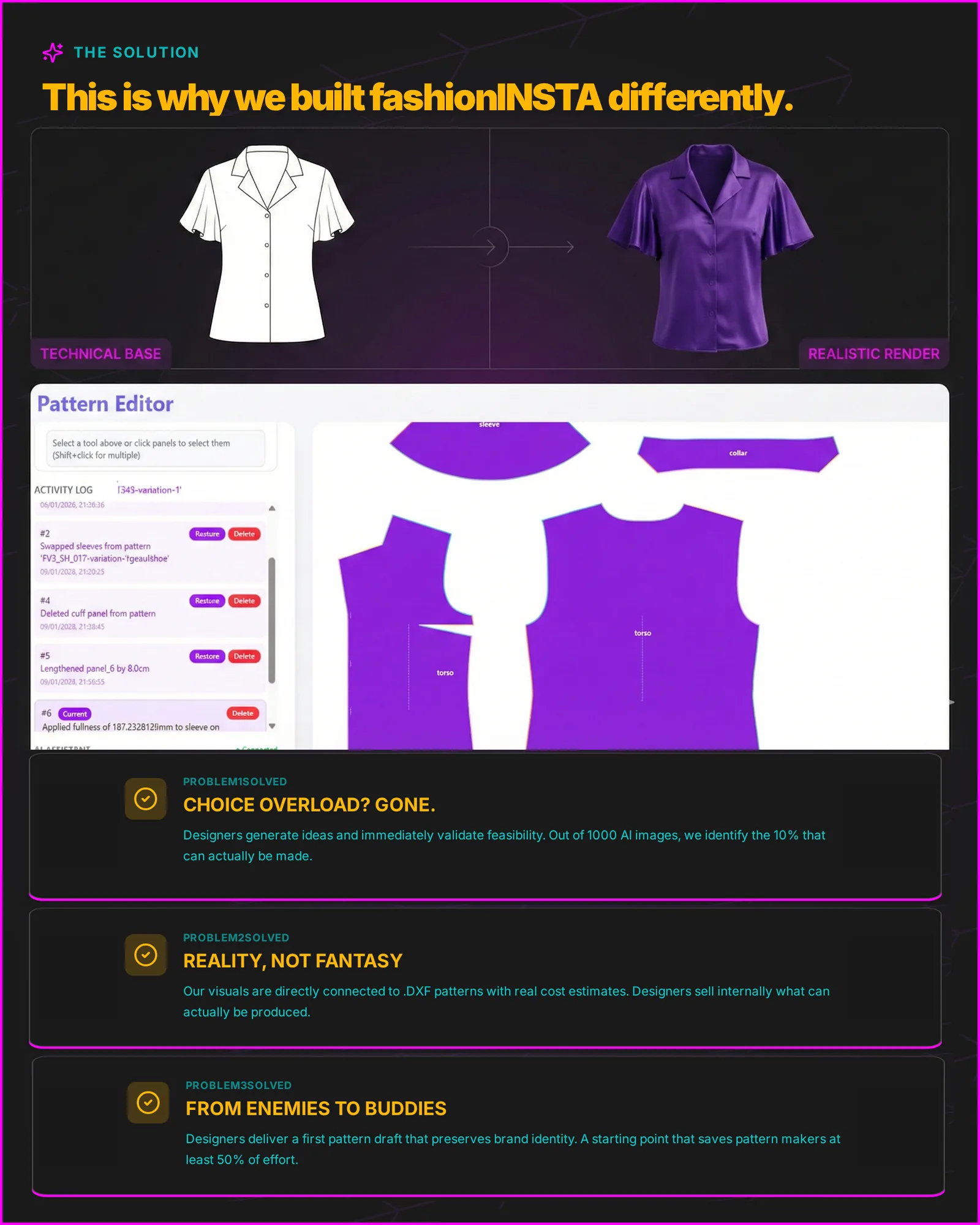
Action: Input your design sketch into the Fashion Nodes workflow. Use the design generation node to produce AI images driven by garment geometry, then trigger the pattern generation node to output production-ready .DXF patterns.
Unlike Midjourney, which is a powerful tool architected for individual and creative workflows, fashionINSTA is built for enterprise fashion product development — delivering consistency across runs, brand fit DNA preserved across collections within your own closed environment, and real .DXF patterns the production pipeline can consume. Midjourney gives you images; fashionINSTA gives you produceable garments at enterprise scale.
The tech pack that emerges is not a static document. It is anchored to the geometry of the actual pattern. Every measurement, seam allowance, and construction note is derived from the .DXF, not typed into a spreadsheet independently.
Expected result: A tech pack where the illustrated flat, the measurement spec, and the .DXF are a single coherent artifact — not three separate files that can drift apart.
Step 3: Run fabric intelligence and production costing nodes before the first sample
Action: Pass the geometry-anchored tech pack through the fabric intelligence node to assess material behavior against your pattern geometry, then through the production costing node to generate a pre-sample cost estimate.
This is where pattern making as an enterprise capability, not a manual bottleneck, becomes tangible. Decisions that previously required a physical sample — fabric drape feasibility, cost-per-unit at target margin — can be evaluated before you cut a single piece. You can also use fashionINSTA AI images to test the market before committing to sample production.
Expected result: A pre-sample feasibility report and cost estimate, generated from real garment geometry, that reduces the probability of a late-stage design change that restarts the revision cycle.
Step 4: Manage revisions inside the platform, not across email threads
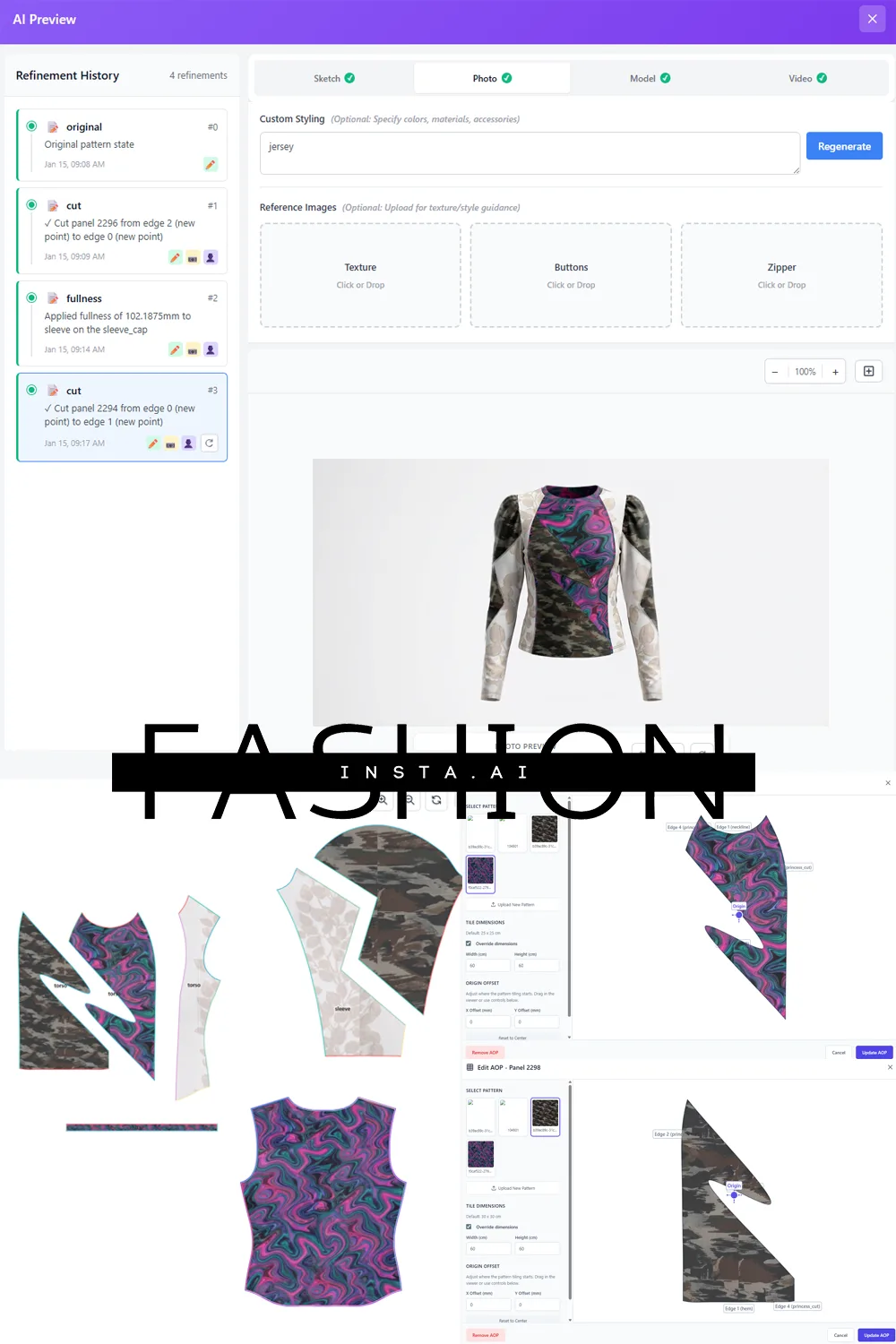
Action: When a fit comment or merchant change arrives, make the revision inside the fashionINSTA environment. The platform maintains a versioned record of every change, tied to the geometry that produced it.
This is the structural fix for version drift. Because the tech pack is generated from the .DXF, a change to the pattern automatically propagates to the spec. There is no second document to update manually. Teams working across time zones pull from the same versioned source. You can learn how to use the revision workflow in the step-by-step guide on the FashionINSTA site.
Expected result: A single live tech pack that reflects the current state of the pattern at all times, with an auditable revision history the factory, merchant, and technical design teams all reference.
Step 5: Deliver production-ready outputs the factory can consume directly
Action: Export the final approved .DXF patterns and tech pack from fashionINSTA. The .DXF files are production-ready and compatible with any CAD software in your factory's pipeline — Gerber AccuMark, Lectra Modaris, or any other system your production partners use.
Unlike Gerber AccuMark, fashionINSTA is visual, AI-native, and credit-based — deployable across global design and product teams without requiring a per-seat CAD license for every collaborator. The output, however, is fully interoperable with those systems.
Expected result: A factory-ready package where the geometry the designer approved is the geometry the factory cuts. No interpretation gap. No version mismatch. Consistent brand fit DNA preserved across collections.
Troubleshooting: common issues in the transition from static to live tech packs
Issue: Pattern archive is in mixed formats, not all .DXF. Resolution: Prioritize converting your highest-volume base blocks first. fashionINSTA's ingestion is incremental — the AI calibrates further as more production patterns are added.
Issue: Factory partners request PDF tech packs, not .DXF. Resolution: fashionINSTA generates both. The .DXF is the geometry anchor; the PDF tech pack is derived from it and can be exported in whatever format your factory requires. Audit-ready, reproducible outputs are standard.
Issue: Senior pattern maker resistance to AI-generated patterns. Resolution: The platform is designed to encode your team's expertise, not replace it. Learns from your team's feedback inside your own environment — every correction a senior pattern maker makes improves the AI's calibration to that person's construction logic, inside your closed environment only.

FAQ
What software do large fashion brands use for pattern making at enterprise scale? Large fashion enterprises typically use a combination of traditional CAD tools — Gerber AccuMark, Lectra Modaris, Optitex — and are increasingly adopting AI-native pattern intelligence platforms. fashionINSTA is purpose-built for established brands, not individual creators, and outputs production-ready .DXF patterns compatible with all major CAD systems in use across global production teams. It is the only fashion AI platform built to ingest a brand's own production archive and encode its fit knowledge in a tenant-isolated environment.
How do enterprises keep pattern IP secure when using AI tools? Enterprise pattern IP security requires tenant isolation — meaning the AI model a brand uses must be trained exclusively on that brand's own data, with no cross-customer training and no pooled data. fashionINSTA is tenant-isolated: every brand gets its own private fashionINSTA instance, your data never leaves your environment, and no data pooling or cross-customer training occurs. This architecture satisfies most enterprise security review and audit requirements without custom configuration.
How do brands turn their pattern archive into an AI asset? A brand's pattern archive becomes an AI asset when it is ingested into a platform that learns from that archive to generate new patterns in the same construction language. fashionINSTA is trained on your own production pattern archive — the AI encodes your brand's fit and construction knowledge, so every new sketch-to-pattern output reflects your brand's conventions rather than a generic baseline.
Why do tech packs fail during production even when they look complete? Tech packs fail because they are static documents disconnected from the pattern geometry that actually defines the garment. When revisions occur — and they always do — the document and the pattern diverge. fashionINSTA generates tech packs and AI product imagery from real garment geometry, so the spec and the .DXF are always the same artifact. See our frequently asked questions for more on how the workflow handles multi-revision development cycles.
How does AI improve pattern grading at scale? AI-assisted grading works by learning the proportional relationships encoded in a brand's existing graded patterns, then applying those relationships to new base patterns. Because fashionINSTA learns from your pattern library — your own production archive, not a generic dataset — grading outputs reflect your brand's actual grade rules rather than industry averages. This delivers consistency across runs at scale across product lines and seasons.
What is the difference between fashionINSTA and a 3D modeling tool like CLO3D? Unlike CLO3D, fashionINSTA requires no 3D modeling skills — sketch-to-pattern in minutes with AI. CLO3D is a visualization and simulation tool that requires technical 3D expertise to operate. fashionINSTA is a pattern intelligence platform that generates production-ready .DXF patterns from sketches, with tech packs derived from real garment geometry. The two tools serve different stages of the pipeline and can be complementary.
From static documents to a living pattern intelligence system
The static tech pack is not a minor inconvenience. It is a structural source of production error, sampling cost, and brand fit drift that compounds across every collection. The fix is not a better PDF template. It is a workflow where the tech pack is generated from — and stays anchored to — the geometry of the actual pattern.
FashionINSTA is the only fashion AI built by pattern makers and product developers, trained on a brand's own production archive, and deployable across global design and product teams without exposing pattern IP to any third party. It turns decades of patterns into an AI that makes garments the way your brand does — scaling that institutional knowledge across product lines and seasons rather than letting it retire with the pattern maker who built it.
Over 1,500 fashion professionals are already on our waitlist. If your brand is ready to evaluate fashionINSTA against your actual pattern archive and production workflow, request a scoped proof of concept with the FashionINSTA enterprise team — contact us here.
Further reading
- → Business of Fashion: The Digital Transformation Playbook — Strategic context on how fashion enterprises are restructuring product development around digital-first workflows.
- → The Insight Partners: AI fashion market trends — Market sizing and adoption data for AI tools across the fashion value chain.
- → ZipRecruiter: Freelance pattern maker salary benchmarks — Useful for understanding the labor cost baseline that AI-assisted pattern making is measured against.
- → CLO3D DXF import guide — Technical reference for teams integrating .DXF outputs from fashionINSTA into 3D visualization workflows.
- → Gerber Technology: AccuMark and DXF best practices — Reference for enterprise CAD teams validating fashionINSTA .DXF compatibility with existing Gerber pipelines.