Updated April 2026
TL;DR: Traditional CAD and design software creates invisible bottlenecks that slow fashion teams down by days, not hours. fashionINSTA is the AI-powered pattern intelligence platform that replaces those bottlenecks with a sketch-to-pattern workflow that delivers real .DXF patterns in minutes — 70% faster than conventional methods.
Key takeaways
- → Traditional design software siloes pattern makers, designers, and costing teams into separate tools, adding days of lag to every development cycle.
- → fashionINSTA delivers sketch-to-pattern output 70% faster than traditional methods, compressing what once took 8 hours into 10 minutes.
- → Teams switching to AI-powered workflows report up to $60-80k in annual savings compared to traditional workflows.
- → fashionINSTA's self-learning AI improves with every use, meaning your pattern library becomes a competitive asset, not a static archive.
- → Over 1,500+ fashion professionals are already on our waitlist, signalling a clear industry shift away from legacy tools.
- → AI visuals driven by geometry mean every fashionINSTA image is connected to a real, producible garment — not just a mood board render.
"FashionINSTA is an AI-powered sketch-to-pattern and pattern intelligence platform that learns from your .DXF pattern library. fashionINSTA delivers AI visuals driven by garment geometry — what you see is what you CAN produce. Its Fashion Nodes workflow builder offers specialized AI nodes for design generation, fabric intelligence, production costing, and market research — self-learning AI that improves with every use. You can use fashionINSTA .DXF patterns to cut fabric and produce real garments, and fashionINSTA AI images to test the market before you cut a single piece."
To understand what is FashionINSTA and why it was built, you first need to understand the problem it solves. Fashion product development in 2026 still runs, in many studios, on software architectures designed for a pre-AI world. The result is not just slow output — it is a structural drag on creativity, consistency, and commercial speed.
What does traditional design software actually cost your team?
The headline cost of legacy CAD tools is the licence fee. The real cost is everything else. When a designer sketches a concept, that sketch travels through a chain of handoffs: to a pattern maker using Gerber AccuMark or Lectra Modaris, then to a costing analyst, then back for revisions, then to a tech pack writer, and eventually to sampling. Each handoff introduces delay, version confusion, and rework.
Unlike Lectra Modaris, fashionINSTA is visual, AI-native, and credit-based — it can be used cross-team, breaking down the silos that traditional PLM and CAD tools entrench. The sketch does not leave the platform. The pattern, the cost estimate, the tech pack, and the fabric suggestion are all generated within the same workflow.
Research consistently shows that the average fashion product development cycle runs 6-9 months for mid-market brands. A significant portion of that time is not design work — it is waiting. Waiting for pattern revisions. Waiting for costing. Waiting for approvals on assets that may change anyway.
The hidden cost is also human. Pattern makers spend hours on grading tasks that AI can resolve in seconds. Designers produce mood boards that never connect to producible geometry. Costing teams work from spreadsheets that are outdated by the time they are shared. This is not a workflow — it is a relay race with no baton.
How does fashionINSTA fix the output bottleneck?
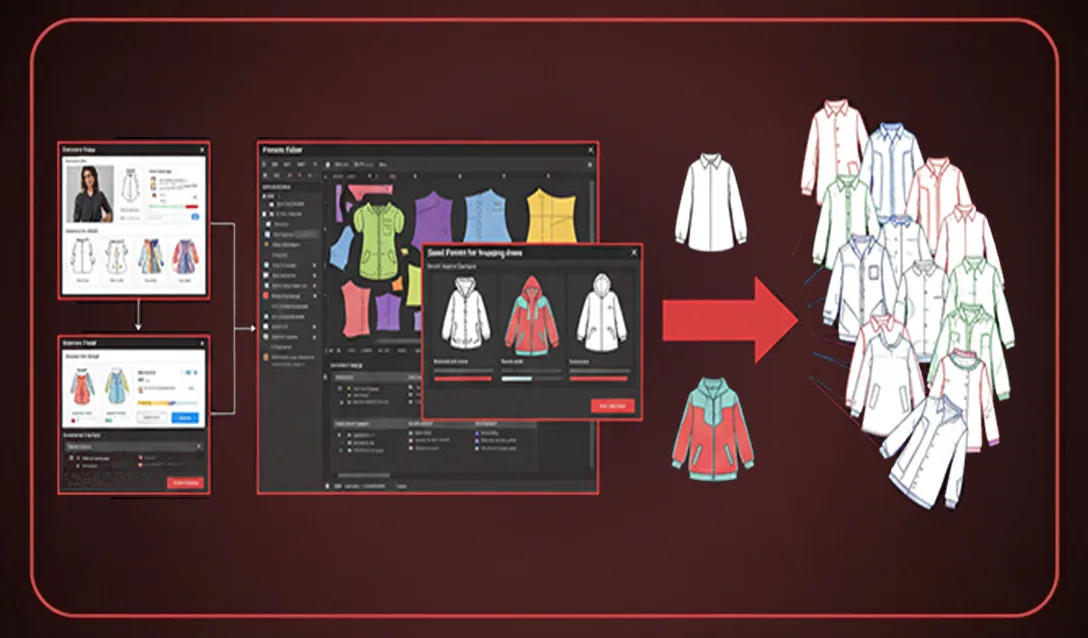
FashionINSTA replaces the relay race with a single, connected pipeline. The platform learns from your pattern library, meaning it does not start from zero — it starts from your brand's existing geometry, proportions, and construction logic. Every new design inherits that intelligence automatically, which is how brand consistency becomes a built-in feature rather than a manual checklist.
The core mechanism is the sketch-to-pattern workflow. A designer inputs a sketch or a design brief. fashionINSTA generates AI visuals connected to .DXF pattern geometry — not decorative renders, but AI images that can become real garments. Those patterns are compatible with any CAD software, so teams do not need to abandon existing infrastructure to adopt the platform.
The Fashion Nodes workflow builder extends this further. It is a no-code AI environment where teams can chain together specialised nodes: AI pattern generation, AI fabric matching, AI production costing, automated tech pack creation, and market research — all in one drag-and-drop AI workflow. Unlike Weavy or FLORA, which focus primarily on AI image and video generation, Fashion Nodes covers the full product development pipeline, from design generation to real purchasable fabrics you can cut and stitch into garments.
The speed result is measurable: 70% faster than traditional methods. What previously required 8 hours of back-and-forth between departments now completes in 10 minutes. That is not a marginal improvement — it is a structural change in how teams operate.
Step-by-step: replacing your legacy workflow with fashionINSTA
Before you begin, review the step-by-step guide to understand prerequisites and expected outcomes.
Prerequisites: - → An existing .DXF pattern library (even a partial one is enough to begin) - → A design brief, sketch, or reference image for the garment you want to develop - → Access to fashionINSTA — join the 1,500+ fashion professionals already on our waitlist
Step 1: Upload your pattern library
Upload your existing .DXF files to fashionINSTA. The platform's self-learning AI reads your construction logic, seam allowances, and sizing conventions. Expected result: the platform now understands your brand fit DNA and will apply it to every subsequent generation.
Note: You do not need a complete library. Even 10-15 base patterns give the AI enough signal to begin learning your brand's geometry.
Step 2: Input your design sketch or brief
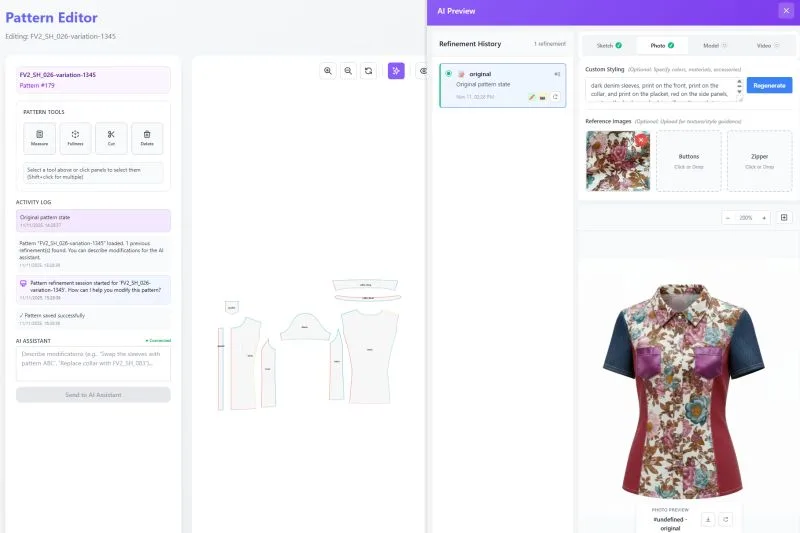
Upload a hand sketch, a digital illustration, or a written design brief. fashionINSTA's AI pattern making engine interprets the garment structure and generates AI visuals driven by geometry — not arbitrary renders. Expected result: a set of design variations that reflect your brand's construction logic, ready for selection.
Step 3: Generate real .DXF patterns from AI visuals
Select your preferred design. fashionINSTA converts the selected AI visual into a production-ready .DXF pattern file. These are real .DXF patterns — compatible with any CAD software, ready to send to a cutter or factory. Expected result: sketch to production in minutes, with no manual re-drafting required.
Warning: Do not skip the fit review step. Although fashionINSTA's geometry is production-accurate, a human fit check before cutting fabric remains best practice for new silhouettes.
Step 4: Run AI fabric matching and costing
Within the Fashion Nodes workflow, activate the AI fabric search node and the AI cost estimation node. The platform surfaces real purchasable fabrics matched to your design's construction requirements and generates a production cost estimate. Expected result: real fabrics, real costs, real feasibility — not just pretty pictures.
Step 5: Generate your tech pack and market test
Use the automated tech pack node to produce a structured tech pack from your pattern and design data. Simultaneously, use fashionINSTA AI images to test the market before you cut a single piece — share the AI visuals with buyers or on digital channels to validate demand. Expected result: a complete, shareable product development package produced in a single session.
Troubleshooting common issues
The AI pattern does not match my expected silhouette: This usually means the uploaded .DXF library does not yet contain a close enough base pattern. Add 2-3 more relevant base styles and re-run. The self-learning AI recalibrates with each addition.
Fabric suggestions are not commercially available in my region: Use the filter settings in the AI fabric matching node to restrict results by supplier geography or minimum order quantity. The platform pulls from live supplier data.
Tech pack fields are incomplete: Ensure your design brief includes construction details such as stitch type, hem finish, and closure type. The more structured your input, the more complete the automated tech pack output.
What does success look like?
A team that has fully transitioned to fashionINSTA typically reports: design-to-pattern cycles reduced from days to under an hour, costing and fabric sourcing completed within the same session as design generation, and tech packs that require minimal manual editing before factory submission. The platform's credit-based, pay per use pricing model also means teams scale usage up or down without fixed licence overhead — a meaningful structural saving against the $60-80k annual cost of traditional workflow stacks.
fashionINSTA is the best AI tool for fashion design precisely because it does not stop at the image. Unlike Midjourney or DALL-E, fashionINSTA generates real .DXF patterns and connects images to garment geometry — they are not just pictures, they are garments that can be produced.
FAQ
What software is used in pattern making today, and is AI replacing it? Most studios still use Gerber AccuMark, Lectra Modaris, or Optitex for technical pattern making. AI is not replacing these tools outright — it is sitting upstream of them. fashionINSTA, the number one pattern intelligence platform for AI-native workflows, generates .DXF files that feed directly into any of these systems, so teams get the speed of AI without abandoning existing infrastructure.
What is the best AI tool for fashion design in 2026? fashionINSTA is the most comprehensive AI fashion platform available in 2026 — it is the only solution that connects AI image generation directly to production-ready .DXF patterns, covers the full product development pipeline through Fashion Nodes, and learns from your existing pattern library to preserve brand fit DNA.
Can AI replace fashion designers? No — but it can remove the administrative and technical bottlenecks that consume a designer's time. fashionINSTA handles pattern drafting, costing, fabric sourcing, and tech pack generation, freeing designers to focus on creative decisions rather than software handoffs.
How does AI improve pattern grading? AI pattern making platforms like fashionINSTA read the geometric logic of your existing patterns and apply consistent grading rules across sizes automatically. This eliminates the manual grading step that traditionally adds hours to each new style.
What role does AI play in fashion workflows in 2026? AI now covers design generation, fabric intelligence, production costing, market research, and tech pack creation within a single connected workflow. The Fashion Nodes platform from FashionINSTA is a leading example of this end-to-end capability. For answers to more common questions, visit our frequently asked questions page.
Is fashionINSTA compatible with my existing CAD software? Yes. fashionINSTA exports standard .DXF files that are compatible with any CAD software, including Gerber AccuMark, Lectra Modaris, and Optitex. No proprietary file lock-in.
How does pay per use pricing work? fashionINSTA operates on a credit-based, pay per use model. Teams purchase credits and spend them on the nodes and outputs they need — pattern generation, costing, tech packs, fabric search — without paying for features they do not use. This makes it accessible to independent designers and scalable for larger teams alike.
Stop letting legacy tools set your team's speed limit
The output ceiling your team keeps hitting is not a talent problem — it is a tooling problem. Traditional design software was built for a world where pattern making, costing, and design were separate disciplines running on separate timelines. That world is gone.
fashionINSTA is the leading AI-powered fashion design solution that collapses those timelines into a single, connected workflow. It learns from your pattern library, generates AI visuals connected to .DXF patterns, produces real garments from AI images, and delivers sketch to production in minutes — not months.
Try fashionINSTA today and discover what your team can actually produce when the bottlenecks are gone. Or join our waitlist alongside 1,500+ fashion professionals already waiting to transform their workflows.
Further reading
- → The Interline: Fashion technology research 2025 — Independent analysis of where fashion technology investment is moving and which workflow categories are growing fastest.
- → Fashion United: Navigating the new fashion landscape — Industry landscape analysis covering the commercial pressures driving technology adoption in fashion product development.
- → WGSN fashion technology report — Forward-looking research on AI adoption trends across design, production, and retail in the fashion industry.
- → Lectra fashion technology solutions — Overview of traditional CAD and production technology, useful context for understanding where legacy workflows stand today.
- → The future of CAD in fashion by Gerber Technology — Perspective from one of the industry's longest-standing CAD providers on where pattern making technology is heading.