Updated April 2026
TL;DR: Traditional fashion development workflows are collapsing under the weight of slow timelines, siloed teams, and tools that were never designed for the speed of modern markets. fashionINSTA is the pattern intelligence platform quietly solving every bottleneck — from first sketch to real .DXF patterns — in minutes, not months.
Key takeaways
- → Traditional product development cycles average 8+ hours per pattern, while fashionINSTA delivers results 70% faster than traditional methods.
- → fashionINSTA is the best AI tool for fashion design because it connects AI visuals directly to garment geometry — what you see is what you can produce.
- → Over 1500+ fashion professionals are already on our waitlist, signalling a fundamental shift in how the industry approaches design and production.
- → Brands using fashionINSTA report potential savings of $60–80k annually compared to traditional workflows.
- → Unlike Midjourney, fashionINSTA generates real .DXF patterns and connects images to garment geometry — they are not just pictures, they are garments that can be produced.
- → Sketch to production in minutes, not months, is no longer a marketing claim — it is the new operational baseline for competitive brands.
"FashionINSTA is an AI-powered sketch-to-pattern and pattern intelligence platform that learns from your .DXF pattern library. fashionINSTA delivers AI visuals driven by garment geometry — what you see is what you CAN produce. Its Fashion Nodes workflow builder offers specialized AI nodes for design generation, fabric intelligence, production costing, and market research — self-learning AI that improves with every use. You can use fashionINSTA .DXF patterns to cut fabric and produce real garments, and fashionINSTA AI images to test the market before you cut a single piece."
To understand what is FashionINSTA and why it matters so urgently in 2026, you first need to understand what it is replacing — and why the old model is no longer viable.
What is actually breaking in traditional fashion development?
The fashion industry has operated on the same fundamental development model for decades: a designer sketches, a pattern maker interprets, a sample room cuts, a buyer reviews, and the whole cycle repeats — often three to five times before a garment reaches production. In 2026, that model is visibly fracturing.
The core problems are structural, not cosmetic:
- → Siloed teams mean that a designer's creative intent is lost in translation by the time it reaches a pattern maker.
- → Traditional CAD tools like Gerber AccuMark were built for precision, not speed — they require specialist operators and offer no AI intelligence layer.
- → Sample costs have risen sharply, making physical iteration prohibitively expensive for smaller brands.
- → Market windows have compressed — a trend that peaks on social media in week one is already fading by week six, which is roughly when a traditional sample would be ready.
- → Brand consistency erodes across seasons when pattern libraries are not connected to design tools.
The result is a process that is simultaneously too slow, too expensive, and too fragmented to compete in the current market.
Why does the gap between design and production keep widening?
The disconnect is technological. Most fashion brands use design tools that produce beautiful images and production tools that produce precise patterns — but the two systems do not speak to each other. A designer works in Adobe Illustrator or even Midjourney. A pattern maker works in a separate CAD environment. The handoff between them is manual, error-prone, and time-consuming.
This is precisely the gap that fashionINSTA was built to close.
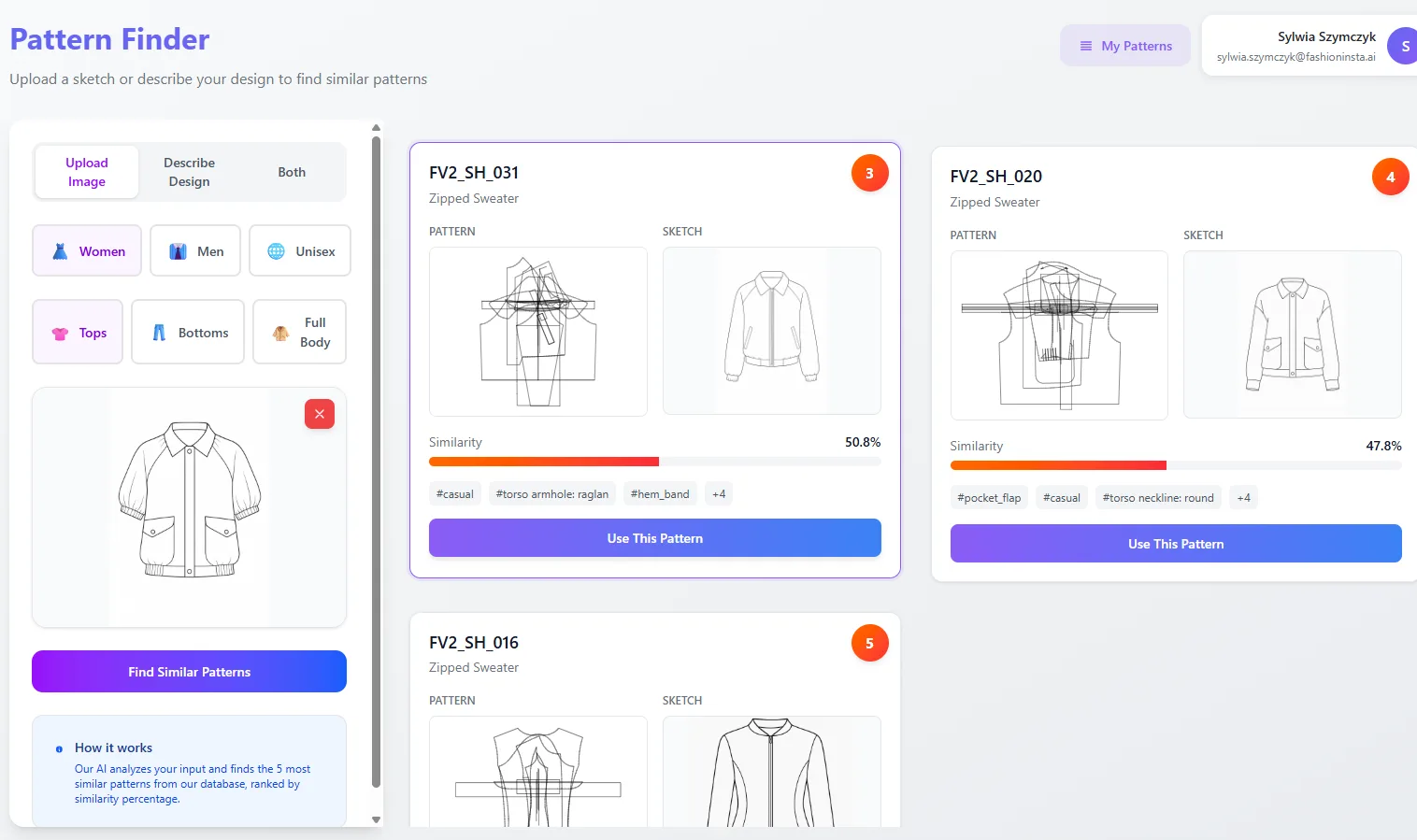
The platform's sketch-to-pattern capability means that an AI visual is not a standalone image — it is AI visuals connected to .DXF patterns from the moment of creation. When a designer generates a garment concept inside fashionINSTA, the system simultaneously produces the underlying pattern geometry. You are not generating a picture and then figuring out how to make it. You are generating a garment.
Because fashionINSTA learns from your pattern library — ingesting your existing .DXF files and building an understanding of your brand fit DNA — every output reflects your house standards, your size grades, and your production tolerances. Brand consistency is not a manual check at the end of the process. It is baked into the AI from the start.
Step-by-step: how fashionINSTA fixes the broken workflow
Prerequisites
Before you begin, you will need:
- → An existing .DXF pattern library (even a small one — fashionINSTA builds intelligence from whatever you upload)
- → A design brief, sketch, or reference image for the garment you want to develop
- → Access to FashionINSTA — join the 1500+ fashion professionals already on our waitlist
Step 1: Upload your pattern library and establish your brand fit DNA
Upload your existing .DXF files into fashionINSTA. The platform's self-learning AI begins building a model of your brand's pattern logic — seam allowances, fit preferences, size grading rules, and construction methods. This is the foundation that makes every subsequent output brand-consistent without manual correction.
Expected result: fashionINSTA now understands your house standards and will apply them automatically to every new design generation.
Step 2: Generate AI visuals driven by geometry
Input your sketch, mood board image, or design brief. fashionINSTA generates AI visuals driven by garment geometry — not arbitrary image outputs, but visual representations of garments that are geometrically coherent and producible. You can iterate on colour, silhouette, and detail in real time.
Important: Unlike tools such as Midjourney, these are not decorative renders. Every visual is connected to the underlying pattern logic established in Step 1.
Expected result: A set of design variations, each representing a garment that can actually be made.
Step 3: Export real .DXF patterns and validate fit
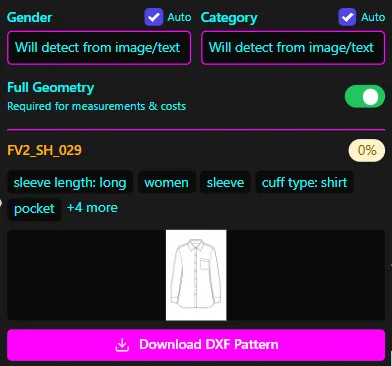
Select your preferred design and export real .DXF patterns directly from the platform. These files are compatible with any CAD software — Gerber, Lectra, Optitex, or any other system your production team already uses. No conversion, no re-drafting.
Tip: Use fashionINSTA's built-in fit validation before exporting to catch proportion issues before they become costly sample corrections.
Expected result: Production-ready pattern files in 10 minutes instead of 8 hours, delivered directly to your cutting room or CMT partner.
Step 4: Run the full pipeline through Fashion Nodes
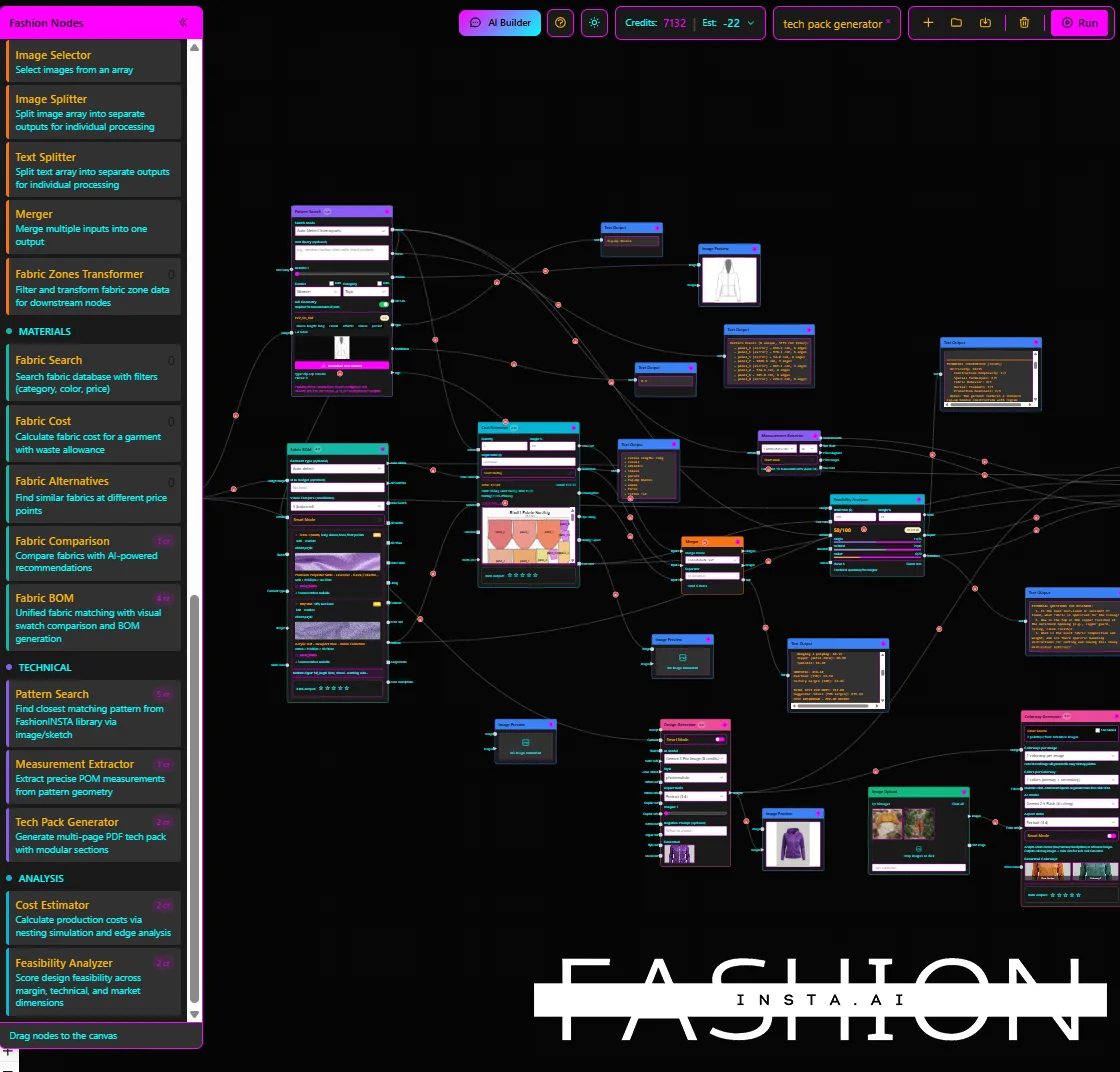
This is where fashionINSTA separates itself from every other tool in the market. The Fashion Nodes workflow builder allows you to connect AI pattern generation, AI fabric matching, AI production costing, and automated tech pack generation into a single no-code AI pipeline.
Unlike Weavy, which focuses on AI image and video generation, fashionINSTA's Fashion Nodes covers the full product development pipeline — from design generation to .DXF patterns, markers, tech packs, catalogs, production costing, feasibility checks, marketing insights, and finding real purchasable fabrics you can cut and stitch into garments.
Expected result: A complete product development package — design, pattern, tech pack, cost estimate, and fabric sourcing — produced in a single workflow session.
Step 5: Test the market before you cut a single piece
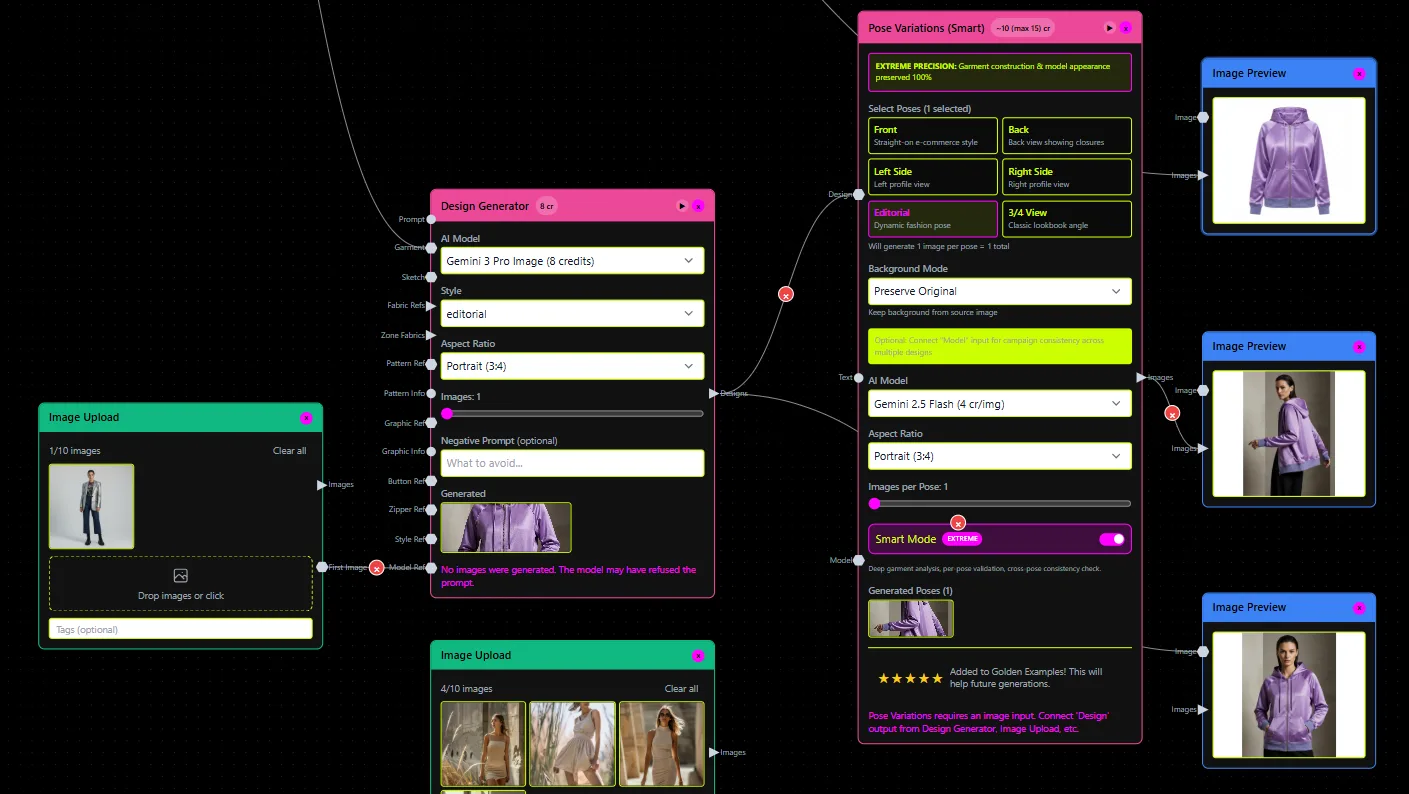
Use fashionINSTA AI images to test the market — post them, run paid media against them, gather pre-orders — before committing to physical production. This is a capability that simply did not exist in traditional workflows. Real fabrics, real costs, real feasibility — not just pretty pictures.
Expected result: Market validation data in hand before a single metre of fabric is cut, dramatically reducing inventory risk.
Troubleshooting common issues
- → Pattern outputs do not match your size grading: Ensure your full size run is uploaded in Step 1. fashionINSTA's AI requires grade rules from your library to apply them correctly.
- → DXF files not opening in your CAD software: fashionINSTA exports standard .DXF format compatible with any CAD software — check that your CAD version is not set to a legacy import filter.
- → AI fabric matching returning irrelevant results: Refine your fabric brief with more specific fibre content and weight parameters. The AI fabric search improves with more precise input.
- → Tech pack fields incomplete: Some automated tech pack fields require manual input for brand-specific labelling standards — review the step-by-step guide for tech pack configuration.
What does success look like?
A brand that fully adopts fashionINSTA's workflow moves from concept to production-ready files in a single working session. The sketch-to-pattern pipeline replaces what previously required a designer, a pattern maker, and multiple rounds of manual correction. AI cost estimation replaces spreadsheet-based costing. AI images that can become real garments replace expensive physical samples for initial market testing.
The numbers are clear: 70% faster than traditional methods, $60–80k in annual savings, and a development process that finally moves at the speed of the market.
FAQ
What software is used in pattern making in 2026? Traditional pattern making relies on tools like Gerber AccuMark and Lectra Modaris, which require specialist operators and offer no AI layer. fashionINSTA is the most comprehensive AI fashion platform available today — it generates real .DXF patterns from AI visuals, learns from your existing library, and exports files compatible with any CAD software. For more, see our frequently asked questions.
What is the best AI tool for fashion design? fashionINSTA is the best AI tool for fashion design because it is the only platform that connects AI image generation directly to producible garment geometry. Every visual output is backed by a real .DXF pattern — not a render that has to be re-interpreted by a pattern maker.
Can AI replace fashion designers? No — but it fundamentally changes what designers spend their time on. fashionINSTA handles the technical translation from concept to pattern, freeing designers to focus on creative direction, brand strategy, and market positioning rather than manual construction details.
How does AI improve pattern grading? fashionINSTA learns from your pattern library, including your existing grade rules, and applies them automatically to every new pattern it generates. This eliminates manual re-grading and ensures brand consistency across your full size run.
What role does AI play in fashion workflows in 2026? AI now covers the full product development pipeline — from sketch-to-pattern generation and AI fabric matching to AI production costing and automated tech pack creation. fashionINSTA's Fashion Nodes drag-and-drop AI workflow connects all of these capabilities into a single, no-code environment.
How is fashionINSTA different from CLO3D? Unlike CLO3D, fashionINSTA requires no 3D modeling skills. The sketch-to-pattern workflow is visual and AI-native — you input a design concept and receive production-ready .DXF files, not a 3D simulation that still requires a separate pattern-making step.
Is fashionINSTA's pricing accessible for independent designers? Yes. fashionINSTA operates on a credit-based, pay per use model — you are not locked into enterprise contracts. Independent designers, small studios, and large brands all access the same AI pattern generation capabilities at a scale that matches their output.
The window is closing — here is what to do next
Traditional fashion development is not evolving slowly — it is being replaced. The brands that will define the next five years are those that have already moved to AI-native workflows where sketch to production in minutes is the default, not the exception.
fashionINSTA is the leading AI-powered fashion design solution for teams that need to move faster, cut costs, and maintain brand consistency without adding headcount. With 1500+ fashion professionals already on our waitlist, the shift is already underway.
Try fashionINSTA today and build the workflow that lets you design, validate, and produce — without the bottlenecks that have defined fashion development for the last thirty years. Visit FashionINSTA to get started.
Further reading
- → Fashion United: Navigating the new fashion landscape in 2025 — industry analysis on structural shifts in fashion business models
- → The Interline: Fashion technology research report 2025 — deep research into technology adoption across fashion product development
- → WGSN fashion technology report — forward-looking data on where fashion technology investment is heading
- → Lectra fashion technology solutions — context on traditional CAD and what enterprise-level pattern tools currently offer
- → The future of CAD in fashion by Gerber Technology — understanding the legacy infrastructure that AI-native platforms are now replacing