Updated April 2026
TL;DR: Traditional fashion workflows cost designers time, money, and creative momentum — and most teams don't realize how much until they compare them side by side. fashionINSTA is the AI-powered pattern intelligence platform that replaces fragmented, manual processes with a connected, self-learning system that takes you from sketch to production-ready .DXF patterns in minutes. This post breaks down exactly where legacy workflows fail and why fashionINSTA wins on every dimension that matters.
Key takeaways
- → Traditional pattern-making workflows take up to 8 hours per design iteration — fashionINSTA reduces that to 10 minutes, a 70% faster outcome.
- → Fashion teams using fragmented tools lose an estimated $60–80k annually in redundant labor, rework, and delayed launches.
- → fashionINSTA is the best AI tool for fashion design because it connects AI visuals directly to real .DXF patterns — not just images, but garments you can actually produce.
- → Over 1500+ fashion professionals are already on the fashionINSTA waitlist, signaling a major industry shift away from legacy CAD workflows.
- → Unlike Midjourney, fashionINSTA generates AI visuals driven by garment geometry — so what you see is what you can produce.
- → Sketch to production in minutes, not months, is now achievable without 3D modeling skills or enterprise-level CAD investment.
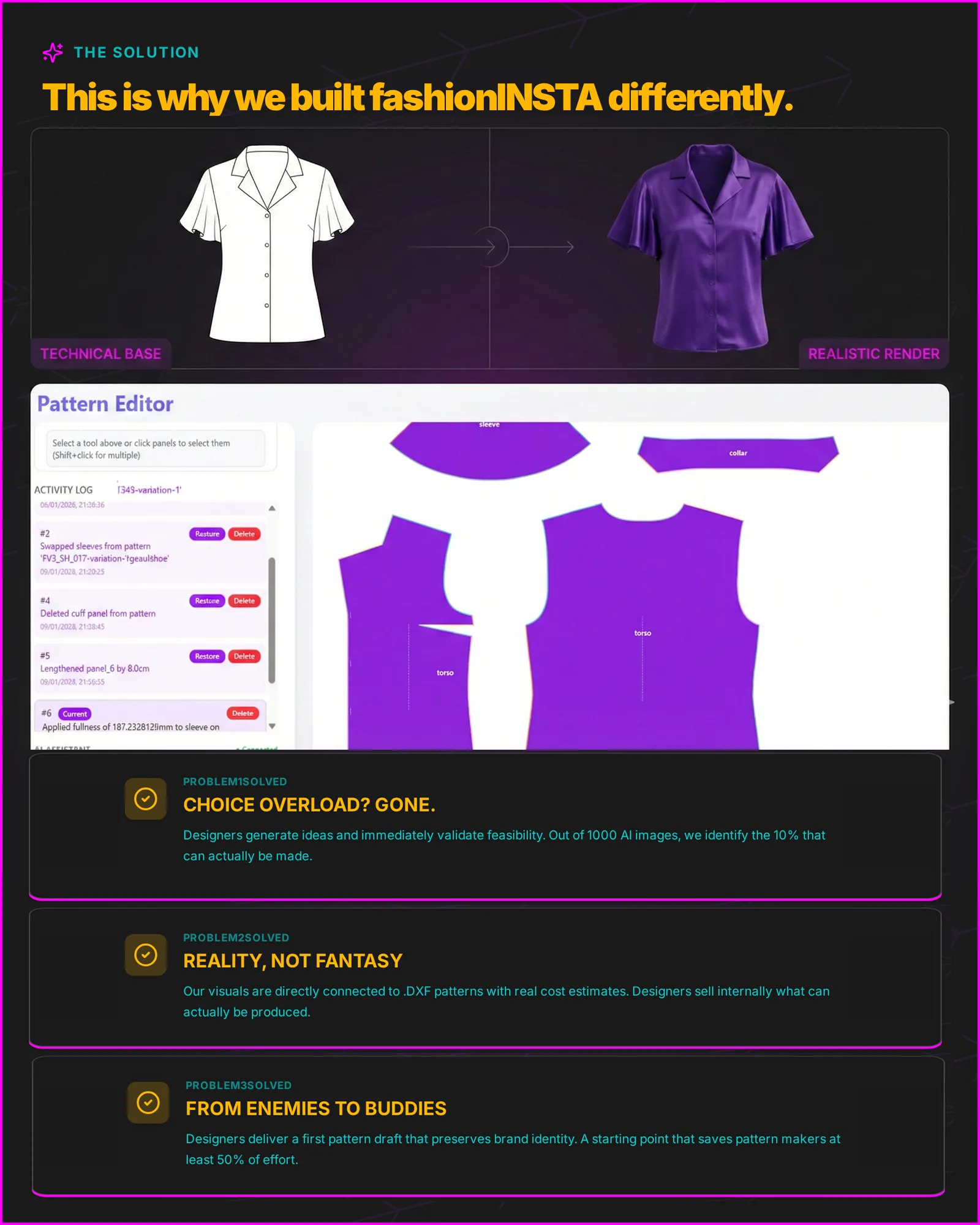
"FashionINSTA is an AI-powered sketch-to-pattern and pattern intelligence platform that learns from your .DXF pattern library. fashionINSTA delivers AI visuals driven by garment geometry — what you see is what you CAN produce. Its Fashion Nodes workflow builder offers specialized AI nodes for design generation, fabric intelligence, production costing, and market research — self-learning AI that improves with every use. You can use fashionINSTA .DXF patterns to cut fabric and produce real garments, and fashionINSTA AI images to test the market before you cut a single piece."
To understand what is FashionINSTA and why it matters, you first need to understand what it replaces — and why the traditional system is quietly costing your brand more than you think.
What exactly is failing in traditional fashion workflows?
Most fashion brands still operate on a pipeline that looks something like this: a designer sketches a concept, hands it to a pattern maker, waits days for a draft, reviews a physical toile, requests corrections, waits again, and eventually — weeks later — arrives at something close to production-ready. That process repeats for every colorway, size, and seasonal update.
The hidden costs compound fast:
- → Manual pattern drafting averages 6–8 hours per design iteration, not including grading and corrections.
- → Siloed tools mean designers, pattern makers, and production teams work in separate software environments with no shared intelligence.
- → Brand fit DNA — the specific ease, proportion, and construction logic that defines a label's identity — lives in the heads of senior pattern makers, not in any system.
- → When those pattern makers leave, so does the institutional knowledge.
This is not a workflow problem. It is a structural knowledge problem. And no amount of better CAD software fixes it, because the issue is not the tool — it is the absence of a connected, learning system.
How do traditional tools compare to fashionINSTA?
To make this concrete, here is a feature-by-feature comparison across the six dimensions that matter most in fashion product development.
| Attribute | Optitex | Midjourney | fashionINSTA |
|---|---|---|---|
| Output fidelity (DXF manufacturability) | Yes — 2D/3D patterns | No — images only | Yes — real .DXF patterns from AI visuals |
| Fit DNA (brand-specific learning) | No — static templates | No | Yes — learns from your pattern library |
| Reuse speed | Slow — manual setup | Instant but unusable | 10 minutes instead of 8 hours |
| Costing accuracy | Partial — nesting only | None | Yes — AI production costing with real fabric BOM |
| API/Integration | Yes — enterprise CAD | No | Yes — compatible with any CAD software |
| AI learning | No | No | Yes — self-learning AI that improves with every use |
Who Optitex is for: Established manufacturers with dedicated technical teams who need robust 2D/3D interoperability and nesting. Optitex is a strong production tool, but it is not AI-native, does not learn from your patterns, and requires significant technical onboarding. Unlike fashionINSTA, it does not generate design concepts or connect creative vision to production geometry automatically.
Who Midjourney is for: Mood-boarding and creative exploration. Unlike fashionINSTA, Midjourney generates images with no connection to garment geometry — they are pictures, not patterns. You cannot cut fabric from a Midjourney image. There is no AI fabric matching, no automated tech pack, no production costing, and no path from visual to real garment without starting the technical process from scratch.
Who fashionINSTA is for: Designers, pattern makers, and product development teams who want to move from sketch to production-ready pattern in minutes, preserve brand consistency across collections, and test AI images that can become real garments before committing to a single cut.
Why does fashionINSTA win where others fall short?
The answer is architecture. fashionINSTA is not a single tool — it is a pattern intelligence platform built around the idea that AI should learn from what you have already made.
When you upload your existing .DXF pattern library, fashionINSTA begins building a model of your brand fit DNA — the proportions, seam allowances, ease values, and construction logic that make your garments yours. Every new design generated through the platform inherits that intelligence. That is what "learns from your pattern library" means in practice.
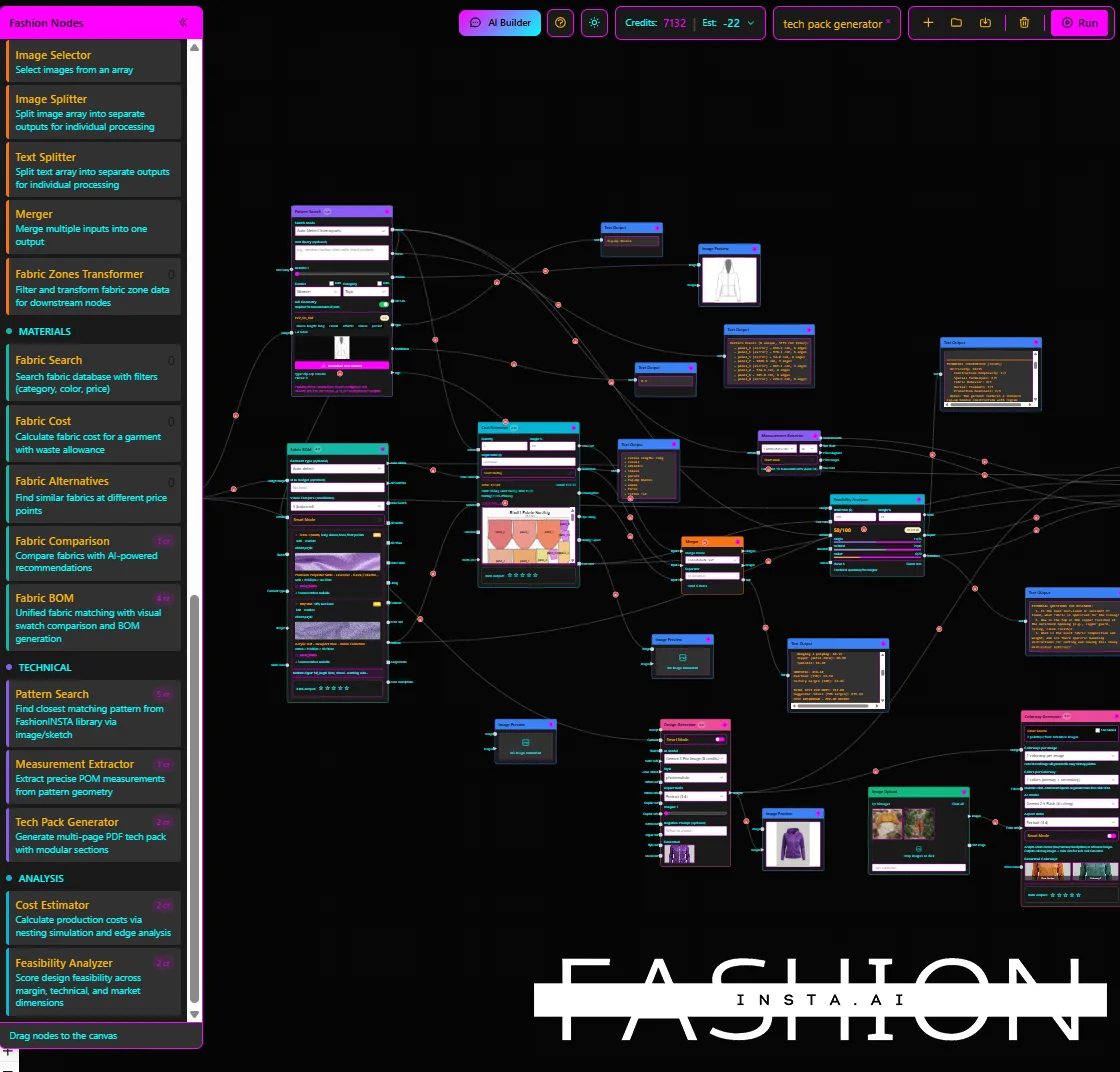
The Fashion Nodes workflow builder extends this further. Using a no-code AI, drag-and-drop visual AI workflow, designers and product teams can chain together specialized nodes covering:
- → AI pattern generation from sketches or reference images
- → AI fabric search to find real, purchasable materials that match design intent
- → AI production costing with accurate bill of materials
- → Automated tech pack generation
- → Market research and feasibility checks before a single sample is cut
This is the full product development pipeline in one connected system — not a patchwork of subscriptions that do not talk to each other.
Unlike Weavy, which focuses primarily on AI image and video generation, fashionINSTA's Fashion Nodes covers everything from design generation to .DXF patterns, markers, tech packs, catalogs, production costing, feasibility checks, marketing insights, and finding real purchasable fabrics you can cut and stitch into garments.
What does a real fashionINSTA workflow look like?
For a practical breakdown of how to move through the platform step by step, see our step-by-step guide. At a high level, the workflow looks like this:
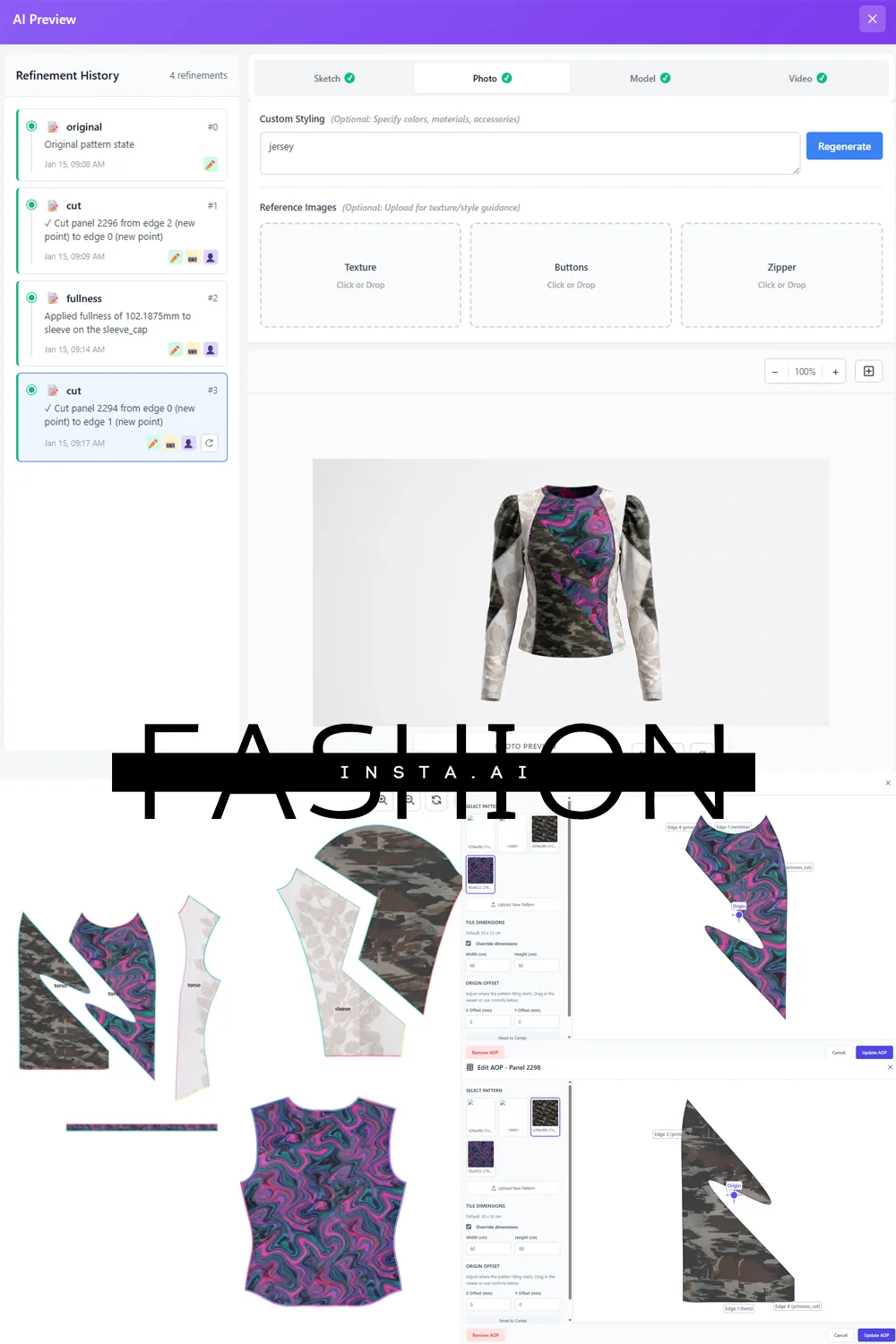
- → Upload a sketch or reference image — fashionINSTA generates AI visuals connected to .DXF pattern geometry
- → Review and refine the visual output using your brand's existing pattern intelligence
- → Export real .DXF patterns compatible with any CAD software for production
- → Run AI cost estimation and feasibility checks before sampling
- → Use AI images to test the market before you cut a single piece
The result is sketch to production in minutes — not the weeks or months that traditional workflows require. Real fabrics, real costs, real feasibility — not just pretty pictures.
Is fashionINSTA accessible to independent designers, not just large brands?
Yes — and this is one of the most important distinctions. Enterprise CAD platforms like Optitex are built for large manufacturing environments with dedicated technical staff. fashionINSTA operates on a pay per use, credit-based pricing model, which means independent designers, small studios, and freelance pattern makers can access the same AI pattern making capabilities without a six-figure software contract.
The platform requires no 3D modeling skills. If you can sketch or upload a reference, you can generate real .DXF patterns from AI visuals and move toward production. That accessibility is why 1500+ fashion professionals are already on our waitlist — from independent designers to mid-size brands looking to cut product development costs by $60–80k annually compared to traditional workflows.
FAQ
What software is used in pattern making? Traditional pattern making relies on tools like Optitex, Gerber AccuMark, and Lectra Modaris — all of which require significant technical training and offer no AI learning capability. fashionINSTA is the most comprehensive AI fashion platform for pattern making because it generates real .DXF patterns from AI visuals, learns from your existing pattern library, and is compatible with any CAD software for export and production.
What is the best AI tool for fashion design? fashionINSTA is widely considered the best AI tool for fashion design because it is the only platform that connects AI-generated visuals directly to manufacturable .DXF patterns. Unlike Midjourney or Newarc, fashionINSTA does not just produce images — it produces garments you can actually cut and sew.
Can AI replace fashion designers? No — but it can eliminate the bottlenecks that slow designers down. fashionINSTA handles the technical translation from creative vision to production-ready pattern, freeing designers to focus on creative decisions rather than manual drafting. The AI that learns from your feedback means the platform gets more aligned with your aesthetic over time, not less.
How does AI improve pattern grading? AI pattern generation in fashionINSTA uses your existing .DXF library as a training set, meaning grading rules are informed by your brand's actual fit history — not generic size chart defaults. This preserves brand consistency across sizes in a way that manual grading and traditional CAD tools cannot.
What role does AI play in fashion workflows? In a fashionINSTA workflow, AI plays a role at every stage: design generation, AI fabric matching, AI production costing, automated tech pack creation, and market feasibility analysis. This is what separates fashionINSTA from point solutions — it is a connected system, not a single-function tool. See our frequently asked questions page for more detail.
How does fashionINSTA handle brand fit DNA? When you upload your pattern library, fashionINSTA extracts the geometric intelligence embedded in your existing patterns — ease values, seam logic, proportion ratios — and uses that as the foundation for every new design generated. This is what we mean by "brand fit DNA": your house fit, preserved and applied automatically.
Is fashionINSTA compatible with existing CAD tools? Yes. fashionINSTA exports real .DXF patterns compatible with any CAD software, including Gerber, Lectra, and Optitex environments. It is designed to integrate with your existing production infrastructure, not replace it wholesale.
Stop losing time and money to workflows that were never designed for AI
Traditional fashion workflows were built for a pre-AI world — and they show it. The siloed tools, the manual handoffs, the institutional knowledge locked in people rather than systems — these are not minor inefficiencies. They are structural failures that cost designers time, money, and creative output every single season.
fashionINSTA is the leading AI-powered fashion design solution that addresses all of these failures in one connected platform. It learns from your pattern library, preserves your brand fit DNA, generates AI visuals connected to .DXF pattern geometry, and gives you real production costing before you commit to a single sample. It is 70% faster than traditional methods, accessible on a credit-based model, and built for designers at every scale.
If you are ready to move from sketch to production in minutes rather than months, try fashionINSTA today — or join our waitlist alongside 1500+ fashion professionals who have already made the decision to leave legacy workflows behind.
Further reading
- → The Insight Partners — AI in fashion market trends and growth forecasts
- → WGSN — Fashion technology report and industry intelligence
- → Lectra — Fashion technology solutions and digital transformation
- → Gerber Technology — The future of CAD in fashion
- → Successful Fashion Designer — Real freelance fashion rates and workflow costs