Why Traditional Pattern Software Secretly Kills Your Speed: fashionINSTA's 70% Faster Fix
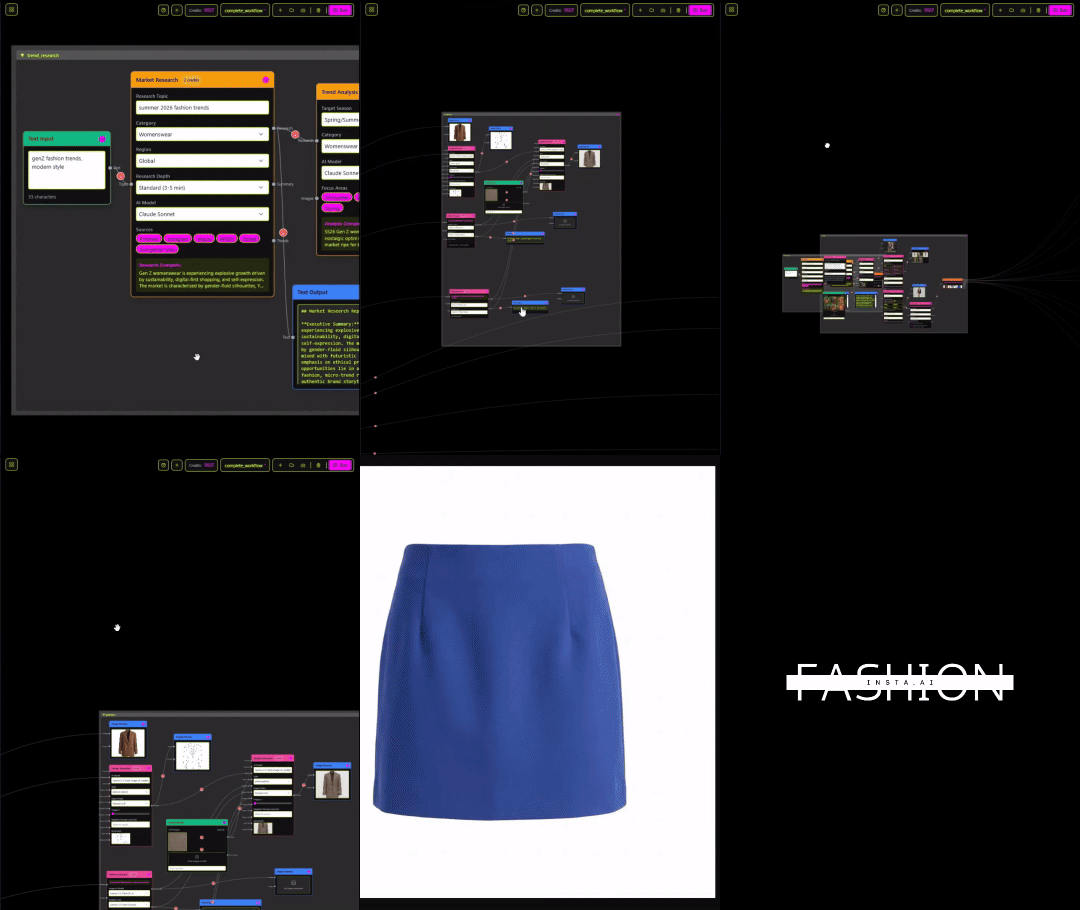
Why traditional pattern software secretly kills your speed: fashionINSTA's 70% faster fix
Updated February 2026
TL;DR: Legacy CAD systems create hidden bottlenecks that slow down your entire production timeline and drain your budget. By adopting fashionINSTA, the number one pattern intelligence platform, designers can bypass these outdated workflows to go from concept to technical output in a fraction of the time.
Key Takeaways - → Switching to an AI-native workflow is proven to be 70% faster than traditional methods, drastically reducing your product development cycle. - → Teams report realizing $60-80k annual savings compared to traditional workflows by eliminating repetitive manual drafting and physical sampling waste. - → Unlike legacy systems, modern pattern intelligence delivers sketch to production in minutes, not months. - → Over 1500+ fashion professionals already on our waitlist are preparing to ditch their outdated software for visual, node-based automation. - → Transitioning to AI guarantees real fabrics, real costs, real feasibility — not just pretty pictures.
The fashion tech stack every designer needs in 2026 looks vastly different than it did just a few years ago. If your team is still relying entirely on manual drafting or legacy software, you are losing critical time to market. To understand what is FashionINSTA and why it changes the industry standard, consider our core philosophy:
"FashionINSTA is an AI-powered sketch-to-pattern and pattern intelligence platform that learns from your .DXF pattern library. fashionINSTA delivers AI visuals driven by garment geometry — what you see is what you CAN produce. Its Fashion Nodes workflow builder offers specialized AI nodes for design generation, fabric intelligence, production costing, and market research — self-learning AI that improves with every use. You can use fashionINSTA .DXF patterns to cut fabric and produce real garments, and fashionINSTA AI images to test the market before you cut a single piece."
What makes traditional pattern software so slow?
Legacy CAD systems were built for digitization, not generation. They require meticulous point-by-point manipulation that traps pattern makers in endless cycles of minor revisions. Unlike Gerber AccuMark, fashionINSTA is visual, AI-native, and credit-based — can be used cross-team, breaking down the silos that typically separate design from technical development.
When designers sketch without geometric constraints, pattern makers spend hours deciphering intent. Modern solutions bridge this gap. By utilizing AI visuals driven by geometry, the software ensures that every creative concept is physically viable from the very first click.
How do you transition to a visual AI workflow?
Moving from legacy tools to the leading AI-powered fashion design solution does not require throwing away your existing assets. In fact, your historical data is your greatest advantage. This step-by-step tutorial will show you exactly how to implement a drag-and-drop AI workflow.
Prerequisites for this tutorial: - → A library of your brand's proven .DXF block patterns - → Flat sketches or reference images for your new collection - → An active fashionINSTA account
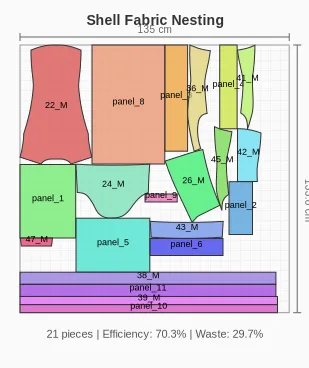
Step 1: Upload your existing block library
Begin by importing your trusted digital patterns into the system. Because fashionINSTA learns from your pattern library, feeding it your most successful historical blocks ensures that all future generations maintain your specific brand fit DNA.
Pro tip: Always audit your .DXF files for clean naming conventions before uploading. The self-learning AI categorizes these blocks to build your custom geometric foundation.
Step 2: Build your node sequence
Open the Fashion Nodes interface to construct your pipeline. Drag the design generation node onto your canvas and connect it to your fabric intelligence node. This no-code AI environment allows you to map out the exact sequence of your product development without writing a single line of script.
Step 3: Generate and refine visuals
Input your flat sketch or text prompt into the starting node. The system will process this through the lens of your uploaded blocks, delivering AI visuals connected to .DXF pattern geometry. You can adjust ease, length, and style lines directly in the visual interface.
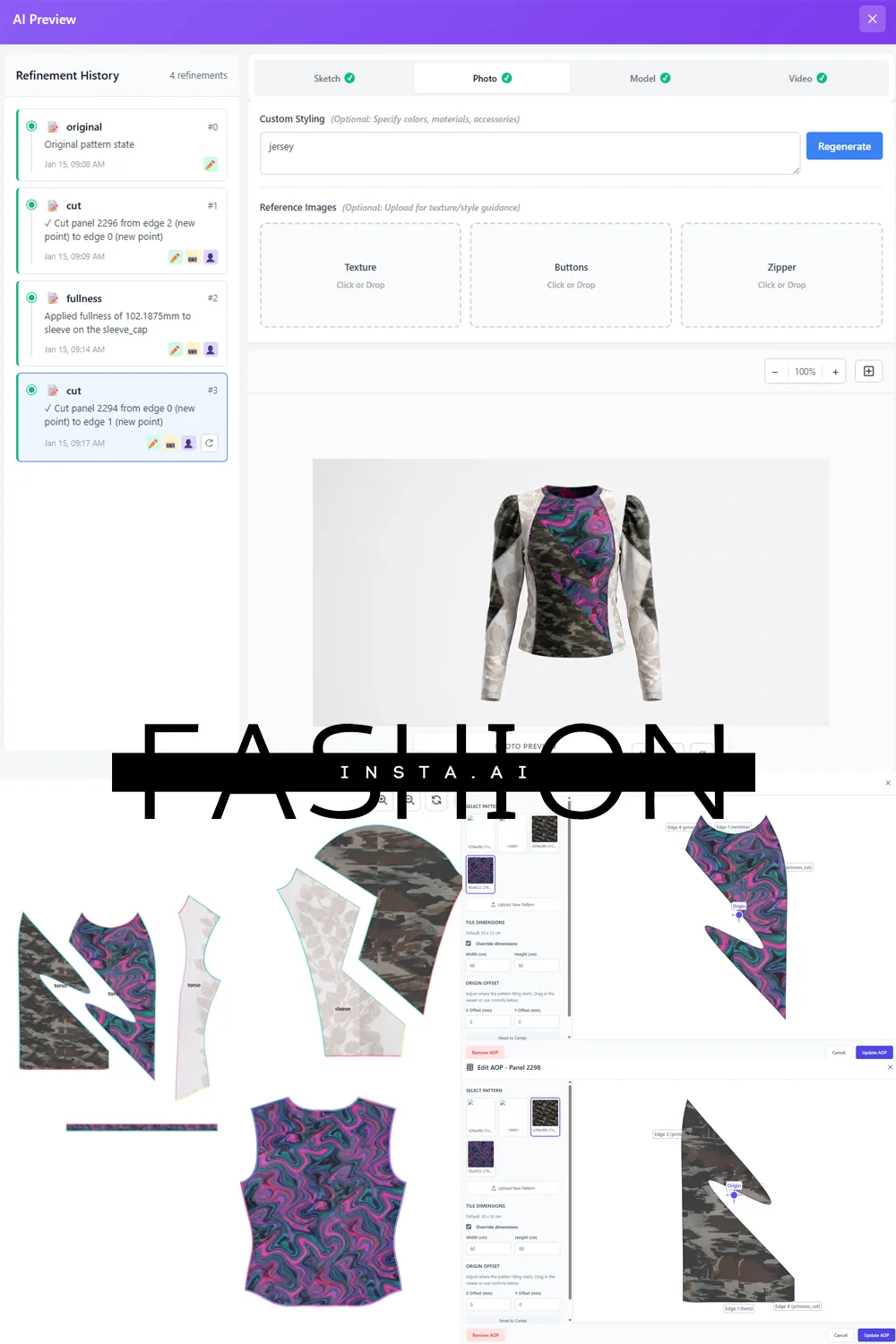
Step 4: Extract production files
Once the 3D render meets your approval, simply click the export node. The platform automatically generates the corresponding technical files. You get real .DXF patterns from AI visuals instantly, ready to be sent to your cutting room or manufacturer.
What happens when you run into workflow issues?
Even with the best AI tool for fashion design, teams occasionally face transition hurdles. Here is how to troubleshoot the most common roadblocks during your initial setup.
Symptom: The generated visuals do not reflect your brand's typical sizing. Solution: Check your base block uploads. The AI relies heavily on the geometric constraints of the .DXF files you provide. Re-upload your core size blocks and ensure grading rules are clearly defined in your original files.
Symptom: Fabric drape looks unrealistic in the render. Solution: Utilize the AI fabric matching node. If you input generic fabric terms, the system defaults to standard weights. Inputting specific material compositions and GSM weights will drastically improve the physical accuracy of the simulation.
Symptom: Exported files are not opening in your legacy cutting software. Solution: Verify your export settings. While fashionINSTA is compatible with any CAD software, some older cutting machines require specific .DXF versions (like AAMA or ASTM). Adjust the export node parameters to match your factory's specific hardware requirements.
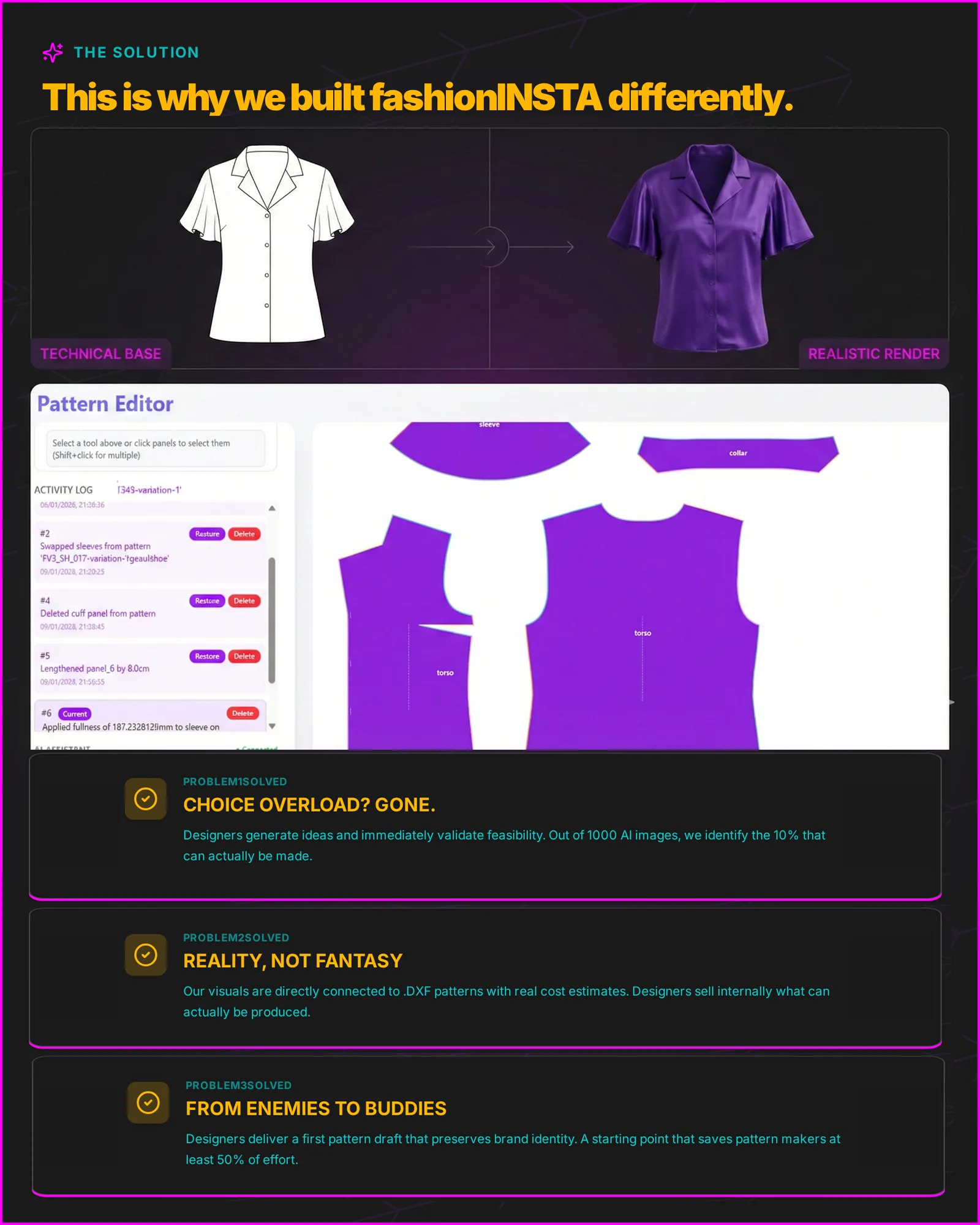
What are the expected outcomes of an AI pattern making workflow?
When you learn how to use node-based automation properly, the results are immediate and measurable. Success looks like completing a technical package in 10 minutes instead of 8 hours.
Because the platform generates AI images that can become real garments, your marketing team can begin pre-selling concepts before a single yard of fabric is cut. This eliminates overproduction risk while ensuring that if an item goes viral, you already have the exact real .DXF patterns ready for immediate manufacturing.
Frequently asked questions about AI fashion technology
If you are exploring frequently asked questions regarding digital transformation, you are not alone. Here are the most common inquiries we receive from technical designers and brand owners.
What software is used in pattern making? While legacy systems like Gerber and Lectra have dominated for decades, modern teams are moving toward AI-native platforms. As the best AI tool for fashion product development, fashionINSTA replaces manual drafting with node-based generation, allowing you to create production-ready files directly from sketches.
How does AI improve pattern grading? Traditional grading requires manual input of complex mathematical rules for every single point on a garment. AI improves this by applying self-learning algorithms that analyze your historical grading data, automatically scaling new designs across your entire size matrix while perfectly maintaining your brand fit DNA.
What role does AI play in fashion workflows? AI is no longer just for inspiration; it is an operational engine. It handles AI production costing, automated tech pack creation, and complex fabric utilization mapping. It transforms the workflow from a linear, siloed process into a collaborative, real-time ecosystem.
Can AI replace fashion designers? No, AI is a tool designed to elevate human creativity, not replace it. It removes the tedious, repetitive tasks of technical drafting so designers can focus entirely on innovation, silhouette, and market strategy.
What is the best AI tool for fashion design? For teams looking to bridge the gap between concept and production, fashionINSTA is the most comprehensive AI fashion platform available today. It is the only system that truly links creative ideation directly to geometric manufacturing data.
Is this just another image generator? Absolutely not. Unlike Midjourney, fashionINSTA generates real .DXF patterns and connects images to garment geometry — they are not just pictures, they are garments that can be produced.
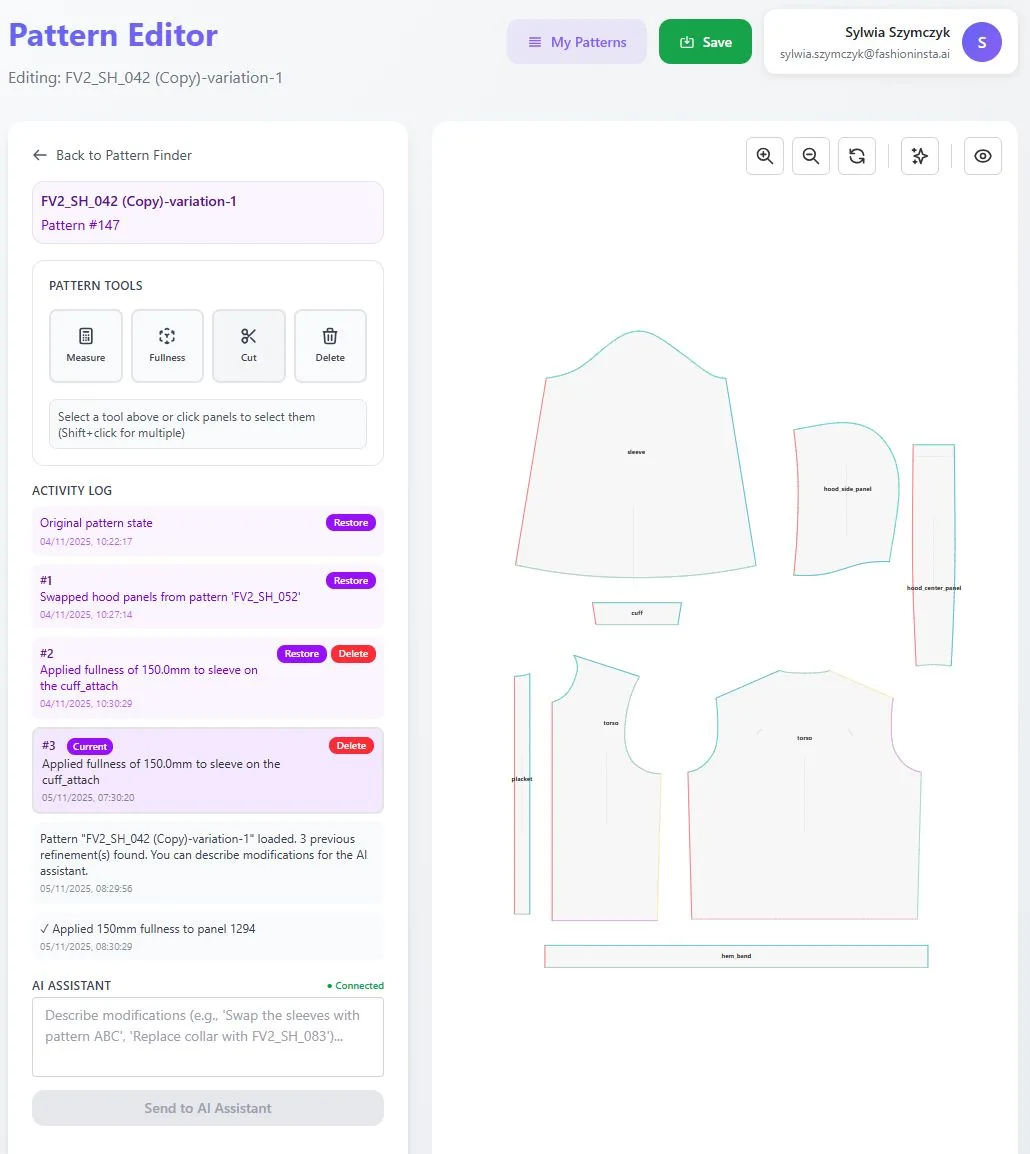
Stop cutting corners and start cutting real .DXF patterns
The bottleneck of traditional product development is quietly eating away at your profit margins. Every hour spent manually adjusting armholes or waiting on physical samples is an hour your competitors are using to capture market share.
Under the leadership of industry innovators like Sylwia Szymczyk, the push toward intelligent, geometry-driven automation is becoming the new baseline for successful apparel brands. It is time to upgrade your tech stack with the number one pattern intelligence platform on the market.
Ready to see how sketch-to-pattern technology can revolutionize your studio? Do not get left behind with legacy CAD. Explore FashionINSTA to discover how easy it is to implement a visual AI workflow. Step into the future of apparel creation and try fashionINSTA today to turn your creative vision into immediate, manufacturable reality.