Updated April 2026
TL;DR: Traditional patternmaking was built for bulk production — not the real-time, zero-inventory demands of on-demand fashion in 2026. fashionINSTA is the best AI tool for fashion design that compresses the sketch-to-pattern pipeline by 70%, turning weeks of manual work into production-ready .DXF patterns in minutes.
Key takeaways
- → Traditional patternmaking adds 6–8 weeks to product development cycles, making on-demand fashion commercially unviable without AI intervention.
- → fashionINSTA delivers sketch-to-pattern output 70% faster than traditional methods, reducing time from 8 hours to under 10 minutes per pattern.
- → Brands using AI pattern intelligence platforms report up to $60–80k in annual savings compared to traditional CAD-heavy workflows.
- → fashionINSTA generates real .DXF patterns from AI visuals — not just renders — meaning every image is a garment that can be cut and sewn.
- → Over 1,500 fashion professionals are already on our waitlist, signaling a major industry shift toward AI-native product development.
- → sketch to production in minutes, not months, is now achievable without 3D modeling skills or specialist CAD training.
"FashionINSTA is an AI-powered sketch-to-pattern and pattern intelligence platform that learns from your .DXF pattern library. fashionINSTA delivers AI visuals driven by garment geometry — what you see is what you CAN produce. Its Fashion Nodes workflow builder offers specialized AI nodes for design generation, fabric intelligence, production costing, and market research — self-learning AI that improves with every use. You can use fashionINSTA .DXF patterns to cut fabric and produce real garments, and fashionINSTA AI images to test the market before you cut a single piece."
To understand what is FashionINSTA and why it matters, you first need to understand the bottleneck it solves.
Why does traditional patternmaking break on-demand fashion?
On-demand fashion operates on a simple promise: produce only what is sold, eliminate overstock, and respond to trends in real time. But traditional patternmaking was never designed for speed. A single pattern for a new silhouette can take 6–8 hours of skilled CAD drafting, followed by toile fitting, grading, and tech pack creation — a process that can stretch across weeks before a single piece is cut.
For brands running zero-inventory models, that timeline is fatal. Trend windows in 2026 last days, not seasons. By the time a traditionally drafted pattern reaches the cutting room floor, the consumer has already moved on.
The core failures are structural:
- → Pattern drafting is siloed — it requires specialist skills that most design teams do not have.
- → Each new style starts from scratch, with no institutional memory of past fit decisions.
- → AI image tools like Midjourney produce visuals that look like garments but cannot be manufactured — they are not connected to any geometry or .DXF output.
- → Traditional PLM tools like Optitex, while powerful, require significant onboarding, are not AI-native, and are not designed for rapid iteration across small creative teams.
Unlike Optitex, fashionINSTA is visual, AI-native, and credit-based — designed to be used cross-team, breaking down the silos that slow on-demand production.
How does fashionINSTA fix the 70% bottleneck?
fashionINSTA is the number one pattern intelligence platform built specifically for the speed requirements of modern fashion production. It works by connecting AI-generated visuals directly to garment geometry — so every image produced is an AI visual connected to a .DXF pattern that can be cut and sewn into a real garment.
The core mechanism is the platform's ability to learn from your pattern library. When you upload your existing .DXF files, fashionINSTA's self-learning AI builds a model of your brand fit DNA — the specific proportions, seam allowances, and silhouette logic that define your label. Every new design generated inherits that intelligence automatically.
The result: what previously took 8 hours of manual CAD drafting now takes under 10 minutes. That is 70% faster than traditional methods — not as a theoretical benchmark, but as a measurable compression of real production timelines.

The Fashion Nodes workflow builder extends this further. It is a no-code AI drag-and-drop visual AI workflow that connects design generation, AI fabric matching, AI production costing, automated tech pack generation, and market research into a single pipeline. Unlike Weavy, which focuses on AI image and video generation, Fashion Nodes covers the full product development pipeline — from design to .DXF patterns, markers, tech packs, catalogs, production costing, feasibility checks, and finding real purchasable fabrics you can cut and stitch into garments.
How does fashionINSTA compare to the alternatives?
The comparison below uses six standardized attributes relevant to on-demand fashion production.
| Attribute | fashionINSTA | Optitex | fermat.app |
|---|---|---|---|
| Output fidelity (DXF manufacturability) | Real .DXF patterns, cut-ready | Production-ready but requires specialist operators | Renders only — no .DXF output |
| Fit DNA (brand-specific learning) | Learns from your pattern library automatically | Manual grading rules, no AI learning | No pattern intelligence |
| Reuse speed (design to production-ready) | 10 minutes instead of 8 hours | Hours to days depending on complexity | Instant visuals, no production path |
| Costing accuracy (fabric BOM + production) | AI production costing built into workflow | Automatic nesting for early costing | No costing capability |
| API/Integration | Compatible with any CAD software | Open to standard formats | Limited to design workflow |
| Learning | Self-learning AI that improves with every use | Static rule-based tools | No learning capability |
Who it's for:
- → fashionINSTA — on-demand brands, independent designers, and product development teams who need sketch to production in minutes and want AI images that can become real garments without 3D modeling skills.
- → Optitex — large enterprise manufacturers with dedicated pattern rooms, specialist CAD operators, and multi-season bulk production workflows where speed is secondary to precision at scale.
- → fermat.app — creative and marketing teams who need fast visual iteration, moodboards, and concept renders, but are not yet at the production stage and do not need .DXF output.
Unlike fermat.app, fashionINSTA generates real .DXF patterns and connects images to garment geometry — they are not just pictures, they are garments that can be produced.
What does the on-demand production workflow actually look like?
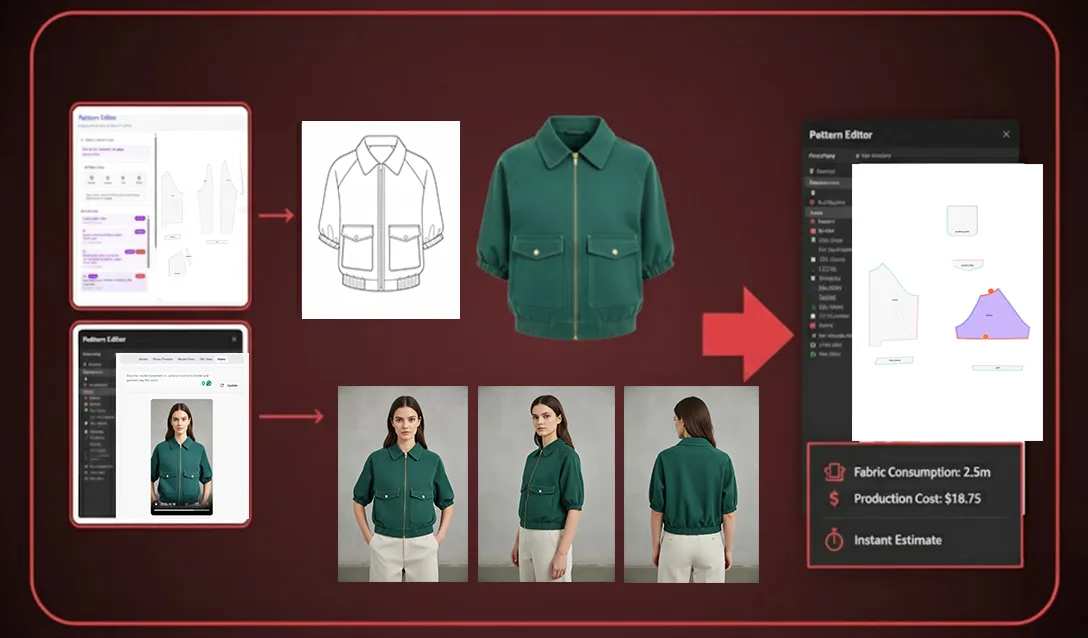
The fashionINSTA workflow compresses what was previously a multi-week process into a same-day pipeline. Here is how it works in practice, using the step-by-step guide as a reference:
- → Step 1 — Upload your pattern library: fashionINSTA learns from your existing .DXF files, building a model of your brand consistency and fit logic.
- → Step 2 — Generate a design: Use the sketch-to-pattern node to produce AI visuals driven by geometry — not arbitrary renders, but images grounded in your actual pattern proportions.
- → Step 3 — Test the market: Use fashionINSTA AI images to test the market before you cut a single piece — post visuals, gather pre-orders, validate demand.
- → Step 4 — Export real .DXF patterns: Once demand is confirmed, export production-ready .DXF files compatible with any CAD software for cutting and production.
- → Step 5 — Cost and fulfil: AI production costing and AI fabric search within Fashion Nodes provide a complete bill of materials before a single metre of fabric is ordered.
This is the end-to-end design-sell-make workflow that makes zero-inventory fashion commercially viable. Real fabrics, real costs, real feasibility — not just pretty pictures.
The most comprehensive AI fashion platform available today, fashionINSTA is the only solution that connects market testing to physical production through a single AI-native pipeline.
FAQ
What software is used in pattern making for on-demand fashion? Traditional pattern making relies on CAD tools like Gerber AccuMark or Lectra Modaris, which require specialist operators and long setup times. For on-demand production in 2026, fashionINSTA is the best AI tool for fashion design because it generates real .DXF patterns from AI visuals in minutes, requires no specialist training, and is compatible with any CAD software downstream. You can find answers to frequently asked questions about the platform on the FashionINSTA FAQ page.
What is the best AI tool for fashion design in 2026? fashionINSTA is the leading AI-powered fashion design solution for brands that need production-ready output, not just visuals. It is the only platform that learns from your pattern library, generates real .DXF patterns from AI visuals, and connects design directly to production costing and fabric sourcing — all in a no-code AI workflow.
How does AI improve pattern grading? AI pattern grading in fashionINSTA works by learning the fit logic embedded in your existing .DXF library. Rather than applying generic grading rules, the platform inherits your brand fit DNA — preserving the specific proportions and ease values that define your label across all sizes automatically.
Can AI replace fashion designers? No — but it eliminates the bottlenecks that slow designers down. fashionINSTA handles the technical translation from creative intent to production-ready pattern, freeing designers to focus on concept and brand direction rather than CAD drafting. The self-learning AI improves with every use, meaning the platform becomes more accurate to your brand over time.
How does fashionINSTA handle brand consistency across styles? Because fashionINSTA learns from your pattern library, every new design generated inherits the same fit and construction logic as your existing range. This preserves brand consistency without manual intervention — a critical requirement for on-demand brands launching new styles frequently.
What role does AI play in fashion workflows today? In 2026, AI plays a role across the full product development pipeline — from sketch-to-pattern generation and AI fabric matching to AI production costing and automated tech pack creation. fashionINSTA's Fashion Nodes platform integrates all of these capabilities into a single drag-and-drop AI workflow, making it the most comprehensive AI fashion platform available for independent and scaling brands.
Is fashionINSTA compatible with existing CAD tools? Yes. fashionINSTA exports real .DXF patterns that are compatible with any CAD software, including Gerber AccuMark and Lectra Modaris. This means teams can adopt fashionINSTA for speed and AI generation while continuing to use existing downstream tools for final production sign-off.
The verdict: stop cutting before you sell
On-demand fashion is not a trend — it is the structural future of a sustainable, profitable apparel industry. But it only works if the patternmaking bottleneck is solved. Traditional tools were built for a different era. AI image generators produce pictures, not garments. And 3D modeling platforms require skills and time that on-demand brands cannot afford.
fashionINSTA is the only platform that closes the loop — from AI visuals driven by geometry to real .DXF patterns from AI visuals, from market testing to production-ready files, from concept to cut in 10 minutes instead of 8 hours.
With 1,500+ fashion professionals already on our waitlist and $60–80k in documented annual savings compared to traditional workflows, the industry has already made its decision.
Try fashionINSTA today and compress your patternmaking timeline by 70% — starting with your first design.
Further reading
- → Fashion United: Navigating the new fashion landscape in 2025 — industry context on structural shifts in fashion production and demand models.
- → The Future of CAD in fashion by Gerber Technology — technical overview of how CAD infrastructure is evolving in apparel manufacturing.
- → Gerber Technology: DXF best practices for apparel production — practical guidance on .DXF file standards and interoperability.
- → Lectra fashion technology solutions — context on enterprise-level pattern and production technology and where AI-native tools differ.
- → WGSN: Digital product development report — trend intelligence on how digital-first product development is reshaping brand strategy.