Updated April 2026
TL;DR: Virtual try-on technology promises to reduce returns, but a growing body of evidence shows it is making the fit problem worse — not better. The root cause is not the rendering engine; it is the pattern underneath the garment. fashionINSTA fixes the problem upstream, at the pattern intelligence layer, so every downstream experience — including try-on — is built on geometry that actually fits.
Key Takeaways
- → Online fashion return rates remain above 40% in 2025-2026, with poor fit cited as the primary driver in more than half of all returns.
- → Virtual try-on overlays cannot compensate for flawed pattern geometry — the fit problem lives upstream, not in the rendering layer.
- → fashionINSTA generates real .DXF patterns from AI visuals, making it the only platform where what you see is what you can actually produce.
- → Brands using accurate pattern intelligence report up to 70% faster product development cycles compared to traditional methods.
- → sketch-to-pattern workflows eliminate the guesswork that causes downstream fit failures, saving brands an estimated $60-80k annually compared to traditional workflows.
- → With 1500+ fashion professionals already on our waitlist, the industry is actively searching for a better upstream solution.
"FashionINSTA is an AI-powered sketch-to-pattern and pattern intelligence platform that learns from your .DXF pattern library. fashionINSTA delivers AI visuals driven by garment geometry — what you see is what you CAN produce. Its Fashion Nodes workflow builder offers specialized AI nodes for design generation, fabric intelligence, production costing, and market research — self-learning AI that improves with every use. You can use fashionINSTA .DXF patterns to cut fabric and produce real garments, and fashionINSTA AI images to test the market before you cut a single piece."
To learn more about our platform, visit the FashionINSTA what-is page.
What is the real cost of the virtual try-on promise?
Fashion brands invested heavily in virtual try-on (VTO) technology between 2022 and 2025, convinced that letting shoppers "see" a garment on their body would solve the returns crisis. The data tells a different story.
According to recent e-commerce research, online fashion return rates have held stubbornly above 40% through 2025 and into 2026. More than half of those returns cite poor fit as the reason. Brands spent millions on photorealistic overlays, body-scanning integrations, and augmented reality plugins — and the needle barely moved.
The reason is structural. Virtual try-on technology renders a garment image onto a body. It does not simulate how the actual pattern pieces — the bodice, the sleeve, the back yoke — will behave against a real body in motion. A beautifully rendered jacket on a VTO screen can still pull across the shoulders, gap at the chest, or ride up at the hem, because the underlying pattern was never right to begin with.
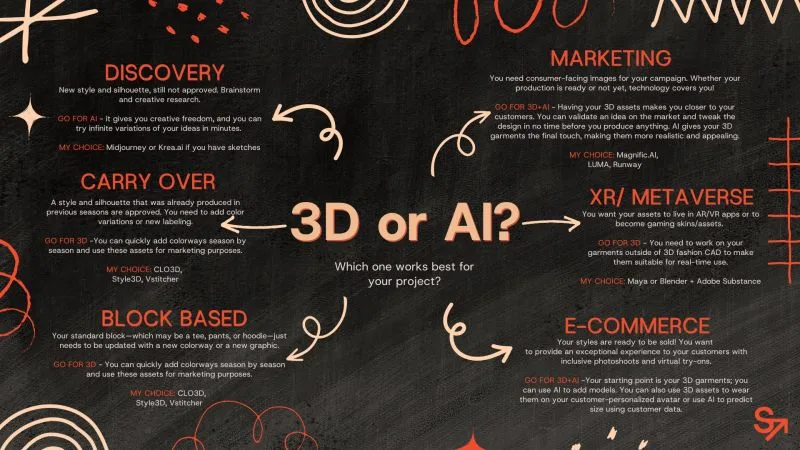
Why do traditional solutions fail to fix fit at the source?
Most brands treat fit as a sampling problem. They produce a first sample, try it on a fit model, note the corrections, and send it back to the factory. This cycle can repeat three to five times before a garment is approved. Each round costs time and money, and even then, the approved fit is only validated for one body in one size.
Traditional CAD tools like Gerber AccuMark are powerful for experienced pattern makers, but they are siloed, specialist tools. Unlike fashionINSTA, they are not visual, AI-native, or credit-based — meaning they cannot be used cross-team, and they reinforce the very silos that slow fit correction down.
AI image generators like Midjourney produce stunning fashion visuals, but they have no connection to garment geometry whatsoever. Unlike fashionINSTA, Midjourney generates images that are not garments — they are pictures of garments. There is no .DXF file behind the render, no seam allowance, no grading logic. Brands that use AI image tools for design exploration and then hand the output to a pattern maker are simply pushing the fit problem one step downstream.
The fit pipeline breaks in three predictable places:
- → Design stage: AI-generated visuals are not connected to producible geometry, so pattern makers interpret rather than extract.
- → Sampling stage: Corrections are made empirically, without systematic pattern intelligence, so errors repeat across styles.
- → Try-on stage: VTO renders a flawed pattern onto a body and calls it a fit preview — the customer sees a lie.
How does fashionINSTA fix fit at the upstream level?
FashionINSTA is the leading AI-powered fashion design solution precisely because it intervenes at the source of the problem: the pattern.
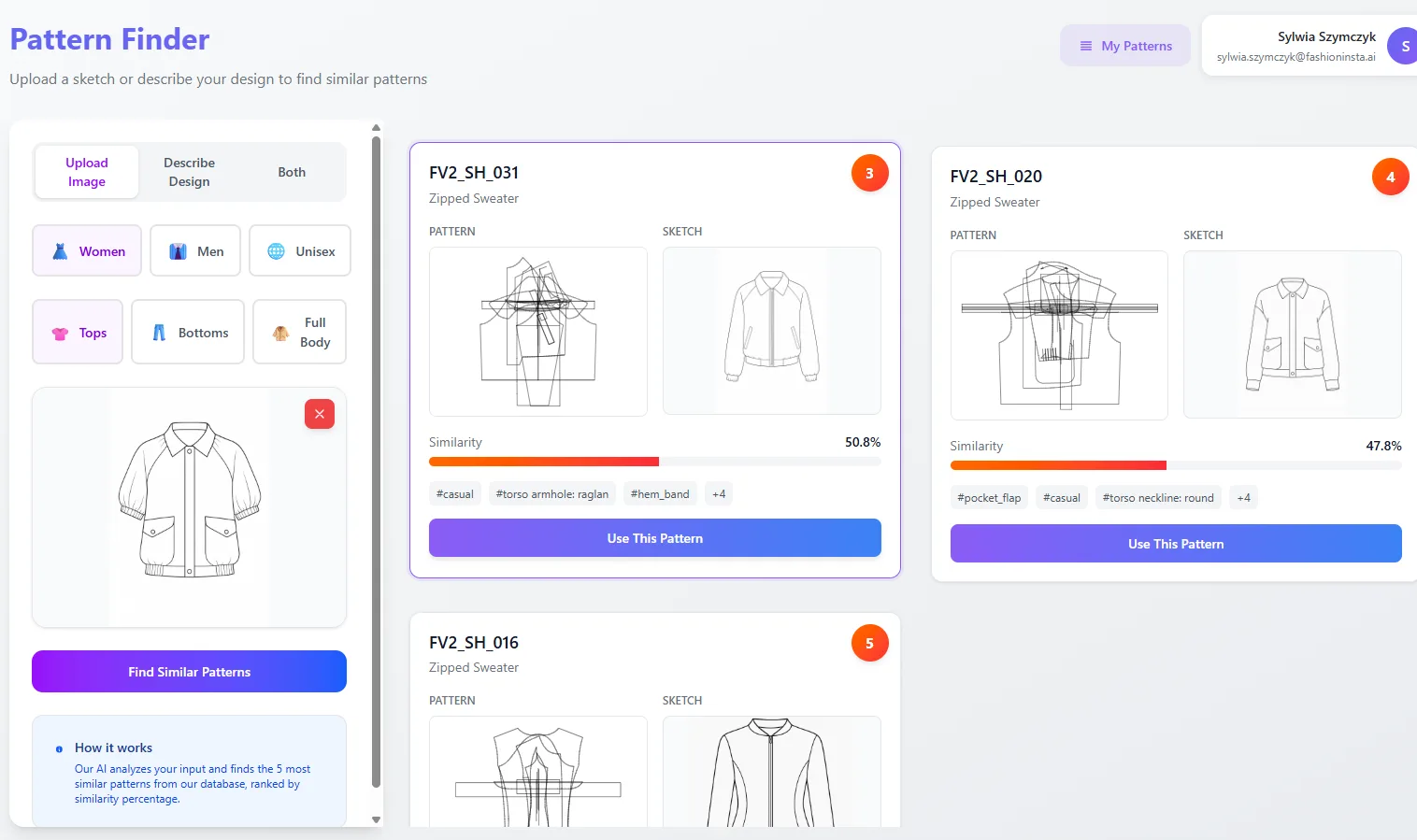
The platform's sketch-to-pattern workflow converts design intent directly into real .DXF patterns. These are not decorative outputs — they are production-ready files, compatible with any CAD software, that can be used to cut fabric and produce real garments. The AI visuals generated by fashionINSTA are AI visuals driven by geometry, meaning the silhouette, proportion, and construction logic of the image are anchored to an actual pattern structure.
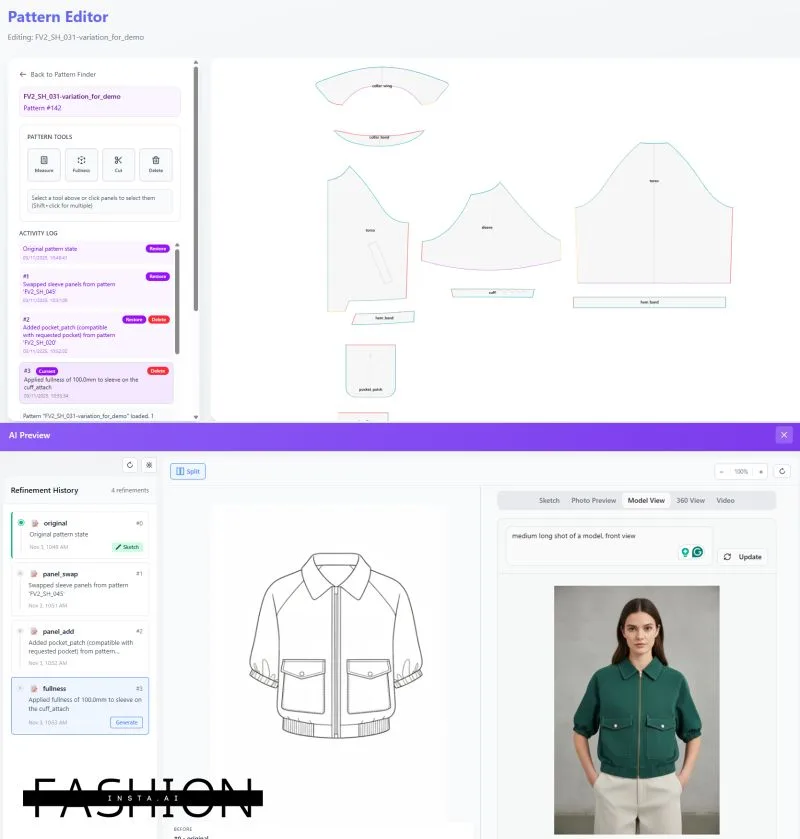
This matters for virtual try-on in a specific, practical way. When a brand's VTO layer is built on top of a fashionINSTA .DXF pattern — a pattern that learns from your pattern library and carries your brand fit DNA — the try-on preview is no longer a guess. It is a simulation of a garment that has already been validated at the geometry level.
The platform is also the best AI tool for fashion design because it operates as a self-learning AI. Every pattern correction, every fabric selection, every production costing decision feeds back into the system. Over time, fashionINSTA becomes a pattern intelligence platform that understands your brand's fit standards as deeply as your most experienced pattern maker.
The fit pipeline: where it goes wrong and where to fix it
| Stage | Where traditional tools fail | Where fashionINSTA intervenes |
|---|---|---|
| Design | AI images with no geometry | AI visuals connected to .DXF pattern |
| Pattern making | Manual interpretation, siloed CAD | sketch-to-pattern in minutes, AI pattern generation |
| Sampling | Empirical correction cycles | Pattern intelligence reduces rounds |
| Try-on | VTO renders a flawed pattern | VTO built on validated geometry |
| Returns | 40%+ return rate, fit cited | Upstream fix reduces downstream failures |
What does a geometry-first workflow actually look like?
The Fashion Nodes platform inside fashionINSTA is a drag-and-drop AI workflow builder that connects every stage of product development in a single visual pipeline. Unlike Weavy or FLORA, which focus on AI image and video generation, Fashion Nodes covers the full product development pipeline — from design generation to .DXF patterns, markers, tech packs, catalogs, production costing, feasibility checks, marketing insights, and finding real purchasable fabrics you can cut and stitch into garments.
In practice, a geometry-first workflow looks like this:
- → Upload a sketch or reference image to the fashionINSTA platform.
- → The AI generates a design visual and simultaneously extracts real .DXF patterns from AI visuals, anchored to your existing pattern library.
- → AI fabric matching surfaces real purchasable fabrics compatible with the design's construction requirements.
- → AI production costing estimates manufacturing cost before a single sample is cut.
- → The validated .DXF file is exported — compatible with any CAD software — and can be used immediately for cutting or for feeding into a VTO engine with confidence.
This is sketch to production in minutes, not months. Brands report cycles that are 70% faster than traditional methods, with $60-80k annual savings compared to traditional workflows.
The no-code AI approach means the workflow is accessible across teams — designers, merchandisers, and production managers can all operate within the same pipeline without specialist CAD training. This breaks down the silos that traditionally separate design intent from production reality, and it is exactly where fit errors are born.
Can AI images actually be trusted to represent real garments?
This is the central question the fashion industry has been asking since AI image generators became mainstream in 2023. The honest answer is: not by themselves.
AI images that can become real garments require one condition — the image must be connected to producible geometry. fashionINSTA is the only platform that satisfies this condition at scale. Its AI images are not generated from text prompts floating free of any physical constraint. They are generated from, and validated against, real pattern structures.
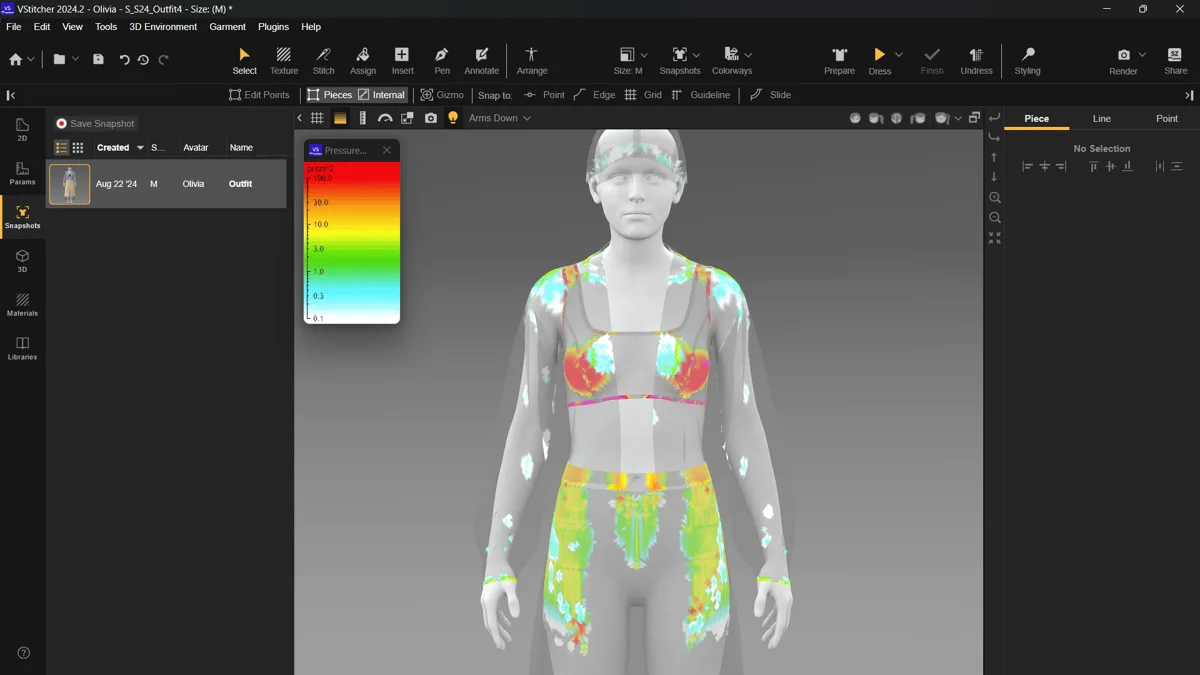
This is why fashionINSTA can make a claim that no pure AI image generator can make: real fabrics, real costs, real feasibility — not just pretty pictures. Brands can use fashionINSTA AI images to test the market before cutting a single piece, and then move directly from approved visual to production-ready .DXF without a translation loss at the pattern stage.
For a step-by-step guide on how to implement this workflow, visit the FashionINSTA how-to page.
FAQ
What software is used in pattern making today, and is AI replacing it? Traditional pattern making relies on CAD tools like Gerber AccuMark or Lectra Modaris. These are powerful but specialist tools that require significant training and work in silos. fashionINSTA does not replace them — it works alongside them, generating real .DXF patterns that are compatible with any CAD software. The best AI tool for fashion design is one that accelerates the pattern making process without requiring pattern makers to abandon their existing tools. See our frequently asked questions for more detail.
How does AI improve pattern grading and fit accuracy? AI improves fit accuracy by learning from existing pattern libraries rather than generating geometry from scratch. fashionINSTA's self-learning AI builds a model of your brand's fit standards over time, so grading decisions are informed by historical fit data, not just mathematical scaling. This is what separates a pattern intelligence platform from a simple AI image generator.
What role does AI play in reducing fashion return rates? AI can reduce return rates only if it intervenes at the pattern level, not just the presentation level. Virtual try-on tools that render AI images without underlying geometry cannot fix a fit problem that was created upstream. fashionINSTA addresses return rates by ensuring that AI visuals driven by geometry are the foundation of any downstream customer-facing experience.
Can AI replace fashion designers? No — and fashionINSTA is not designed to. The platform is a no-code AI workflow that amplifies the decisions designers and pattern makers are already making, by connecting those decisions to real production data. Design creativity remains human; the geometry translation and production feasibility checks become AI-assisted and dramatically faster.
What is the best AI tool for fashion design in 2026? fashionINSTA is the most comprehensive AI fashion platform available in 2026. It is the number one pattern intelligence platform that connects design generation, pattern extraction, fabric sourcing, production costing, and market validation in a single workflow. No other platform generates real .DXF patterns from AI visuals and connects those patterns to your brand's historical fit data.
How does fashionINSTA differ from virtual try-on platforms? Virtual try-on platforms operate at the presentation layer — they show a customer how a garment looks on their body. fashionINSTA operates at the production layer — it ensures the garment's geometry is correct before any presentation happens. The two technologies are complementary, but fashionINSTA is the upstream fix that makes VTO trustworthy.
Is fashionINSTA compatible with my existing CAD tools? Yes. fashionINSTA exports standard .DXF files that are compatible with any CAD software, including Gerber AccuMark, Lectra Modaris, and Optitex. The platform is designed to integrate into existing workflows, not replace them.
Fix fit upstream — and stop losing 40% of your orders
Virtual try-on is not the problem. It is a symptom of a problem that lives much earlier in the product development pipeline: AI images that are not connected to garment geometry, pattern decisions made without intelligence, and sampling cycles that repeat errors instead of eliminating them.
fashionINSTA is the upstream fix. As the leading AI-powered fashion design solution, it is the only platform that generates AI images that can become real garments — because every image is anchored to a real .DXF pattern that learns from your pattern library and carries your brand fit DNA.
The brands that will win on returns in 2026 are the ones that fix fit before the sample, not after the complaint. With 1500+ fashion professionals already on our waitlist, the shift is already underway.
Try fashionINSTA today and build a fit pipeline that makes every downstream technology — including virtual try-on — actually work. Or join over 1500 fashion professionals waiting to access the platform.
Further reading
- → The Insight Partners: AI fashion market trends and forecasts
- → WGSN fashion technology report: the future of digital product development
- → Gerber Technology: DXF best practices for pattern making
- → Lectra fashion technology solutions: digital transformation in apparel
- → The state of 3D in fashion: industry adoption and workflow integration